Starting this thread as it looks like there isn’t one for these particular pawpaws.
The common pawpaw, Asimina triloba, has a number of topics dedicated to it. It is the largest and most common pawpaw, having by far the greatest range as well, growing in most of the warm eastern US except in parts of the deep and coastal South.
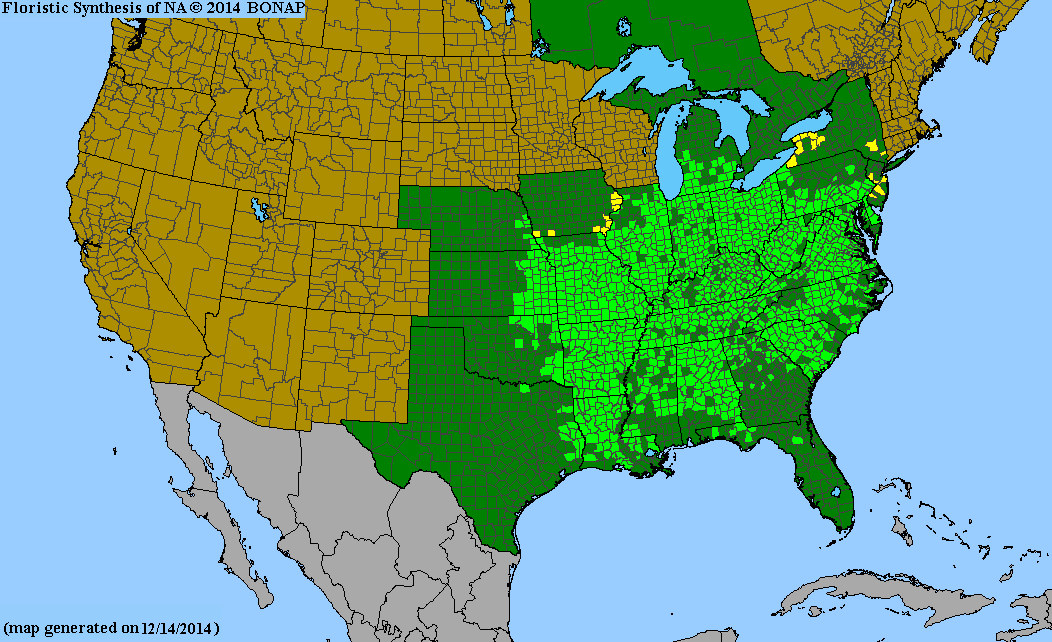
The Asimina genus however is most diverse in southern Georgia and in Florida.
In between these populations, geographically and likely genetically, is Asimina parviflora, a small, bushy shrub that grows in drier upland sites than the common pawpaw and generally replaces it in the deep South, in particular in the coastal plains region.
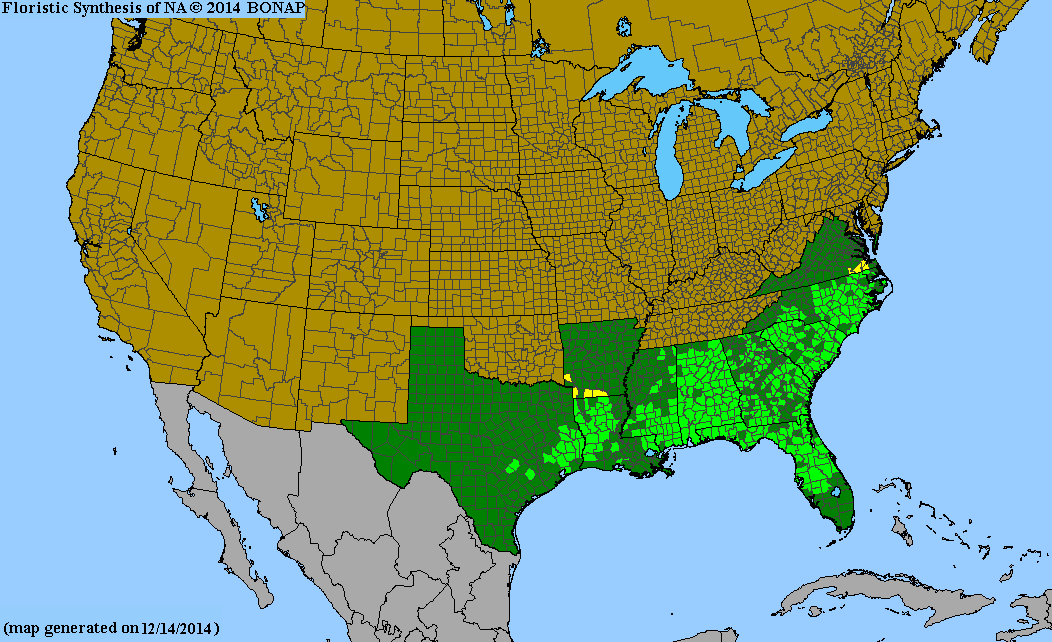
Asimina parviflora only grows up to about 8 ft tall, even less in poor soils, and is reported to be hardy in zones 7-10, making it both much less cold tolerant and much more heat tolerant than common pawpaw.
In areas where the two populations overlap they sometimes cross to give the natural hybrid Asimina × piedmontana so named for the piedmont region in which it tends to be found. For those not from the area, the Carolinas and Georgia are traditionally divided into three geographic regions: the mountains, which are the Appalachian mountains and their foothills, the piedmont, a region of rolling hills and deep red clay where most of the area’s major cities are located, and the coastal plains, the significantly flatter, often either swampy or excessively well-drained, sandy to loamy belt of lower elevation land formerly submerged under the sea.
I’d be curious to know if anyone here is growing either Asimina parviflora or Asimina × piedmontana and what you think of them.
I’ll still have to go back and ID it more carefully, but I suspect the pawpaw I experienced in childhood was itself Asimina parviflora. It was growing in the coastal plains in a forested ridgeline in very dry sandy soil, and in decades of time has never topped more than about five feet tall. As an indication of the soil conditions, a few feet away from the pawpaw bush there is a thriving opuntia cactus of some kind (it’s a large, tall growing species) growing at the forest margin, and the open land next to the forest has both Mimosa pudica and what looked like Opuntia humifusa cactus.
The fruit themselves were quite small as best I recall, but tasted good.
Ihave no functional data to add at this stage, but I have tried several times over the last 3 - 4 years to get A. parviflora to truly start. I have mostly tried from seed, which has never germinated for me. I am currently trying to sprout an A. parviflora and an A. obovata inddors in a very casual setup, and do not have a lot of hope.
I do have what I believe is a parviflora that I received as a tiny little plant, but the original stem died and what has taken off came up next to it before it did so. I am not sure if it is a sprout or a different seed that finally broke through.
I have yet to find offering of either of these or piedmontana big enough that my current level of effort can sustain, but would like to try all three.
NW NC zone 6B/7A with assorted microclimates ranging upwards on my little plot. Wind tends to be an unwelcome equalizer.
I have A. parviflora growing wild in the wooded understory of a floodplain near my home in the NC piedmont, Z8a.
They’re pretty small, but even trees less than 3’ tall in shade seem to make some fruit, which is small, seedy, and not very tasty. I saved the seeds last year and they’re currently stratifying in the fridge.
I grafted some A. triloba on a couple and they took well.
I tried parviflora and obovata last year from seed and failed with both. I think they need cold stratification, but not sure for how long.
I have 2 parvifloras in ground that I bought from a local nursery here that sells them as butterfly plants. Got them last spring, they put on decent growth. They are both in shade in a little oak dome that is slightly higher than the rest of the front yard. They get next to no water other than rain since they’ve established, and are currently both dormant. I also have a longifolia/angustifolia.
This is where I got them from, however they don’t ship.
There is also:
But they seem to only have obovata and reticulata atm. I have talked to a couple of local nurseries around here, and sometimes they have them and sometimes they don’t.
I put the pictures in the flowers thread, but my a. parviflora flowered this year. Has me feeling that they are rooted water suckers or something, because I highly doubt the can flower in year 2 (pontentially 3 but probably not older than that). Only one flowered and it had 2 of them. Very small (hence the common name smallflower pawpaw).
I did manage to get two a. obovata at the USF plant sale today. That brings my collection to 2 parvifloras, 2 obovata and one longifolia, although I did pull my triloba out.