If your two Lehman hybrids are large enough to spare a dormant cutting or two, I would love to graft them onto A. triloba rootstock or a foster tree here in Texas. I have a LOT of plant material I could send you in return.
2 Likes
So is it that parviflora can’t make patches/suckers or that where it is commonly found isn’t suitable for suckering? Kind of interesting, I never even thought about the suckering trait as unique to triloba.
2 Likes
It is not unique to triloba. If anything, lack of suckering would be unique to parviflora. All the Florida scrub pawpaws natively form suckers, and it is their primary defense for surviving forest fires. Parviflora will also sucker if damaged. It is more likely that the conditions parvifloras are naturally found in are not the best for suckering in, or conversely, leaves them with no reason to sucker.
4 Likes
Those flower pictures are really helpful. This spring I found a huge patch of what I assumed where A. triloba, based on their size and location. But their flowers were triangular just like your second picture. I haven’t seen any fruit on them but this has inspired me to go take a closer look. It has been a light fruiting year for both triloba and parviflora in the woods near me.
5 Likes
I’m going to have to go back and reexamine all of the patches of what I had assumed to be parviflora, those determinations being largely based on the fact that they were not growing under the conditions that triloba would be, as well as their shorter stature.
4 Likes
The hybids I saw looked much more like Triloba than what I’m used to seeing with parviflora, I think. They are growing on a river bank, which are the conditions I usually find triloba and not parviflora, though there’s definitely parviflora growing on the slope a few hundred yards away. Possibly the triloba and piedmontana are mixed together.
3 Likes
You are correct, ALL Asimina species (including A. parviflora) and their numerous hybrids produce clonal root suckers, likely as mechanism for surviving and quickly recovering from forest and prairie fires. A. parviflora can sucker, just not as profusely as A. triloba, which tends to form large clonal groves over time.
6 Likes
Whenever you find A. triloba and A. parviflora growing in fairly close proximity it is reasonable to expect some A. x piedmontana specimens in the area as well. Again, the most definitive evidence for identifying this hybrid is floral morphology, so March-April is the best timeframe for distinguishing between these taxa. In rough numbers, there are about 300 ‘confirmed’ iNaturalist observations of Asimina x piedmontana and about 5,000 observations of Asimina parviflora, so the hybrid is relatively rare compared with its less-common and more geographically restricted “parent” species (for the record, there are about 50,000 iNat observations of Asimina triloba, but it spans a much, much larger geographic range than A. parviflora). It also appears that Asimina x piedmontana struggles to set many fruit (even more so than its 2 “parent” species). It is unknown if it can be successfully pollinated with pollen from either “parent” or if it requires non-clonal pollen from another A. x piedmontana plant. If you do encounter what you suspect are wild A. x piedmontana specimens I would strong encourage you to document them with numerous photos and upload them to the iNaturalist website or smartphone app to confirm the identification and expand the scientific database.
5 Likes
Asimina x piedmontana often co-occurs with A. triloba (and/or A. parviflora). Although the two “parent” species have somewhat different habitat and soil preferences, these can still occur close enough to each other to allow cross-pollination and resultant hybrids.
3 Likes
I plan to do this next spring when they are blooming. I still haven’t made it back out to closely scout for fruit, and even if I did find any it might be triloba fruit, as I’m not sure which of the hundreds of plants, no doubt mostly clonal suckers, are triloba (if any) and which are piedmontana.
4 Likes
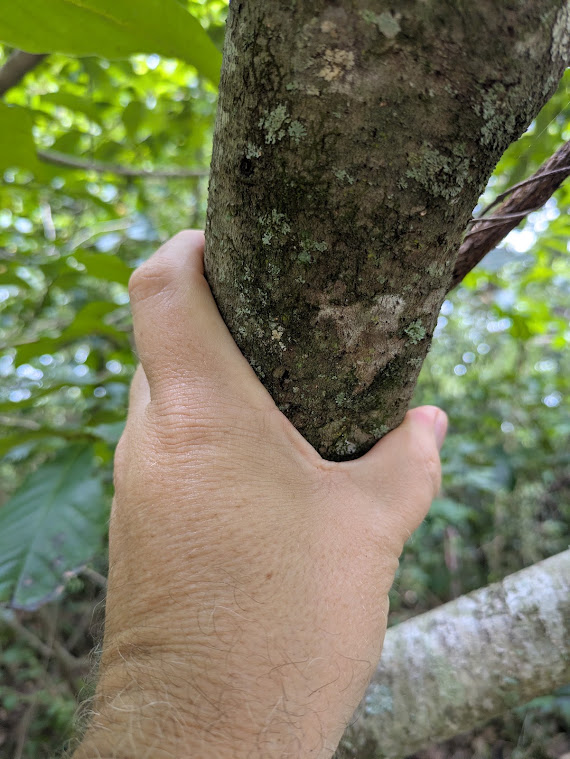
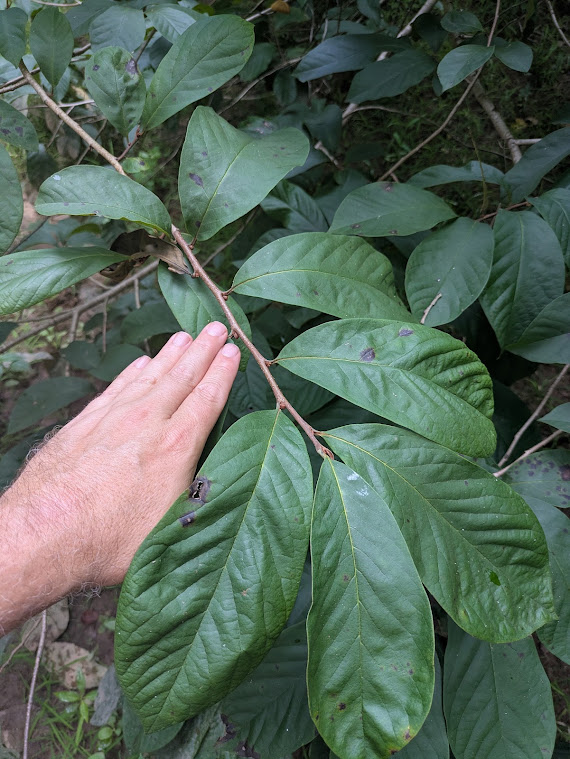
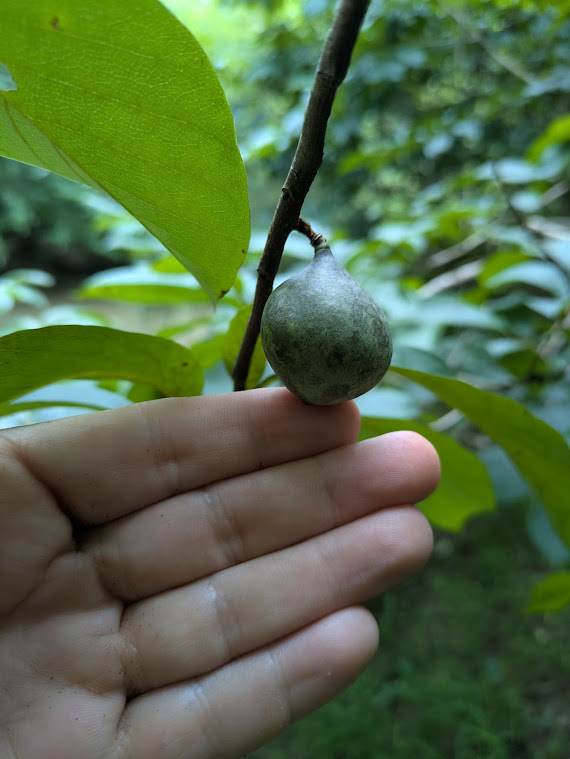
I finally made it back out to the paw paw patch that I know, based on the flowers, contains some piedmontana. I located one fruit after scouting for about 30 minutes. I took some pictures of what could be triloba but which I suspect is piedmontana. Below is a picture of the trunk about 3 feet off the ground with my hand around it to show the size, some leaves with flower buds, and the solitary fruit, which seemed to be almost ripe, and is the smallest mature triloba fruit I’ve ever seen if it is triloba and not piedmontana.
7 Likes
Nice find! I have definitely seen Triloba fruit that small too
4 Likes
Yes, this is indeed Asimina x piedmontana. Note that the leaves are intermediate in morphology and size between Asimina parviflora and Asimina triloba, the trunk far too large caliper for A. parviflora, and the paucity of fruit is classic for the hybrid (In fact, the hybrid is often completely devoid of fruit). Ideally you would return in March to photograph the flowers to confirm the identification, but the evidence you have provided already is sufficient for me. You should still upload these photos to iNaturalist (website or phone app) to get additional expert opinions.
I would love to know if the (likely) single seed in that fruit is actually viable. Any chance you can return when the fruit is ripe to collect the seed and grow it out? As you probably know, Asimina seeds must not be allowed to dry out and require 2-3 months of cold stratification in the fridge (NOT freezer) before sowing in deep pots (12” depth minimum). If you succeed in getting germination let me know. Thanks!
5 Likes
So… @Johnsgard… the fruits of A.x piedmontana typically have only a single seed in their fruit?
The A.parviflora back home on the AL farm usually had 3 or more - more seeds in larger fruits.
I agree that the leaves pictured certainly look to be intermediate between parviflora and triloba.
4 Likes
My suggestion that this fruit only has a single seed in it is based entirely on my first-hand experience that small round Asimina triloba fruits invariably seem to have only a single seed. And, yes, Asimina parviflora fruits usually contain several seeds per lobe, but much smaller in size than most A. triloba seeds. Asimina x piedmontana plants rarely set fruit, so I don’t have any working knowledge of how many seeds their fruit generally have. If you go back and manage to harvest the fruit you located (before varmints find it), update us on how many seeds it has inside (photo would be great) and how the fruit tastes.
3 Likes