They are all more or less the same thing, same concentration. They are all made the same way more or less which is why they are all the same concentration. The commercial guides are not the best to follow if they are in % dilution since they probably assume air blast sprayers. My suggestions above are from various small bottles eg hi-yield brand, I would take those numbers as more reliable for us.
I looked up manual for 32 oz Hi-Yield Improved Lime Sulfur Spray, 28% polysulfide.
For PLC in peaches:
PEACHES: Brown Rot, Leaf Spot. Apply 4 teaspoons per gallon of water. Apply 3 to 5 times at weekly intervals before Harvest. Brown Rot Blossom Blight. Apply 1 to 2 fl. oz. per gallon of water. Apply in pre-bloom, early bloom and full bloom stages. Leaf Curl, Scab, Shothole. Apply 12 1/2 to 15 fl. oz. per gallon of water. Apply in dormant season. Powdery Mildew. Apply 9 1/2 fl. oz. per gallon of water at green tip stage. Use 1/2 fl. oz. per gallon of water on Summer foliage.
I stand corrected. I looked at my spray sheet I have hanging in the garage, and I am not spraying for those things on peaches. I used copper when I had shot hole issues and never have had PLC to speak of. So it’s not that the Hi-Yield label is different, it is that I was not using it for those peach diseases. Note that I now often do spray my peaches with l/s since it doesn’t accumulate like copper, but I don’t have problems with any of the diseases so the lower dose seems enough.
I have corrected my listing above which didn’t mention peaches at all.
1 Like
Scott, thanks for update.
On this site I’ve seen that east coast growers are fortunate to have only mild and sometimes no trouble with PLC.
But out here in the PNW, it’s totally leaf disfiguring, making you look like a poor husbandman/woman …since it’s something easy to notice from yards away. When untreated, it leads to rapid peach decline.
The Hi-Yield guide recommends significantly lower dosage for Nectarines as compared to peaches. I wonder how arbitrary are these recommendations.
NECTARINES: Brown Rot, Leaf Spot, Shothole. Apply 4 teaspoons per gallon of water. Ap-
ply 3 to 5 times at weekly intervals before Harvest. Leaf Curl. Apply 7¾ fl . oz. per gallon of
water. Apply in early Winter and late dormant period. Powdery Mildew. Apply 4 to 6 tea-
spoons per gallon of water. Apply when Disease appears.
Nectarines and peaches are both prunus persica, and other than the fruit there is no real difference. So, this is just more evidence that these things are incredibly arbitrary. I feel like my peaches are well-soaked with l-s after 1/2 cup per gallon and it’s not clear any more than that is going to help.
1 Like
I also neglected to read the PLC dilution rate on Brandt L/S manual for nectarines:
“Early winter and late dormant. for Leaf Curl- Apply 6 gallons/100 g”
Oh well! - Just came in from spraying peaches and nectarines with 15g/100g.( Definitely need eye protection at that rate.) I’ll soon see if I’ve created a problem for the nectarines.
Buds are breaking fast here so last spray will have to be in the next dry window.
2 Likes
I wouldn’t take the label so seriously. Peaches and nectarines are the same species, and it has to be an error on the label to give a different dosage for a dormant spray where there are no fruit present. These labels are not made by scientists running experiments, it’s just various random opinions smooshed together in a sometimes-inconsistent manner. The more modern chemicals have been studied more scientifically and generally have more accurate dosage information.
1 Like
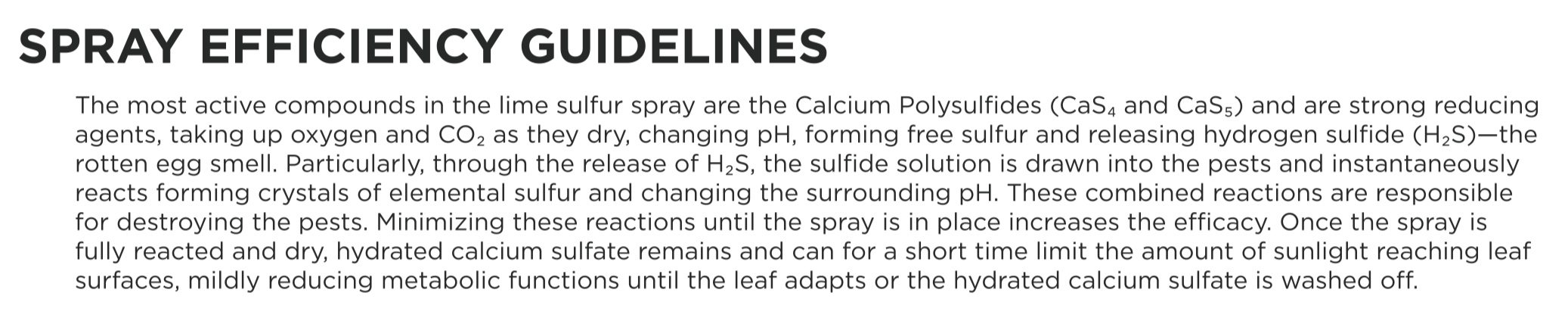
Product literature from Lime Sulfur Ultra has a brief description on how LS works. It primarily reacts with pests releasing hydrogen sulfide and changes the pH of the surface to alkaline thus creating an inhospitable conditions for the microorganism. I think when the rotten egg smell is probably an indicator of its effectiveness. As the rain washes away the residue the surface too looses its alkaline nature. I remember reading in a 19th century USDA document where few farmers at that time were spraying lime to control PLC.
@scottfsmith OSU recommends LS and rates (Excellent) it on par with Ziram for controlling PLC in PNW. I guess a large enough dose has greater duration of effectivity.
1 Like
Note OSU only recommends 3 or so oz per gallon for PLC though. I don’t know where this 8-15oz came from.
… I looked through all the various state guides I have stashed away and the only one with a per gallon amount was Virginia. They are at 5oz/gal for PLC on peaches. It’s interesting that many states don’t list lime-sulfur in their guides any more. I changed the above guide amount to reflect this lower quantity.
1 Like
By OSU I mean Oregon State University. Link to their disease/pest guidebook.
1 Like
On my peach trees I never really have a problem with leaf curl. I get it most of the time but the tree just drops those leaves and grows new ones quickly. At least here as long as you aren’t looking for maximum production peach leaf curl is no problem.
1 Like
It looks like both peaceful valley and 7springs don’t carry LS anymore.
We are finally getting warm enough to get a dormant oil spray out in my area. Cant say that im excited to do so at the moment though.
Thats too bad. I wonder if it has become a shipping hazard or something … lots of farm stores are still selling it in person. If you have a local farm store I would try them. There is also some available on eBay or the pet dip version on Amazon etc which should be the same.
I’m glad I bought 2.5 gallons a few years ago…
Does anyone know how many Tablespoons or cups per 1 pound of Imidan? What I am looking to do is build a sprayer/tank around using the 1lb water-soluble bags.
I know this lime-sulfur chat is about peaches but I couldn’t find lime-sulfur and ended up using cueva +oil for the peaches and plain sulfur+oil for everything else. In case anyone else is trying to find an alternative.
Fungonil/bravo 720 is also recommended for peach leaf curl if you can find it.
The sulfur was powdered, from TSC. I also sprayed it with oil on my pears when they looked like this and that worked and didn’t hurt the tree (and I didn’t have mite problems).
I can’t believe I sprayed in late feb and early march last year! There’s snow on the ground right now and everything here is frozen solid!
Imidan has been discussed.
Spray amounts guide - #38 by J.D
Cueva
Daconil is same as Bravo and is labeled for PLC.
Thank you!