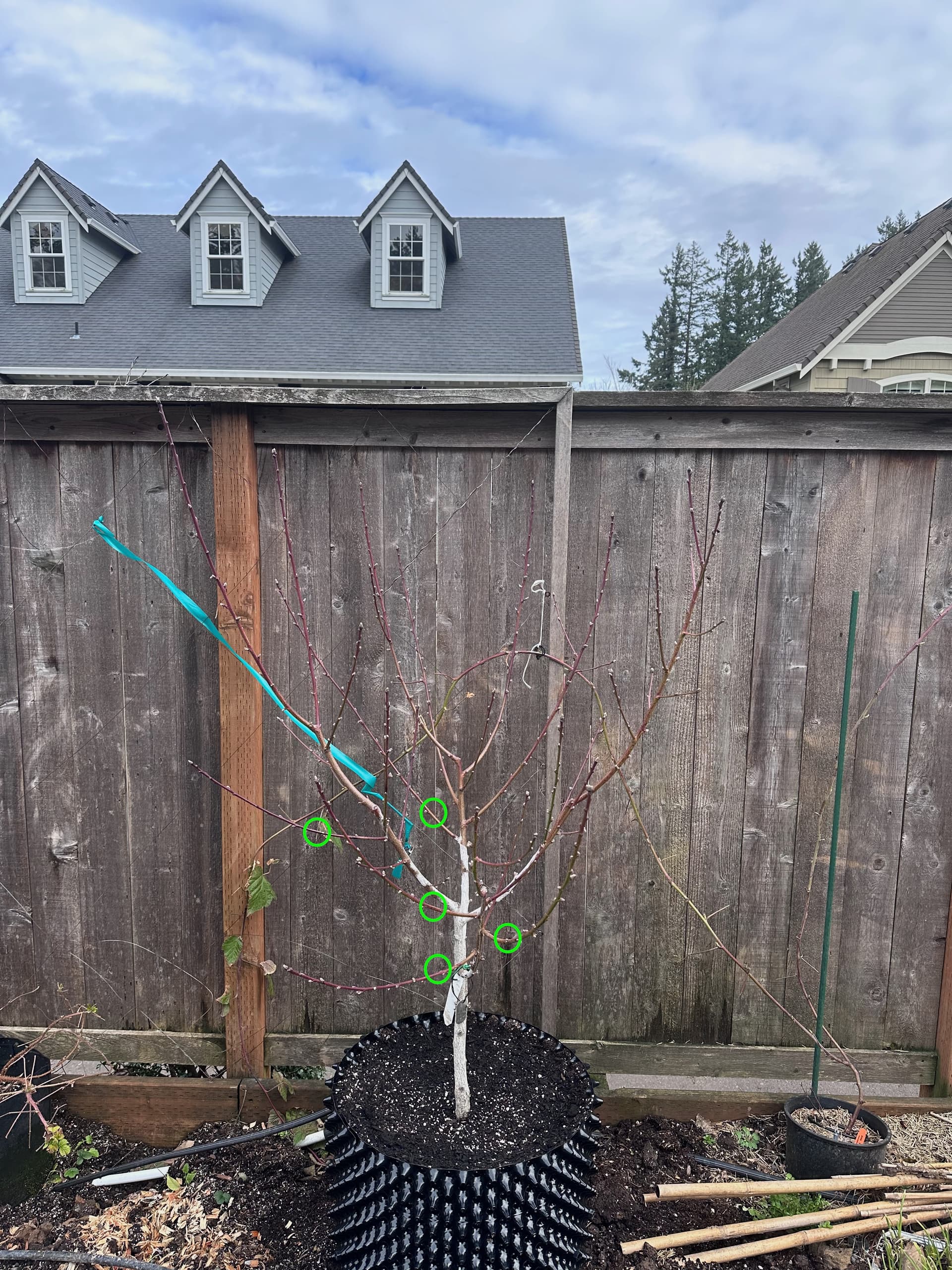
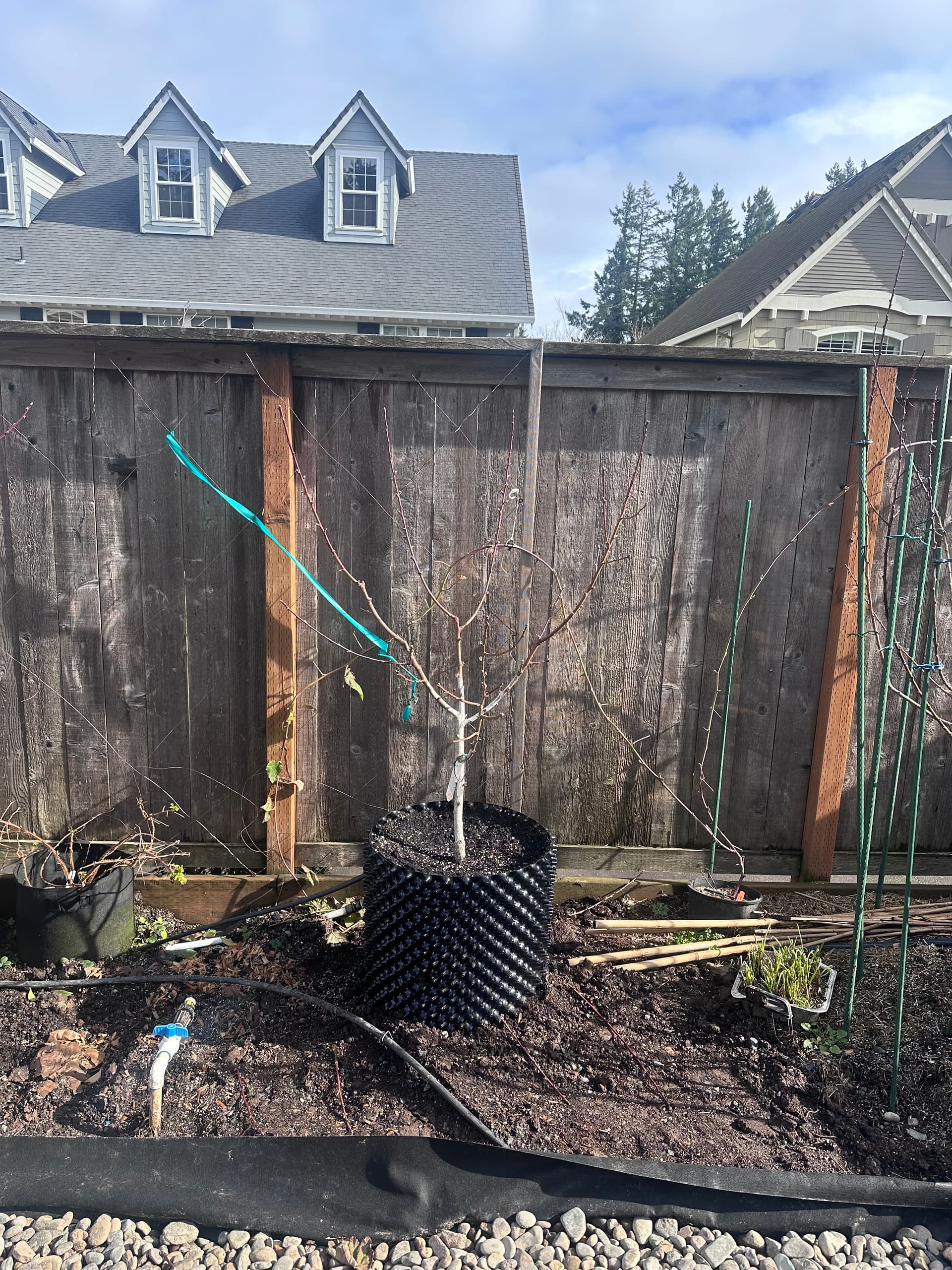
I am training this one year old peach tree for structure. I am thinking rather completely removing the laterals deemed unnecessary for overall structure of the tree, stub them to 2-3 buds so that they grow through the summer and fruit next year. One hand removing them completely helps the tree to divert energy to the primary scaffolds/shoots part of the structure and increase the branch diameter.
On the other, stubbed laterals consume energy to grow the shoots season, but I am assuming the energy spent on growing new thin shoots is lower and most of the trees energy will go towards the structural branches. Kind of win-win situation where fruiting wood is renewed while primary scaffolds also get stouter. Thoughts?
Few examples of laterals I want to stub in rounded in green.
Stubbing makes sense until you are satisfied with the shape. Is this a standard rootstock? Do you intend to grow in the pot or plant in the ground? I would cut back the tops to outward growing buds taking off about 1/3 of the lengths of each branch to encourage stronger scaffolds as well.
Dennis
Kent, wa
There is a learning curve so don’t be surprised if results are not what you expect. I myself would do heading cuts instead of stub cuts. Meaning I would take off 2-3 buds not leave 2-3 buds.
If it was a cherry tree I would do the stub cuts. With peach in my own personnel experience stubbed peach branches often die. In this case it would not really matter so why not? See how the tree responds. Best way to learn.
I see the circle most left looks like a secondary scaffold branch. I would head cut not stub that one. Let it further branch more.
It’s Oregon Curl Free on Lovell. I plan to put it in the ground next year, I have it will root into the soil this year to speed up the growth.
I’ll cut to an outward bud for the primary scaffolds, undecided whether to cut 1/3rd to just the tips.
Interesting, do you have any idea why they failed to grow. Reason I want to avoid heading cuts at this point is to a bunch of shoots at the top (below the cut) which shades out lower branches.
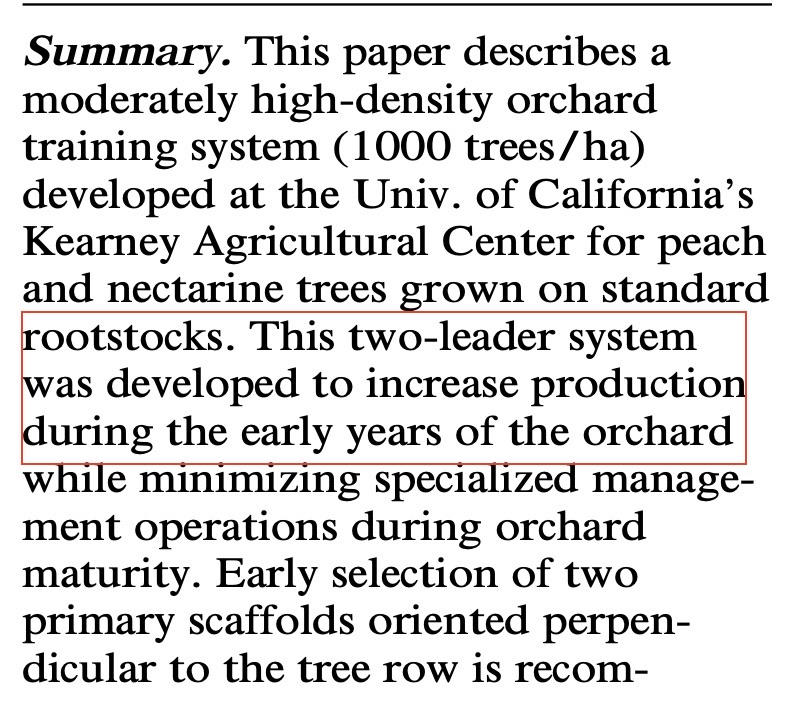
Edit: This article from peach researcher says stub cuts for younger shoots (1 yr).
I never really thought of the year old shoots as stub cutting. But yeah I use that method to create fruiting wood. I think of stubbing as removing 1/2 or more of a larger branch. One should always prune back new growth some. I at least head the branch if still growing it out.
I’m not sure why some branches die with stub cuts? I guess because peaches in general are stubborn to branch from old wood. Plum’s are better at branching and cherries will branch all over the place.
That article was very good! It summed up pruning nicely.
Stub pruning is essential for me with my potted fig trees too. And also my grape vine.
@Drew51 Super interesting comment that you do stub pruning for your potted figs. I’m just getting into potted figs and have a bunch of varieties I’m trying to start and also some I’m grafting to a 2 year old potted black mission fig. My black mission is very very lanky with a main trunk, which has and open center starting at about 2-2.5 ft and then 3 branches forming that open center. My issue is that each of those is going straight up and are about 4-5 ft tall with no branching or vegetative growth at all (as of now) except at the tips. I recently took one of them down and grafted a yellow longneck on there. Let’s see if it takes. And I have similar plans for the other 2. How do you maintain your figs? I will try to look at any other threads where you might already have explained this! Thanks!
What I do with figs is try and form an open vase scaffold system. I like it at a height you don’t need ladders. The scaffolds are like a cordon. They are permanent. Branching off the cordon is your fruiting wood. With figs fruit for main crop is on new wood only. At the end of the year you remove all but one or two nodes of the new wood. Let it grow out in the spring harvest and prune back to scaffold once again and indefinitely repeat each season.
The wood becomes quite gnarly with time. But you could always stub cut and form new scaffolds.
Unlike peach old wood does branch. A couple times I did not like the shape of my scaffolds. So I cut it down to the ground and formed a new trunk and scaffolds. I have had to regrow many that were freeze damaged to the ground. Sometimes they die but most times they will grow back.
Cutting back shoots in peaches is usually done to reduce the crop load in a manner much quicker than hand thinning the fruit. That is besides the summer pruning that is done to keep vigorous water sprouts from excessively shading the less vigorous growth where next year’s crop will be born.
As far as training peaches, what you need to do is choose 3 permanent branches at the height you want them and make sure light can reach the entire length of these branches to keep growth close to the scaffolds for their full length. I believe you are not focusing on the long view of the shape you want, you aren’t growing a bonsai peach tree.
On the other hand, I don’t grow peach trees in pots, not even for my nursery. In the ground they are already bearing big crops on 3" trunk diameter trees by the third year when given what they need for vigorous growth. Why are you growing yours in a pot?
Fruitnut is the man to go to for info on growing peach trees in pots.
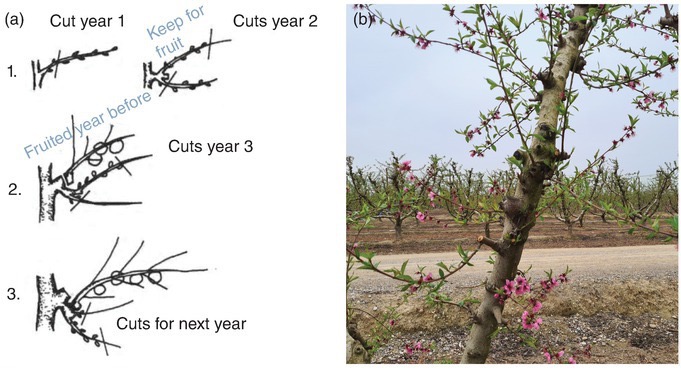
Stubbing is one approach for thinning and renewing fruiting wood. It is the primary renewal method for “V” architectures KAC, Hex, quad etc.
This peach will be put in the ground sometime this year or next (some yard work in progress right now). The tree is close to 4ft and doing well in the pot. It was a less than pencil thick shoot last July when I planted it.
I grow in pots to test seedlings. If I like them I may keep or graft to another tree. Also it’s a way to increase the amount of trees I can grow. I’m all out of in ground spots. Peaches easily fruit in containers. I usually harvest around 10-15 per tree. I have three in pots, so at least 30 fruit which is plenty. I have 11 trees in ground too, only one is peach, one is nectarine.
My daughter just bought property with about 40 fruit trees. I went and did a Quick Look. Going back Sunday to begin cataloging and fertilizing. All of them are young and small. Exactly what I want! I will keep the orchard pedestrian.
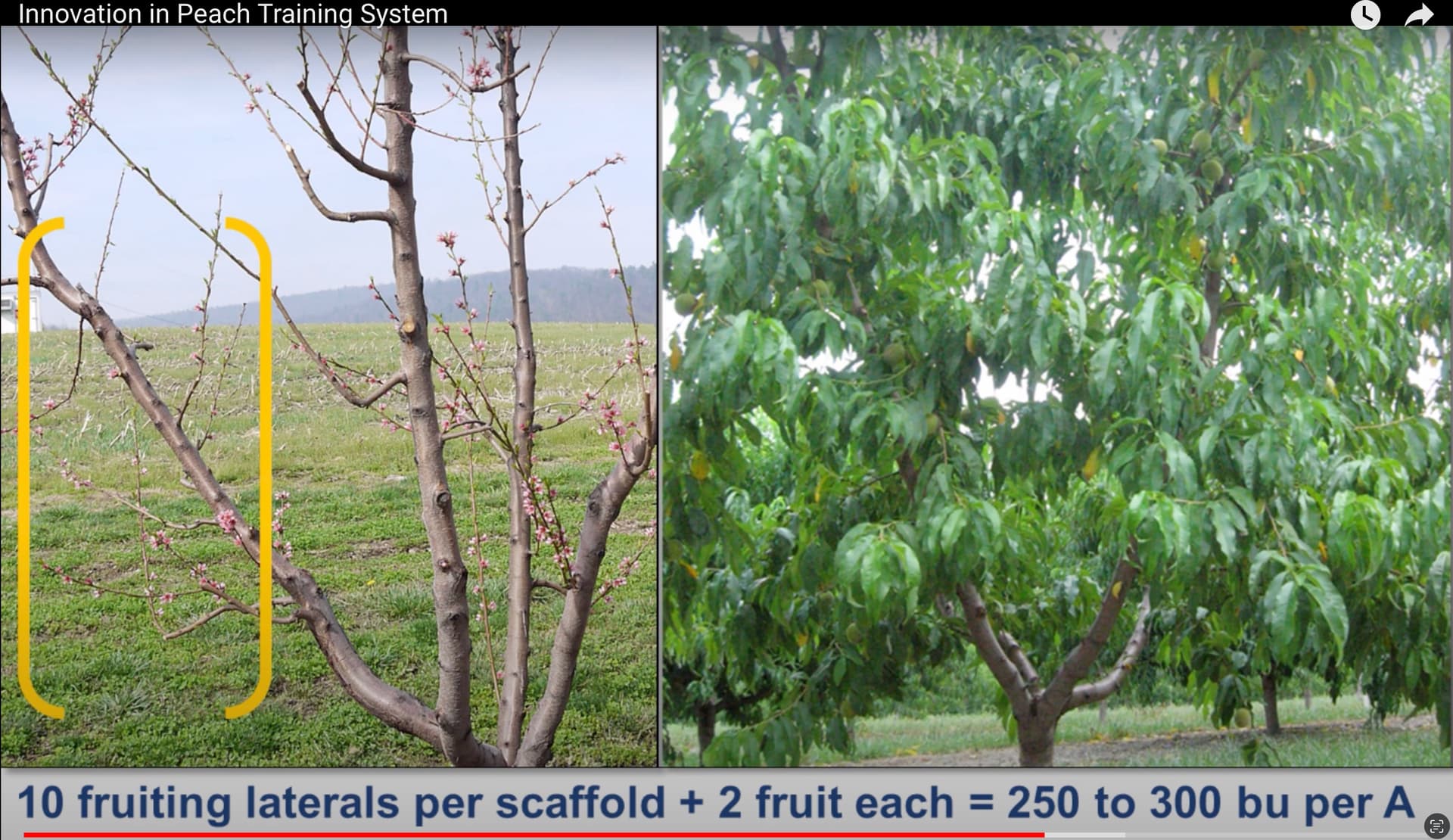
Applies to peaches, stub a shoot and it grows that year and fruits next year. This picture shows how it’s done for V trained peach architectures. Same concept is what I am using in an open vase/V hybrid system.
Peaches only have buds, leaf and flower, on previous years growth. You do not manage them for spurs, you manage them for shoots that are replaced every year. It’s not very complex once you’ve worked with them.
The photo seems to indicate a tree that is treated the way most people treat the scaffold branches. This is done for close spacing where the only permanent branch is the trunk itself. I have heard of this method before, but it is not a common management method in this country, or at least, I haven’t heard of it being used here. I’ve heard it is a common approach in Israel.
KAC-V (Kearny) method from UC is pretty old. Recently other institutions are looking into this architecture since it offers earlier harvest and ability to mechanize process.
I think this method is great for backyard grower, specially for those with limited space. Its simple enough that one can stub half the growth for next years fruit and fruit the other half. Orin Martin shows this simple but effective method.
The first two links seem not to lead to a management system as you describe it. I don’t have patience for videos but that link did not demonstrate clearly a straight trunk with only temp branches on it and the video showed him cutting back one piece from the previous year to a stub, but I fail to see how this is an improvement over simply using this years shoots for next years peaches starting from the scaffold itself. True, I didn’t take the time to listen to what he’s saying- like a said, I have no time for videos because I can read so much quicker than someone can talk.
It seems like many younger folks get most of their info visually these days, but I’m a fan of the written word.
My takeaway from Orin’s demo is to cut back to a stub the branch that had fruit the previous year.in the spring. Also any older branches that are still there but not fruiting get cut back to a stub.
since you like reading, the attached paper provides a good insight into peach architectures. agronomy-11-01961.pdf (2.9 MB)
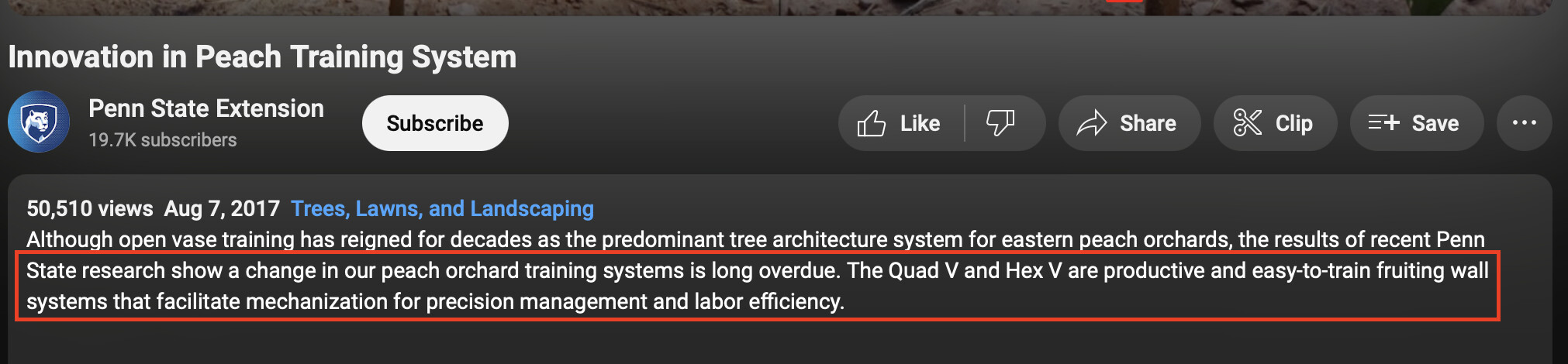
Thats correct, but if you read the other link from good fruit grower I have posted above. Establishing a stub when the wood is new (1 year) is the key to have an easy and reliable process year after year. As you can see in this snapshot from the Penn state video, for a home grower it’s easy to prune for an expected harvest and adjust for adverse scenarios.