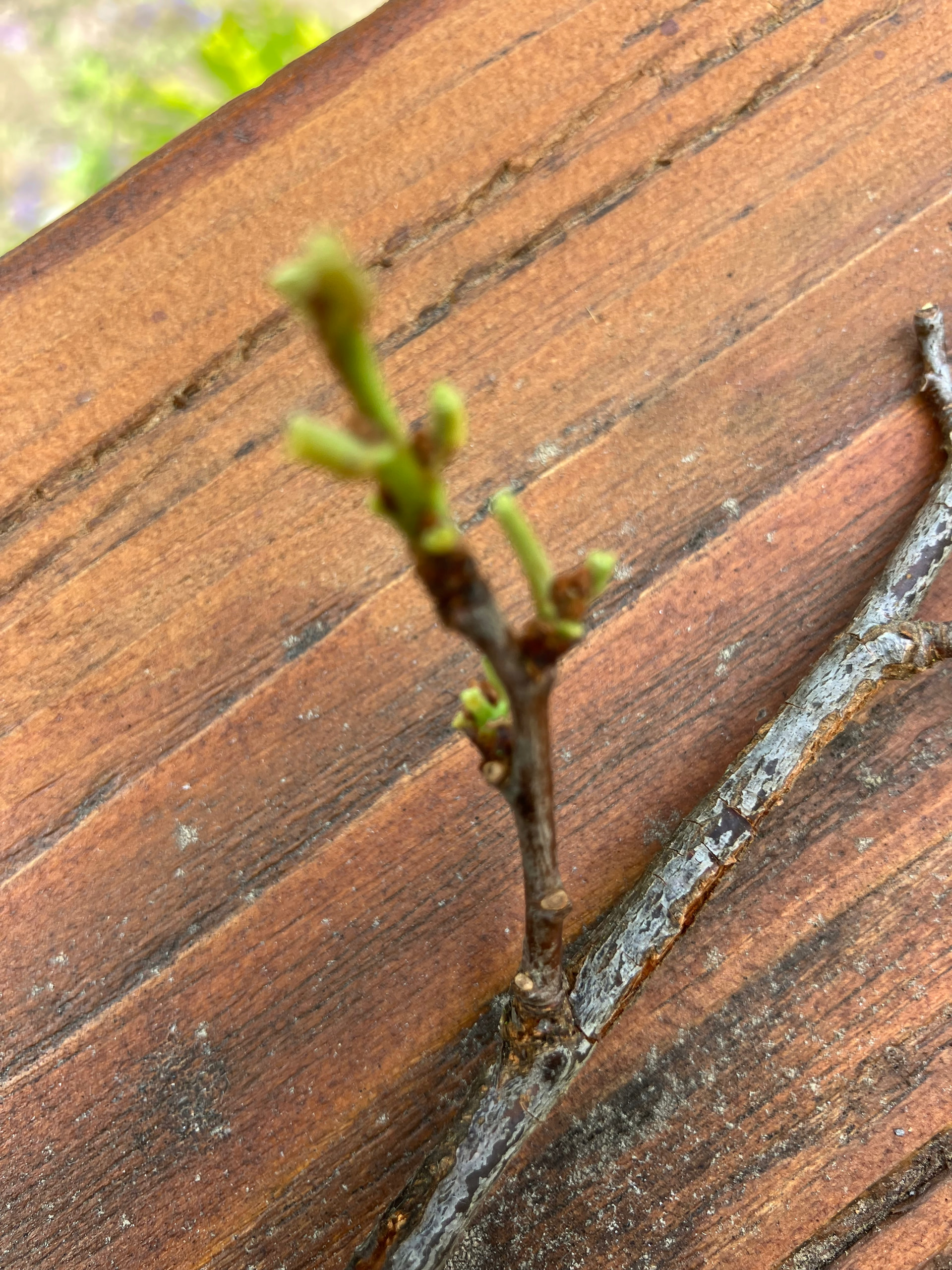
Typically I start summer greenwood grafting in mid to late August when the axil buds of this years growth are well developed. However, today I discovered one of my 2024 grafts of Black Ice plum had been broken off somehow. So rather than trying to regraft it fully leafed out, I noticed that the axil buds were already well developed. So I secured 9 scions and grafted them onto native rootstocks from my native thicket. It will be interesting to see them take on native stock as the companion branches are one of the polinizers that Black Ice requires for success.
Good save on those scions. Native rootstock is tough stuff, curious to see how the take rate compares to dormant grafting for you. Do you wrap them with anything extra to keep humidity up while they’re still leafing out on the companion branches, or just parafilm and leave them to it?
I cut off all leaves leaving just a stem stub to protect each bud, then I soak them in cold water a couple of hours, then dry with paper towel, then seal them with a layer of parafilm, then graft them and cover the entire scion and graft union with aluminum foil to keep shaded during callousing time of 2-3 weeks. Once buds begin to break thru parafilm, I will gradually allow more direct early morning only sunlight. When vigorous growth begins I remove the foil.
This works very well when new growth buds have matured, ideally later in August would work better.
I have a lot of black walnuts on my property and a friend of mine has an English walnut. I prefer the English walnut for eating and the black walnut for cakes and cookies. Some of my Black walnut trees are only a couple of inches in diameter so if I was to graft them would it be easier to Bud graft them this summer or to wait until next spring and graft them with scions. This might be out of my league because I have only grafted Apple, Pears, and Plums successfully.
Your question is also a bit out of my experience to give advice. I prefer to refer you to @Fusion_power who IMO is our expert on nut tree grafting. Darrel has advised me in the past on a few walnut grafts, but it’s been to long for me to recall all the important factors for success.
Spring grafting with walnut is generally more successful than fall budding. However, you can do both. Set some buds this fall and if they don’t work, collect scions this winter and then graft next spring. Look up greenwood grafting for walnut.
The black walnut sapling that I am planning on working on is about 5ft tall and forks at about 3ft. The wood above the fork is kind of fuzzy would I put the bud on that or down where the bark is rough and thicker.
I tried grafting for the first time this early summer. I grafted some peaches onto other young peaches and onto thin rootstock. I will be very surprised if any take. I consider it just practicing right now. The branches, root stock and scions are just too thin I think.
I am adding some comments that members new to grafting might consider about Summer grafting as to why I feel it offers many attractive options. Observation of new varieties to determine which develop early axil buds is the best way to determine when the opportunity arises. Reasons why you may want to try it:
A recent new variety graft broke off during the growing season and you want to rescue the variety until you can taste its fruit.
Your original graft of a new variety is not doing well due to poor placement so you might give it a more prominent location with better chances on a more mature rootstock.
You desire to accelerate the fruiting of a new variety by improving its cross pollination potential.
By regrafting a new variety on a more mature rootstock you increase chances of it fruiting sooner than on an immature rootstock.