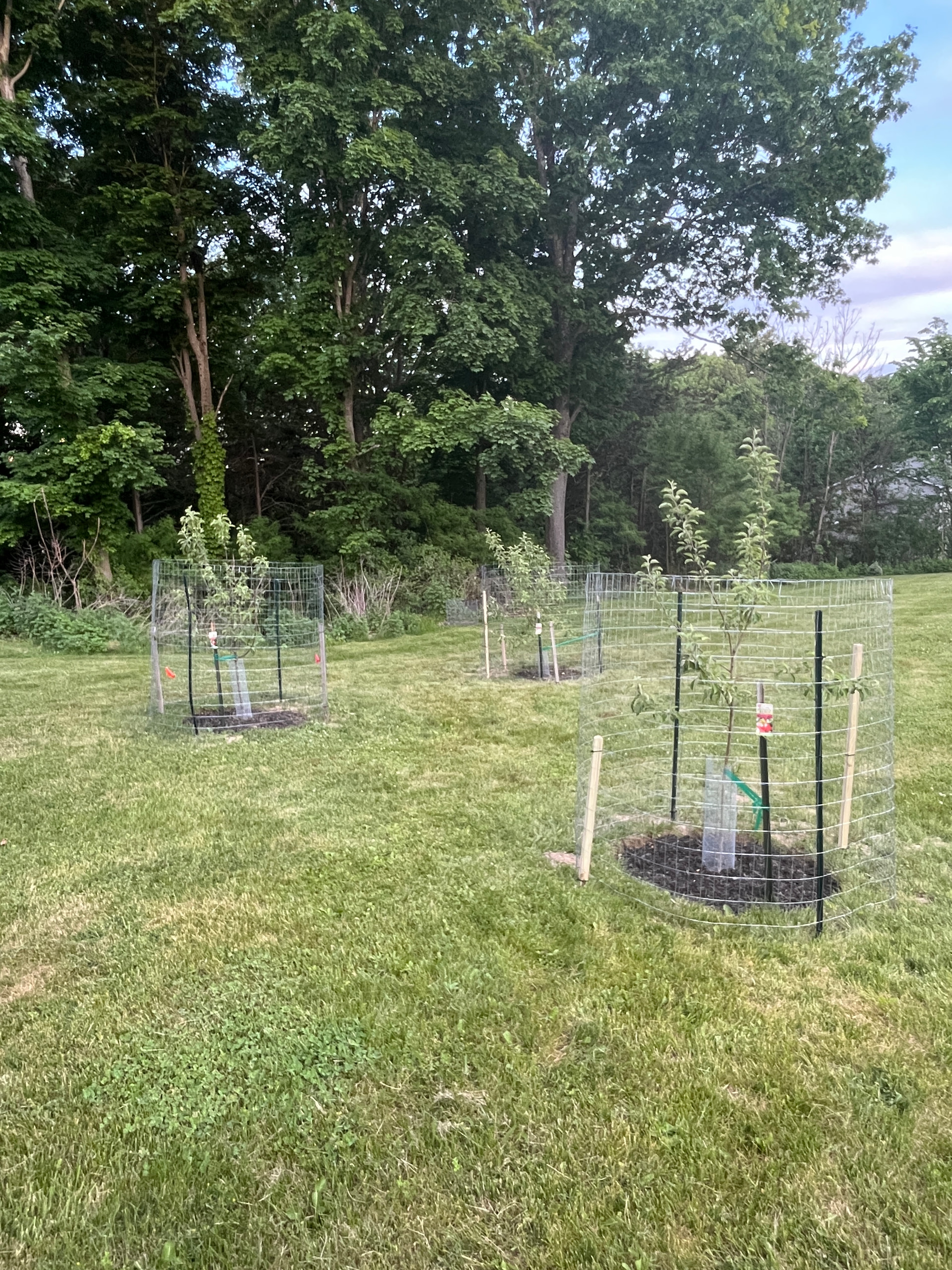
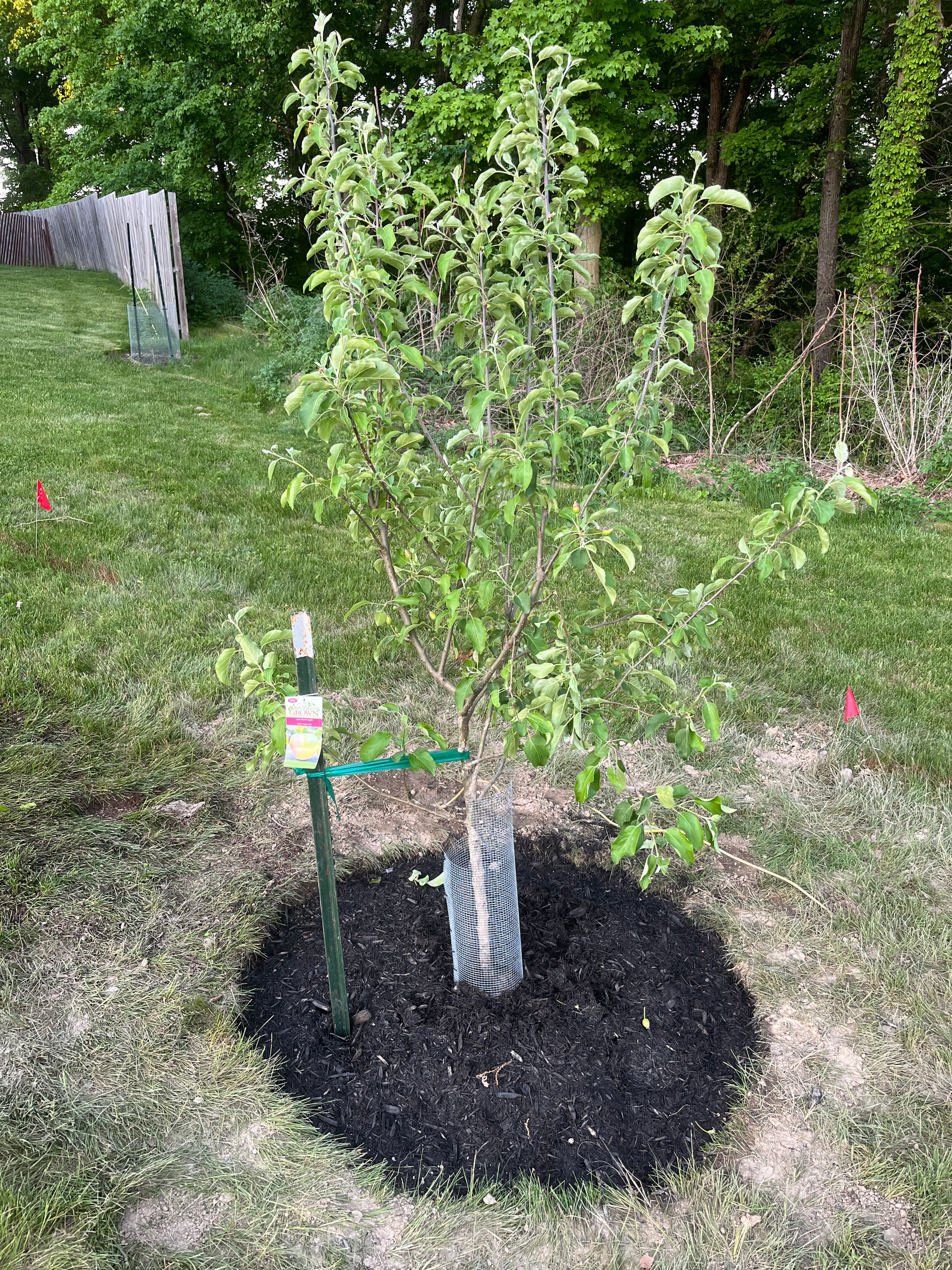
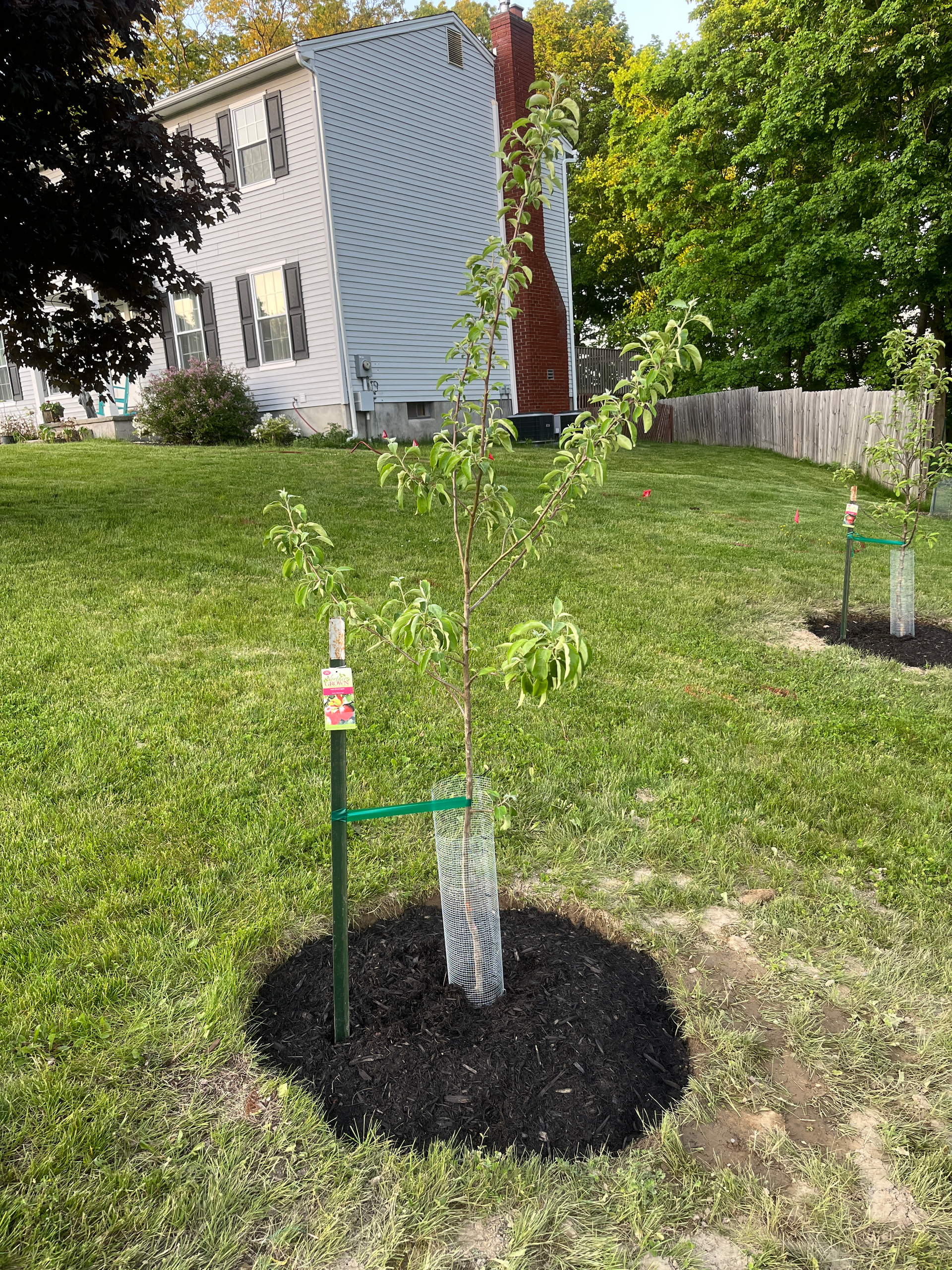
I made a post asking for pruning guidance and didn’t get much response, so I’ve done some more reading and wanted to ask some more specific questions. I’m in New York (Hudson Valley area) and the tree is a young semi-dwarf apple tree (planted this Spring)
When a heading cut is made on the leader and multiple upright shoots develop below the cut, if I want to select one as the continuation of the central leader, should the competing shoots be removed during summer pruning or is it better to wait until dormancy?
For potential scaffold branches that are becoming excessively long, is it generally better to head them back during the growing season or during dormant pruning?
If I have lateral branches coming off the leader that I expect to remove entirely during dormant pruning, does it make sense to make a small heading cut on them during the summer to reduce their vigor and direct growth elsewhere, or is it better to leave them alone until removal?
How much vertical space should I allow for scaffold selection? My tree was about 4 feet tall before the leader was headed. At what height should I make sure I’ve selected all of my primary scaffolds?
My current thought is to use four main scaffolds spaced roughly toward the four compass directions and train the tree into something between a modified central leader and a delayed open-center form.
If it helps, I’m trying to balance good structure with keeping the tree at a manageable size for backyard fruit production. I’d appreciate any advice from growers who have trained semi-dwarf apples from the beginning, particularly in climates similar to New York.
The first post in this thread should give you a good idea
With apples it’s best to prune as little as possible (only prune co-dominant leaders and crossing branches) until they start flowering. Then after they start flowering prune for structure.
Semi-dwarf is a very wide range, do you know the exact rootstock?
It varies based on rootstock vigor and intended height. One general rule is:
Semi-dwarf: 24–48" between tiers
Vigorous standard: 3–4+ feet between tiers
Some recommend first tier beginning around 30–36 inches above ground but if squirrels are a problem you might want to start much higher.
With a young tree in its first year, the instinct to prune is usually stronger than it needs to be. Most of the energy should go into establishing the root system right now. Phlogopite’s advice is solid — leave the leader mostly alone and just remove anything that’s clearly competing with it. The structure can be refined once it starts bearing.
Pinch back the competitors for dominance of selected leader if you want any branches coming off at the heading cut, otherwise just remove them… or not. It isn’t a critical issue either way unless you are creating a higher tier of scaffolds at the point of the heading cut. Pinching works fine for directing dominance to the selected leader.
If you need more secondary branching the best time is ASAP during the growing season- supposedly, after first growth the cuts tend to induce more growth well behind the cut instead of at the cut itself- I’ve not seen the research and haven’t really tried to nail this issue down. Cut back to a small side branch.
If the tree is becoming heavily shaded from temporary growth, remove it, otherwise leave it if you are trying to size up the tree ASAP.
You headed it when it was too short, unless you wanted to begin a tier of scaffolds at that point. On free standing trees expected to reach a height of about 12-14’ you want about 4’ between tiers with subsequent tiers located directionally from the trunk in between the tiers below. Heat the tree when it reaches its desired height, if you don’t need to head it to get branches where you want them. You can usually score the trunk at first growth to get branches to grow where you need them with Malus.
None of this will make the process entirely clear to you- that generally comes from years of practice and observation even after you research it as well as possible. Did you read my pruning by numbers topic in guides? It provides guidelines for sizing up a tree and bringing it to bearing in pretty simple terms. You are obsessing on details that aren’t usually important until the tree begins to bear. All you need to do for the first few years is keep the growth balanced without oversized scaffolds.
Thank you for taking the time to answer my questions. I really appreciate the help.
I have been working my way through your guide. To be honest, some of it is still going over my head a bit, but I’m trying to absorb as much as I can. Part of my challenge right now is figuring out which details I’m overthinking and which details are actually important for me to focus on at this stage.
I’m also trying to sort out what actions I should be taking now on these young trees versus what I should simply be aware of and plan for in future years. Since I’m new to this, it’s sometimes hard for me to tell whether a particular decision matters right now or if it’s something that won’t become important until the trees are older and beginning to bear.
Part of the reason I may be overcomplicating things is that I’m worried about making a mistake that permanently affects the structure of the tree. For example, I’m afraid of pruning a permanent scaffold branch the wrong way, selecting the wrong branch, or making a cut that seems minor now but turns out years later to have been a significant structural mistake. I suspect that’s why I keep asking questions about details that may not be all that important yet.
As for the trees themselves, when I say they were headed at 4 feet, that’s a bit of a generalization. I have three semi-dwarf apple trees, and all of them appeared to have been headed by the nursery at roughly that height when I purchased them. After reading and watching a number of videos, I had been leaning toward training them as either a delayed open center or modified central leader with three or four main scaffolds. Since the nursery already headed them at that height, I was thinking that two or three of the eventual scaffold branches might come from the new central leader that develops above that heading cut.
I’m continuing to read, watch videos, and learn as much as I can. If some of my questions sound like I’m obsessing over details that don’t matter yet, it’s mostly because I’m still trying to build a framework in my head for what I should be paying attention to and what I can safely ignore for now.
Thanks again for all the advice and for sharing your experience.
I’m also including pictures of my trees to get a visual frame of reference for what I’m talking about.
Yeah, me too. I’ve been studying Alan’s guidance for years but just haven’t had enough hands-on experience to apply it well until oh, maybe the last three years. You just have to get in there and make mistakes. Remember, though, your trees are programmed to survive, and they’ll usually find a way to survive.
Biggest thing for me is being afraid to remove stuff. But you have to. Open your tree up, try to simplify things, and don’t try to save everything that might work! Not all your choices will be good, but that’s what experience is all about.
If you stick to what I say about ratios you actually don’t need to do anything else for most varieties until you get your first good crop. That part isn’t very complicated, it is after when all the other numbers come into play.
With apple trees, the only permanent mistake is killing it. It is the perfect remodeling species. Generally you can get it go grow branches wherever you want to and as long as you give the beginning branch light it will grow.
The first trees I planted on my property don’t have a single branch of the original variety.
The problem is that no beginner instinctively wants to remove and excessively thick branch when it may be half the tree.
Are you a YouTube watcher? I ask because I tend to be a visual learner. Plus seeing how much of a tree is actually taken out during summer pruning may put your mind at ease about having to make the needed cuts.
At 1st glance of your pruning guide, I saw you mention that it is commercial orchard practices. But later on in your guide you say that home growers don’t need the efficiency of a central leader and an open center is easier. I’m glad you made that differentiation because not many new growers/pruners (myself included) understand there is a difference between commercial practices and home/hobby practices.
Commercial growers are dealing with very narrow profit margins- Imagine how a 10% difference in yield would affect that.
Nevertheless, I’ve seen commercial orchards in the northeast where the trees weren’t trained to any particular specs besides leaving lots of fruiting wood and good light access to it. I’ve also seen ones where they started off as pyramid shaped central leaders but the top tier ended up dominating and the trees were pruned to a weep with three scaffolds starting about 10’ from the ground and just about reaching it- looking like big mushrooms. Now that is the easiest shape in the world to manage.
With a first-year semi-dwarf you’re right to be cautious. The competing shoots from a heading cut — I’d remove the strongest upright rival now and pinch the others rather than hard-cutting, just to slow them without stressing the tree. The rootstock matters a lot for how vigorous those laterals come back.