Keep in mind that cultural methods can and do affect fireblight susceptibility. The most common concern is too much nitrogen fertilizer early in the year.
3 Likes
I did not fertilize my apple trees, pear trees or persimmon trees this spring.
I did fertilize other things…. but not those.
Apples and Pears… because of FB.
Persimmons because too much N can cause fruit drop.
Well I will have to say no store bought fertilizer was used.. but I have been giving them brown and green layers of mulch.. last year wood chips and green chop n drop, then fall leaves. This year some late winter (mowed bagged leaves and grass clippings).
Will be adding more grass clippings and green chop and drop soon.
When I do give them store bought organic fertilizer…. I end up having to prune off a lot of growth with summer or late winter pruning.
I will see how much that changes by giving them nothing but composting thru their mulch layers.
TNHunter
2 Likes
Another tree, must be some bug transferring it, maybe leaf footed? This one dropped flowers like almost a month ago.
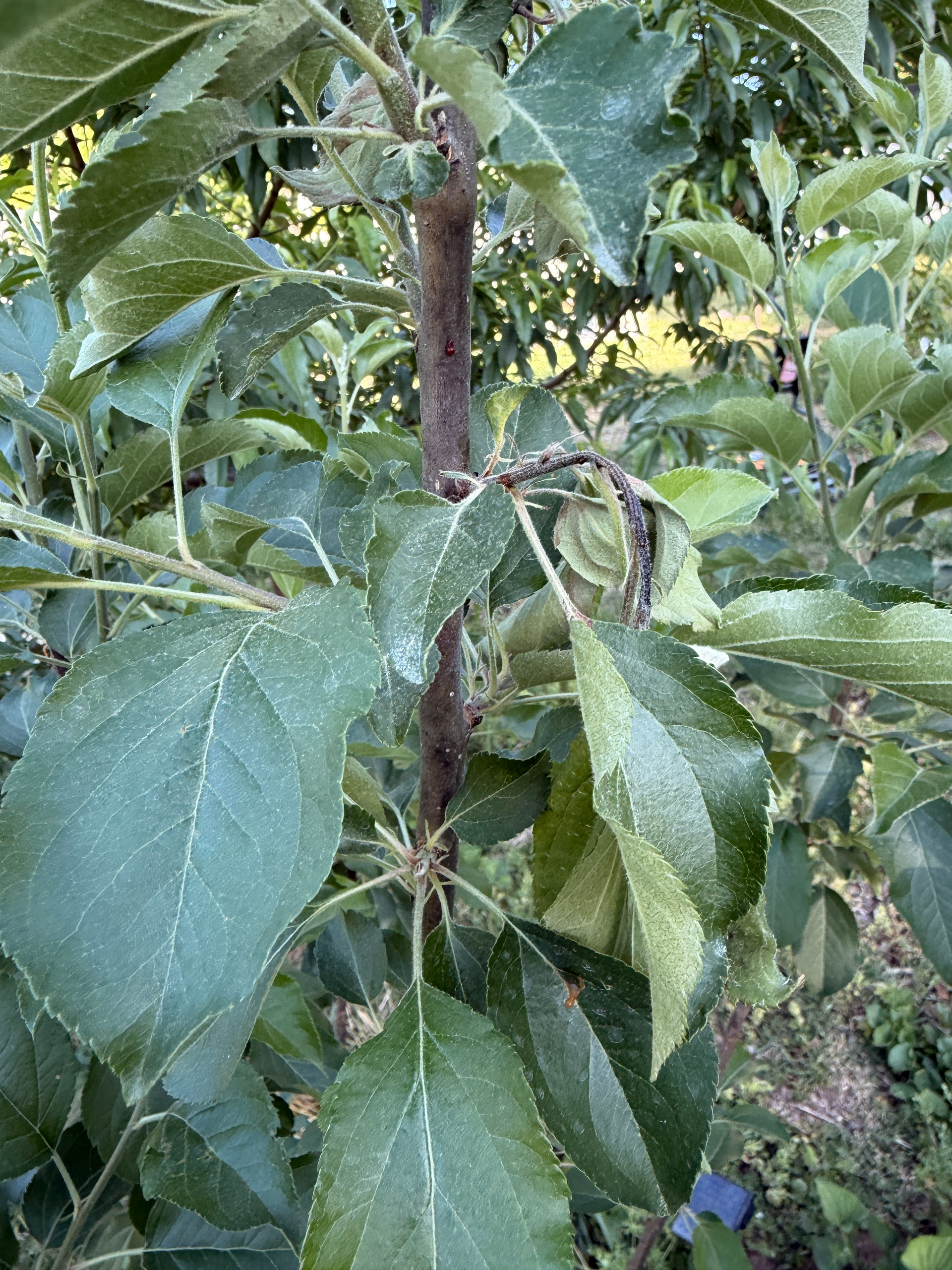
Sorry about your outbreak. I think it can take a couple of weeks or more to move from the flowers to the shoot tips but yeah ive read that sometimes sap feeding bugs can move it around.. Have you had a hailstorm? The rate of discovery of new infected twigs has declined for me over the couple of days. Seems to be that the larger, older fruit are ok, which points to the more recent rain we had 2-3 weeks ago. So far no major damage but my crop has probably been cut in half, maybe worse. I check in the AM when the humidity is up and those beads of ooze are big and shiny. By the end of the day they can kind of dry up with this low humidity we are having.
1 Like
No precipitation at all for 12 days at this point. Im not sure how I want to prune this one, looks like realistically I need to prune the entire top of the tree since it’s a short 6” branch, unless the collar provides some resistance
I cut my 10 ft tall goldrush on G-30 off at 4 ft off the ground in my 2017 outbreak. It messed up the structure for a while but it’s still going and has 4 nice scaffolds and the top has fully re-grown. It produces probably 1.5 bushels of apples per year. I hope it’s still ok after this outbreak. Im not saying you should cut it off, because I don’t fully understand your case, but just noting that cutting it back can sometimes save your tree. I also cut back 2 other trees that year but they started to ooze from the cut after a few days so I replaced them.
1 Like
Yeah I did the same to another last year, these are all still relatively young trees(1-4 years old) but still not fun. I have been using hydrogen peroxide to clean pruners but going to swap to bleach to be safe, will probably just buy a new set of pruners. Going to make a spray bottle of antibiotic to spray on the cut as well.
In this case that pic is of the main stem, so unless I’m missing something it’s within the 12” mark so can’t imagine it’s not in the trunk at that point as well.
1 Like
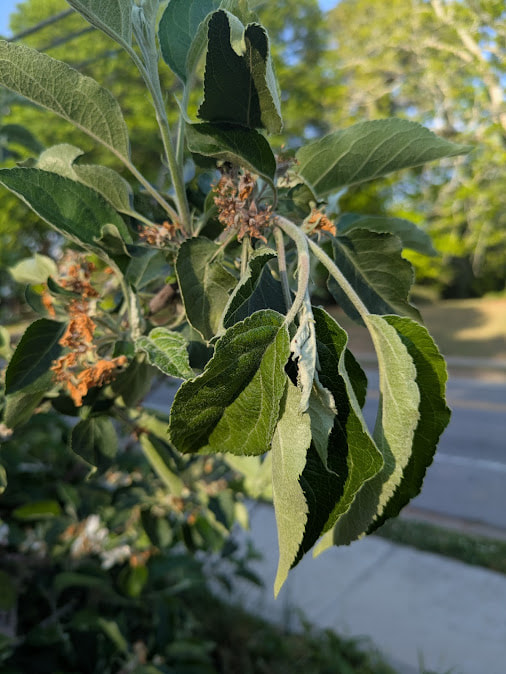
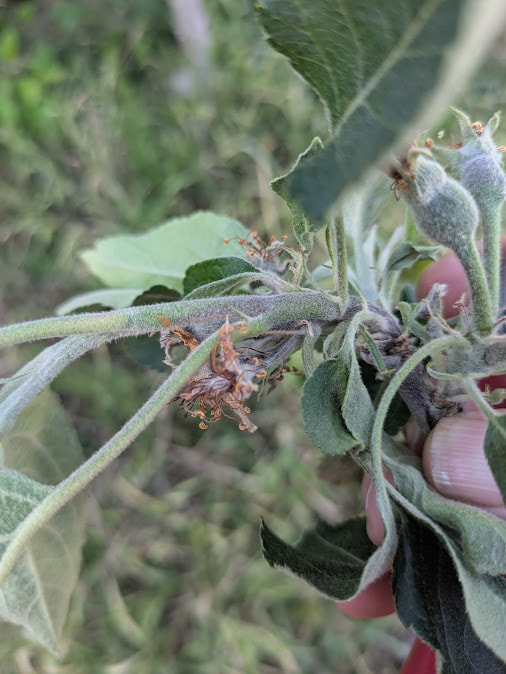
All minor strikes so far, with three of my five apples hit (so far) and no pear strikes. A record dry spring for me with only one brief shower in the past month, which has certainly helped, and I was able to get a streptomycin spray on the trees just before that rain. Attached is a picture of today’s strike, so anyone wondering what very early fireblight looks like, this is it. The second picture has a drop of the toxic ooze on the shoot, which is a confirmation that this is fireblight and not something else.
1 Like
Yep - that’s pretty much exactly what all mine have looked like so far, crazy how many though.
1 Like
Also found this article that is a bit more casual about them - I was curious since a lot of the extension people I talked to mentioned if there was canker and such and I was basically like, there was almost no damage minus curling branches.
Just for the learning experience, could you highlight the ooze drop in the picture?
Here are - in my opinion, 3 good pics of the early symptoms.
Ooze - Could also be clear yellow
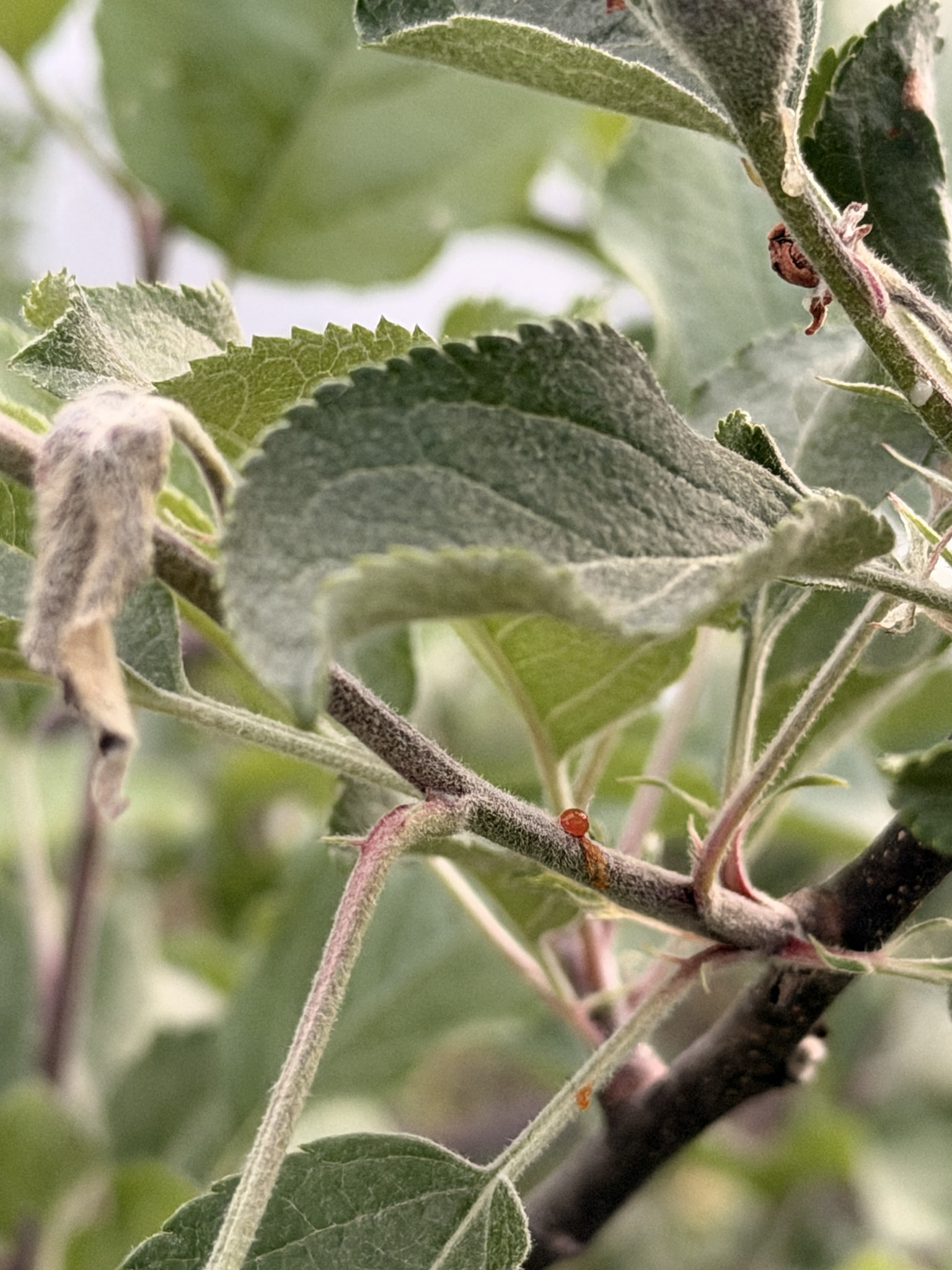
J Hook-

And vein on bottom of leaf towards middle getting dark:
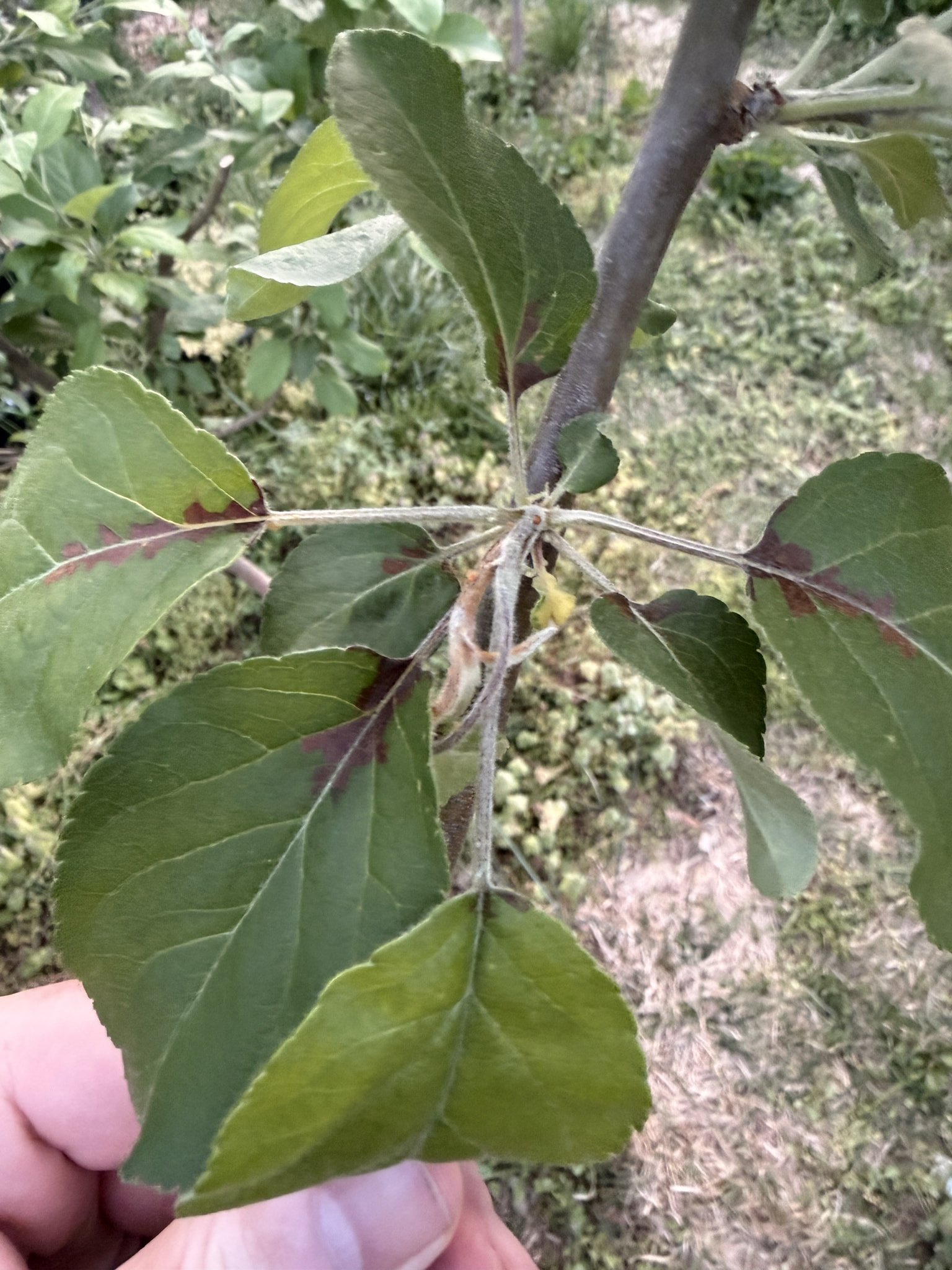
Someone correct me if I’m wrong.
6 Likes
Also this may be a stretch, but would it make sense that bugs are struggling to find water because of the drought and thus are turning to green foliage = transmission of fireblight?
@Mysta posted a much clearer picture than mine. The pictures he posted show symptoms probably 12 hours later than mine, but that’s absolutely what mine would have looked like including the leaf discoloration beginning near the base of the leaves. I know there’s a big debate about what to do, but I prune mine out back to 2nd year wood immediately.
2 Likes
Yeah the article I linked mentiones just pruning back in dry weather alone made a huge difference.
1 Like
Going to try and document bugs i see on branches of apples. I am trying to think of a way to create an alternative spot for the bugs to get water, they don’t seem to use the bird bath. But I’m pretty confident that is what is spreading the blight. Re: bugs searching for water in a drought.
2 Likes
You are likely correct. Warm weather allows an increase in insect activity as a whole and that includes blossom visitation.
Excessive blooming is a curse as well.
You’ve just made a case for early Surround applications to prevent insect activity. I’m paying a price for a late spray start. I’ve been sick as a dog and insects are crawling everywhere.
My FB is always worse in dry warm Springs for me.
1 Like
I sometimes get confused on whether or not I have blossom blight or fireblight on my apples. After looking into this I think most of mine are blossom blight but I’m not sure.
According to Google
Yes, blossom blight is a specific, early-season stage or symptom of fire blight. Fire blight is the overall disease caused by the bacterium Erwinia amylovora, while blossom blight refers specifically to the infection of the flowers, which turn brown or black, wither, and often ooze.
When you see blossom blight does it eventually progress to blight in the adjacent shoot? When I see blossom blight I have been breaking off the whole spur or shoot figuring that if I just pick off the blossom with visible FB, the bacteria has already moved past it to the base of the shoot without showing immediate symptoms. Would be nice if it could be stopped just by picking off the cluster when the blight is only seen in the flowers/fruitlets so that more wood can be ppreserved. Are you seeing a lot this year and have you sprayed anything?
1 Like
There are two separate things getting confused I think.
There is something called “blossom blast”, but that I believe I mistakenly called “blossom blight” in a post above, Pseudomonas syringae. It shows up most after blossoms freeze. The symptoms are slower to show up.
Looks a lot like fireblight but stops either at the cluster or after killing the shoot. Really hard to tell them apart in a place like mine where the weather goes from 28F to 80F in a day or two.
2 Likes