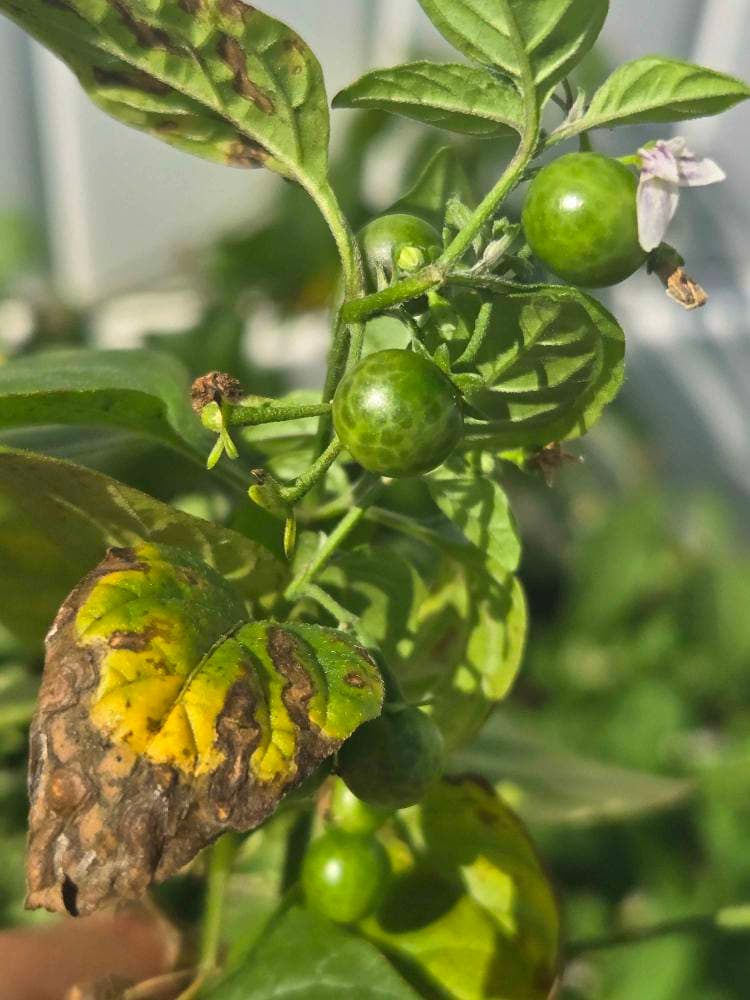
Tomatoes, Peppers and other Fruiting Nightshades 2026

I am going very big into the Nightshade Family this year, so I feel like its time to start this year’s tomato and peppers thread. Overall, I am starting over 30 different varieties of tomatoes and peppers, and will hopefully have roughly 15 different species of fruiting Solanaceae. Before I start listing, I would love to hear what everyone else is growing as well, whether its old favorites, some new trials or those ones that are on their last chance.

Tomatoes (* means new to me)(~ means last chance)
In ground/growbags already:
Tess’s Land Race* (S. pimpinellifolium)
Volunteer pimpinellifoliums (probably Everglades)
San Marzano #2* (S. lycopersicum)
Cherokee Purple* (S. lycopersicum)
Gary’s Golden Bear~ (S. lycopersicum)
Ace 55 (S. lycopersicum)
Tasmanian Chocolate* (S. lycopersicum)
Sungold (S. lycopersicum)

Seeds started:
Coyote~ (S. pimpinellifolium)
Golden Currant (S. pimpinellifolium)
Ozark Pink* (S. lycopersicum)
Orange Peach* (S. lycopersicum)
Clackamas Blueberry~ (S. lycopersicum)
Snow White Cherry (S. lycopersicum)
42 Days~ (S. lycopersicum)
Banana Cream~ (S. lycopersicum)
Black Cherry* (S. lycopersicum)

Peppers
In ground/growbags already:
Sweet Chocolate (Capsicum annuum)
Walmart Red Bells~ (C. annuum)
Thai Dragon Seedling (C. annuum)
Poblano (C. annuum)
Jalepeño (C. annuum)
White Zinfadel~ (C. annuum)
Violgo (C. annuum)
Mattapeño (C. annuum)
Brazilian Starfish (C. baccatum)
Violet Sparkle (C. annuum)
Unknown peppers (One type is definitely C. annuum, others have not fruited yet)
Giant Sweet Devil’s Horn (looks like the seed was crossed with a bell though) (C. annuum)
Sugar Rush Peach (C. baccatum)
Sugar Rush Peach Stripey (C. baccatum)

Seeds started:
Diamond (C. annuum)
Mattahorn* (C. annuum)
Datil Pepper* (C. chinense)
Pippin’s Golden Honey* (C. annuum)
Zavory~ (C. chinense)

Other Fruiting Solanums:
In ground/growbags:
Casper Eggplant (S. melongena)
Cocona (S. sessiliflorum)
Tree Tomato (S. betaceum)
Pepino* (S. muricatum)
Walter’s Groundcherry (Physalis walteri)
Coastal Groundcherry (P. angustifolia)
Sierra Leone Groundcherry (P. grisea)
Tzimbalo* (S. caripense)

Seeds
Wonderberry (S. retroflexum)
Garden Huckleberry* (S. melanocerasum)(these two may be the same, but from different sellers)
Orange Otricola Berry* (S. nigrum)
Chichiquelite Huckleberry* (S. nigrum)
Schwartzenbeeren Blackberry Huckleberry* (S. nigrum)
Litchi Tomato* (S. sisymbriifolium)
Dwarf Tamarillo~ (Cyphomandra abutiloides)
Purple Corban Tomatillo (Physalis ixocarpa)
Chupon de Malinalco* (P. philadelphica subs. ixocarpa)
Aunt Molly’s Groundcherry (P. pruinosa)
Sunberry~ (P. minima)
Casana*~ (S. cajanumense)
Musho*~ (Jaltomata cajacayensis)
Hairy Fruited Eggplant~ (S. lasiocarpum)

Roughly 50 varieties/species of Solanums. I am running out of seeds of a few off them, but nothing that I am running out have wowed me. Most of the non-standard species are perennial here, so hopefully I won’t have to buy them again. I am most excited for Orange Peach and Cherokee Purple tomatoes, Mattahorn and Sugar Rush Stripey Peppers, the tomatillos and Musho. I am least excited for the hornworm and stinkbug pressure I am going to have. Hopefully, there will be so much solanum fruit the stickbugs won’t bother anything else.

Tldr; I am planting alot. What are your fruiting nightshade plans this year?
10 Likes

I must say that is an impressive list! Sadly, I don’t have the time to handle the amount you’re planting.

I do a few each year, but usually no more than 2-3. So far, I’ve settled on ‘Doux d’Espagne’ pepper (c. annuum) and ‘Green Zebra’ tomato (S. lycopersicum.) I’ll probably add a paste tomato into the mix, but haven’t decided yet on which one.

4 Likes

if a few people are interested I have some interesting phenotype S. emulans with striped flowers. Fruit ripens to black and its definately aprt of the black nightshade complex. Taste is basically a slightly sweet tomato to me.


I grow these. they act as my tomato hornwrom penal colony (all get relocated to these plants and they still produce a lot of fruit)

I’m also growing:

Brown Jalapeno
Black hungarian pepper
Purple Tomatillo
Rio grande verde tomatillo
Copia Tomato
Dad’s sunset
Alice’s dream
Carbon

Then for various family members I am starting the following too.
Sungold
Profi Frutti Mandarin Tomato
Turkish Orange Eggplant
Black Shine Hybrid Eggplant
Bridge to Paris sweet pepper

I want to try a ground cherry that doesnt taste like a tomato, so if anyone has a variety or species let me know

5 Likes

Physalis grisea (at least the one I have, Sierra Leone, but I believe @a_Vivaldi has had the same experience with a different variety) doesn’t have that tomato flavor. They either taste more like a citrus or sometimes like caramel (I only had 1 plant with the caramel taste, and it was possibly a different variety). Both my Walter’s and Coastal Groundcherry taste similar to apricots and are very meaty. Goldenberries taste like tomatoes to me, Sunberries (p. minima) taste like how tomato plants smell, and Mullaca (P. angulata) tastes like an unripe tomato. Sunberries make a good salsa though.

3 Likes

Yes, P. grisea doesn’t have a tomato taste to me either.

1 Like

Adding some new tomatoes here. Blue Beech. Carbon Beefsteak, Green Zebra and another paste type and a low acid slicer.

3 Likes

This is the first iteration of the 2026 garden plan. Since I am tomato heavy in interest, this does not include the pepper intentions. That will be added at a later date. Also on the list will be a couple melons and squash TBD. My wife has taken over green beans (jade for sure and one more) and cucumbers (she has two favorites I will insert). She has six large raised beds. My stuff is in a 50’X50’ traditional garden space. There are also several rows of asparagus in “my” garden along with some seedless blackberries.

BLACKS
Bear Creek
Indische Fleisch
Amazon Chocolate
Big Cheef
Black Burgundy
Black from Tula
Cherokee Purple

RED
Brandywine Red
Cuostralee
Daniel Burson
Fred Limbaugh Potato Top
Medford
Neves Azorean Red
Old Brooks

PINK
Earl’s Faux
Kolb
Purple Dog Creek
African Queen
Giant Belgium
Soldaki
Tidwell German

RED HEART
Ernesto
Butter and Bull Heart
Kukla Portuguese Heart
Volovi Ushi
Canadian Heart
Oleyar’s German
Reinhardt Purple Heart

PINK HEART
Granny’s Heart
Hays
Sgt. Pepper’s
Willow’s Bulgarian Heart
Erdie Family Heart
Hungarian Heart
Ludmilla’s Heart
Michaella’s Pink Heart

ORANGE/YELLOW
Kellogg’s Breakfast
KBX
Orange Oxheart
Wisconsin 55 Gold
Yellow Brandywine (Platfoot)

BICOLOR
Hillbilly Potato Leaf

BLACK HEART
Reinhardt Chocolate

2 Likes

great news, i’ll look at p. grisesa. how tall do they get? wondering if i could use them as ground cover around some things since they reseed so readily. also anyone have a seed source? It looks like its my native one too so thats fun. Or at least near native. i guess Physalis heterophylla and Physalis virginiana var. virginiana are a bit more prevalent. has anyone tried either of those?

Mine have been very short everytime. Usually less than a foot tall. They would make a decent raised bed or garden groundcover but not very good anywhere you walk.
The only place I can find seeds from a quick search is Tradewinds Fruits (they have one from Quebec and thats where I got the Sierra Leone variety originally) or Etsy sellers.

have you had p. pubescens, especially “goldie ground cherry” they also have those and are described as “very sweet” and strawberry pineapple. kind of interesting…

1 Like

I have not. I believe someone in the PNW talked about how they were super sweet and were sold as pineapple ground cherries. I cannot find that post and I don’t remember who said it.

I’ve grown coyote before, I liked it a lot. I didn’t realize it was a different species. I just assumed all tomatoes were S. lycopersicum. I guess since lycopersicum means wolf peach they’re called coyote cause they’re miniature wolf peaches. That’s fun.

2 Likes

interesting. i think i’ll do both and try them in a pot this year and next year if good we’ll try em around some trees/ brambles

1 Like

Currant tomatoes are typically S. pimpinellifolium. They are believed to be one of the wild ancestors to traditional tomatoes, although they themselves are at least semi-domesticated. They are extremely bushy compared to traditional tomatoes, but they typically grow great in my neck of the woods. They do better with humidity, don’t typically suffer from RKN and don’t need as big of temp changes to set flowers.

2 Likes

Last year was my first time trying Tasmanian Chocolate. They did well on my deck in foggy Oakland (but not as foggy as SF). Would have been my highest yielding by far if it weren’t for the mice. They’ll be making a comeback this year and will hopefully do at least as well in my new place.

My wife said they were the best of the varieties I grew last year. I’m partial to black krim myself, but they were good. Hope they do well for you

2 Likes

I used to like Black Krim and Tula. Then I tried Carbon Beefsteak.

2 Likes

@sharq

Great list! I also wanted to remind everyone they are still night shades. All food is a little problematic. The family of plants is Solanaceae. “The theory linking nightshade vegetables to rheumatoid arthritis (RA) suggests that certain compounds in these foods may worsen inflammation and contribute to joint pain in some individuals with RA. Nightshades, a family of plants that includes tomatoes, potatoes, eggplants, and peppers, contain a naturally occurring chemical called solanine, which some believe could be a trigger for inflammation.”

“Know your triggers: nightshades and joint health.” - Pain Institute of Southern Arizona.

“Some people are sensitive to different foods, including nightshades, whether or not they are living with arthritis. Montoya points to a couple of different possible scenarios. The first is oral allergy syndrome – when people who have allergies to tree or grass pollens also react to certain foods that have a similar protein makeup. Tomatoes are a common trigger. Another possibility is latex-fruit syndrome, when people who are allergic to latex also show sensitivity to some foods, including tomatoes and potatoes, which have similar proteins.”

" The plants contain alkaloids, which can be dangerous in large doses. Some nightshade plants are even deemed unsafe to eat. (One is even called deadly nightshade!)

A bitter-tasting compound known as solanine is the main culprit, explains Dr. Calabrese."

"A tomato allergy is a type 1 hypersensitivity to tomatoes. Type 1 allergies are commonly known as contact allergies. When a person with this type of allergy comes into contact with an allergen, such as a tomato, histamines are released into exposed areas such as the skin, nose, and respiratory and digestive tracts. In turn, this causes an allergic reaction.

Despite the fact that tomatoes and tomato-based products are some of the most heavily consumed foods in the western diet, tomato allergies are extremely rare. An individual with a tomato allergy is also prone to allergic reactions with other nightshades, including potatoes, tobacco, and eggplant. Often, people with a tomato allergy will have a cross-reaction to latex as well (latex-fruit syndrome)."

I said it before about pawpaw , cherimoya, star fruit etc. etc.

"All food is toxic in large quantity. There is a little arsenic and cyanide in most fruits. I accept toxicity as part of life. I eat prunus besseyi at times which are more toxic than star fruit, poke greens after boiling at least 2x, mushrooms, not to mention think about many peoples food allergies to strawberry , shrimp,wheat, milk etc. Food is life and death and i expect nothing different from any fruit or vegetable.

2 Likes

Lord willing for 2026, I hope to grow the following tomatoes:
Moravsky Div
Gold Medal (orange-pink)
Italian Heirloom (an oxheart)
Andrew Rahart
Honey Drop (orange cherry)
Gardener’s Delight (red cherry)
Prudens Purple
Piennolo del Vesuvio

For peppers:
Mountaineer
Red mini
Orange mini
Sparkle Or Lipstick (only one of the two)
Biquinho
Collage

Eggplant: Listada de Gandia

1 Like

How do you like sugar rush peach? I just got some seeds to try this year. I’m debating whether to actually grow them with habanero since I love habanero and even one plants produces so much more than I can use and find people to give to in a year. I think I will have my container of dried habanero from last season for the next 3.

I bought a lot of new tomato seeds, but decided to stick with tried, true and loved: sungold and blush and grow half as many to free up space for other things. I normally give away 50-75%, so I figure this will be perfect. And, while I find tomato pruning meditative, it’ll be nice to do something else with half that time.

My grocery store mini peppers were fabulous and so productive last year, so I’m doing that again plus some purchased snack time peppers to compare.

Pumpkins on a stick are the (planned) exciting addition this year!

3 Likes

Good tasting, but had no heat even though they are supposed to. I had a pretty bad stink/sucker bug problem on all my peppers so they all ripened underdeveloped last year. Working on fixing that this year and hoping for some better flavors.

If you haven’t acquired them yet, Matt’s Peppers have them for sale.