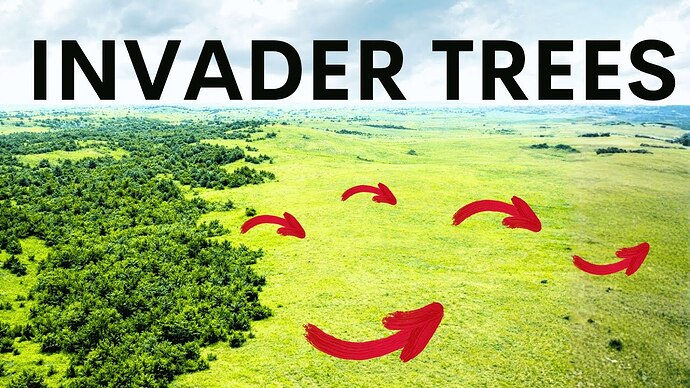
What is your opinion? Are we part of the problem? Is there a problem?
What is your opinion? Are we part of the problem? Is there a problem?
It is real and quite disturbing. DH and I bought a property in Reno county KS about 15 years ago. Gave my neighbor permission to hunt so didn’t have the back field mowed. Only hired mowing for the acreage around the house. It was supposed to be our retirement home so only visited sporadically.
The entire back field is now a forest of trees. Where did they come from? Property is surrounded by crop fields. 15 years of neglect turned acres of prairie grass to a jungle. It haunts me.
Nature knows best. Problems only exist in the human mind. Trees growing becomes problematic? It almost feels like satire L0L
not enough grazers to keep the saplings from getting started. the buffalo herds in the past kept it prarie. without them , the trees can take hold and spread.
I would guess that in some area where there was once forest it is changing to grassland.
Fires are necessary to keep grasslands from becoming forest. Modern people have been suppressing fires instead of lighting them.
Clark- Good question. It reminds me of the theme of an old book, “Playing God in Yellowstone,” that once humans have sufficiently trashed an ecosystem, we need to conjure the wisdom and power of God/Mother Nature to restore it, which many times is impossible.
Ecosystems change all the time. A few thousand years ago much of the West was far wetter than it is today with giant ground sloths and mammoths/mastodons and more. Different ecosystem. A few hundred years ago, fire shaped the plains and massive herds of bison roamed huge territories, also shaping the plains. Different ecosystem. Today, fire is controlled by humans and massive uncontrollable burns are rare. Bison are managed in vastly smaller herds that cause limited disruption to human activities. A different ecosystem is developing again. It happens.
Grassland ecosystems require periodic grazing, mowing or burning. Keep them untouched, and you prevent the disturbance required for that ecosystem. Then you get a forested ecosystem. The earth doesn’t care. It’ll make lemons into lemonade (even if we were hoping for orange juice).
Personally, I think we should be updating building codes to require homes built in fire adapted ecosystems to be built to survive fires. Then stop suppressing fires and just encourage them to burn through a quickly as possible on a regular basis.
It’s more than likely the Native Americans set fires to improve grazing for horses.
many townships used to do prescribed burns to control undergrowth but stopped as the public whinned about the smoke even when they were notified about it in advance. saw a vid where they were burning portions of the everglades to find the pythons. if the fire didnt kill them they would come out of their dens looking for cover and were easy to spot on the blackened earth.
Here in Tennessee… we already have trees everywhere.. always have.. all my life anyway.
If you want a clearing/field… you have to clear it.. and keep it bushhogged or mowed.
Trees reproduce.. many on a massive scale anywhere conditions are favorable… seems like conditions have become more favorable there… and they are just doing what is natural.
TNHunter
The natives did attract the Buffalo with lush green grass after it was burned off.
In contrast, here’s a popular saying from the 1800s:
My opinion is-
Having trees out on the prairie is good and beneficial, but what more than likely is making up 95% plus of the trees growing is eastern red cedar, which outside of windbreaks they are a demerit to the landscape.
It would be significantly more desirable if the the trees that are growing (or will be growing) there are trees that are highly controlled what (specificly only for lumber, fruit, nuts, and windbreaks) grows and where they grow. Ideally trees will only grow only in specific places and anything else needs burning to prevent trees growing where they shouldn’t.
My opinion with burning is obviously controlled burns, but should be somewhat checkerboarding the various parcels of land yearly what get burned and not just letting it rip through immense areas of land in one go.
I’m of the frame of mind of a highly human affected/modified (and maintained) environment in a positive way (and working with nature to our benefit and not fighting it in every aspect) is the best environment.
Obviously the ideal way in my opinion to go about land stewardship is not practical to do it everywhere (my thinking, is for like my local area which used to be open Prarie 140 years ago).
Here in southern Illinois it doesn’t take but a few seasons of neglect to produce trees that were once prarie grasses. To maintain prarie I have to graze. My grazers are cattle, they eat tender young saplings in the spring. I also have cut and bale hay, plus bush hog once or twice a year. This seems to work pretty well. I think the biggest help to maintaining prarie are the cattle. They have been around since the beginning. They fertlize the soil, the soil produces more grasses. They eat more grasses and fertlize the soil more. It’s a nice harmony.
Before Europeans arrived, there were no cattle on the prairies, nor horses. Only bison were numerous enough to have a large effect on the ecosystem. Since restoring bison to their historical abundance is not an option, we, the people, have to decide what to do with the prairies. I certainly don’t have an answer, but I think that there will be more than one answer.
What do do with the prairies of the western midwest is a really interesting question. Projections indicate that many if not most counties in this area will lose human population over the next generation. The traditional definition of “frontier” is an area of six or fewer people per square mile. The frontier areas of westrn Kansas, Nebraska, etc. are currently expanding, not contracting.
@vitog
The “plains”, including portions of present day Canada, have a varied history of climate and wildlife over the past 7,000 years. Bison did not always exist in large numbers, nor were they the only hooved animals present.