I’m curious about the temperatures at which trifoliates drop their leaves—if they drop them at all.
Over the past two years, I’ve grown a couple dozen trifoliate seedlings each year, and the results have been all over the map. Some seedlings lost all their leaves after just a day or two of temperatures in the upper 20s °F, while others retained all their leaves even after sustained temperatures in the low single digits. Does anyone know whether leaf retention versus leaf drop tells us anything about the relative cold hardiness of these plants?
What really surprises me is the huge temperature range at which leaf drop occurs, even among seedlings I believed came from nucellar seeds. I would expect some variation between clones, but a nearly 30-degree difference seems extreme. Has anyone found leaf-drop temperature to be a reliable way to screen for zygotic seedlings in trifoliates?
I’m also interested in hearing what percentage of zygotic seedlings people typically get when growing non–‘Flying Dragon’ trifoliate seeds. The batches I’ve grown appear to have a much higher percentage of zygotic seedlings than published charts suggest, with several individuals in each batch showing clear phenotypic differences. If leaf-drop temperature is an effective screening method, then the percentage of non-nucellar seedlings in my batches would be significantly higher than expected.
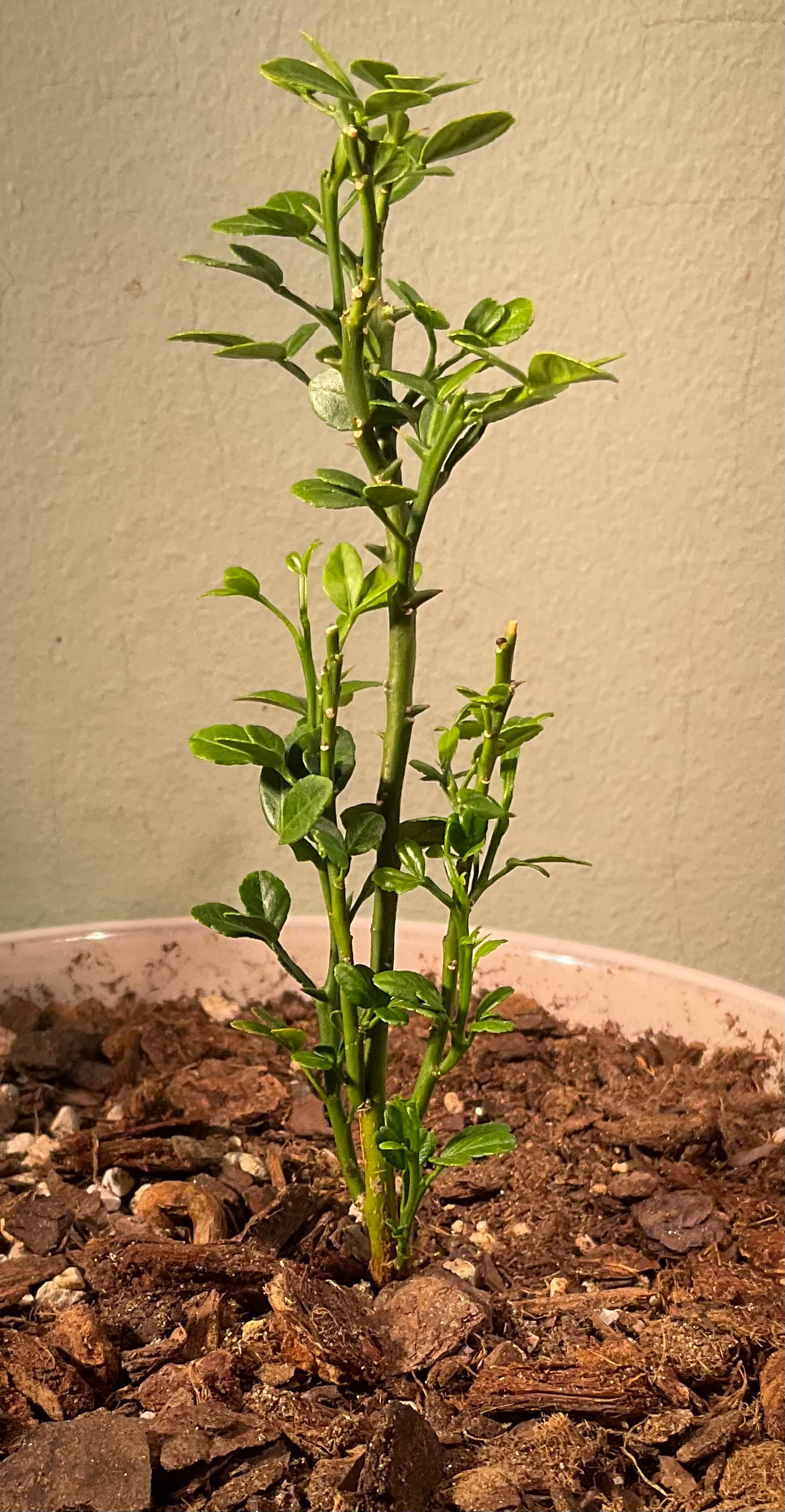
As an example, here’s one of the more interesting zygotic seedlings from last year. It has much smaller leaves, shorter internode spacing, and a very fastigiate growth habit.
I’d appreciate any insights or experiences others are willing to share.
I don’t think your quite using the terminology correctly.
zygotic embryo are formed from the female ovum and mail pollen
an nuclear embryo is one generated as a clone of the mother plant.
Polyembryony is the property where a seed will contain more then one often one zygotic and one or more nuclear embyos.
If your crossing you want the zygotic seeds rather then the nuclear. And I guess your asking is there anyway to tell.
I think in the case of trifoliate leaf morphology is the best way without dna testing.
I understand the distinction between nucellar and zygotic seedlings. I grow several cold-hardy citrus types from seed, including trifoliate orange. It’s possible I misused the terminology, but after rereading my post, I don’t see where that occurred. I’m not making any crosses with these—these are straight trifoliate seeds, so all seedlings have trifoliate leaves. My question is whether the temperature at which trifoliate seedlings drop their leaves could be a reliable way to screen for zygotic (non-apomictic) seedlings when obvious phenotypic differences aren’t present.
My experience for mine was that 80% lost all their leaves in the upper teens, and the remainder that held their leaves got cooked when it went below 0°f. The source of my trifoliate seeds said that he liked that tree, because it kept all its leaves throughout the winter unlike all the other ones, which made me greatly concerned, because I already ordered them and they were on their way, and for most tree species the more cold hardy things drop their leaves quickly in the fall.
But now looking at my seedlings nothing has suffered any damage from the -17°f we got down to last monday, so that is encouraging.
The best way to thin out the most clonal plants right after they germinate is said to be to remove any from seeds that have more than one sprout.
On that note, for me, the majority of my trifoliate seedlings were not polyembryonic.
I know they all do at a certain temperature, but I have several trifoliates and US-852 that still have their leaves after experiencing temperatures close to 0 for an extended period, while others grown from the same type of seed lost their leaves more than two months ago. I found this interesting and wondered whether it might be a way to screen seedlings.
It could definitely be a factor. All of the seedlings are either one or two years old, and it’s very possible this will change as they mature. Among the one-year-old trifoliates, some currently have leaves while others do not. The same pattern is seen in the two-year-old trifoliates, as well as in the US-852 plants from both age groups.