I think in low-humidity regions, using plant dead plant matter is going to be more risky. Decomposition rates are lower, so pathogenic biota persist for longer and in greater numbers before being replaced by dedicated heterotrophs.
Out here in the southeast, not only is decomposition happening at a much higher rate, but the ground will be covered with a layer of dead plant matter regardless of if wood chips are applied–be it weeds or blown over lawn or forest detritus, whatnot. So whatever is in the garden is going to be under pressure from waste-born pathogens regardless of if I apply wood chips or some other organics-heavy waste. That, and we just have vastly deep reserves of pathogens in every lawn, ditch and forest-edge, whereas somewhere like the central valley in California might as well be a giant petri dish–a few woodchips in our it’s-the-jungle-but-with-frost climate doesn’t even register, but some woodchips out in the California not-actual-sterile-but-might-as-well-be clime is going to make a big difference.
Probably the best illustration of the differences between warm low and high humidity regions is the fact that y’all have to plant trees to recreate forests–we have to keep bushhogging to prevent forests from establishing themselves where we don’t want them. It’s a totally different kind of nature in these parts, and she’s hella aggressive.
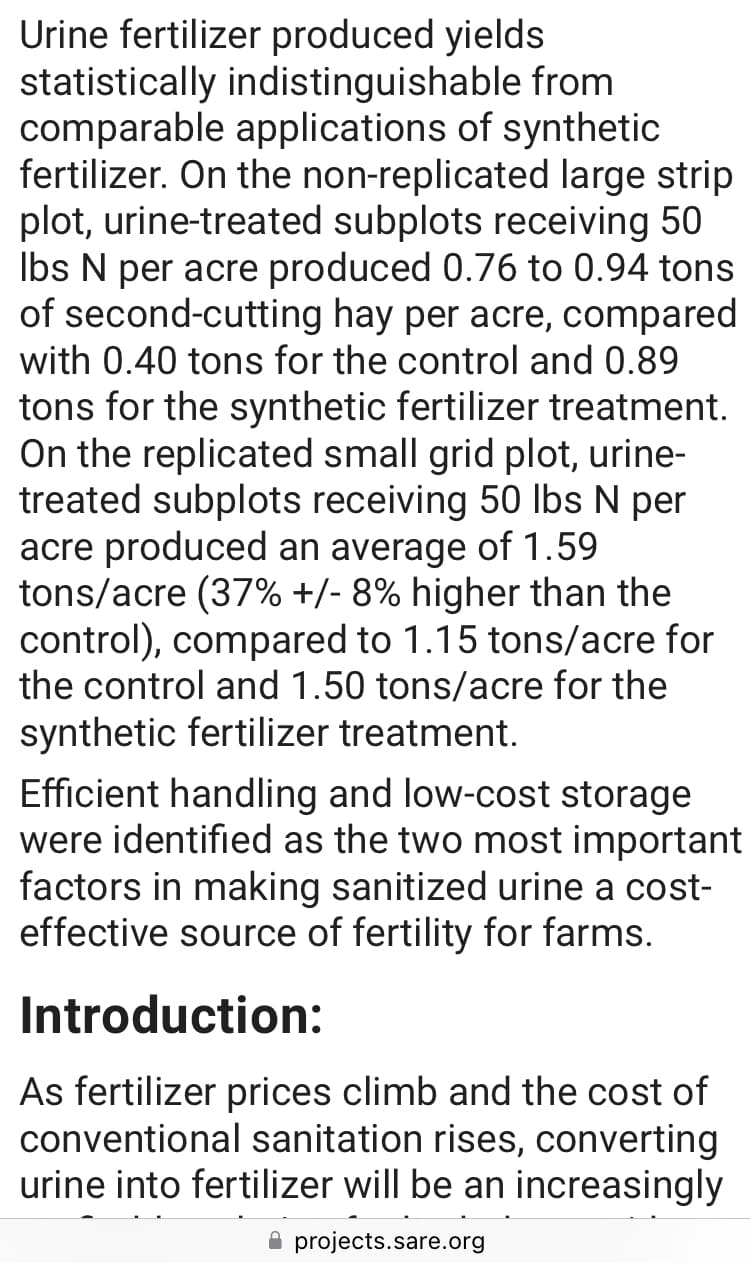
Not necessarily so. 5:1 diluted human urea has significant higher levels of nitrogen then miracle from and it is a liquid fertilizer.
Then you talk about the correct ratios followed by using 10-10-10, which is nowhere near a correct ratio for any plant.
There is a lot that goes on around plant nutrient uptake where not even the mythological perfect ratio would ensure proper uptake. Your 10-10-10 works well because while not being balanced by a country mile it provides decent nitrogen while making the other two available. On the same vein it is quite possible to provide all the nutrients through organic fertilizers, to me it is just a lot easier to blend in so called “chemical” fertilizers.
Granted, but I still don’t call that enough to outweigh the health risks.
Yes, 10-10-10 is very unbalanced. I use it as a baseline, and add whatever else is needed on top. I’m also using it essentially as a smoothing function: try as I might, my fertigation regime is not especially consistent (life finds a way–to get in the way…), so having some slow-release stuff out there helps provide a more consistent background rate–something especially important when summer thunderstorms start randomly doing full soil drenches over the entire garden.
The main thing is 10-10-10 is just really cheap. Cheap, provides a baseline, and smooths out the nutrient loading.
I have used Florikan, HyR Brix, and Anderson from am Leonard. All three are excellent. Free shipping a few times a year for 50 pound bags. Price has about doubled though the last of couple years. Well balanced with 3-1-2 ratios include micro and macro nutrients. New patented slow release that does not disturb soil bacteria. Awesome products that work well extremely well.
All of the soluble nutrients are in urine, and it’s essentially devoid of pathogens. Humanure is mostly a carbon source. I wouldn’t apply urine to leafy greens but it works well for anything else and is free.
Every bit of N and P we put to use not only feeds the things we grow closing the nutrient loop, but lessens the degree to which these nutrients are leached into the environment in problematic ways.
Which health risks? I use horse manure, there are no known toxic health effects from exposure to it. Human urea, I only use my own, comes out sterile and even if it isn’t pathogens don’t survive the soil. I dilute 5:1 and never spot any smell. Often I just apply it to the compost pile.
I don’t think anybody here is really all that systematic with their fertilization. Meaning even those of us that apply it on a regular basis are pretty much hoping for the best. I also use 10-10-10 early in the year and urea later on. I use osmocote on my potted plants. I deploy a ton of composted manure and wood chips because my soil is as crappy as they come.
Human urine is not pathogen free. It can be, but often isn’t. Urine borne pathogens include E. coli, some forms of strep, HIV, and of course any of the various bacteria that cause UTIs, as well as some more exotic things like typhoid fever.
Sure, if you’re using your own, no one else eats from your garden, and you’re not using it on greens or ripe fruit, yeah, you’ll be fine. But, failing any of those conditions, it’s a health risk.
Is it a huge risk? Probably not, at least if you’re being careful. But, back to my original point, I highly doubt the little bit of unbalanced fertilizer you get is worth that risk.
That’s a fair point. Although some forum members definitely are (Richard has a pretty intense system iirc), by and large people are just doing what is convenient and what aligns with their beliefs, lifestyle, and pocketbook.
Same with wood chips. I know I’ve applied at least six tons so far this year, and wish I had time to do twice that. My soil isn’t crap, but it isn’t amazing either.
At some point I’d love to experiment with fine charcoal. If I can figure a way to produce it in bulk for cheap, I’d love to see what the soil properties of a high charcoal mix would be. I’d expect something resembling a volcanic soil, what with the high weatherability, high cation exchange capacity, high porosity, fast drainage, and light weight. Not to mention the much longer lifespan on charred carbon as opposed to organic carbon in soil.
I’m not much concerned about closing the nutrient loop, but that’s more a philosophical question that basically just depends on world view.
As to leaching, we have common ground. I’d love to see our rivers healthier and less polluted. That being said, I’d not go so far as applying human waste directly to human food crops. We already have so many issues with E. coli, salmonella, etc on stuff like spinach and strawberries coming from chicken or other manures being improperly applied to fields, I’d hate to see what industrial scale application of human waste would look like. Imagine cholera making a comeback in the US, to say nothing of the far higher levels of hormones, drug residues, antibiotics, heavy metals, etc that come with human waste. Applied to animal feed crops? Yeah, I’d be ok with that. But to human food crops, no, the fertilizer isn’t worth the health risk.
out of a healthy person ,human urine comes out of the body sterile. its just as safe to handle, maybe more so, than other organic fertilizers. feces i would never use as that’s where all the bad stuff lives.
i put my urine in my compost piles to let excess salt drain off. it really gets it things going in there. my wife knows this and has no problem eating food grown with my compost. the hot composting also helps eliminate the bad bacteria in there so im not worried about what im putting out.
None of those survive the soil. Heck not a single case of HIV spread have ever been reported after a person has come in contact with straight urine.
On the other hand there is stuff in the soil that is downright deadly including anthrax. If you are concerned about pathogens forget about the nearly non existent risk for urine and worry about the very real risk form the soil itself. Then again that real risk is still miniscule so I don’t worry about it.
Id like to offer both a retort and a concession @a_Vivaldi
Id like to state up front that we ought not belabor this discussion. People have entrenched ideas based on some combination of their understanding of facts and their values. Both of those are hard needles to move. I will say my piece but intend to leave it at that.
Waste is, on some level, a fascinating cultural phenomenon. Use of human waste to grow food is an issue which probably conjures more cultural baggage than for any other other waste-related practice. Taking a step back is apt to be instructive and lead to objectivity.
Ive heard some very similar if less impassioned arguments for and against other organic waste streams. I receive annual deliveries of fall and spring leaves from my town, for example. To most people, they are trash. People toil to eliminate what they see as a burden. The contents of these leaves- mt dew bottles and matchbox cars are some of the most common “bycatches”- reflect people’s attitudes. Perhaps a similar phenomenon may help explain many of the more problematic contents of our own bodily waste streams?
Other people point to a not dissimilar laundry list of issues with these leaves, like high amount of “invasive species” propagules, jumping worms, garbage, various pollutants, etc. Often as not, there is a feeling or attitude of disgust that accompanies these gripes. I wouldnt argue that we should ignore these matters, but the fact is, as in the case of leaves and brush, the stuff needs to go somewhere, and where it goes, these things will follow.
I don’t mean to be ideological or purist. To me its not about ideology, but about ergonomics. The merits of this idea dont hinge upon it being done at scale, either, though I think most ideas as pragmatic and commonsense would lend themselves to that, provided the correct groundwork were laid. There are all manner of pragmatic reasons against scalability too, though those would tend to center around sunk cost and legacy infrastructure. On a grand scale, in for example an urban environment, it may not be worth the bother. This thread is about fertilizer that is “low cost” and “organic” though, so we hardly need to consider that scale. With few exceptions, Id venture that people reading this thread are not in a position to put others at meaningful risk from this practice. By and large, people here are growing fruit, whether on trees, bushes, or canes. These are inherently compatible with urine, as are grass and cereal crops of any stripe, whether for forage or human consumption. So to are many (most) vegetables, especially considering that application is easily withheld within a reasonable window prior to harvest. We have such conventions for substances far more dangerous, like pesticides, so why overemphasize the pathogen risks from urine? The fact is, they are low and easily mitigated.
There are other risk factors you propose that dont strike me as compelling. Urine is only going to contain soluble substances, so definitely not heavy metals, for example. The other substances are either ephemeral and/or uniquitous. Where we wish to place such things is an open question. I suppose to the degree that they might be persistent, we can expect that they will not only disperse, but also accumulate as they move up the trophic ladder, ala microplastics and fluorocarbons. More likely, much or all of these are dealt with (whether under our fruit trees or elsewhere, like in a water body) by some combination of microbial breakdown and binding and chelation with clays and soil carbon.
This last point brings me to close on a bit of common ground- char. Its clearly great stuff, and I think the fact that it isnt known and investigated as such is unfortunate. Urine and char is a good combination, the urine acts to “prime” the char, which as you surely know has the ability to adhese the nutrients and make them stable and bioavailable over a long period of time. And both char and urine are great examples of truly appropriate technology, one that needn’t be ideological since at its basis its pragmatic and based on simple observation . Life begets life, after all, does it not? This understanding is, if nothing else, a foil to our Promethean urges, which we embody and which somehow always seem to get us into trouble.
I’ve been using homemade fish fertilizer/emulsion. I’m an avid fisherman and instead of dumping the fish scraps in the local bayou I’ll put them in a 5 gallon bucket, 1 pound brown sugar, a few tabs of acidophilus, fill the bucket up with water, slap a lid on it and drill the smallest hole in the lid you can to off gas and let sit for a month or 2. This has been my go to fertilizer for the past year and a half and my results have been very good. I’ve figured out I can grow a my food crops without having to buy fertilizer from the store. This makes me very happy
I’ve done several batches so far and the batches that have just spotted sea trout almost everything is gone except a few teeth and a few bones. It is definitely impressive. One batch I had a fairly big redfish in the bucket , the vertebrae were left and some rib bones but most of it dissolves. The local drug store has the acidophilus usually sold as probiotics(Lactobacillus acidophilus). The smell is the downside here. It kinda smells like vomit once it’s “cooked”. You have to drill a tiny hole so it can off gas. If the hole is too big then flies can lay their eggs in there and although the maggots don’t ruin the fertilizer they are gross and the smell changes from vomit to dead critter smell. Store your cooking bucket away from the house! I fill a 5 gallon bucket about a third of the way with fish scraps.