Thanks, Levers. I have already sprayed Kocide in late fall. I could wait to spray it again around bud break.
So this time, I may just spray Surround. That’s easy since I don’t need to put on my hazmat gears. If it rains tomorrow as they say, I may have to wait to Sun.
Many peach growers in Southern Illinois use 50-50 exterior white Latex/water mixed with Lorisban on their peach trunks for borers and the paint for sun scald. I wonder if it also delays bloom a little? I did this last year for peaches and plums.
I had a zillion peach tree borer flies in traps. The U of I etymologist recommends removing borer flies from the traps with a tweezers every so often, which I didn’t do last year. My traps were black. I’ll remember my tweezers this year.
You can also delay bloom to some extent by erecting some kind of temporary shade for the tree in late winter/early spring. Obviously just not very practical on a large scale.
So I’m resurrecting this old thread, because to my knowledge, no one on the forum has ever reported on using diluted white paint to try to delay bloom of peach trees. I don’t know @scottfsmith did you ever give it a try?
I decided to give it a try. I had been reluctant to try it in the past because of the potential expense. Also in the past it seemed like peaches were more of a regular crop here. The new trend seems to be one of not so regular. Last year we only got a 20% peach crop. The year before was nothing. This year doesn’t look necessarily good. We’ve had a very mild winter overall. Mild winters tend to force early bloom. Early bloom has a higher risk of frost damage.
So I decided to finally experiment with light colored latex paint. I ended up buying about 4.5 gal. of light colored (misprint or oops paint). It was 10 bucks per gallon. As I recall the study that Michelle Warmund conducted used a dilution ratio of 1:1.
So my first pass at this I used all the 4.5 gal. of paint and about that much water. It turns out this is way too much paint. It wanted to clog my sprayer (pto sprayer) or clog the wand I was using. I used about all that mixture up and then added probably another 3 gallon of water, so maybe 13 gal total? My guess is you could dilute the latex paint using 75% water and 25% paint, or dilute it even further. More experimentation is needed in that regard.
I ended up coating 5 trees total, which ended up being 3 different varieties of peaches. The varieties in each case have some control (untreated) trees right next to them of the same variety as the treated trees.
I know the sample size is small, but since the trees are right next to untreated trees, I should be able to get some useful information. I didn’t want a larger sample because I don’t know what this light colored paint will do to the trees (kill them possibly?) I sprayed the whole tree, not just the trunks.
I sprayed them sometime around Feb. 7th after we had already had a significant amount of warm weather. I’m thinking it would be better to spray them as soon as they went dormant for maximum delay of bloom, but I didn’t get too it in time. I didn’t use white paint because the big box store didn’t have any white oops paint, so I picked out light colored paint.
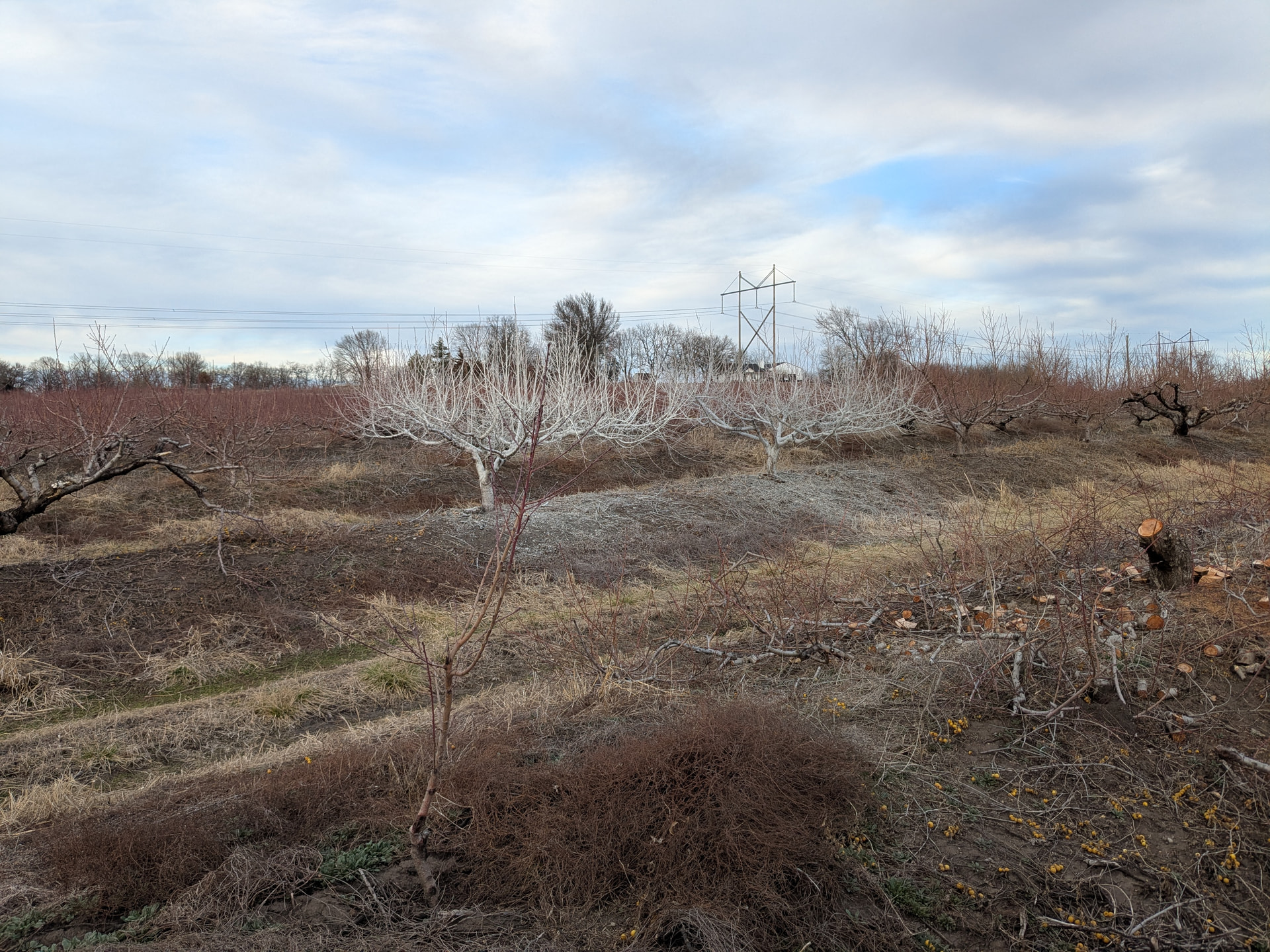
Here’s a pic of a couple trees I painted. Up close they actually look pretty cool, but I don’t have a real close up pic right now.
Up here in MT we had a long spell of 50 degrees temps in January that if slightly longer would’ve caused the trees to bloom. Now of course it’s back down to 15 degrees lows regularly. It seems the trees passed the test this year, barely, but painting and/or shading the stone fruit is getting tempting. I’m a little hesitant as my trees are backyard trees and have landscaping value too.
Somehow I missed this thread earlier. Delaying bloom by a week would be very useful in my climate. We have a predicted low of 22 coming up Monday, probably our last freeze of the year, after a couple of weeks of warm weather. Some of my trees will be in full bloom. This is an issue nearly every year.
I’ve never had blossoms killed by frost here in the PNW, but I this thread gives me an idea. I have a yellow fuzzy female kiwi that blooms too early for proper pollination because my only male is a green fuzzy. If I can delay the female’s blooming time by a week or two, they would be a better match. I can’t spray because the female vine is growing on a trellis right on a south-facing house wall; so, I think that I’ll try shading the female vine.
Under most conditions I’d also doubt two weeks delay What would be even more effective is evaporative cooling. But that’s difficult to implement, takes a lot of water, and may result in excessively wet soil. The idea is to keep the buds wet by misting or spraying in spring whenever the air temp is above about 40F.
Given the date of the publication, the “whitewash” they refer to was probably a traditional limewash, like the one used by Huck Finn.
Hydrated lime is still used in some areas for coating fruit trees. Latex paint mixtures are probably safer, but limewash may offer additional benefits beyond latex paint, and it is definitely cheaper.
Milk (casein) glue was often added to limewash as a sticker, similar to traditional milk paint, to improve adhesion and durability.
I am in the Eastern Panhandle of WV, Zone 6A, and we have a terrible time with late frosts. I’ve brush painted the trunks of my fruit trees, from ground to first branches, with heavily diluted white latex interior paint for several years in an attempt to delay bloom. I don’t know how well it works. Last year the entire crop of apples, pears, cherries and pawpaws was lost due to late frost!
The theory behind painting the trunks is that it is supposed to cool the trunk and delay the sap running in Spring. On a late Winter sunny day I’ve put my hand on the unpainted trunks and they were almost hot to the touch on the sunny side, whereas the painted trunks were cool. Again, how much the paint delays bloom is questionable, but it was free and took about a half-hour to do the entire orchard, so at least it wasn’t an expensive or time-consuming mistake.
I would be interested in your results since I did not do a control sample to see what effect the paint would have.
I’ve wondered about that Steve. On the one hand, both white paint and shade should keep the sun from directly hitting the shoots/buds. But most shade cloths let some sun through. One could cover the trees with black plastic to prevent any sun, but I wonder then if the temp below the plastic would be kind of warm?
I’ve honestly no idea what shading or painting will do. Definitely room for experimentation there.
Would you mind elaborating on this. What is the reason for some growers using hydrated lime on their trees? Is it to delay bloom? I didn’t know growers were still doing this.
Do you know anything about the mixture rate and how much casein as added?
In the areas that still use limewashes, they’re done primarily as part of a pest management program and to prevent sunscald.
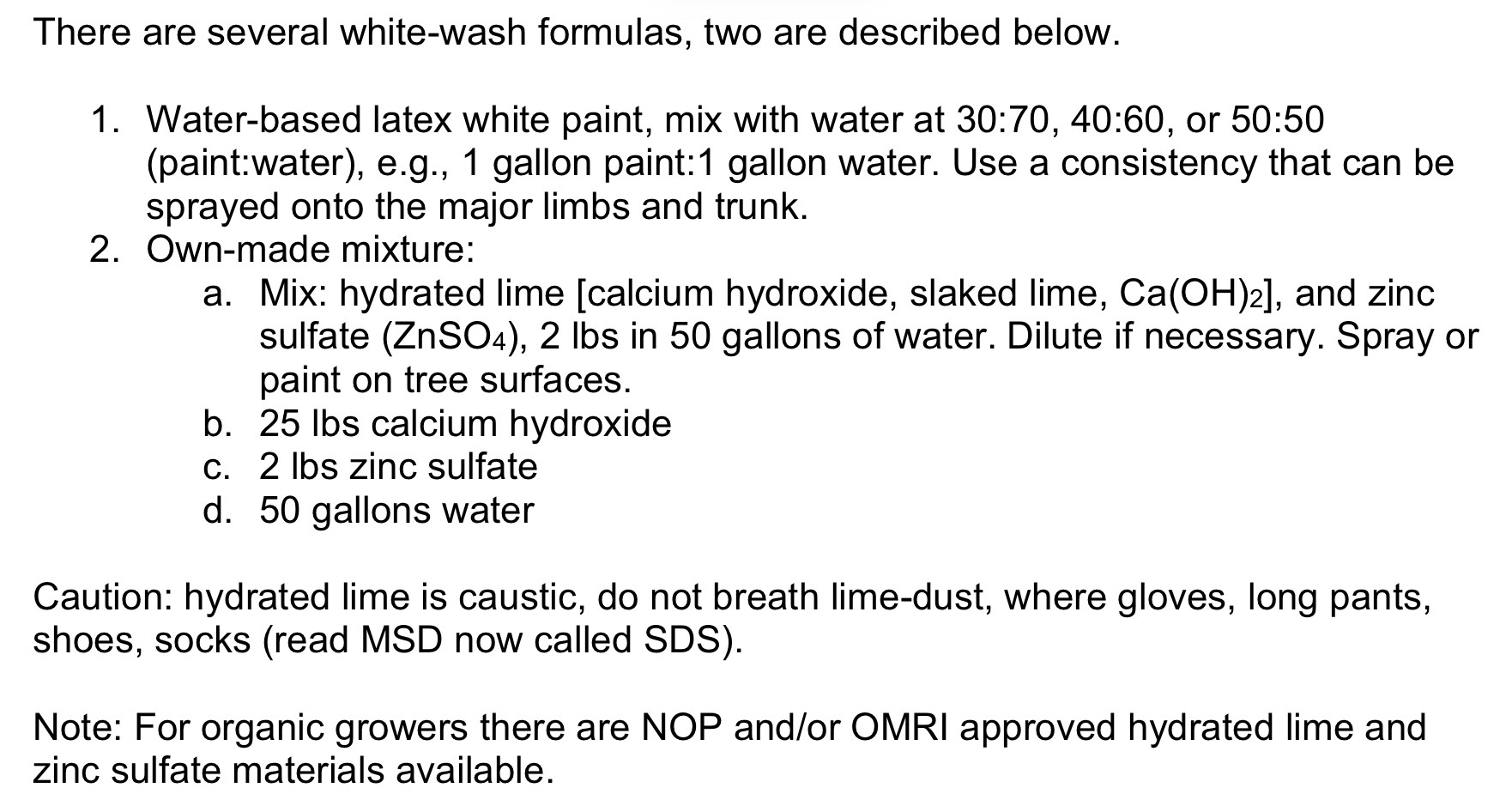
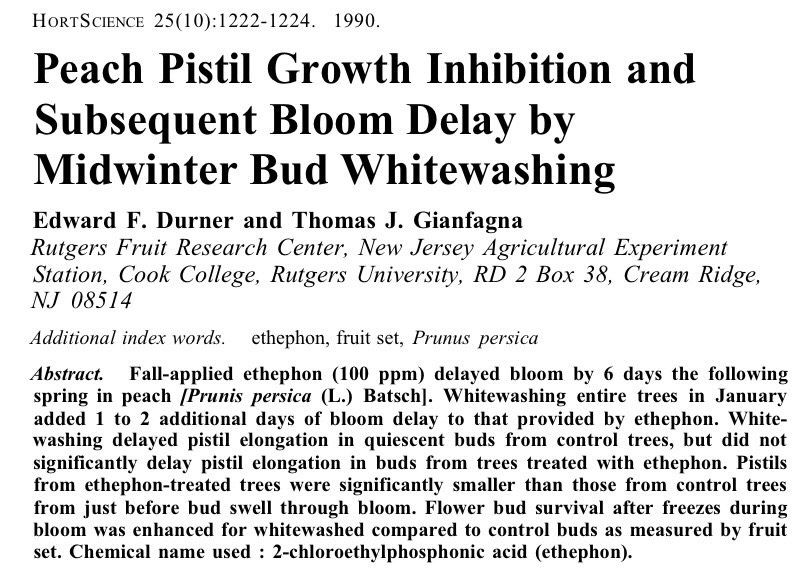
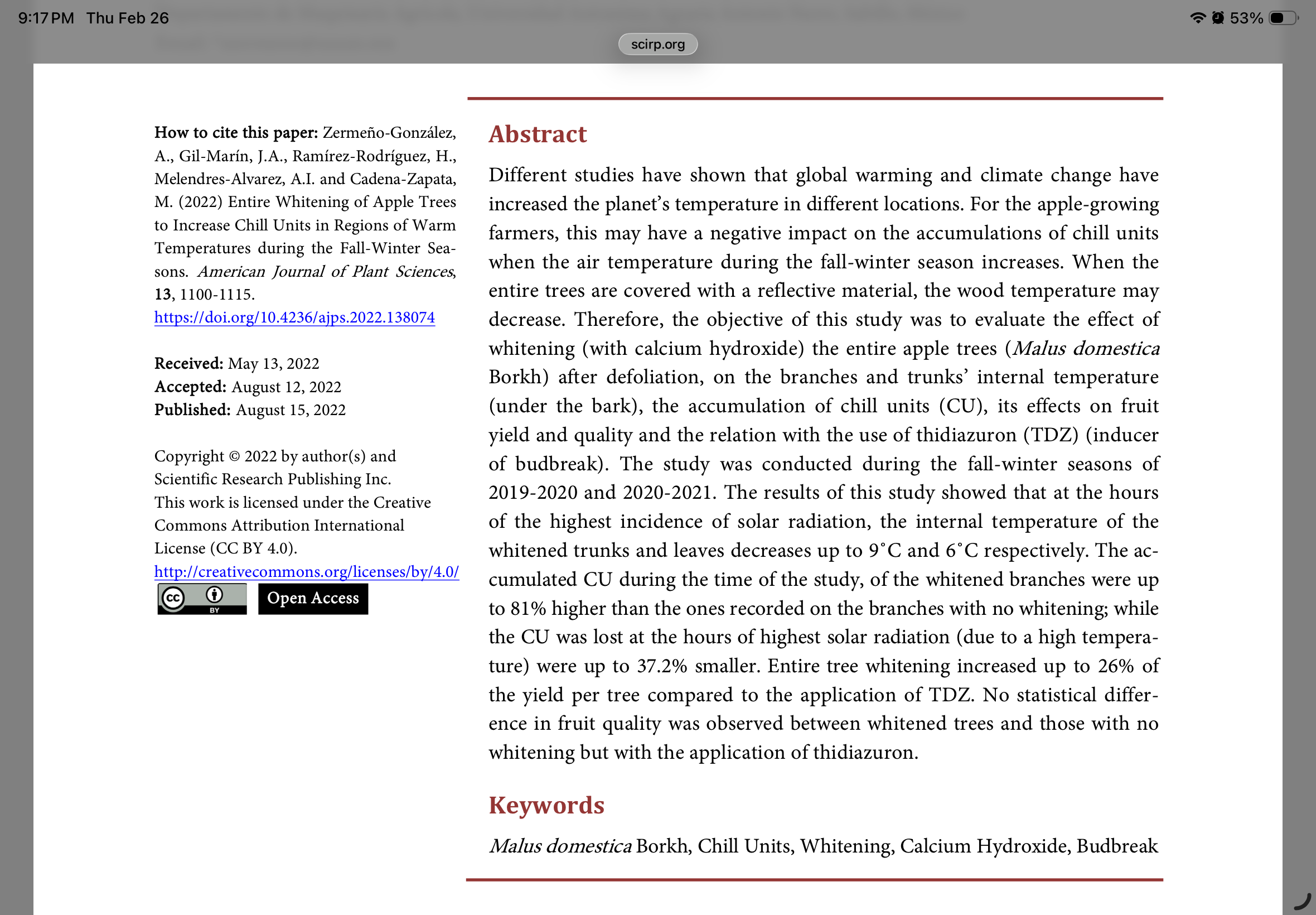
I don’t know of anyone using it specifically to delay bud break, but the studies below are relevant. This whitewash formula is from the University of Florida, but I’ve seen a couple of other universities list the same formula.
As for casein glue, the Amish are the only ones I’m aware of that still use it as a sticker, but it used to be incredibly common. The publication Scott posted was from early 1900s, so my guess is the whitewash they used was probably lime-based with casein as a sticker—which is essentially milk paint, which was also common back then. For use as a sticker in fruit tree sprays, most antique extension publications I’ve seen use around ½ lb of casein glue to 100 gallons of water.
Edited to add the first study is done with latex paint, the second with traditional lime based whitewash.
The goal should be to delay the buds not the sap. The bud flower with there stored energy the sap takes over to sustain everything after. So if your only painting the trunk you might create a differential between the buds and sap.
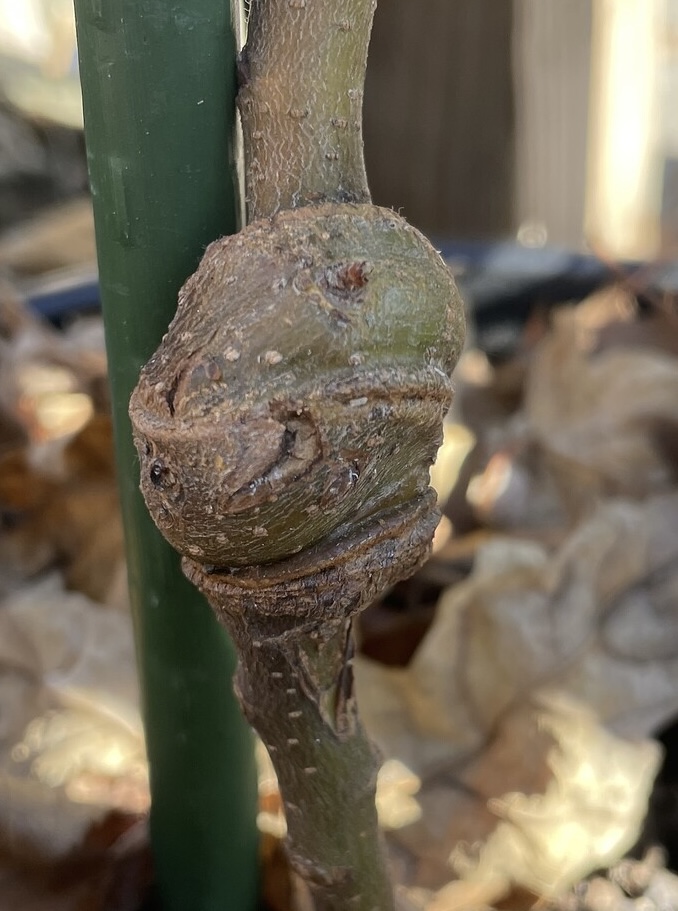
This is slightly off-topic, but phloem interruption (girdling, bark inversion, knot-tying) may delay bud break. A couple of years ago, I tied several Mulberry cuttings in knots to try to dwarf them. They leafed out almost a month later than cuttings from the same tree that weren’t knotted.
Last year, I tied a few Apple, Pear, and Trifoliate orange in knots to see whether the effect could be repeated—I should know the results in a couple of months.
It’s probably not a practical solution, but the effect was fascinating, so I thought I’d mention it.