I’m pulling for the paint. Spray once and be done. Easy for me with only a few trees.
2 Likes
Crazy warm here this winter/spring. I am in N. AZ at 6000ft. Too late for me to try this now with daytime temps in the 70s. Normally day temps are in the 50s and nights in the 20s. Late frosts are sure to come. Will follow this.
1 Like
CHAT suggests that getting adequate paint on the important small wood it not a simple project and that you cannot just put diluted latex paint in a conventional sprayer. I don’t know if this is true, but I’m curious about the results of anyone trying this. I suspect Surround might be the ticket and I’d like to read of someone’s controlled experimentation with it.
The Rutger’s experiment’s main positive result came from ethphon, which is not even legal to use for this purpose.
1 Like
Any special kind of sprayer for this? Fairly easy to clean latex paint out of sprayer after job? Put anything in the paint to make it easier to clean out- like a bit of Dawn detergent, etc?
1 Like
The main question, it seems to me, is whether you can get a good coating on the fine wood that matters?
When trying to spray diluted latex paint onto trunks for SW sun damage protection, I found that it would plug up the hand sprayer. I ended up using a dish detergent bottle. It was messy and somewhat wasteful, but we got the paint for free at a recycle place.
1 Like
Well, you can, and I have, but…
Even diluting the paint with an equal amount of tap water, does not make it really thin enough. And there’s the lumps. I pour the mixture through a paint strainer bag, but the nozzle continually fills up, and I have to back-wash it. I’m thinking the latex coagulates there. Perhaps there’s so much solid material that it separates due to the centrifugal motion of the fluid in the nozzle. I am able to make progress, but it’s really frustrating at the same time. I have the same problem with Surround™.
Use a hand-pump sprayer, not your best electric-pump model. Also, sprayer-cleaning detergents are probably not sufficient to cut the latex residue and, in fact, seem to cure it.
3 Likes
I read carefully the article “Peach Pistil Growth Inhibition and Subsequent Bloom Delay by
Midwinter Bud Whitewashing” Edward F. Durner and Thomas J. Gianfagna.
They used white interior flat latex wall paint with 2 parts paint to 5 parts water and sprayed the entire tree Jan 18th. The trees were first sprayed with Regulaid (0.1% by volume) on the 17th of October to act as full controls since they were also trying something called ethephon which was sprayed with the Regulaid on Oct 17th.
The whitewash delayed bud swell, pink, and what they called “balloon” by 2-3 days. The whitewash did not delay full bloom. HOWEVER, the exciting part is that they had several freezes during bloom and the whitewashed peaches had more fruit set: 0.05 fruit/cm for control and 0.09 fruit/cm for whitewashed.
This article is hilarious because they don’t really measure the thing we all care about directly - In the end, how much fruit was produced in August (or july or sept or whatever)?!?! They use a lot of proxies. One of them is pistil length. They have a theory that shorter pistils are less likely to be damaged by the cold.
They have a follow up article a couple years later where they actually looked at yield. Whitewashed trees did better (12.1 kg/tree for whitewashed and 5.3 kg/tree for controls).
Their findings were sort of alarming because they tested dormant oil as well in this study and found it reduced yield.
The dormant oil was applied March 5th (8% by volume). It was “Sunspray 6E,Sunoco Oil”. There was no significant reduction in fruit set or blooms or anything but there was a reduction in the number of fruit per tree (“12.2 kg fruit per tree for controls, 5.2 kg fruit per tree for single application of oil, with 84 and 29 fruit per tree, respectively”). 8% oil by volume sounds like a lot to me - and maybe that was part of their issue.
5 Likes
Here, what I need is a way to reduce peach set over 90% of the seasons. Supposedly hort oil during bloom can knock off a lot, but not when I tried it… I think that was based on a report by UC Davis and might have been the result of oil sprayed when temps were in the ‘80’s. If oil can damage leaves in the lower ‘90’s I’m not surprised it would destroy ovules at considerably lower temps.
In my nursery I wish I had a practical means of eliminating flower buds on every species I grow. I didn’t expect the hort oil to work because if it did it would be widely used in the nursery trade. The reason the UC Davis guys didn’t realize this might be because they are academics  . They don’t spend enough time out of doors with their trees.
2 Likes
Surround is used on the West Coast for chill hour accumulation in pistachios and cherries. I believe the guidance says not to spray in February, since it may delay bloom. I’ve read up to two week delays are possible. Surround is also breathable, which probably helps release trapped heat.
I still think limewash or calcium carbonate would probably be more effective at delaying bloom. In addition to being breathable and reflective, they also have microcrystals that can scatter incoming light. This reduces the amount of energy converted into heat, keeping the tree cooler. Calcium carbonate, like Surround, is sprayed to help with chill hour accumulation.
I think @benthegirl got that study right — one benefit of the latex paint was protecting blooms from freezes.
1 Like
This is so interesting. The effect of the dwarfing or delay would be expected to be perpetuated and not a just a one time thing the year it was knotted?
Did you break any trying to knot them?
1 Like
The dwarfing effect persists for multiple years, and any potential delay in leafing out likely does as well. This effect is caused by a disruption in the normal flow of sap. I believe it will continue until the branches naturally graft together through inosculation and sap flow returns to normal. In the example pictured, I probably should not have pulled the knot so tight; instead, I should have left a large loop on the side to prevent or at least delay inosculation.
All of this is based on the research of Dr. Karl Sax. He found that when apple trees were looped in this manner, they could be significantly dwarfed—after five years tied in a knot, the trees were only half the size they otherwise would have been. There is also some debate about whether this technique induces earlier fruiting.
When I first began experimenting with knotting, I broke many seedlings and cuttings. Now, I can usually do it without breakage because I have a better sense of when the wood is about to snap. Seedlings and new growth are much easier to work with and may even be possible to knot in a single day—by bending the shoot in the morning and completing the knot later that day. Most of the time, however, I have needed to finish the knot gradually over several days to a week or two. I typically tie a string around the end of a branch and slowly pull the branch into position.
Dr. Sax also found that inverting one or two rings of bark and grafting scions backward can produce similar effects. Girdling may work as well. I have never tried bark inversion, but I have intentionally grafted mulberry scions backward. The growth was so weak that I eventually cut the scion off, flipped it right side up, and regrafted it the following year. As a result, I cannot say how the technique would perform over the long term.
In Dr. Sax’s research, I did not see any mention of delayed leafing out, although that was not the primary focus of his work. It may be that this effect is enhanced—or only occurs—in species with particularly heavy sap flow, such as mulberries. It will be interesting to see how the other tree species respond when they leaf out this spring.
2 Likes
That is fascinating. If you have pictures of the process and others, could you start a thread about it? I would love to follow this. Makes me want to grow out some seedlings to experiment.
1 Like
Sure, once the snow melts I’ll take some more pictures of the ones I looped last year and make a thread about any potential delays in leafing out. I grew out seedlings to loop this year, so I’ll try to take pictures of the process as well. I don’t have much to report right now though.
1 Like
I seem to have gotten a pretty good coat on the shoots. But I was using a Rears pto sprayer with continuous mechanical agitation, and an adjustable wand.
I think the research Michelle Warmund did was using an airblast sprayer, but I may be wrong. I can’t imagine getting good coverage with an airblast sprayer. Plus the small nozzles would be much more prone to getting clogged up.
If I were going to try to use a pump sprayer. I would use a very large nozzle.
4 Likes
With only a few trees to spray I will use a cheap 1 gallon pump up sprayer. It might be a 1 time use and dispose.
1 Like
Yeah, now that I think about it, peach shoots are straight and smooth and shouldn’t be difficult to completely coat. CHAT couldn’t formulate that reality.
Of course, it would take a delay of at least a week to generally make meaningful difference and there are even year when frost spares the earliest blooming peaches because once swelling gets to a certain point, later blooming varieties can, for a short time, be more vulnerable to freeze damage than early ones.
I hope a member that tries this leaves a control. I will wait for results before considering it.
1 Like
That may legitimately be the case in your climate, but it’s not been the case here, since I’ve been growing peaches.
The university tables all show petal fall as more freeze susc. than bloom. That’s exactly been my experience. Post bloom, the ovules just freeze and fall off easier than during bloom.
Here is info from WSU which is quoted all over the internet (including MSU’s tables). You’ll note that column 7 (post bloom) is more sensitive in both the old standard temps and the WSU research.
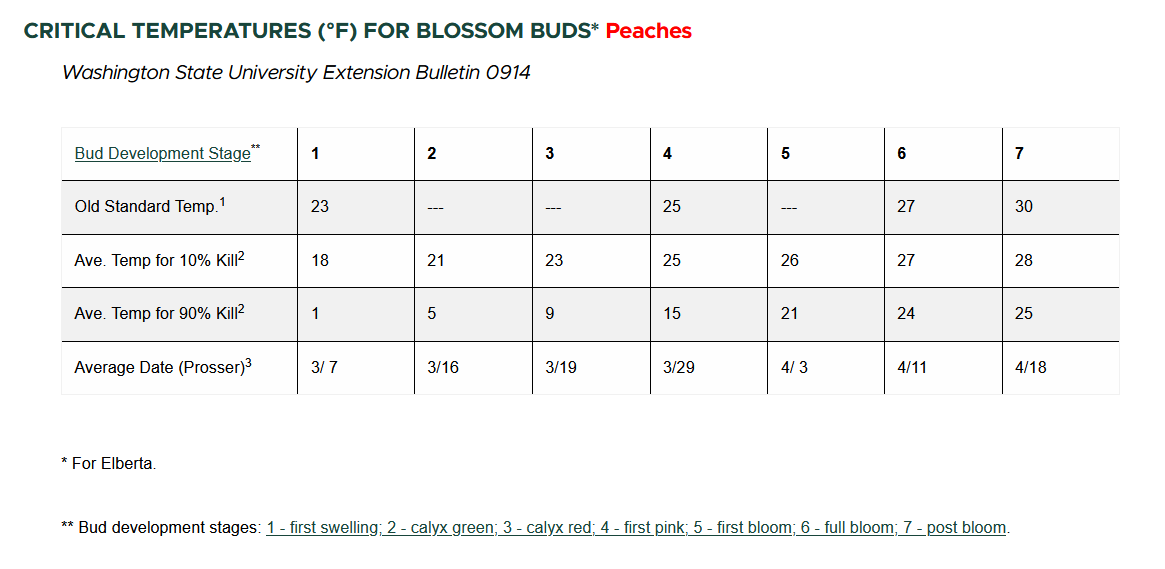
I am aware that once the fruit gets a certain size it can be less susceptible to freeze damage. I asked chatgpt what size that would be (since I know you are fond of that platform) and the bot said somewhere around 3/8” to 1/2” size fruit would be where the freeze resistance would surpass freeze resistance at bloom.
It’s never happened here since I’ve been growing peaches, but in full disclosure, I did have someone in this area that it happened once here (before I was growing peaches). Apparently a very very late freeze occurred and the fruitlets were large enough their size protected them from the freeze.
I’ve been growing peaches here for about 20 years (about 15 at some commercial level) and a freeze that late hasn’t occurred during that time. So I think pushing bloom back does have real value here.
I don’t know if you saw it in my post, but I do have controls of the same variety on each of the three varieties I painted white. The biggest flaw in my “trial” is that the sample size is so low. But if there is a big visual difference in bloom time, I think that will perhaps give me encouragement to try with bigger numbers.
I’ll admit the research @AdamNY posted kind of puts a damper on my hopes. I’ll just have to observe the trees to see if there is any visual difference.
4 Likes
My first “real” job was working for a very well respected orchid grower. At the time, he had been growing orchids for over 60 years and still refused to have anything but glasshouses. The problem with growing orchids under glass is that they need diffused light. This is where I learned about shading with white paint.
Every spring, as soon as the weather was going to be nice for a few days, we would clean the greenhouses and get them ready to paint. Painting was done with a standard power sprayer pulled behind the lawnmower. Nothing fancy. We never had clogging issues or trouble with the flow rate.
I think the reason it worked for us was the dilution rates and the fact that Mr. Lines always insisted on new paint, even if there was some left from the previous year. We diluted at a ratio of 8:1 water to paint. It sounds thin because it is. It still shaded the greenhouses exceptionally well, though, and it never clogged the sprayer.
If I were to try shading trees, I would start there. If I need more coverage, I could always make another pass. I suppose one could play with the ratios some, but keep in mind that the paint has to be pretty thin to flow through conventional spray equipment. Otherwise, you might as well invest in paint spray equipment instead. That’s what is designed for the thick mixtures.
Just my thoughts!
5 Likes
Spray only the flower buds? In what dilution? thanks