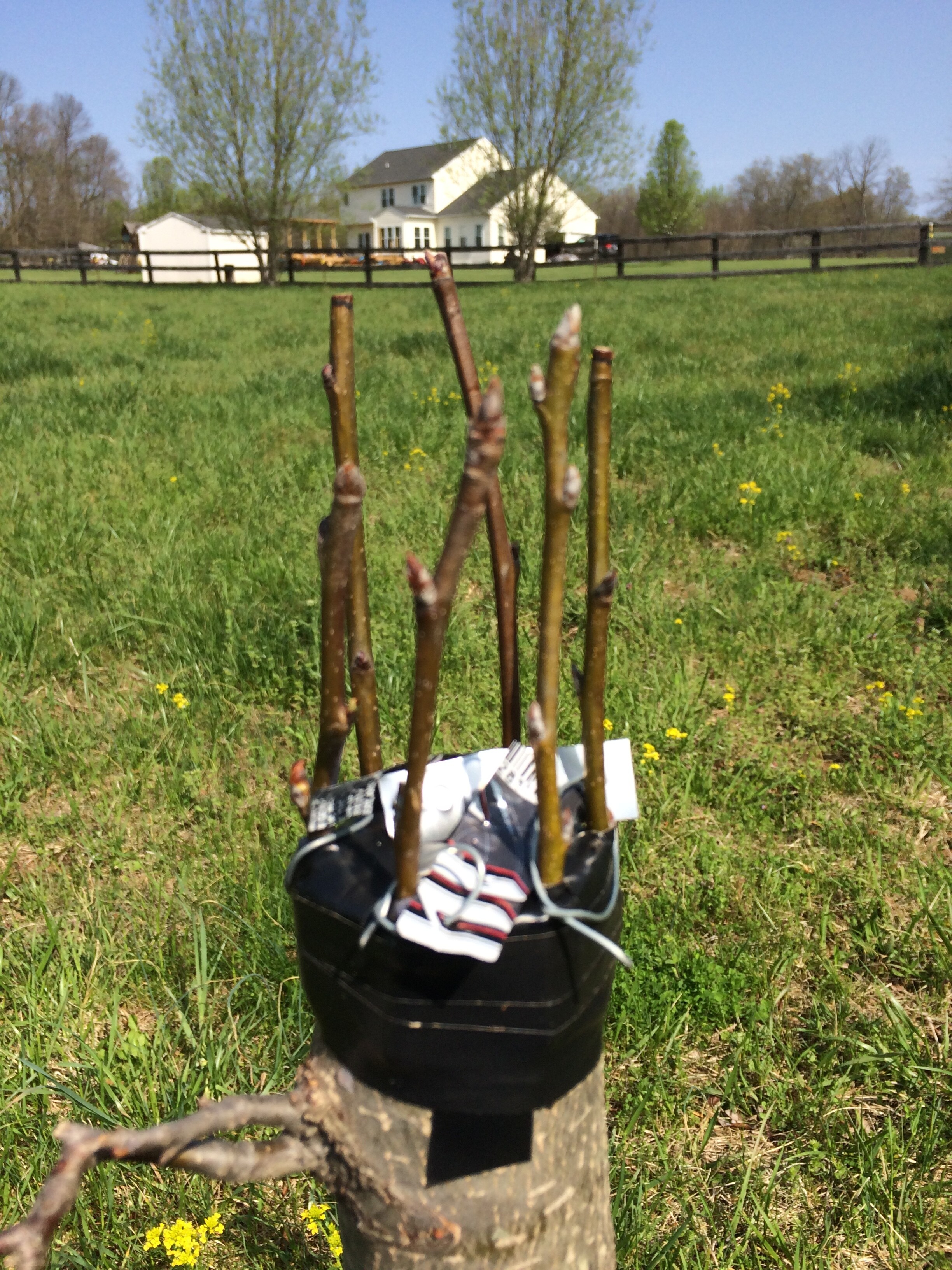
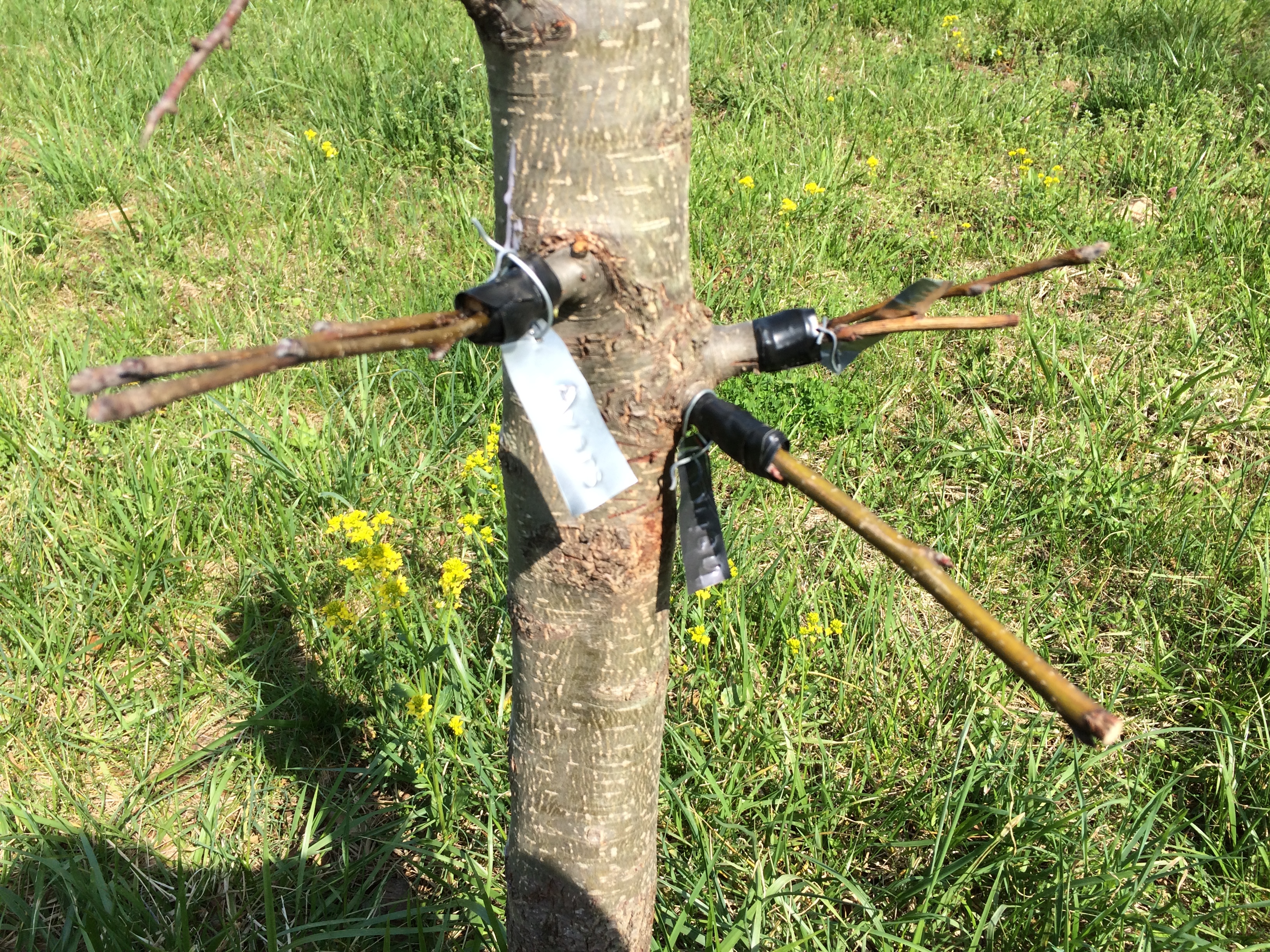
You need to use the electrical tape to wrap tight around all the scions 5 or 6 times to keep them from drying out and prevent rain water from rotting your Grafts. Do it ASAP. If it has been like that for a few days then I would redo them by down further on the rootstock.
Thanks, Tony. I did wrap around (phone died before I got a pic) but didn’t wrap the cut surface of the rootstock. I will do that today. My little handsaw for cutting the trunk is either poor or my skills are poor- probably a combo😐 so I’m not anxious to try to cut that trunk again until I buy a better saw.
Are you talking about the Bartlett pear sending out all these thorny suckers? Does the Callery rootstock ( when grafted on) do the same thing with all the thorny suckers being sent out?
I have wild callery that have larger fruit 3/4 inch . Someone else had some also . Some suggested a Kiefer cross . I got researching hardy rootstocks and found Harbin / pyres Ussarian mentioned as used for flowering pears . I got to wondering if perhaps a flowering pear died back to the rootstock . Providing a pollinator for the early Bradford types . Harbin has larger fruit . No way to know for sure . Bradfords have been in bloom for a week or so and some fruiting pears are starting . Including a Asian pear orchard a few miles away . These seem too late to be much good as pollinators for Bradfords . Just thinking .
Looks like its been 18 days since your graft…just curious if you’ve seen any signs of life? Probably too early there.
BTW…please take @tonyOmahaz5 ’ s advice about bracing those that you stump grafted. I did 2 stumps almost exactly like yours looks and was thrilled when they took off…and took off they did! They got to almost 3 feet long but I wasn’t smart enough to brace them (for example, drive a long stick in adjacent to the stump and tie your grafted scions to it). Sure enough, the wind took them out one by one. The last one was really callused in and I thought sure it was solid enough to not need bracing…wrong. I lost them ALL,. So just keep it in mind. It really hurts when you get the hard part (the grafting) to work and then loose them due to something so simple. Good luck…keep us posted (with photos if possible.)
Hey clarklinks I did more research and now think these larger fruited wild pears may be pure Harbin . I found pictures of fruit that look just like what I have . Found a taste description that says astringent which mine are . It seems the fruit descriptions are mostly about the improved selections . Mine seem to be unimproved . My fruit is 3/4 to one inch . One description of wild type says 35 MM . So a little over a inch .
Thanks for checking! I looked the day before yesterday and saw no progress or growth that I can see. Some scions are looking like they’re drying out I will look again today and take pics!
We are all pulling for you! If they look wrinkled, you’re probably in trouble. But even if none of them make it, don’t get too discouraged…try it again next year and we will all try to help. But don’t give up on this year…sometimes they take a while and still come out. two weeks is CERTAINLY not enough time to say for sure that they won’t still come out. Photos might help us judge their progress so I hope you do post some.
BTW…you actually inspired me to graft some bradford pears! There were a couple in my yard when in bought my place in 2012, so they are full sized trees. But I’ve always hated them because 1) they are just shoddy trees (Brittle,wind catchers that often break) 2) They don’t produce edibles, 3) They stink when they bloom (maybe its just me but I don’t like the smell), and so on. I’ve always wished they were gone but didn’t want to have huge empty spaces in my front yard for the next few years until I could get a fruit tree to size up. After seeing your posts and efforts, I decided on a new strategy. Those pears have lots of root suckers, so I selected 3 small ones that are about 1-3 feet from the trunk of the main tree and grafted them. The idea is that I’ll leave my big trees in place so my yard has (fairly) big trees, and at the same time I’ll let the newly grafted root suckers grow for 1-3 years so when I do cut the big ones, I’ll have new FRUITING trees well established and of some size.
Not sure why I felt like describing my long term landscaping plans to you in such detail (ha) but I’m afraid you’ll have to get used to my rambling posts-most people here are pretty tolerant. haha. The point is, your efforts inspired me to do some callery pear grafting myself, so I hope we both have some success!!! Good luck.
Don’t worry, I understand the urge to ramble about your tree plans. Whenever I do that at home my family’s eyes glaze over, so this is really my only outlet for that stuff.
I literally laughed out loud when I read that post and I appreciate it more than you will ever know. I’m sure people here must think I am a constant talker in “real life” who never shuts up and dominates conversations but it’s almost the opposite of that. I’m actually a pretty reserved, quiet guy who is a better listener than talker. That honestly is the truth. Really! But EXACTLY like you said- none of my friends, coworkers, family ever wants to talk trees, so this is my only outlet. That’s why, while I have an audience who shares the same interests, I tend to talk way, way too much! ha. So the patience and forgiveness you and others have shown to my long winded posts is much appreciated!
I’m so excited for you, Annie!!! Isn’t it just so exciting to see that new life that you (sort of) created come to life? Problem is, you now have the disease/addiction to fruit tree growing and especially grafting. Don’t fight it. You’ll find yourself closely inspecting those grafts at LEAST once a day and often more! haha You;ll be telling people you know who could care less all about the new tree you “made” and how good its doing. You’ll be spending even more time here with like minded folk. You’ll be buying tools and trading or buying more scion and/or trees. Yes, my friend, you’re life is about to change…all because you basically just stuck one piece of wood against another piece. That’s how easy it is to catch the disease/get the addiction. You have my congradulations and my sympathies (its not all rainbows and lollipops and some days you’ll threaten to cut them all down).
Ha!! True, I’m sure! I’m excited to see new life and also keeping in mind the potential fragility and trying not to let my hopes get too high! I think I’ve read that sometimes the buds can green up from stored energy - is that right? Or if I’m see how greening, is it likely that the rootstock is feeding the scions? I’ve also read about incompatibility where sometimes the growth can occur for awhile and then stop. I will certainly keep checking and update:) thank you so much for the support and tips!! I need to give many thanks to @Auburn for giving me the scions and chance to experiment!
Sounds like you’ve been doing your homework, and everything you said is true. Scions can sprout and grow from energy within even they haven’t really connected to tree via cambium layers. But if that is the case the growth will be fairly short lived,and they won’t get very big before they wild and die. And in my experience, even though what you describe certainly possible and I’ve had it happen, the majority of scions that fail either never do anything or never make it much beyond showing a little green on swollen buds. The exception to that is the other situation you described…where you get a good deal of growth but then the tree later- for reasons we don’t often know- rejects graft after an extended period of time (can even be more than a year later). But this isn’t very common either. If you get a few inches of growth, its pretty likely that they will make it. What I want to again caution you about- and what I feel is a much bigger threat to your success than spontaneous rejection or false growth from stored energy- is the threat of wind or animals damaging or dislodging your graft. Birds love to land on the high point of a tree or limb, which would be your grafts. Many a graft has been ruined by a bird landing on them and unseating them. Also, if those grafts do take on a good sized tree like that, they will grow faster than you will believe. As gratifying as this can be, its also problematic. Having a 4 foot long stick that is attached with only a little bit of tape and whatever natural callousing has occurred in the early weeks (not much!) makes it very weak and prone to being blown off. So please find some way to brace it. attaching a strong stick of some kind to the remaining tree stump (or driving it into ground adjacent) will help both of the problems I’ve just described. Make it taller than the scions (quite a bit taller to account for future growth) and the birds will land on it rather than your graft. Then attach the grafted scion wood to the stick as a brace so it will support it in windy conditions. Good luck.

 I will look again today and take pics!