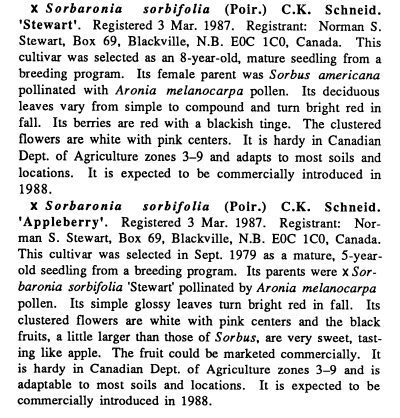
‘Appleberry’ appears to be a very cool, but highly under-documented intergeneric Aronia hybrid which despite its reportedly apple like flavor has not been widely distributed. I suspect this may be due to it being released prior to Aronia becoming popular/widely known amongst gardeners. As a way to combat the lack of information available I will use this thread to link to the few publications which already exist as well as to post periodic updates with first hand observations as my ‘Appleberry’ grows.
What we know so far: ‘Appleberry’ was bred in New Brunswick, Canada by Norman Stewart who first crossed Aronia melanocarpa with Sorbus americana and then used a select seedling from this cross which he named ‘Stewart’ to cross back to A. melanocarpa to produce the seedling which he would then select and name ‘Appleberry’ for its sweet, apple flavored fruits.
Important nomenclature notes:
The German name for Aronia melanocarpa is “apfelbeere” which translates into English as “appleberry.” However, dispite this coincidence ‘Appleberry’ as a cultivar name should only be applied to the specific clone thus named which originated as a F2 back-cross hybrid between Aronia melanocarpa and Sorbus americana with the hybrid formula being (Aronia melanocarpa × Sorbus americana) × *Aronia melanocarpa. This is a departure from other ×Sorbaronia hybrids tracing back to the breeding work of Ivan Vladimirovich Michurin who used Sorbus aucuparia to produce his back-cross hybrids.
Google gets confused - The hybrid designation ×Sorbaronia sorbifolia confuses the Google search engine which thinks it’s just a mis-spelling of a different species called Sorbaria sorbifolia. If you would like to use an internet search engine to find published info about ‘Appleberry’ I recommend using “quotes” around “Sorbaronia” to ensure Google doesn’t just show you search results for “Sorbaria” instead.
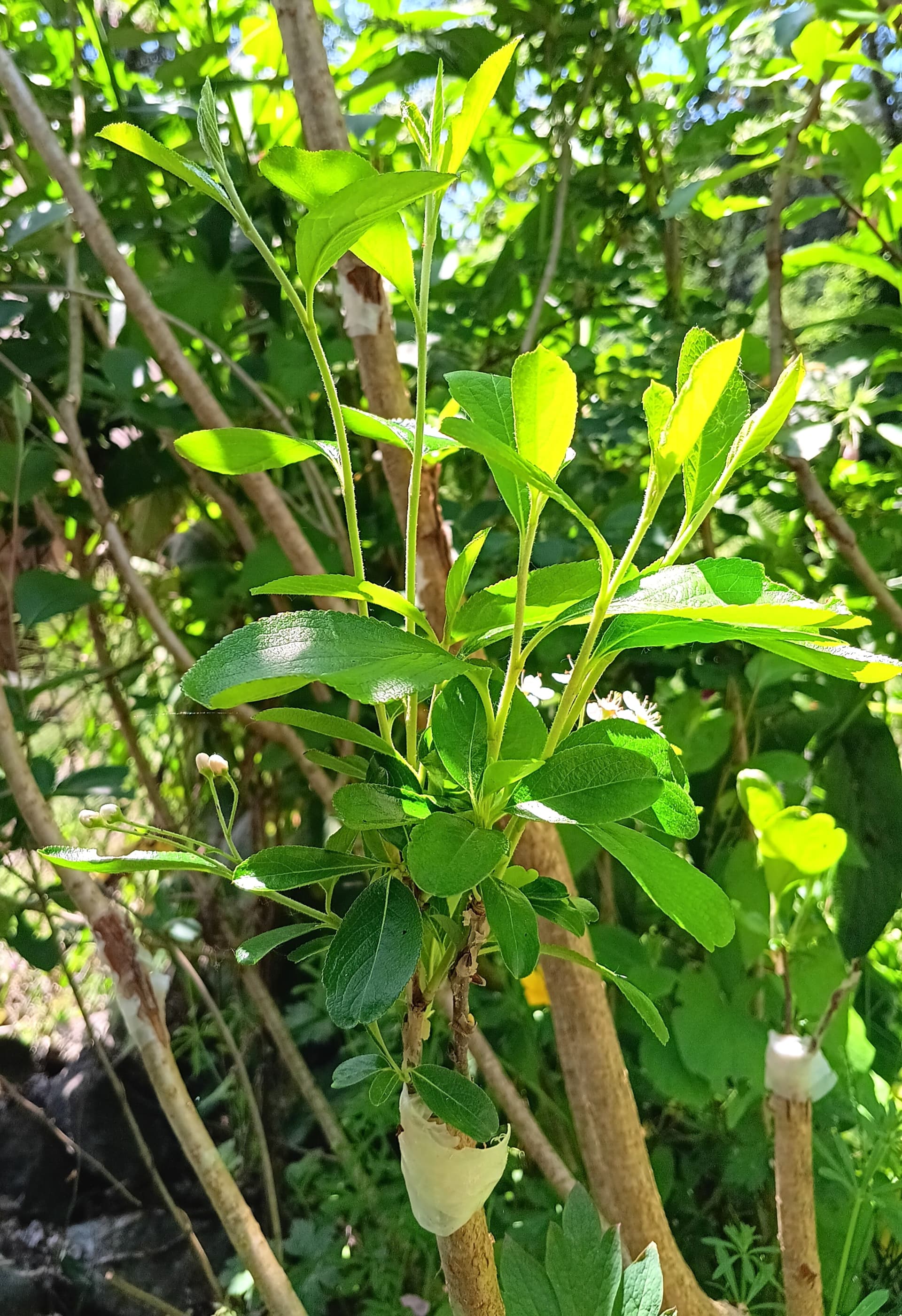
I’m happy to report that the good folks at the USDA made an exception for me and sent me scion of ‘Appleberry’ this year (which I appreciate greatly). Though this scion was VERY thin and short, I was able to get grafts to take on both ×Sorbaronia mitschurinii and Aronia melanocarpa rootstocks. Most of these grafts have not grown much yet (probably due to most of the buds being fruiting buds instead of vegetative buds), but a couple are now pushing vigorous growth! Almost all of the flower buds aborted naturally in the early stages of bud emergence, but there are a few flowers blooming now from the scion which is pushing the most vigorous growth so I am leaving them to see if they will set fruit. The best looking of the grafts is pictured below.
Once I get enough growth to experiment with, I would like to attempt getting ‘Appleberry’ onto its own roots. I suspect that as an own-root form it would very likely become a multi-trunk, suckering shrub like Aronia. If so, further propagation could be made via digging rooted suckers. That would be a whole lot nicer than working with crazy thin scion wood!
suprised ive never heard of this seeing i live right on the new bruinswick border. if in the future you ever have a scion or 2 to share i would be very greatful. cool find!
it likely should be easy to root from cuttings. not to highjack your thread but i have a apple serviceberry i got awhile back that is setting fruit . it almost died but has come back. curious if the taste would be similar to your berry. its not a cultivar. i think i got it from cold stream farm about 4 yrs. ago.
Because of how rare it is right now, I’ll probably share some scion wood as soon as possible. I’ll update here if/when I get to that point (fingers crossed). When it comes down to it, I might have to be ruthless and prioritize sharing with people who I feel most confident in their propagation abilities (no offence to anyone who’s not experienced/skilled at grafting or rooting).
I do agree with you that it would likely root well from cuttings, but I would like to see if I can get it to push some thicker branches before attempting. I don’t think the limited stored energy in the incredibly thin branches would be enough without very optimal rooting conditions. Experiments are in order!
i have 8ft. ivans belle i grafted 4 pears to. they all took and are growing vigorously. this one should be similarly easy to graft esp. to a aronia roostock which i have a plenty. looking forward to it. anything in that family that i have, grows very vigorously here.
It appears that the source who donated ‘Appleberry’ to the USDA collection was:
Curator Freek Vrugtman of the Royal Botanical Gardens in Hamilton, Ontario, Canada
This implies there could possibly be a mature specimen of ‘Appleberry’ present in that collection for public observation if anyone is in that area (hint, hint).
I agree that it makes sense to be careful with it until you have gotten source plants established. I’m admittedly not experienced/skilled enough in grafting/rooting to be involved but will be watching for updates to see how it goes. I’m particularly curious about what the fruit ends up being like for you.
I’m super curious about the fruit too. I already have a pure Aronia selection that has good fruit for fresh eating, so I’m hoping that ‘Appleberry’ not only tastes good, but also tastes different. haha
Definitely interested here. I’m game to add it to my collection after it’s been spread around a bit further. Excited to watch your progress and glad you have it.
This is very interesting. Has this hybrid been tested in the southeast at all? Any info about resistance to fungal diseases? We grow two different species of Aronia here with very little difficulty aside from seasonal fungus and deer, but frankly the fruit isn’t anything worth bothering with as an edible… Although historically both mountain ash and chokeberry have been eaten, so the potential is clear. If down the line you ever need a southeastern testing site I’d be interested in volunteering a corner of my orchard in the name of research.
I’m not aware of any trialing having been done for ‘Appleberry’ in any climate. There’s very little info available for it as it appears not to have gotten picked up and distributed by any nurseries. As a guess though, being an A. melanocarpa back-cross, it would be most likely to do well anywhere that species is known to do well. Actually, both parents are native to quite a large part of North America, so that’s reason to be optimistic that the hybrid could be widely adaptable.