Sorry if I wasn’t clear. I have already tasted ‘Northwest Park’ the last couple years and reported on it. PI 662003/Ames 27010 is the one which I will be tasting for the first time soon. That one is different from ‘Northwest Park.’
Not my colleague, but a curator with the USDA collection. PI 662003/Ames 27010 is the one he said was the only one worth eating.
Well, that makes me even more excited about procuring that one! I sourced my Aronia cultivars from Ken Chance at AFFN. They are doing great work. In the notes on the cultivars, they noted that both AMES 30007 and PI662003 scored 7 to 8 out of 10 at a tasting at Ohio State University. So I’m feeling hopeful about both of them.
And I didn’t even know about the existence of the apple berry cultivar until reading your thread. Thanks for dropping me a breadcrumb trail.
Similarly to you, I’ve found that Aronia is incredibly tenacious in its growth. I’ve planted a zone in my orchard that is wet and boggy and they are thriving. And I also planted a redundant set of the cultivars at the very top where it’s sandy and gets very dry. They are doing fine in both locations, although I’ve noticed a larger fruit set when they have ample water.
Although they seem to strike fairly easily from cuttings, I’ve found that stool layering is the easiest way to propagate new plants for me.
I’m really excited about both Aronia and maqui as berries that could make a huge difference in human health when consumed regularly.
Had a few berries last year. Not impressed but maybe I didn’t let them mature enough.. Of course it is a seedling so not the original 662003 plant.The bush has berries now so hoping they will be better this year.
They only had PI 662003/Ames 27010 available as seeds, but it’s a tetraploid selection which means most of the seedlings should be clonal. What percentage are clonal is what I don’t know, so I will be comparing the five seedlings I saved to make sure they’re all indistinguishable before doing any further propagation (which will be by cuttings rather than by seed). I did cull a couple seedlings after the first year of growth since they looked slightly different from the majority (indicating they might not have been clonal), but the five I kept are all aesthetically indistinguishable and the fruit set looks very uniform between them all. I have tasted a couple almost ripe berries and while they don’t taste ripe, they do have more sweetness than I’m used to for Aronia which gives me a lot of hope for their ripe quality.
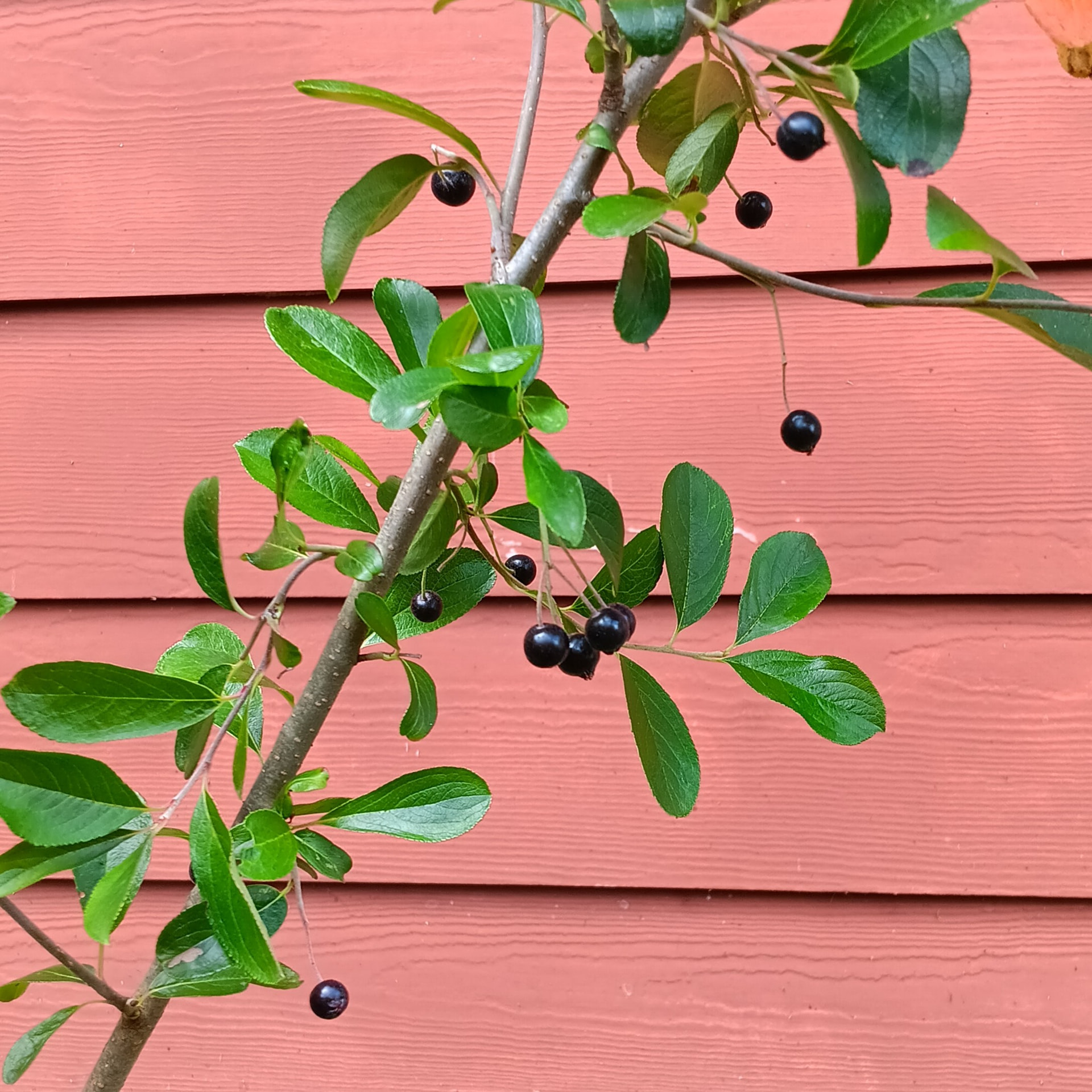
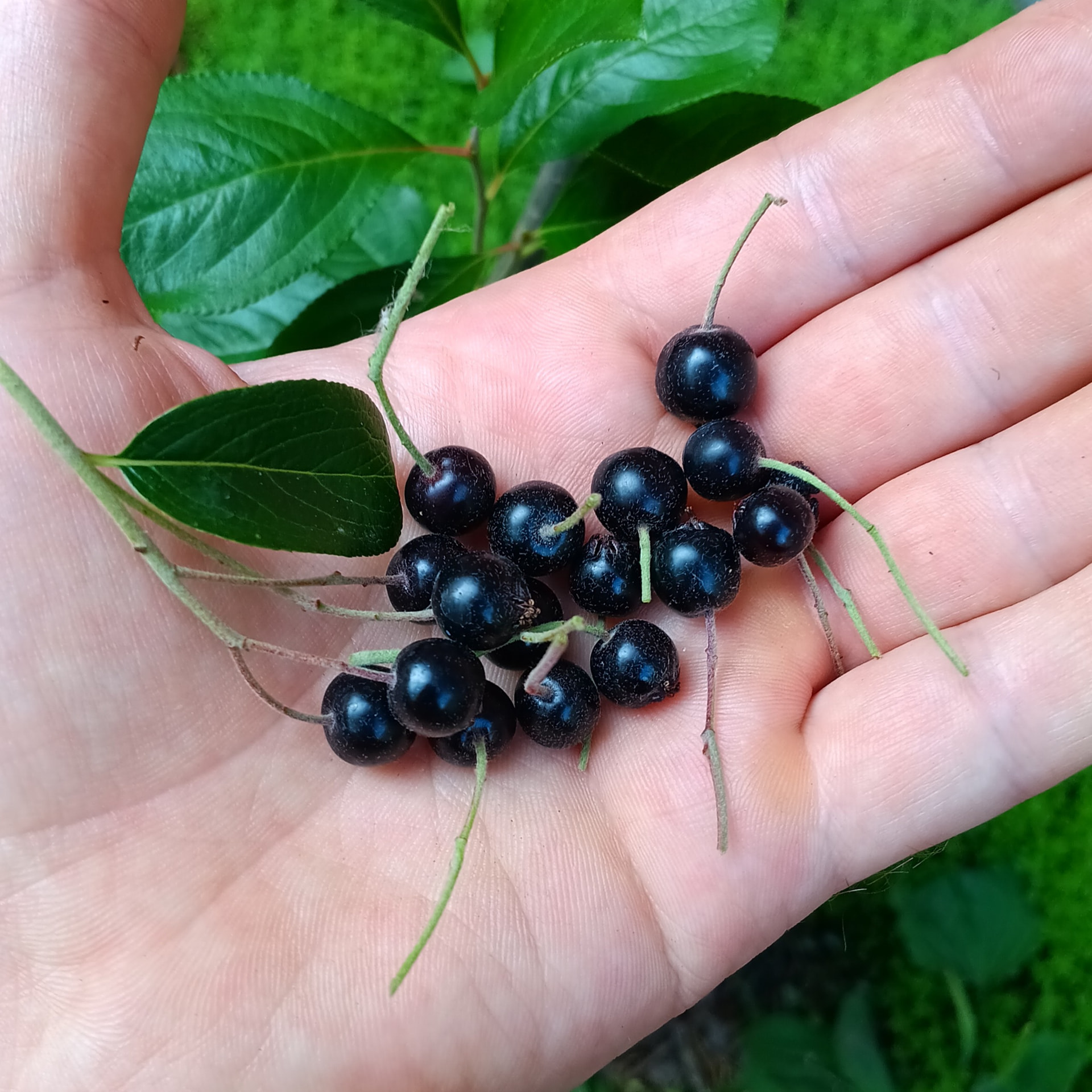
I was able to get 14 berries total off the potted ‘Appleberry’ which only had pear trees for cross-pollination while it was in bloom. Because I wanted to save the seeds, I had to carefully dissect each berry which I’m sure slighly affected my tasting impression since I was not able to eat the berries whole. The seeds appeared to be adequately mature, but their seed coats were obviously not fully darkened yet. The ripest of the berries had become somewhat purple and juicy inside, but the slightly less ripe berries were firmer, pale inside and not so juicy. Clearly I should have let them ripen a little longer for a fully fair tasting evaluation, but I can do that next year when I’m not trying to save seeds.
Because they were small, I ate the dissected berries all together at once. Their flavor had mild notes of typical Aronia, but with only mild astringency along with a slight green apple flavor. Definitely worth continuing to evaluate. I was hoping to also try berries from the in ground ‘Appleberry’, but lost 100% of that fruit to deer, so maybe next year…
I would really recommend doing an air-layer to get it growing on it’s own roots, it doesn’t even need to be big for that, you’ll just need a stick to support the peat bundle if the branch isn’t strong enough.
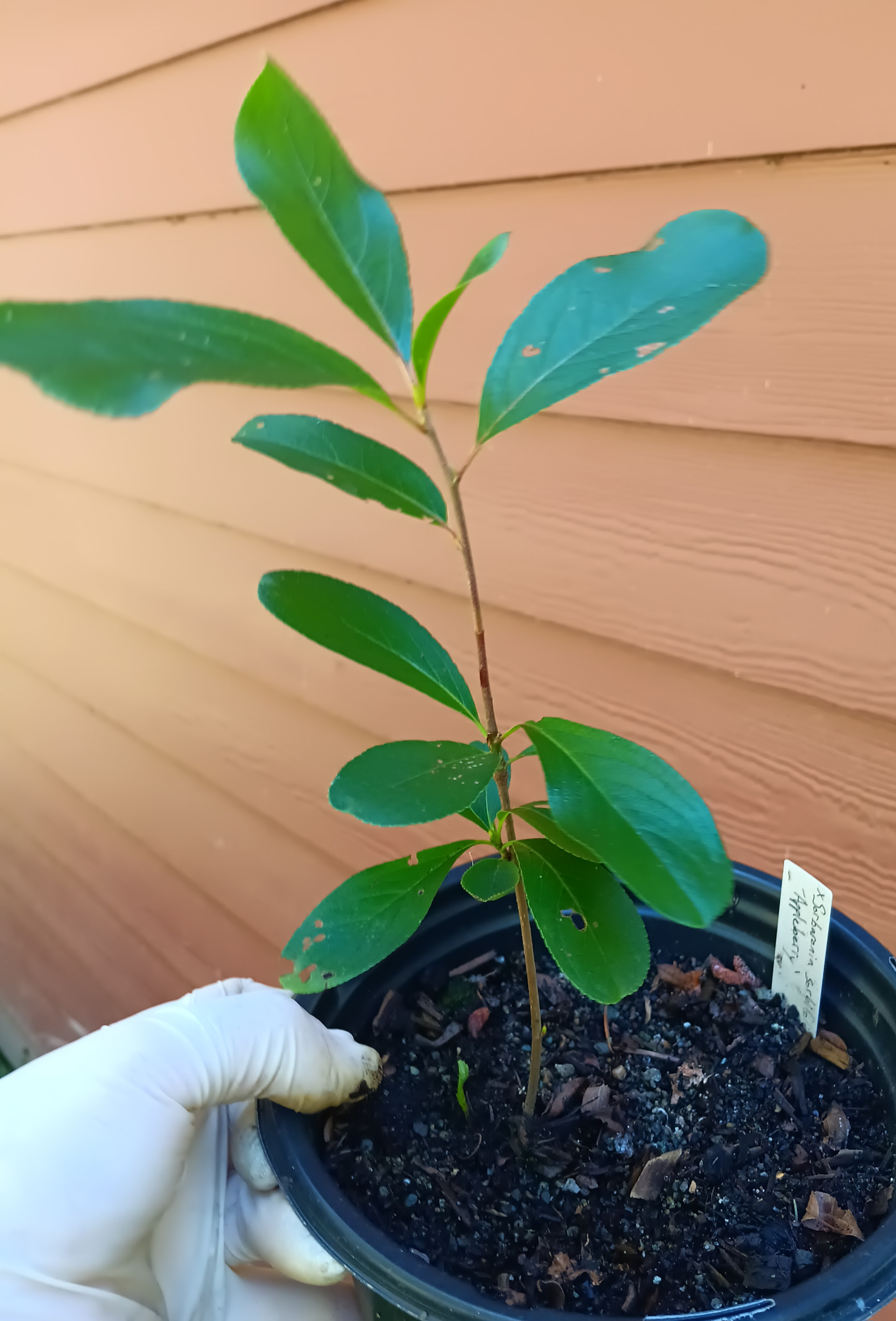
I do have a grafted ‘Appleberry’ which I buried the graft on to get it on its own roots as well as one seemingly successful rooted cutting. I’m hoping that it’ll sucker like pure Aronia does so I can propagate own root clones more easily.
Not super sweet cause they had a light tartness, but next year I won’t be so quick to pick them the moment they turn black. We shall see.
I think they could end up being good for fresh eating, but with their slight tartness they might be really good for cooking. I like to add something tart to balance regular Aronia when I bake with it.
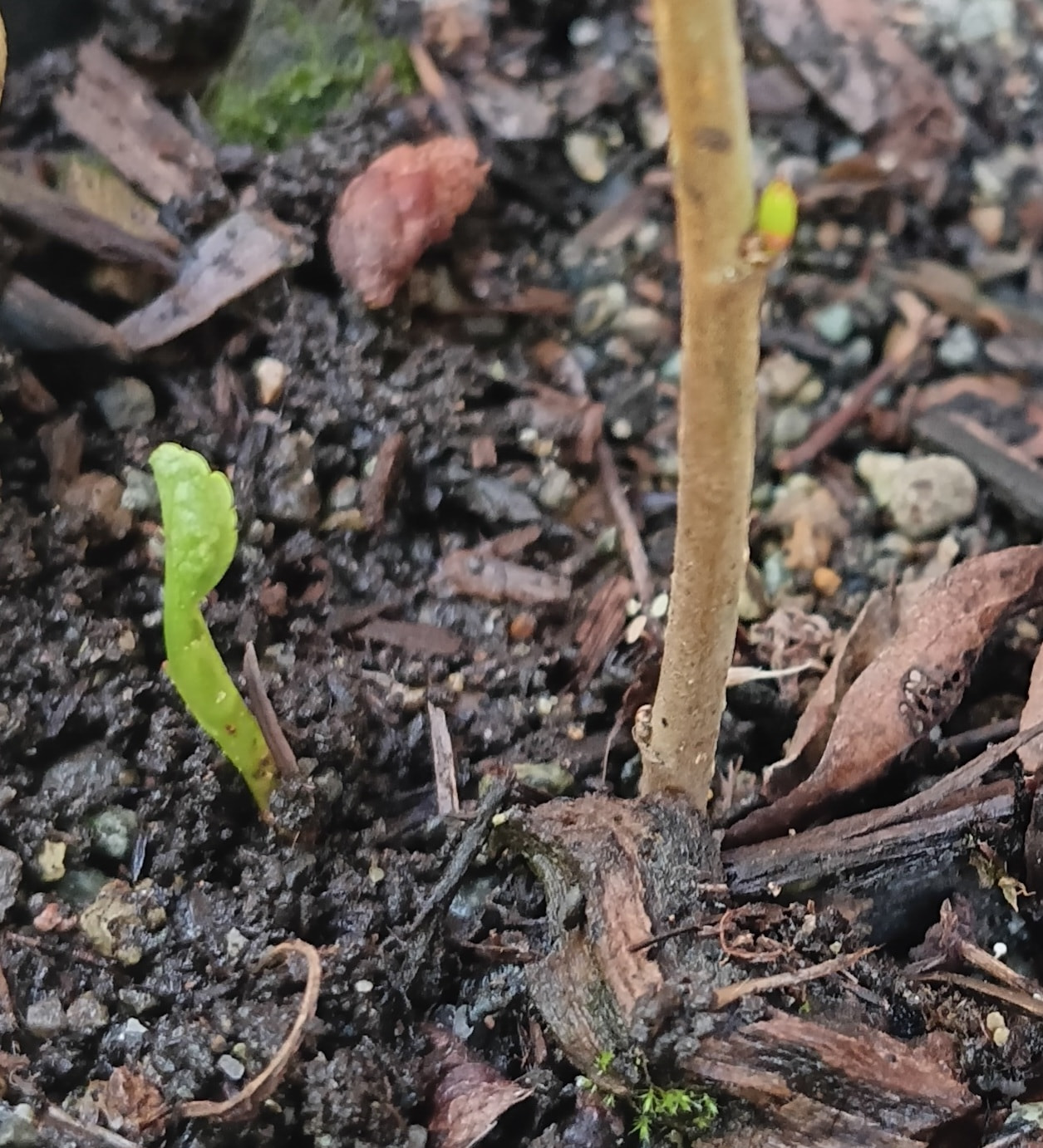
I have a positive update. Although only one out of four cuttings planted this year was able to root (slowly), I can now confirm that ‘Appleberry’ retains the suckering habit of normal Aronia, so now that I have it on its own roots, it should be easy to produce future generations of own root clones via division of rooted suckers! Of course it can also be reproduced via cuttings, but if my results prove consistent, it’s not anywhere as high a take rate as compared to cuttings from pure Aronia.
That’s amazing! I love own root trees for this reason! And I’d really love to get one from you eventually!
Eventually you could make a stooling bed and that could produce 50+ per year once mature.
I could look for the details for you but at the New York Nut Growers’Association there was a study shared with cutting down the mother (they call that “sacrificing”) and putting tough zip ties on the bases of the suckers once they reached 1/4 inch, and then covering them with 6-8” of aged sawdust until they collected them in the fall, they all rooted quite well, unless the zip ties broke, so you need really tough zip ties, maybe a double or triple wrap with the ziptie would help too.
With regular Aronia I find that fertilizing really well also increases sucker production, so I believe that will also be a really useful technique. I don’t think I’d be able to find enough demand to justify producing ‘Appleberry’ in mass at this point. It really is still in the trial phase as far as deciding if it’s worth growing since there is such limited data on it. At least as of right now, the primary demand will be from a small handful of people here on the forum who are interested in novelties and further breeding, so I think I’ll be able to get enough clones going to satisfy existing demand in the very near future. I’m tempted to cut scions to send out over winter for more broad trialing, but I have to think about whether I’m willing to sacrifice next years fruit production for that…
Ideally you’d probably want to find an established tree you can topwork with a Scion from this, then all that energy in the roots will put a lot of growth on that Scion and you’ll have plenty of scions to share and you can save the horizontal branches for fruit too.
I did already have lots of grafts on an established in ground Sorbaronia, but deer have prevented it from being the productive power house of scion wood production that it should have been. For this reason, the ones I have in pots are currently my strongest growers. I don’t think there will be a huge number of people wanting to grow ‘Appleberry’ until it’s better trialed, so if the first handfull of people who grow it have positive reports (which would take a couple more years) it will have been enough time to scale up naturally to meet a greater demand later.
It seems like you’re quite optimistic that there will be a lot of demand very quickly.
id be happy to dedicate a good part of my hybrid aronias and my time to help you grow out some wood for it. i only harvest half the crop on my 2 bushes. might as well dedicate the rest to help you in your project. let me know.
I’m not in need of anyone to produce ‘Appleberry’ scion wood on my behalf. Once it’s a little more clear whether it’s worth scaling up production or not, it’ll be easier for me to scale up my own producion rather than to outsource it.
There seem to be a number of people here who are very concerned with getting the production numbers up, but that’s just not something to worry about. If it proves worthy enough to become commonly available we already know it is easy to graft onto Aronia and ×Sorbaronia and also possible to grow on its own roots with further own root propagation via suckers and layering.
When I—and I’m sure others—see your ‘Appleberry’ posts, or posts about plants we want but don’t have yet, it’s like dangling crack in front of an addict. We all just want a hit.
Don’t worry, I’m planning to start getting propagules out in the not too distant future. I already have four ‘Appleberry’ clones in pots now to serve as mother plants, and if needed I could also throw a fence around the ‘Appleberry’ grafts I’ve got on a mature in ground plant to stop the deer from eating them. I think I could technically cut enough scions this winter to meet the current demand of people wanting to trial it, but it really might be best to leave most of that material intact for a better chance to evaluate the fruit next year. I’ll probably still cut a couple scions this winter, but will need to be judicious with prioritizing who they should go to.
I’m excited to hear about your trials. I may want to graft it someday myself, but I really want to see what you think of the fruit. I’d cut what you need for your own designs and let the rest grow. If someone wants to make it worth your while in the meantime to share, well then, entertain them on a case by case basis.
If the deer really like it, the fruits will likely go well with venison.