I had a well know local heirloom apple expert and his father sample an apple at my MIL’s place back round 2003. The local expert identified it as a Black Twig. The testing results came back as Stayman!
Now here is where things get weird. The results say Triploid
“Most authorities believe Stayman is a triploid variety, although there is no direct evidence of this. However several of its red-colored sports (e.g. Scarlet Staymared) are triploid.”
(Apple - Stayman - tasting notes, identification, reviews)
I have three trees on a parcel out on the old farm. No other apple trees within pollinating distance. These trees include a Stayman, a Winesap, and a Summer Banana. The Summer Banana is getting pollinated. Either the Summer Banana is self fertile or the Stayman isn’t sterile.
For those not experienced with WSU’s testing, each contributor has a user code that is posted on the spreadsheet. Mine is AKPS, and the three-digit code that follows signifies the order/number of submissions.
Some time ago, there was a discussion about the Kentucky Limbertwig parentage not being correct @ myfruittree.org
. The user code for that test submission is AHCR. 99% sure this is the user code for Horne Creek. They have a serious Limbertwig mislabeling issue.
Their Royal Limbertwig pic is not a Royal Limbertwig. I’ve eaten Royals from David Vernon’s and the late Maurice Marshall’s place. I’ve eaten the one’s I’ve grown decades ago. They’re very distinct in appearance and consistent in shape.
The Horne Creek pic of the White Limbertwig is very suspect. All the pics I’ve seen besides Horne’s pic are a cream colored apple with no red.
I communicated with Cameron Peace about the parents of the sequenced “Kentucky Limbertwig” being cultivars which came along much later than it. He advised it was essentially the first and so far only submission they’d had claiming to be KL. He said he would remove it from that “tentative” status as a result of our identifying that discrepancy. He alluded to a big batch of trees they were DNA sequencing which seemed to have a lot of mislabels.
I have about a dozen different Limbertwigs, mostly via scion trades here and elsewhere. I’d like to know if they’re properly ID’ed or not.. Wish the DNA sequencing price was a wee bit less.
Speaking of Stayman, perhaps even one I have growing which some locals had labeled as “Old Stayman”. I’ve wondered if it could have been the original and what is widely known as Stayman today might itself be a sport? Perhaps one day I’ll give in and send 'em for a DNA “test”.
A lot of descriptions online that include parentage or triploid information aren’t keeping up with the new information available from DNA testing. Black Twig isn’t an unreasonable ID to give a Stayman based on phenotype. Black Twig is a triploid child of Winesap, just like Stayman.
Pollination wouldn’t be a deciding factor, in my opinion. Almost everywhere in the US, the idea that we need two “compatible” apple trees for good pollination isn’t really true. Malus is hiding in plain sight all around us.
In terms of the question about DNA surprises, I’ve attached the results from Seed Savers Exchange up to this point. Needless to say, lots of surprises! We’re specifically focusing on “problem trees,” so these results don’t necessarily reflect the collection as a whole. That being said, Cameron has found that, on average, about 25% of trees in historic collections are mislabeled. That’s certainly true of SSE.
I was recently told by a reputable apple grower Ark Black and Winesap were not true triploids. I found the statement to be quite provocative, so I quickly checked WSU spreadsheet, and both of these were not categorized as triploid. That all being said, the Winesap I grow produces sterile pollen. The Winesap is the parent of many other cultivars as well. What are you seeing concerning this matter?
Another interesting tidbit from the now missing Mytree.org spreadsheet is Blacktwig parentage. Results showed Red Limbertwig as one of the parents and the other parent was blank suggesting the Winesap was not the other parent. Since the Winesap parentage narrative predates DNA testing, it surely could be incorrect. Have you seen any Blacktwig DNA returns that suggests the Winesap is in fact one of the parents?
The Ark black was thought to have a Winesap as a parent, but Mytree.org spreadsheet showed no identifiable parents.
Looks like Arkansas Black and Winesap are both diploids, not triploids. Stayman and Black Twig are triploids. They have the entire genome of Winesap, plus the normal half from the other parent.
What makes you think your Winesap has sterile pollen?
I’ve attached the most recent version of the MyFruitTree reference panel.
What makes you think your Winesap has sterile pollen?
I have a small tree plot on the family farm that has consisted of a Winesap and Stayman and one truly viable pollinizer in recent years.
Between 2016 and 2024, the orchard consisted of one full grown Winesap on a M111 and one fully mature M111 Yellow D . I had sawed the Stayman down to the stump and saved a sucker, sawed down two Summer Bananas and planted a new Summer banana that year as well in 2016. Before 2016, the Yellow D produce like an apple tree should. When I sawed down the other trees, the Yellow D had about 6-10 malformed apples per year until the tree blew down in 2024. The Winesap benefited from the Yellow D pollen and produced very well. It also proved that ploidism changes with sport mutations since it was obvious the Yellow D was not self fertile. This accidental experiment also demonstrated to me that pollination partners need to be within 200 yds.
Since 2024, my new Summer Banana is blooming strong, and the Stayman rootsucker is doing so as well. Oddly enough, the Summer Banana produced about 20 apples suggesting perhaps it’s self fertile. Since Myfruitree.org does not have a Summer B in their main sheet or accessory panel, I plan to donate leaf samples and the funds for a comprehensive DNA test.
I do see where the Black Twig is showing the Winesap being a parent tree. Thanks for sharing this updated page.
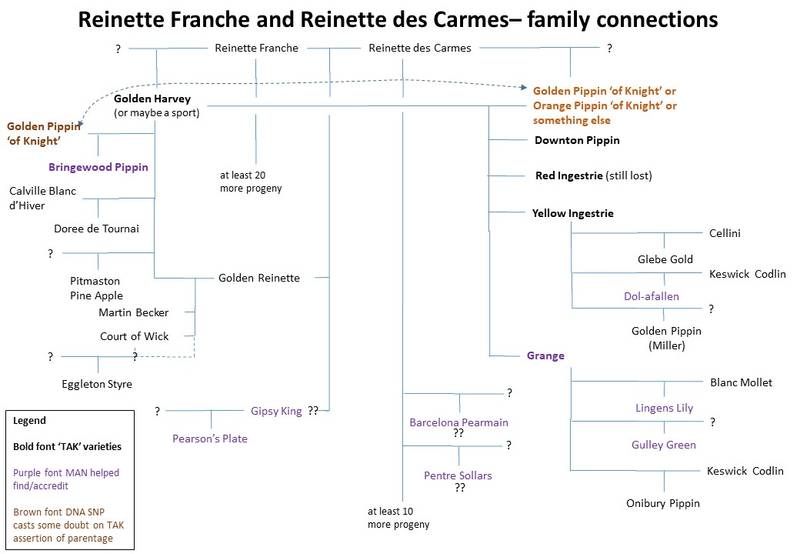
Looking over that extensive list I find two high-flavored apples found by the same guy (five years apart from each other) that have the same parents in reversed order: Claygate and Adams Pearmain. The parents are new (or rather, really old and never discussed) names to me: Reinette des Carmes and Reinette Franche. I love Claygate and have known about its triploidy before grafting it.
As for Adams Pearmain, I hope to graft it this month and compare its flavor profile. I am also keen to verify how well it handles late frosts once blooming.
It’s curious Lamb Abbey Pearmain is listed as having Reinette de Hollande (another Francophone name I had yet to encounter) listed as seed parent, but no mention of Newtown Pippin as the pollen parent. According to the literature, it should be the other way around.
GoDaddy is a domain registrar.. If you register smsmith.com through them and next year do not pay the renewal invoice.. They’ll likely point it to a webserver of their own which shows a “This domain is for sale” banner.. All without your knowledge or consent. Once you stop paying for it, you have no control over how the domain is used, or by whom…
I have gipsy king, pitmaston pineapple, pigs nose pippin (DNA tested in this family also) already and grafted golden Harvey and Bringewood pippin this year.
Yep, the website is currently down! Apparently there’s an issue with verification within the WSU system. They expect it to be back up and running in the next few months. In the meantime, anyone can email Cameron’s grad student, Dongyun, about DNA testing needs. His email is dongyun.lee@wsu.edu.
Yes, so many! In terms of mislabeled trees, I think SSE takes the cake for the most rootstock. We haven’t always had consistent management and there weren’t always eyes on the nurseries and trees. We’ve since created a nursery management framework that should prevent this from happening in the future.
I also have some pending “full tests” from this past summer/fall. That batch is still being processed, but yes, you’ll still receive results even though the website is MIA.