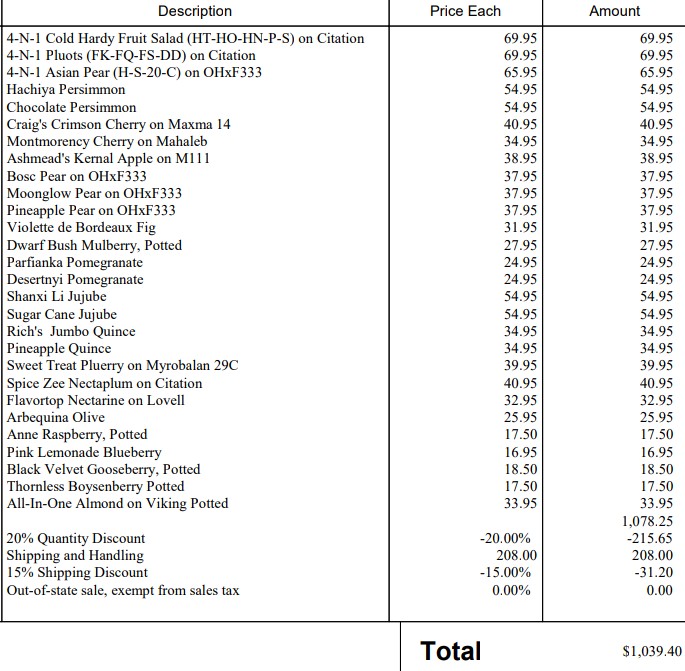
I’ve shared here what I hope would make up a perfect food forest that would ideally eliminate the supermarket for my family and potentially set me up for success in a local farmers market. Aimed for superior, diversity, quality, yield, and suitability for zone 7 (with a few challenges that I’m willing to take head on). I plan to keep most if not all of the tree selections from Bay Laurel Nursery in two north and south adjacent rows, in the same pasture as chickens and various other poultry. Any and all feedback or experience would be much appreciated. Thanks.
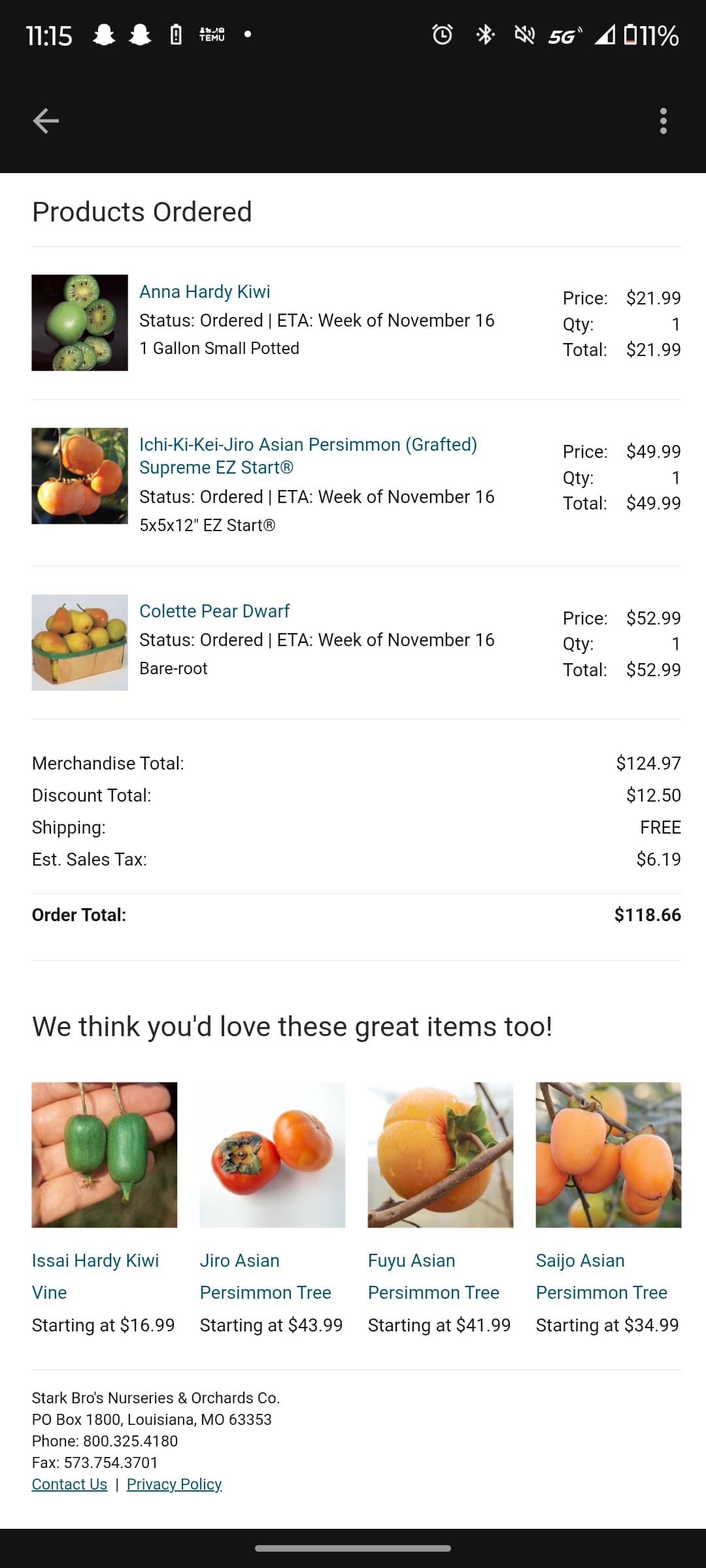
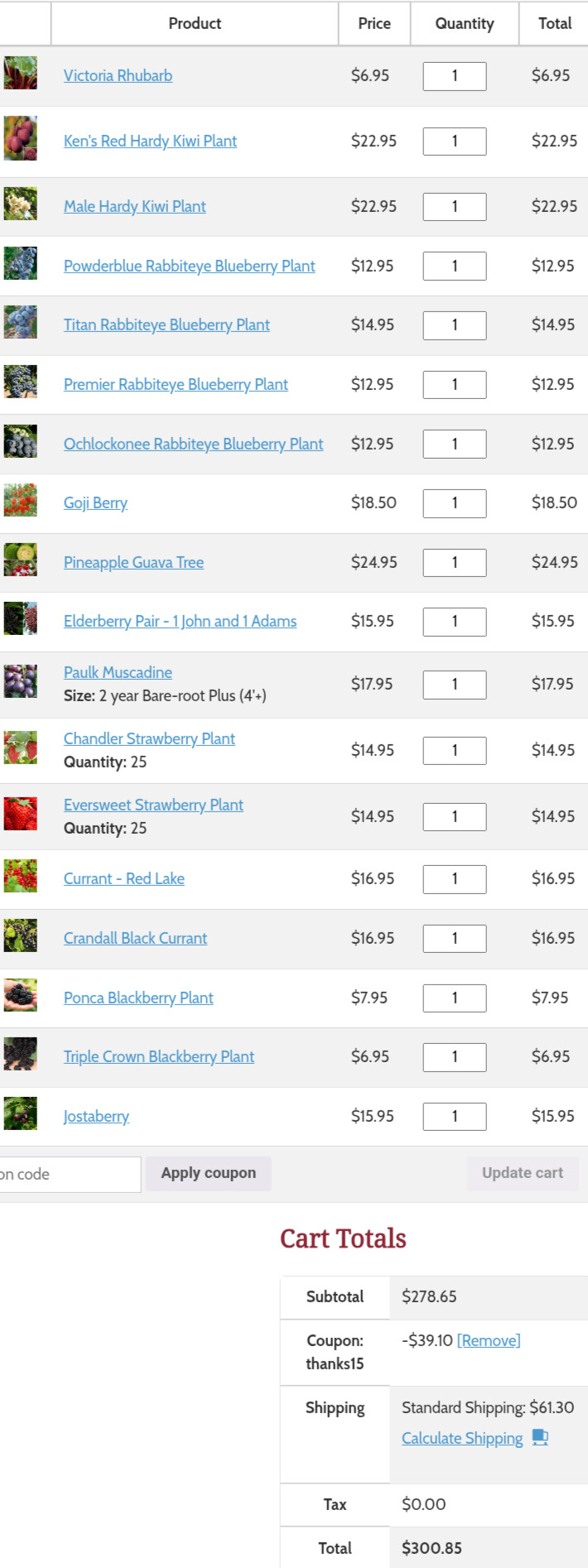
Stark Bros Nursery:
pineapple guava. Most people have not had success in zone 7. Do let us know if this works for you.
muscadine. Why are you growing muscadine instead of grapes? Some muscadines are cold hardy to 7 and below.
is rabbit eye blueberries better for your climate than northern high bush?
are the pomegranate varieties chosen hardy? If so do let me know how they do for you!
I’d recommend different varieties of jujubes, specifically giant honey jar / honey jar or black sea over the Li. Honey jar and black sea should be readily available, and there are other varieties available which are superior to li. However I’m not sure which is considered best for drying and not just fresh eating.
is the olive cold hardy?
Some possible fruits missing to consider:
maypops. They’re hardy to 7.
honey berries.
Juneberry
pawpaw
other nuts besides almonds
cornelian cherry
I’m also a little surprised only 1 apple. There are so many cool apple varieties out there!
Those are all great concerns. Luckily I believe I’ve covered the most of them whilst planning and selecting my varieties. Although I am now slightly regretting placing the order for the Arbequina Olive as I’ve seen people state the fact that they have potential to fail in zone 8 and that their “cold hardiness is overstated”, the guava on the other hand (which produces more, tastier fruit than the maypop) I’m confident, if managed correctly, I can see to it that the tree prospers. Additionally, I’ve only recently found out about muscadines and the way they are highly regarded for their taste ( https://youtu.be/DII4wb9DUZ4?si=90a4pj-1awzfsN6j ) and high yield, (60+ lbs in the case of the Paulk muscadine) as well as being much larger than grapes. The rabbit eye is recommended for my region and even if there are better varieties I wouldn’t be able to pass on the pink lemonade blueberry. Pomegranates are rated to zone 7 although potted is recommended for the Desertnyi. Now I wonder what makes you recommend swapping the Shanxi Li Jujube and what varieties of apple you are referring to as cool, I currently have David King and Golden Delicious, and I plan to get a Fireside apple in the ground sometime. I also plant
to wait for 3 gallon potted pawpaws next year (KSU Benson, Susquehanna, TayTwo) and will surely check out your other recommendations which is what I was looking for, to make sure I’m not missing anything. Well that’s me making my case please correct me if I’m wrong but like I said aside from the olive I would say I covered my bases well while taking some mitigated risks. Thank you for your input.
Eme, I appreciate the consideration, I’ve never been real too fond of them raspberries from the store so I wasn’t sure how well of a fit they would be for me although if I were to get just one to experience fresh raspberries, what variety would you recommend? Thanks.
I’m very new to all of this. I recommend using the search function here to look up varieties you are questioning. There’s a whole thread on raspberries and blackberries that should give you way more than you need. I’m growing Caroline and Joan j but only for 2 summers. Caroline are awesome and so easy to grow.
As a side on something you regret in the order- I think I have changed almost every plant order I’ve ever placed anywhere. Just email or call the company.
Is an excellent thread on jujubes. Having tasted a few varieties myself, I’d rather have one good sugarcane than many Li’s.
Have you tried a muscadine before? From the store, they remind me of having a kiwi like sourness. They are bigger than grapes but only the seeded varieties are actually hardy to 7 (supposedly). They’re delicious but I personally prefer seedlessness.
Pineapple guava will likely survive but it may be difficult to fruit. Definitely let us know how it goes (success or failure) is how we all learn together.
I second the vote for a caroline- I had one I grew this year and it tastes like a “good red raspberry”. 85% of what I have bought from the store is plain, but the homegrown red/yellow raspberries really taste great.
Caroline it is then, thanks for the motivation as a fence sitter. As for the jujube I have both sugar cane and shanxi, although if I ever seem disappointed in the li I could always learn to graft a honey jar onto it. Which is the beauty of it.
Oh yes- there are interesting apples that have red flesh or have unusual tastes like anise (sweet 16 for example). There are many other unusual apples too. If you already have a few apples, it can’t hurt to graft instead of planting new apples too
That’s like saying this one song will cover all of electric music. It’s one specific type of apple, it’s very tart forward, you may not like it.
If you truly want the best of the best of all the different flavor categories of apple (disease resistance notwithstanding) you’d be looking at 30-50 different varieties
Back to disease resistance, I’m assuming you plan on spraying your stonefruits? You will not consistently get fruit from them otherwise, if you want a minimal spray program there are much more robust varieties (that aren’t as extremely high quality but far better than store bought) to choose from
There are many more fig varieties worth getting, again impossibly huge variation in flavor in the best figs of different categories
No mulberries seems like a huge omission, they are extremely low effort and the best varieties are extremely tasty, not to mention the bonus of satiating the birds and saving some of your other berries once the mulberries are mature
I also agree the jujube selection should be much greater, they are an extremely low effort fruit and the right varieties are high quality
Yeah from what I understand, the Ashmead’s Kernel is a very unique taste, for the apples I believe it certainly has my foot in the door and is probably the most common highly regarded heirloom apple.
I also agree the mulberry would be a poor choice to leave out. I had a wild mulberry tree that I unfortunately lost to a flood many years ago, that’s why I added the dwarf mulberry tree (potted). I didn’t want a huge tree with mostly inaccessible fruit, the dwarf gets to 18’-20’ on its own I believe. Do you think I got the wrong variety?
As for spraying, I’ve seen many a YouTube video using some sort of clay spray for protection of stone fruit and others, what do you think of this method.
Finally what figs and apples would you say are must haves for a diverse permaculture orchard? As for the jujubes, what cultivars would you recommend I dive into, to graft onto other jujubes is the honey jar jujube a great recommendation? Thanks for your input.
Look at the link @zone7a posted for jujube and use the search function to look at apple, fig, mulberry, permaculture, whatever threads. Search “surround” to see how people use the kaolin clay you are referring to. This site is such a wonderful source of information.
Well I was tryna see what y’all specifically would recommend. I’ve scoured this forums as it’s been the best resource for a beginner like myself, well anyways y’all have been a great help so far thanks I really do appreciate it.
Hi Fiddle, I don’t have much input as far as tree recommendations go, but I was wondering where in NE OK you are. I was born in SE OK and grew up in Broken Arrow. I live in NE KY now, so the climate is quite a bit different.
As you know pecans do well there, and peaches as well. As far as pears and apples are concerned, it’s not the ideal climate but should be workable. Blackberries are better suited than raspberries, gooseberries and currants would be pushing it, unless they’re in the shade, they don’t like the intense heat. Not sure about blueberries, but southern rabbit eye varieties are a better bet than northerns. Strawberries should be okay.
Hi, any input is appreciated as I am very new to this stuff. I am north of Tulsa and you are absolutely correct that pecans do well here, I have about 30-40 pecan trees lining my property lines. Well I didn’t know about them berries I will certainly be sure to make efforts to protect them from the sun thanks.
Although the Crandall black currant (Ribes aureum/ syn: Ribes odoratum) is native to the Great Plains, it isn’t the same as the the Eurasian black currant which is Ribes nigrum. It’s Ribes nigrum cultivars which are grown overwhelmingly for fruit and processed to make jams, jellies etc…
Your Ribes (gooseberries, currants and hybrid jostaberries) might struggle in full sun (with the heat). In the wild in nature, they would grow in the understory of a forest, in more northern latitudes. So for OK in the summer you might need full or partial shade, well mulched, making sure they are well watered during the summer. If you have a cold spot on your property, put them there.