I’m in upstate SC, zone 7b. My Southern Sensation vine has been bearing 2 years. I’m over the border of where it’s Winter hardy. It’s survived temps in the low teens with no major damage, but I do have it planted six feet off a South facing wall.
I ordered it from a Texas nursery, and I believe it already had PD. It has symptoms such as leaf stems that adhere to the canes and leaf discoloration. I use a neonicotinoid insecticide drench to help control the PD. I haven’t pruned it yet, but It had good vigor all season, and I believe it will bear again this year.
4 Likes
This is amazing work Dijon. I just started mulberry crossing this year, currently ripening a few berries of Taiwan Long x wild alba. I would love to get cuttings of Two Spirit to use as a pollen donor at some point. Or even a female parent too. I think that having both types of flowers on the tree might be really useful in breeding, it may lead to higher fertility in the hybrids. I would love to trade for P2SG or for any of your hybrids that might be big enough. I can send you anything from my breeding work, the most “advanced” stuff I’ve been working on is cold hardy passionfruit, which are incarnata-dominant hybrids with mixes of 4-5 other species in there in different proportions.
6 Likes
3 Likes
Ooh
Care to share some details? I’ve a very similar project going, though targeting zone 8 rather than 7 (crazy how different one zone can be for marginally hardy species) with P. incarnata and mostly P. cincinnata but also some P. tucumenensus and edulis, and soon edulis var flavicarpa, contributions, and pending some chromosome duplications then also a P. incarnata x phoenicea lineage and a P. incarnata x coccinea one. A few other members of the forum are also working on passion fruit improvement both with pure incarnata and with hybrids.
4 Likes
I should start a thread and share some photos. I’ve been doing passiflora crosses since around 2017, but I got the initial material from others who had been making incarnata wide crosses. It’s been interesting seeing the process go down the generations, in terms of how things recombine unexpected ways. It’s been a really great learning experience and I found it wasn’t difficult to get really nice cold hardy hybrids. It strengthened my resolve that backyard plant breeding with small populations can nevertheless make great progress. It’s still picking up steam now that I’ve gotten self-fertility from edulis transferred into cold hardy lines. This is the biggest “hack” for cold hardy passiflora breeding as far as I’m concerned, when you make the initial F1 you want to use incarnata as the maternal parent and a self-fertile edulis as the pollen parent. If you do this you can make F1s that are fully self-fertile (and with fertile pollen). What this means is you can use this F1 then, either as the pollen or seed parent, to transmit self-fertility to other hybrids. What this does is it restores fertility to other hybrid lines. The self-fertility therefore acts as a general fertility restorer and will save anyone doing this work a lot of effort in selection and breeding. Even though self-fertility is a maternal trait, in the initial F1 is transmits through pollen. There are a couple papers about cytoplasmic inheritance (like self-fertility) in Passiflora going through the pollen of wide crosses in the initial crosses.
In addition to being incarnata domininant, I have hybrids with Cincinnata, tucumanensis, flavicarpa, edulis, and Phoenicia genetics in there. Phoenicea is the newest one I’ve been working with (Elizabeth seedlings), but a couple 1/4 Phoenicea hybrids just popped up out of the ground last week.
13 Likes
I looked at your site of your projects and I am very intrigued with the sweet potato × Ipomoea pandurata hybrid. I would think it would be awesome to have ‘sweet potato’ that can survive our winters here.
Also intrigued with the goji breeding. I’ve heard the black gojis and their f1 hybrids, like the stardust, behave like a determinate tomato in their fruiting, unlike the barbarum ones that act like indeterminate. Do you know how exactly inheritable that trait is?
I’m wanting to grow the seeds out of my stardust goji self pollinated whenever they fruit to see what variation shows up and to select for the ‘indeterminate’ ones. Also self pollinated Imperial goji seeds to have the fruit qualities of the yellow goji, but the production and disease resistance of the red.
Also I would really like to know/try if kangaroo apple (I know there are at least 2 species that go by that name) can hybridize with goji?
6 Likes
Please do! I’ve only skimmed your blog posts but it’s quite something, seems you’ve done both a lot of research and a lot of good work. Color me impressed!
5 Likes
@Miniforests
I’m still waiting to see if my graft of a “male” P2SG branch will keep that staminate flowering pattern, but I can ship you some budwood from the mother tree once the new growth starts to lignify. DM me with your address if you’d like.
I browsed through your blog too, incredible stuff! I’ve been curious about crossing sweet potatoes with I. macrorhiza & have been toying around with interspecific nightshade grafts too (mostly for nematode tolerant rootstocks, but now I’ll have to try making a cold hardy Tamarillo with a goji graft!).
Your work with Passiflora hybrids is impressive too, but not sure I can convince my current landlord to go for it since we can overwinter P. edulis here in FL. Are any of your crosses non-suckering?
A couple weeks ago I grafted the ‘Him. FSP’ x ‘P2SG’ seedlings onto a 20 year old tree at a friends. With any luck I’ll find out which are fe/male next year & then I’ll start sharing scion, assuming any turnout worthwhile.
2 Likes
I’m doing my part to help the bird’s Rubus/Ribes/Sambucus backyard breeding program. I know we have a thread about raspberry breeding, but couldn’t find it…How long do they usually take to start fruiting from seed?
I remove the Wineberry seedlings that come up (none have appeared to be hybrids so far as I could tell), but have a reddish/purple caned raspberry seedling that came up last year.
I’m growing Anne and Double Gold. One of my neighbors has some reds (I believe, probably Heritage or something…my info is from what I can hear being shouted a yard over, not directly talking with him). I think the Double Gold sometimes has pink/red/purple tinged canes? So it could be a selfie of one of those? Or the parent’s traits coming back in an F2 hybrid?
This year it’s sending up two (so far) regular light green primocanes. I have it nicely trellised on the Juicy Jewel pear tree they planted it next to. I’m hoping it will fruit this year so I can find out if it might be something worth moving and keeping or cull it. It’s “healthy and primocane fruiting” or “at least a bit healthy and has weird color fruit” are my not particularly stringent criteria for keeping it.
4 Likes
I just finished planting a 200 foot row of cowpeas which are F2 from a cross of Piggott Family Heirloom X Colossus crowder. The intent is to select out a very large cowpea with excellent flavor from Piggott. Total seed planted should be around 600. The F2 seed were selected for large size and speckled coloring. Barring incident, roughly 30% of the plants should produce seed with the desired traits. Why develop such a cowpea? Because shelling cowpeas is a labor intensive process if you don’t have a shelling machine. These can be shelled by hand in half the time due to larger size
Total traits being selected are:
Large size
Superb flavor
Dark speckled coloring with the typical shriveling from Piggott (has to do with sweetness)
Long pods with at least 20 cowpeas along with large number per plant
Pods held high in the plant for ease of picking.
I grew a short row of the F1 seed a couple of years ago. Of that growout, only 8 plants had all of the desired traits.
10 Likes
workign on stabelizing both love gourmansun (goal is a bicolor oxheart with extremely low seed and moisture content, same great flavor) and blood sport (a vareigated poblano cross). Trying to maintain and stabelize the foliage varieigation and pepper vareigation selecting for larger peppers. heat is not so important to me. I’m at f4 on the pepper and f2 on the tomato
4 Likes
Brilliant work with those mulberry hybrids! Do you work with I. macrorhiza? I’ve been wanting to send my sweet potato seedling to someone that grows macrorhiza in order to OP hybridize them. It should be pretty easy to do OP, if I. macrorhiza keeps its flowers open some during the day.
The passiflora hybrid rhizome habit is all over the place, there are clumpers, running clumpers, and different degrees between them. I would like to do some more selection work for the pure clumpers, its really ideal since you can propagate by rhizomes or cuttings and management is easy. So far in my small yard its been harder to evaluate because I planted blocks of seedlings out of necessity, but as I get the select seedlings propagated out to other places it will be easier.
3 Likes
That’s the hope with the hybrid sweet potatoes, and I think its achievable, particularly in the F2 generation. I already got one F2 seed in the basement during winter, but it succumbed to fungi or hybrid breakdown (it doesn’t seem like one can necessarily tell the difference?).
Yea I know what you mean about black goji/stardust having that more upright robust habit. Its less like the trailing rubus habit of barbaric and chinense. And it does correlate with with earlier fruiting. I’ll ask my friend who is growing out some of my stardust x Chinese ‘large leaf’ seedlings what he thinks about their habit and fruiting in comparison. The little ones under the oak tree in my yard do seem more upright than L. chinense, perhaps leaning toward that black goji habit. They haven’t fruited yet, too much shade. In my experience, stardust goji is male sterile, it will not make fruit without another cultivar around it, and all of its seedlings are outcrosses.
Regarding combining kangaroo apple or tamarillo with cold hardy traits from goji, if those species form adventitious roots/shoots readily, you can copy the go-tomato technique to achieve this. Otherwise you want to do something called a double graft technique where you collect the seeds from an adventitious rootstock shoot that forms in between two hetergraft scions. This adventitious shoot also must have its leaves pruned (except the 2-3 small leaves at the apex) as it grows and forms fruit. I discuss both of these techniques on the selection pressure substack.
4 Likes
I wonder if it is hybrid breakdown, if doubling ploidy would help with that problem?
That’s a pity with the stardust not being able to produce self fertile seeds. Do you know if its pollen is sterile or just can’t self pollinate?
What is the “go-tomato technique”?
Is the double graft technique basically just making a chimera and saving the seeds of it?
1 Like
Even if it is hybrid breakdown, I’m sure some of the seedlings will develop ok. I may have just watered that one seedling too much. I should be able to get more F2s with open pollination. I only tried like 18-20 hand pollinations when they were indoors, then I gave up. If it’s 1/20 OP rate that’s not so bad with how many flowers they make.
Here is the paper on the go-tomato technique: https://www.researchgate.net/publication/385976508_Horizontal_transfer_of_plasmid-like_extrachromosomal_circular_DNAs_across_graft_junctions_in_Solanaceae
It transfers eccDNAs across the graft union and amplifies them in adventitious tissue, giving it a bit of hybrid vigor which is used for phenotypic selection.
The double graft is similar in that it also involves generating an adventitious shoot to amplify mobile genetic material. But the double graft involves collecting seed from this shoot, and selecting the variation from there which is about 68% novel variation in the seeds, a very high rate.
The easiest way to think about it is that stresses like heterografting cause the production of eccDNAs which are mobile, self-replicating circles that flow in the cambium, then adventitious growth (which crucially arises from the cambial region) is able to select out cells with this mobile genetic material which is stable. EccDNA is is able to express even when it doesn’t integrate into the chromosomes of the cells that take it up. It can later integrate itself into the chromosomes, but even when outside of them is still able to transmit through seed.
Yea I think stardust is an amazing parent from not having fertile pollen. It makes pollen, but doesn’t self. I guess it could be an SI mechanism, but I assumed its F1 sterility. Up to now I haven’t had anything to cross it with early in the season, but im recently observing that Lycium carolinianum is able to throw out a few very early flowers. It looks so far like this cross is working, but it’s very early. This would be the first old world x new world Lycium hybrid I think.
3 Likes
I have a few I. macrorhiza I started from seed about a year ago. One flowered last year, so I’m hoping to get more blooms this go around. Whether their flowers persist into the morning really depends on the weather. I still have some in tree pots, so I can move them into the shade after they’ve blossomed. I’m definitely interested in helping you get hybrid seed! You’d have to do all the (winter) selection tho, regular sweet potatoes overwinter here just fine.
I’ve also overwintered macrorhiza back home in Northern VA, so I could send you material instead if you like.
4 Likes
I forgot to update on this, and didn’t take as many pictures as I thought I did, mostly because most of them were cut up, cooked, and dug into before I got back in from milking.
They all seemed lackluster in their sweetness to a identical degree on every single one of them, but they all had the good butternut flavor in them to varying degrees mirroring the juiciness in them.
The big vase shaped one was the most watery, though the other two big white square ones from the same plant weren’t nearly as watery.
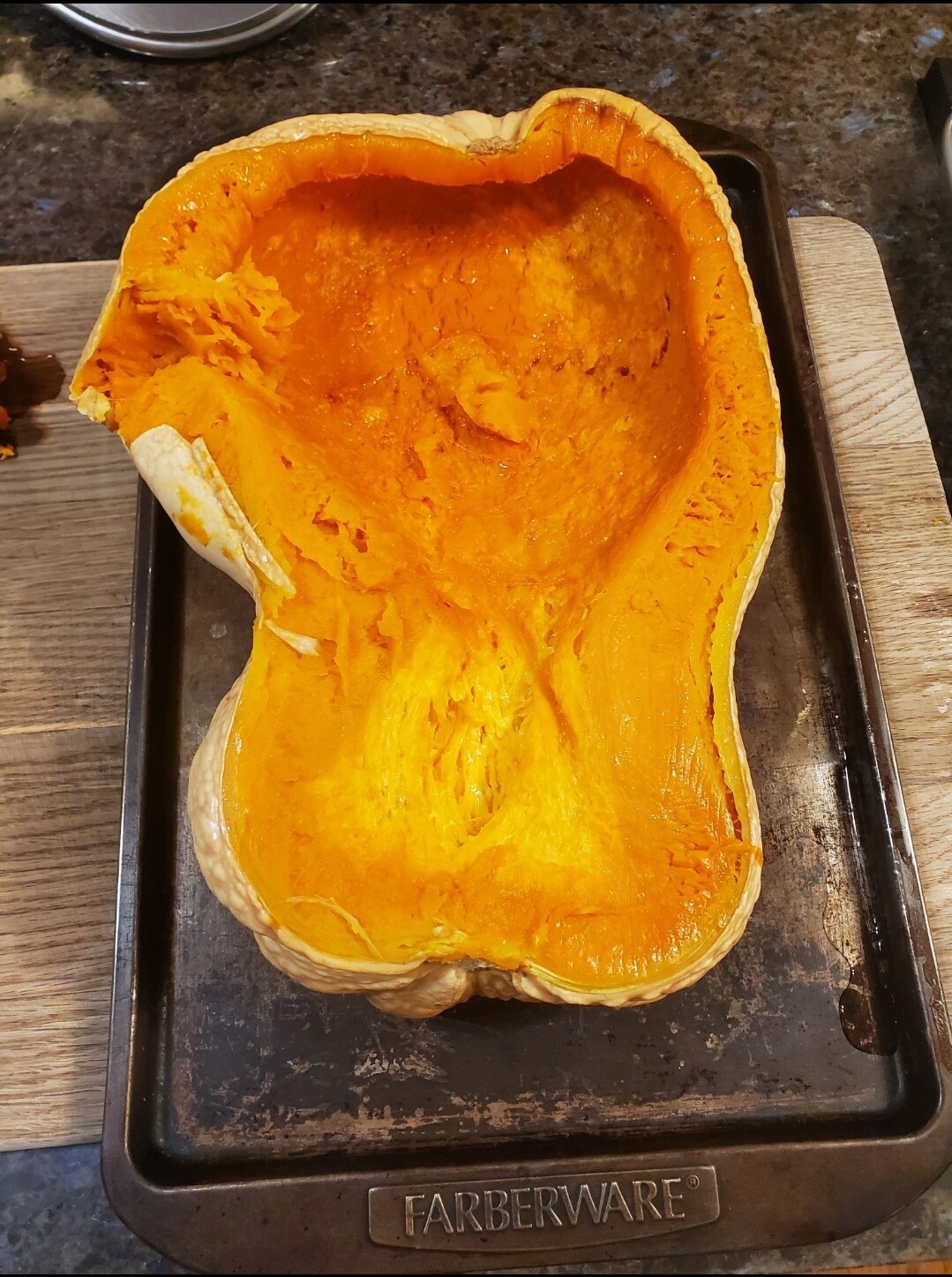
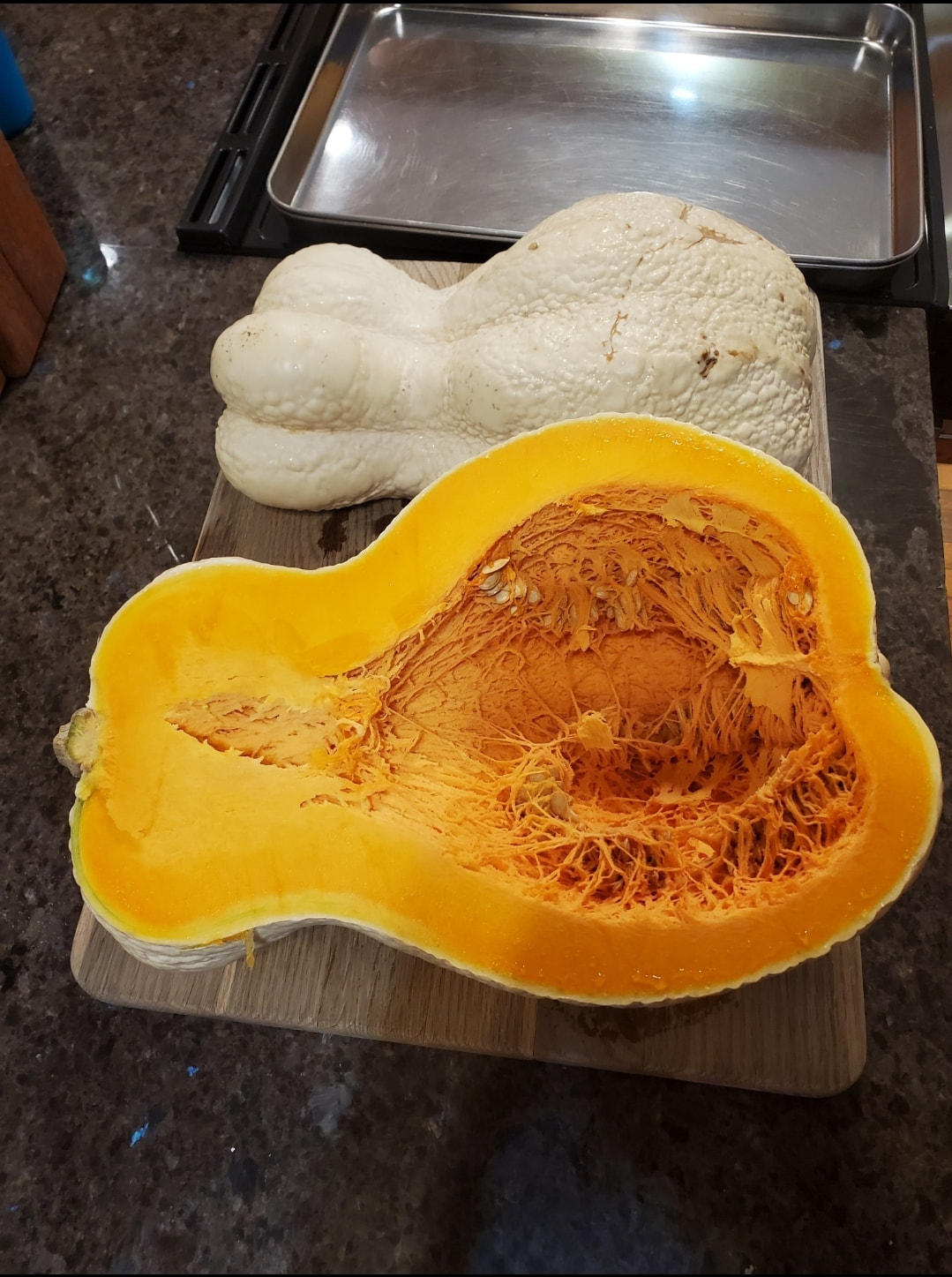
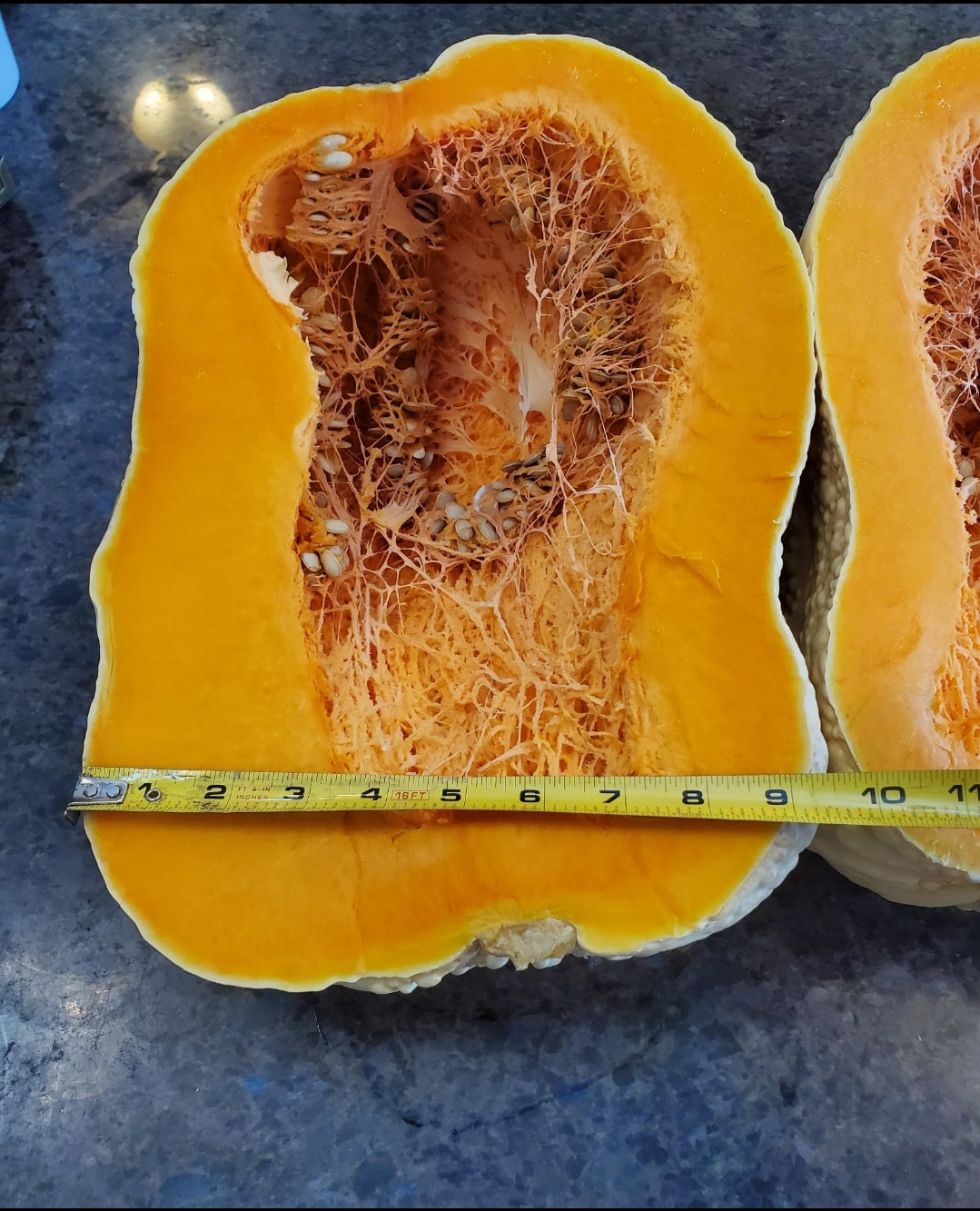
The big brown light one was about the same taste as the big white squar ones, but had some spaghetti squash like texture in it.
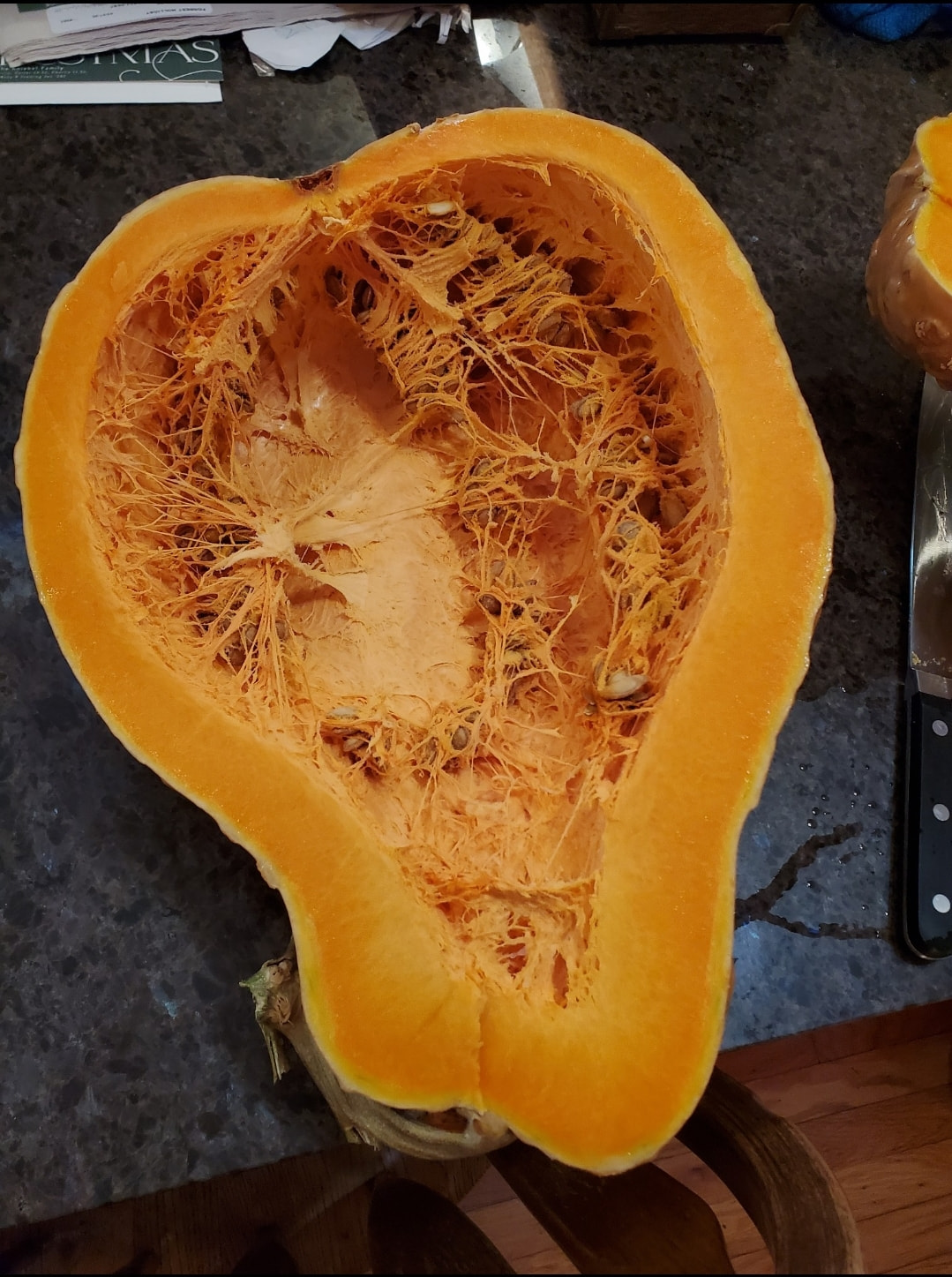
The cinderella pumpkin shape ones (I had myself convinced I had pictures, but I guess not) were the most ideal (the least) in juiciness levels and had great taste too undiluted, but not much sweetness like all the rest.
The straight long tan one was extremely similar to the white square ones, but maybe slightly less watery, and it fit perfectly both halves on our largest cookie sheet pan.
I was kind of thinking of planting some real sweet butternuts in with the plants for this year to add some more sweetness back into it, but thinking about it, I bet the trait that makes them super sweet is recessive and whatever crossed with the parent did not have any extra sweet traits in it and hence the results I got. So probably will do anothe year of selecting before deciding to introduce any other genetics.
5 Likes
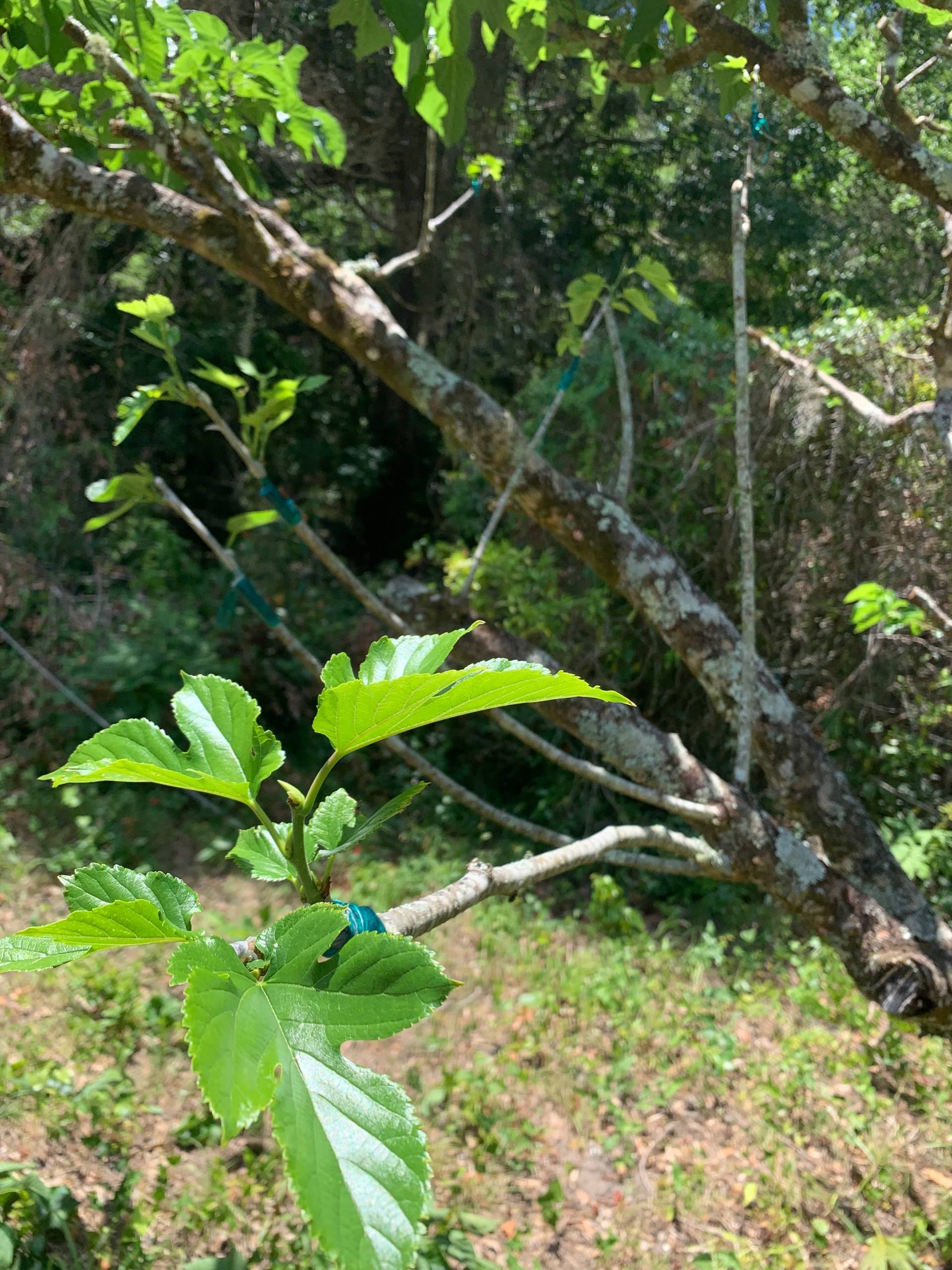
Grafts are taking!
Unfortunately, the utility company came by & chopped the Pithlachocco tree way, way back. Already attempted some crosses this year tho, including with ‘Siam Jumbo’, ‘White Shahtoot’, ‘Riley’s Chickenclaw’, & some select Morus rubra.
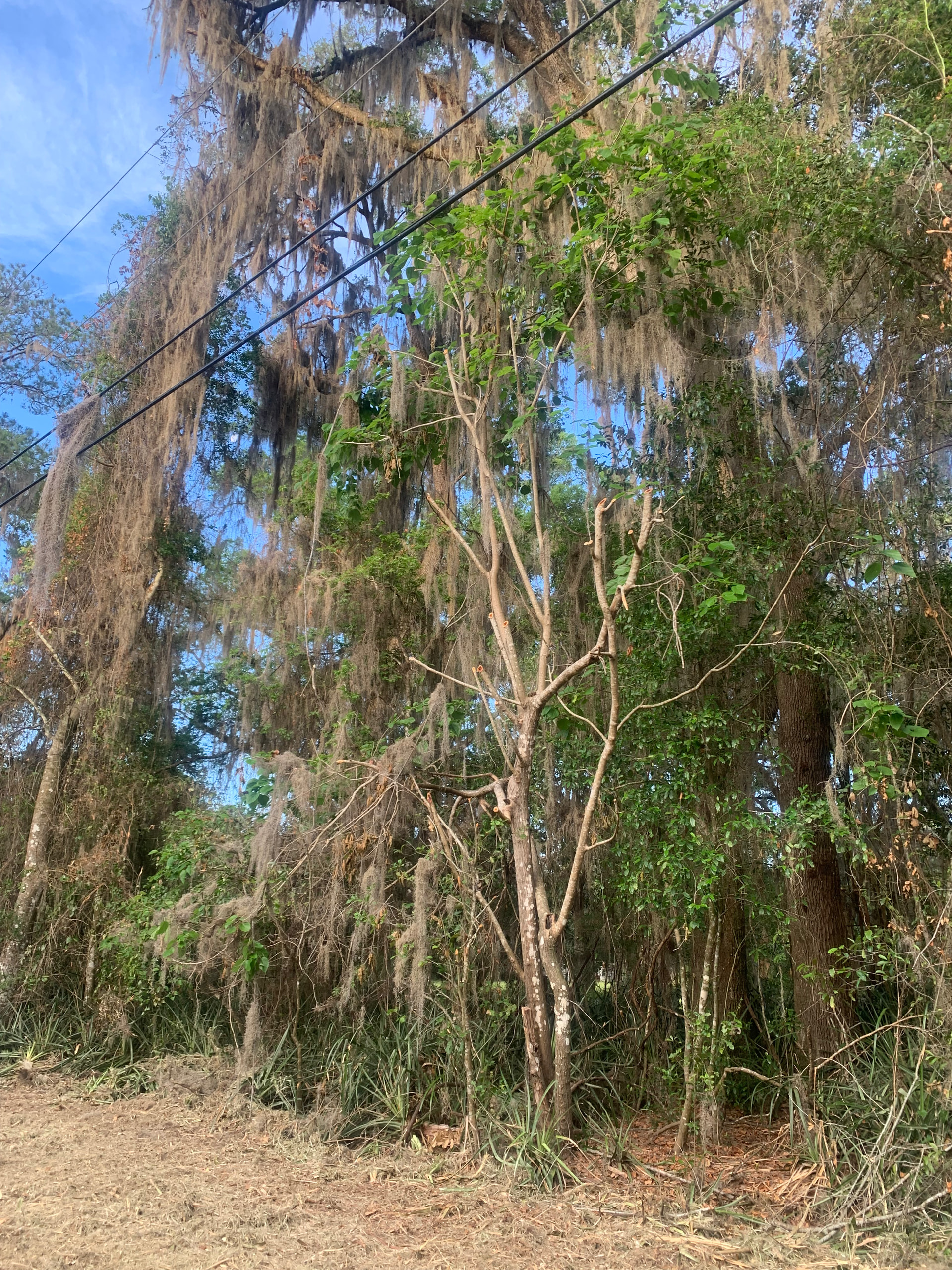
I have no idea where I’m going to put all these trees.
6 Likes
I have about 8 macrorhiza seeds I just received. I tried it years ago in SW Virginia had trouble keeping it going. A couple seedlings I left out and a couple I brought it, but could never get anything to survive very long. Do you have any propagation or overwintering tips? I will send you a piece of the sweet potato root ASAP, message me your address. I think you’re more likely to make the cross than me. The longer term goal is to have a bunch of interspecific 4n sweet potato wide hybrids to intercross. I just sent a piece of that batatas to someone who is growing I. leptophylla to cross in as well.
2 Likes
This is incredible, exactly what needs to be done for increasing mulberry diversity and adaptation. Chickenclaw crosses too, wow! Very exciting, can’t wait to see how things go.
Today I actually planted some seeds from Taiwan long x wild alba. My first year crossing mulberry. But I think you’re using a really elite pollen parent, not only for the size and fruiting ability, but I kind of suspect this could help restore good fertility to the hybrid seedlings. A lot of times interspecific mulberries only make female flowers.
4 Likes