I’m a newbie too, first time grafter this year on a tree I inherited. I had three successful grafts!!! apparently, apple tree is easy to graft
-look into different types of grafts so when the time comes, you can use judgement and execute based on how it’s progressing, for me only my bark grafts took (none of my cleft grafts took)
-graft experts makes it look way easier than it actually is, expect that it will take longer - at least for me
-practice cutting on branches first to get a handle on how to make the wedge
-youtube is your friend
There are a ton of good dependable apples. For flavor and dependability with resistance Hudson Golden Gem is hard to beat. I often surprise by recommending Red Delicious and it’s many sports, mutations and progeny. A home grown Red Delicious will shame what comes from the grocery store.
The NFC in the UK recommends some fine easy growing croppers. Some you find here in the USa include Wyken Pippin, Wealthy, Spartan, Belle de Boskoop’s, Northern Spy, Kidd’s Orange Red, Jonagold, Jerseymac, Holstein, Fameuse, Egermont Russett, Claygate Pearmain, Baldwin, Ard Cairn Russet, Anas Reinette, Alexander and Allen’s Everlasting.
I would throw in Waegner and Etter’s Gold. But there are others too.
good luck with your grafting. It is interesting to try and do. Especially if you get a successful graft to take. I did my first grafting this year. I knew I would not have 100% success rate and the ones that did take look pretty good.
The more vigorous the trees the better they can grow grafts and the more vigorous the shoots that you graft to. In other words the shoots at the top of the trees that get the most light may become big bearing branches much sooner than grafting to a more shaded shoot.
That doesn’t mean that it’s necessarily better to graft high on a tree because you have to think of how you want the tree structured- and that can get complicated because whatever you graft onto the existing tree is likely to grow at a different level of vigor than what is there already. A tree grafted to several varieties of different vigor can be difficult to manage. Your trees have a nice shape now as modified central leaders but already the top branches are dominating lower ones and destroying tree balance as “pyramid” or Christmas tree shaped trees.
You could consider cutting out the top half of the trees, waiting one year and then working with the shoots that the beheading inspires, one as a leader to replace the top tier.
I can make this so complicated that you will be frustrated and it’s perfectly alright to start grafting ASAP and begin the inevitable process of learning from your mistakes. If you are already a gardener it should be a pleasant and interesting road.
The first thing I think you should do is eliminate the plastic barriers at the base of the trees and expand the grass-free area with a ring of mulch at least of 5’ diameter. Give them some nitrogen before putting down the mulch and another moderate dose in spring right around first growth when you may be grafting.
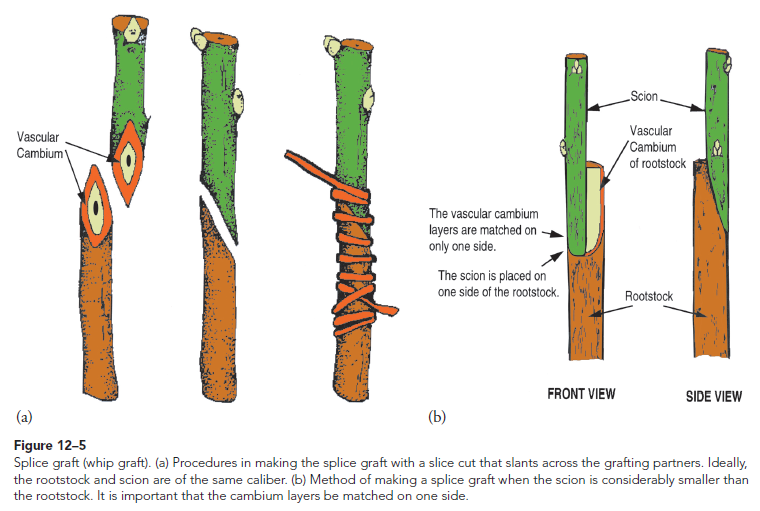
The simplest graft to perform and pretty much the only one I use these days is a splice graft to a vigorous upright shoot.
This drawing shows a splice graft of scion wood of different diameter to the shoot on the tree- if they are nearly the same diameter the process is easier. I use vinyl electric tape to join the scion to the mother wood but you may be better served to use rubber electric tape that won’t ever girdle the graft once it starts growing vigorously. I either cut or unwrap the vinyl tape a year or so after performing the graft.
You simply have to understand what the cambium is and at least match it on one side of the scion with the mother wood.
A few years ago I did a few posts about grafting which were intended to get input from others on the forum. (My own comments were pretty basic, but the responses are gold - a real wealth of information from people with much more experience). The idea was to provide something of an outline to help keep all that information handy and to lay out the basic nomenclature, which can confuse. Here are a couple of them -I hope they are useful to you:
As far as matching diameters of scion wood to mother shoot, the drawing I provided doesn’t reveal that if the graft was done further up the mother shoot, diameters likely could have been matched. This makes using tape much easier, because it forces cambium to match up on both sides and you don’t have to worry much about the scion shifting position as you tape it to the mother shoot. When you use rubbers, you can see how they match up and make sure at least one side has aligned cambium as the drawing illustrates.
I find it so much easier to graft with parafilm. It is self adhering so you don’t need to put knots or adhesives. When used in multiple layers it is strong enough to support a small stick. It will also fall off later in the season as it the graft union swells and the parafilm degrades in the heat.
I like parafilm too, but my grafting technique is not so good that I can confidently skip something else to hold the pieces together. I like grafting rubbers, which are strong enough to pull things up tight, easy to handle, and degrade on their own over a season. I often wrap first with parafilm and then follow with the rubber, but you can do it the other way too.
I tend to use whip and tongue when possible. I feel of all the grafts that one needs the least support. So for that purpose parafilm is more than adequate
I had trouble making whip and tongue grafts at first. Then I found a pair of Sears razor blade shears. They make a very fine oblique cut on both pieces. Then I use a tiny Opinel knife to make the tongue cuts.
This causes next to none crushing of the wood and my takes are going way up.
Those are the similar idea. However my Craftsman shears have about a 5 to 6 inch blade. Which delivers nice acute cuts which exposes a lot of cambium. Which makes scion takes much easier.
They are like the ones you showed but the cutting block is brass.
There is no male and female apple trees. They contain both male and female reproductive organs. There is some other reason why you arent getting apples off that blank tree. Either not enough chill hours or maybe they are blooming early and getting hit by frost.
Or maybe it is just a bad cultivar that will always drop its fruit so its is basically sterile. I doubt it’s sterile though as I haven’t seen an apple do that. Your climate is most likely too warm for that cultivar. Apples have to have a certain amount of chill hours during the winter to produce fruit the following year. That tree may require more chill hours than your zone can produce
If someone told me they have 2 apples trees and one bears fruit and the other does not, then I would have to ask what the varieties are? If known?
IF both flower every year at same time and only the same tree keeps bearing fruit, its possible the one bearing fruit is a triploid variety? If so, it would be pollen sterile and be unable to pollinate the other tree. In that case, you need to plant a 3rd variety so all bear fruit. Triploids are not common but do exist.
They also typically have large fruit.
Welcome to the group! I bought an old Colonial that was a small farm and it has four well-established apple trees - a very old Wolf River and three unidentified younger trees. The house listing gave Wolf River (which was easy to identify because of the huge fruit), Quince, and Golden. I think these three were the original ones in the backyard (one was cut down); there are two more on the side, one a very delicious all red apple that has nearly no pests or diseases. I was a newbie, too, and found Michael Phillip’s book “The Apple Grower: A Guide for the Organic Orchardist” which has been very helpful as well as a joy to read. I also got on my local county extension (UNH) mailing list and I get wonderful resources regularly from them. I highly recommend doing the same as they are a wealth of information, have an extensive searchable database, and have people readily accessible to help you with anything to do with livestock and growing things. They also had a grafting workshop I went to and I successfully grafted a Macoun which finally bore an apple three years later. I have since added a Honeycrisp, Jonathan, and a Liberty to my small orchard. I once had an apple tree that never blossomed and I suspect the person that gifted it to me had grown it from a seed. I would use your sterile tree for grafting practice! Good luck and come back regularly to this group - there are people on here from all over the world and I find their experiences very interesting! Pam, Zone 5 (that’s another suggestion - put your zone on your user name)
Thank you Pam Zone 5 !
I found Michael Phillips book at the library earlier this week, and you are right it is a joy to read. I have been trying to follow all the good advice here - I just found a used Craftsman razor blade sheer tool with spare blades on eBay, was thankful for that as they were no longer sold anywhere else - and I bought a roll of parafilm. And I added a Baldwin and a Wealthy scion to my order from Fedco, as the Cummings’ scion selection was not in my budget. I have greatly enjoyed reading everyone’s posts watching the videos on grafting techniques and looking at all these different apple choices to select my scions - from the pictures I think it is possible my yellow apple tree could be a Hudson Golden Gem? mine are very similar in appearance. I intended to clean up beneath my trees today but got sidetracked - had to get my little pond ready for winter and harvested the last of my tomatoes and chard and herbs before tonight’s hard frost. I think we still have a few more good days left? I want to get that done before the snow comes to Ohio.
Jeri Zone 6B
Yes, we are supposed to be getting 1-2" of snow here in SW Ohio. Way too early for winter, IMO.
I am in zone 6B as well.
I picked all my apples off my trees in the last few days since it is supped to be 23 for two nights in a row PLUS the snow. I was hoping to leave the apples on a little longer , maybe a week or so longer. Now happening now with the 20 degree nights plus the snow.
Young apple trees (some varieties) can easily go 4-5 years or more before they start flowering.
They have to develop fruit spurs first…
Summer pruning is normally done mid to late August and it encourages the tree to develop fruit spurs… then you start getting blossoms and fruit… if your tree has a pollination partner (another that blooms while it is blooming).
You can easily add a pollination partner if needed by grafting… chestnut crabapple is in flowering group 2… and make a great pollination partner for most early blooming apple trees… trailman crabapple blooms in flowering group 4 and works well for pollinating later blooming apples.
Chestnut and trailman are good eating crabs too … one to 1.5 inch size.