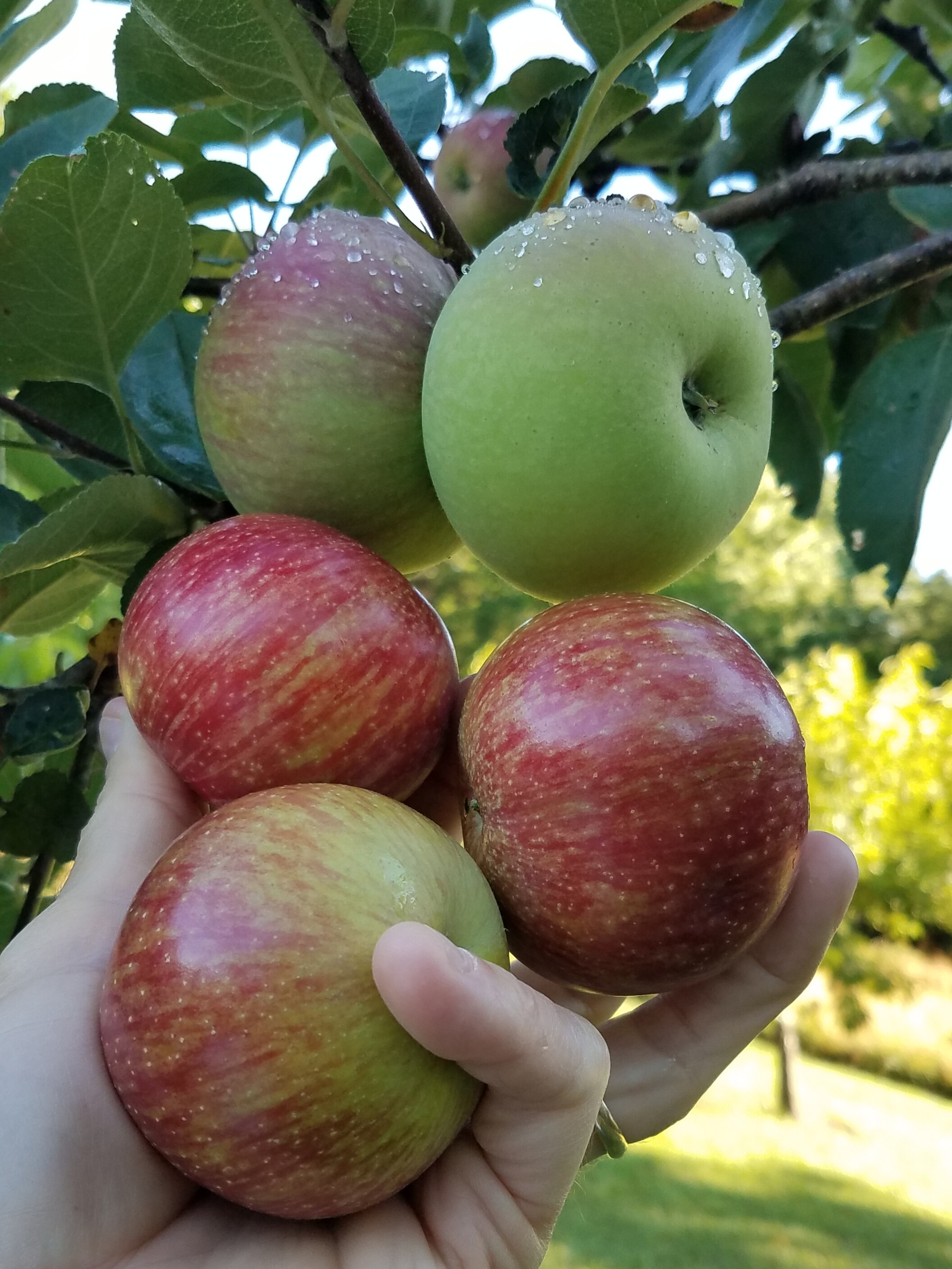
I’m not sure if it’s scab that affects KdS as you describe your fruits, or at least not solely scab. I believe it’s one of the many descendants of the notoriously difficult to grow, heat hating Cox that inherited at least the heat hating genes.
I had a KdS tree at the crop bearing stage for 10 years, and the apples look as you describe every single year. Scab isn’t much of a thing in my orchard, but hot and dry is. I expect you have similar conditions in southern Oregon (near Medford?), if not quite as hot and dry as I am in Reno. I finally topworked the tree to about 10 other Cox children in spring 2020. Here’s hoping at least a couple prove better adapted to my conditions, because the promise of Cox-like flavor is something all apple lovers should experience. BTW, Rubinette performs well here, so even if every other Cox offspring fails, at least I have one of the very best to fall back on.
My daughter started eating Goldrush this year in October, and has developed a taste for under-ripe apples. She is now eating supermarket Granny Smith
She claimed to prefer the under-ripe Goldrush to the ripe ones. Somehow my mental block refused to accept that, but it may be true. Hopefully its just s phase
Taste buds are often different. One of my daughter’s is a lemon sucker, meaning that she loves to suck on raw lemon. I like lemon, but not raw like she does. So just a suggestion, see if your daughter also likes raw lemon and if she does, you have a lemon sucker on your hands.
Tart/sweet… is how I would describe them. The initial taste is Wow Tart followed by a nice dose of sweetness.
I have never had a McIntosh apple that I know of… or yellow transparent… but assume that both contributed to its flavor profile.
If you let them ripen fully… they go past red… to a purple red color… and they soften up some too… in the red stage nice and crisp… either way that initial wow tartness is there… followed by a nice amount of sweetness…the sweetness increases as you go thru the red stage into the purple red stage.
You might be able to get some at the link below ?
I may offer some scionwood for trade a bit later.
We ate our first few apples on June 12 this year… yes early and ripens a few at a time for about a month.
They look great. Nice that they are that early and still are a crisp apple. I had a yellow transparent apple in my orchard years ago. Only thing it was really good for was for sauce. It got too mealy really fast and too soft to really enjoy as an eating apple for very long.
My wife is a dentist. She would advise you and/or your daughter to limit the lemon sucking. The acid erodes tooth enamel, leading to cavities and, if it goes too far, lost teeth. If she only occasionally does this, it’s not an issue, but if it’s a frequent habit, there will be problems down the road.
Yeah, I enjoy eating the lemon slice on my tea at a restaurant…it grosses everybody else out! (But, since I eat at a sit-down restaurant only 3 or 4 times a year, shouldn’t hurt my enamel…besides my enamel is old and touch…lol.)
Yep, that’s maybe one we’d see in supermarkets if it had been developed by washington apple growers or Cornell or even the New Zealanders.
About the only apples to make a go from the UK is the old Cox Orange Pippin!
There are still bitter and sharp apples from the UK that we don’t have here. Most apple breeding today is concentrated in the U.S., Australia, and New Zealand.
Today I learned: that Blueberry is an antique. I’m still waiting for him to post the picture… where he was riding a dinosaur to school.
Brambley’s Seedling and Ashmead’s Kernel are pretty commonly grown in my area as well. Ashmead’s is often celebrated as one of the top apples in the world, certainly the London Horticultural Society long considered it the standard by which to judge all apples.
On my property Ashmead’s has failed to produce well, but at others it does fine. If the soil is good in our climate it wants to grow wood more than apple- I suppose I should try it on 26. However, no apple that is done by mid-Oct is that important to me. I start to store them towards the end of that month.
Among British imports is also the little known Rosemary Russet, which scion wood came to me from northern Arizona a couple years ago. Apparently it is adaptable. Mine, on Gen30, has convenient scaffold branching with little help from me. It is 9 feet tall & just might bloom next year. With a flavor profile often compared to Ashmead’s, it offers reputed advantages of high fertility, precocious bloom (we’ll see about that) & lovely pink flowers.
I hope so.