Best way to transplant 2" caliber fruit trees in fall

Hi, I am moving one mile across town in southeastern Michigan. I have a small orchard in my 1/4 acre-city backyard and am now getting it ready to sell. Likely a new owner would not appreciate quite so many trees and I’m heartbroken to give them up, especially as after years of work I’ve finally learned to spray, prune and am getting consistently good fruit. As a result, after reading many threads on this forum I’ve decided to try to bring some of the trees not older than 5 years with me. That will leave some mature trees for the new owner (peach, apple, plums, cherry) that they will hopefully enjoy, but also be less likely to overwhelm them with work. It also means that hopefully I can enjoy some of the fruits of my labors without having to start over and wait years for more fruit. Also, a few trees are sentimental to me. For instance, I have a Shenandoah pear tree on OHxF87 that I planted on the day my brother died and later grafted some of the variety Tyson pear onto it (my brother’s name). It’s 5 years old and about 2 inches in diameter, though a little wider at the graft. It’s been pruned to stay small and columnar along my driveway. The new house will close Nov. 24.

Past threads I’ve read about transplanting fruit trees in fall have given me courage to try and it’s always possible the new owners will cut every single tree down and so I don’t feel I have much to lose. What I’m still wondering is: 1) Is it better to dig up now and put in pots either in the garage or outside or leave precut in their original holes in case the ground freezes? OR 2) Is it better to dig and transplant the same day on Nov. 24 or later, after closing? I’m not sure how hard the ground is at that point in our zone 6 climate as I usually don’t transplant trees in the fall. I will be hand digging, along with my husband who is a wonderfully good sport. I hope to transplant the two 5-year-old pears, a 3-year-old peach, possibly one cherry and young plum. I may or may not move apples. I also will move some smaller plants, including currants, grapes, blackberries. Any and all help to improve my chances of success is appreciated. We will purchase the new house and then sell the current house a month or two later so we will own both houses for a short time. We will be terribly busy, however. Thank you so much for any help you can provide.

For others interested in the topic, below are a few of the existing strands I found helpful.
Fall transplanting Observations:

Moving 3-year-old peach trees:

Transplanting 3-5 year old dwarf fruit trees:

To plant or not to plant during fall & winter?:

What month is good to dig up a peach tree and move it

transplanting older apple pear trees

Green-gage plum tree
1 Like

Kare Hunt,

I used to travel to China quite often on business. I had lots of time looking out the window in taxis. I would see a new roadway being built and could see the new landscaping going in.

They would have a pile of what looked like logs with small root balls. These logs were maybe 6-8 inch diameter and topped off at 10 to 12 ft, not a single branch twig at the top. They would be just planted with stakes and wires to keep them from toppling over. I thought, “good luck on those growing!!”

Traveling down an slightly older road, same thing but now the logs had a bushy tops. Ugly to say the least

Years later while walking down much older street in Beijing, I saw 2 foot diameter trees lining the road both sides. Each had a clear trunk to 12 feet and an open center like shape!

Severely removing the top makes transplanting possible.

Not according to some researchers. Carl Whitcomb explored tree reaction to trasnplanting extensively and his discovery that removing branches didn’t help trees recover or add overall vigor changed the generally accepted rule “prune the top to match the bottom”.

I will say that there are many variables- Whitcomb only worked with sexually immature trees although some had good diameter. A fruit tree with a lot of spur wood, which is an energy sink, might recover better if that spur wood was removed, for instance. With peach trees, even immature trees expend a ton of energy on producing flowers which somewhat alters the equation with them.

I have transplanted thousands of bare root trees in and out of my nursery over the years- I never remove wood to balance top to roots and do not suffer consequences. I’m trying to get trees above the deer browse line ASAP and not pruning trees makes that happen sooner. You have to realize that those branches contain a lot of stored carbohydrates.

Alan,

I’m just trying to imagine the root ball of a tree with a 2 inch trunk. I would think a 2 ft diameter root ball would still be lopping off some big roots.

I recall reading peach growers will lope off the entire top of a small tree if the branch structure is all wrong.

A truck mounted tree spade would be the most secure method for larger trees

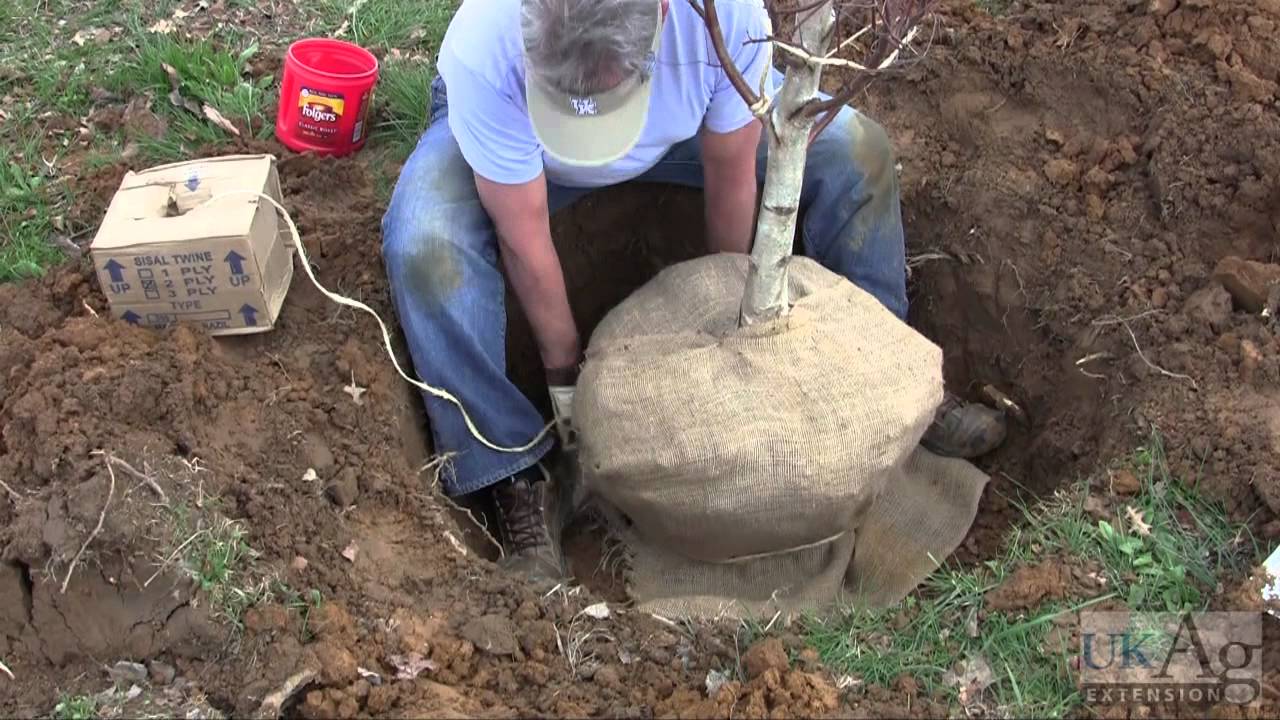
This is a video of digging 2" caliper field grown trees by the book. I watched it last year and broke about half of the rules myself transplanting a few that i placed in wrong spots. I am a learner by video myself so YMMV.

1 Like

Root ball? I am not a ball and burlap nurseryman. My trees are either in Whitcomb in-ground “rootmaker” bags or are grown to move bare root. When I move a bare root tree it has much more root mass than a typical ball and burlap tree. All I know about the ball and burlap method with fruit trees is that there is a wide range of quality between nurseries that produce them… and that those balls sure are heavy! Good soil for this is usually pretty high in clay so the balls stay solid. .

I’ve been involved with several tree-spade jobs with apple trees when moving big trees from 3-8" diameters, but we never B and Bd them- just moved them with the machine except once. That was when I bought about 40 2.5" to 3.5" caliber trees from someone who purchased a former commercial orchard and I paid a tree-spade guy to spend a couple of hours just lifting the trees and dropping them back in the ground in a very clay soil. When I moved them the soil was wet and I broke it away from the roots so I could move 20 trees at a time in my rack body truck by myself. I covered the roots with wet leaves and the trees ended up thriving probably just as well as they would have if I’d transported the ton of soil that would have come with the roots. There are advantages to not having a root ball planted into soil of a different texture.

Thinking back, I really put in some hard working days back then. I’m glad my life is easier now.

1 Like

I moved a couple smaller trees in the fall, about 1" caliper. Dug around the root ball by hand (manageable at that size) then used water to rinse off the dirt and bare-root them as they came out of the hole. Full dormant, early mid Nov zone 5. Replanted in the same yard so they were out of the ground only 30 minutes or so. Carefully spread out all the fine roots while re-planting. Has worked well.

Going to move another tree next month, 2 year old asian pear. Just need to move it 2 ft (neighbors cut down some trees so was able to add some more in the new sunshine and now need to fix the spacing so it doesn’t drive me crazy in ten years :joy:). I have a mini excavator now so might use that, also scheming on a diy tree spade using a shovel blade welded to a jackhammer bit or for a hydraulic breaker on the excavator. In this case since I can just lift it out of the one hole and plop it into the next one with the mini, I think it’s probably lower impact to dig a giant rootball, maybe when the dirt is frozen so it holds together better.

My experience is very limited though so take this with a grain of salt!

Though I dont have any experience with your particular climate, soil and other particulars I would imagine that for zone 6 your well on your way do dormancy by now. At any rate the trees are not putting out new growth so you are good to go for bare root.
Its not that you have to have an immaculate, clean root ball when your done. In my mind the term “bare root” just means not potted or balled and burlapped. You can leave some soil if it looks practical and efficient. Its like @Alan points out though, its just not good for your back.
As long as you kept the bare roots moist and cool you could keep them for months but better insurance would be to plant or heal them in somewhere sooner.
As far as removing above ground material to match the damage to the root system… I have not done this too much except with very big trees, apples and pears, that I ripped out of the ground with a tow strap. Most important for me is to give the transplanted tree a break, the first season, by removing all fruit that has set and watching for suckers and removing.

I’ve moved a bunch of trees by now - if I sat down and thought about it, probably over 30. I planted some too close together, some in a wet spot when they needed a slope, etc. Most were 5-7’ tall on B9, so a lot off the roots were closer to the ground. The M111s were quite a bit taller than I am and about 3” diameter. They were a bear to move, digging by myself, and I ended up cutting off more roots than I wanted to because there was just no way. I have learned to have the new holes mostly dug FIRST and a big pile of compost to heel the trees in in case I ruined my back for the rest of the day.

Digging them up is the hard part. Planting them in a good hole is something I can manage after work if I have to. Needless to say, trees need to be dormant, and I think it’s best if there’s a good soaking rain coming.

And yes - ALL my moved trees survived. The ones I moved due for better drainage actually looked quite a bit better just a few months after moving them. The last 6 I moved have set less fruit than their better initially planted buddies, but I think I will get more fruit in the long run.

I think you made a good choice, especially to continue to honor your brother with his pear.

You should be able to move your trees in the fall easily. Especially being after late October.

You can dig, but you might see if local contractor or nursery could help you out.

A 2" tree balled and burlap should have a 26" ball and that can vary depending on your expertise. If you bare root take as much root as possible. I would prefer to work with the B&B tree especially in the fall. You can dig and not have to hurry and plant right away if you keep it moist.

I ran a commercial nursery, and we would dig malus and prunus in the fall, usually after mid October. We would dig in early September, but we would apply an anti -desiccant prior to digging and water them well. We might wait a little later on prunus if they hadn’t harden off yet. Both were easy to move. We would dig and store under irrigation from one to 6 weeks prior to shipping or selling. Often we would dig late and carry the trees over until the next spring for sales. Certain varieties work better than others for storage and we wouldn’t dig and store malus or prunus out of a preference to dig in the spring. Just the way we did it.

Pears go dormant later, and if they still have leaves when digging I’d use an anti-desiccant prior to digging. We wouldn’t dig pears until early mid November. One of the trees we would hold off digging early. When the leaves were turning color and ready to start to drop, we’d start digging.

We never pruned or removed branches…ever. We would dig 12-16,000 trees in the fall and around 18-21,000 in the spring. Shade and ornamental trees and machine dug.

I hand dug a very dense european fastigate beech once, it was 6" with a 50" ball and we removed some of the interior branches. Beech can be tough to move.

I think branch removal comes from the days when water was harder to supply, handling was slower and balls were smaller for ease of handling. We didnt have skid loaders in the 70-s. Not questioning old timers techniques their reasons were valid. If the tree is very dense or ball too small, it wouldn’t hurt to remove a few branches, but not necessary.

I would suggest whatever way you go, hydrate the tree about 3-5 days prior to digging. Water is the key to success. Soak it and let it dry a little prior to digging. It will also make digging easier.

The pear will be the most challenging of them, but digging it in mid November you should be good. I would not dig it without soaking it in. Dig a little trench around it and soak it.

I can’t stress the benifits of watering fall dug trees prior to digging. A lot of guys would dig and say they would water them after digging. Well you just cut off 70% of the roots and the tree is dehydrated to begin with. Not a good start to a successful transplant. With this belief we we very successful moving fall trees earlier than many other nurseries. In Ohio we are dry in the fall. Prior to drip irrigation, we would trench and water 1000-1500 trees a week prior to digging. 10 guys trenching, 2 guys with water wagons watering. It was a slow process, but essential.

If you hand dig, have a sharp spade to cut roots, with a clean cut while digging. Roots shouldn’t be roo big on a 2" tree. The pears have deeper roots so you may have to dig a deeper ball on them. A lot of root sytems resemble how the top grows. Pears grow up and tall, and their roots go deep. A spade will help cut those deeper roots as you narrow the ball at the bottom. There is some artwork in digging good balls.

Good luck and hope you can save your sentimental trees and enjoy them in your new home.

1 Like

Species react differently to transplanting. Transplanting apples while they still have some leaves can be an advantage if the soil is warm enough (about 50F or above, supposedly) the trees can send out new root that fall in the new location not just from stored energy, but also from photosynthesis derived from those leaves. I never strip off leaves from apple trees while doing Oct through Nov transplants, but I don’t protect them when I transport them in my truck either. I end up usually with some leaves left at the tips of shoots.

**Pears have given me a problem when transplanted bare root. I have lost large trees that I’ve carefully moved that way and had them die even though I saved most of their roots. They have a different kind of root structure than any other common species I grow, more cable-like than easier to transplant species. However, those early failures represent a small number of attempts so I’m not sure if my anecdotes are reliable.

I just asked CHAT about the difference in pears and they do survive much better when balled and burlapped than moved BR based on research it referenced. They do not have the same capacity to replace the fine roots that are lost during a bare root transplant as other common tree fruit species.

Also, root regeneration apparently occurs even when soil temps are in the upper '40’s for apples and pears- peaches need higher temps.

In my nursery, pears from my wholesalers received bare root tend to take more time to re-establish than other species and I always grow them in in-ground Rootmaker bags (a Whitcomb invention). When I receive a mixed species shipment, pears are planted first.

1 Like