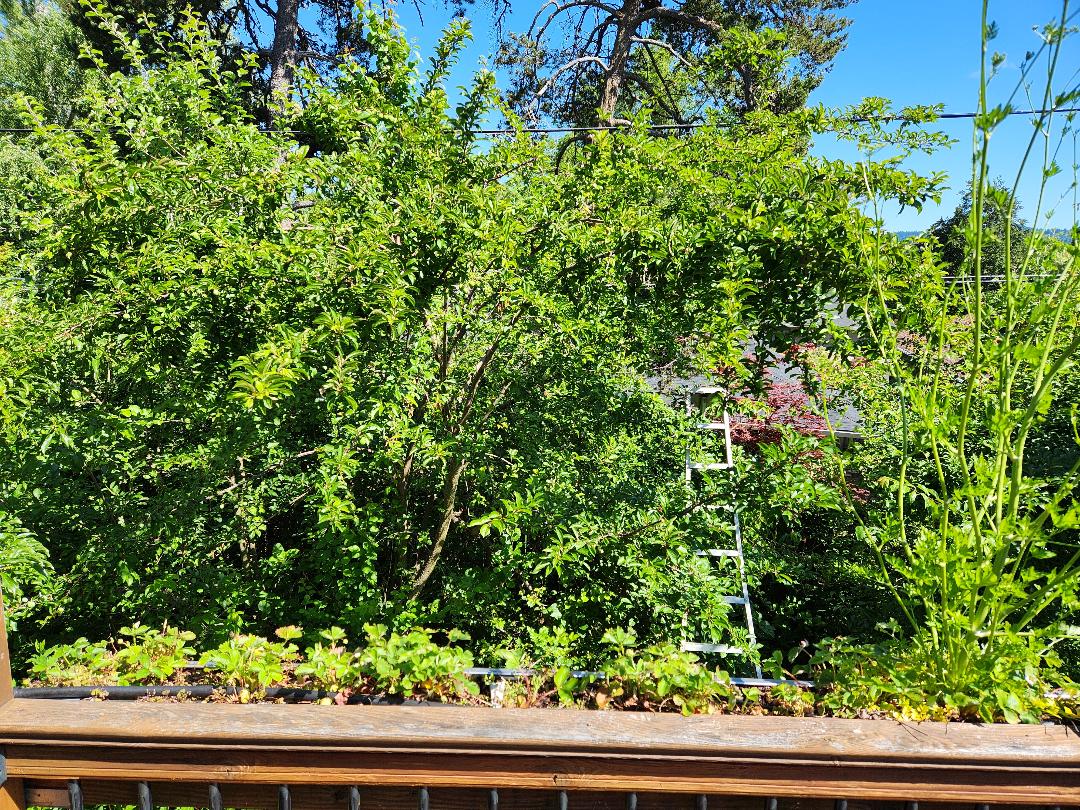
I noticed this year that my plum tree had extraordinary fruit set. I went up and had to thin out probably 500 plums. Then I noticed that one of my favorite varieties, Howard Miracle, had way more branches that it had ever had before. If I didn’t thin them, they would definitely have broken. All of this new growth came after a 7 year plateau in which it had stayed the same size.
I have been finishing up with biocharring my yard. I went through all of the areas that seemed to need it the most. I didn’t biochar the plums until the end because they were already doing so well.
Then I decided that I didn’t have anywhere else to work on, so I biocharred them too. It took me awhile to connect the extra new growth with the biochar, because I’ve been so busy this spring. I’m glad I did though, because it made a big difference.
I’m not saying that this is absolute rock-solid proof. It has just happened with so many other trees like this that it is hard to ignore. With the pie cherry trees, they blew up after an 8 year plateau, and then stayed at the new high level. Same with the American persimmons and the medlar. They never went back down.
Shiro is having a normal good year. Same with Hollywood. Methley is having a huge year, but it’s the same tree. Same with Santa Rosa.
The multi-year step-change pattern you’re describing with the pie cherries and persimmons is interesting — consistent with the idea that it takes a season or two for the biochar to fully charge and for the microbial community to establish around it. One application paying dividends for years is exactly the appeal. Do you inoculate the char before applying, or just work it in raw?
The question is, did your tree have a great fruit set, or did your tree create several new branches this year after being on a plateau for 7 years? There is a big difference between the two. My tree grew a lot more Howard Miracles because those branches weren’t there last year.
Since the most active growing roots are at the dripline, I dig in biochar in a circle around the dripline of the tree. I dig in the spade, jimmy it back and forth to create a crevasse, then fill it with biochar. Then I cover it with soil or mulch.
John S
PDX OR
What are you using to innoculate the char after you make it? I have a large bag still from last year that I have used here and there not realizing I should innoculate it?
It’s the opposite on the east coast in your latitude. Last year was our year… my Flavor Supreme set a good crop for the first time then… I didn’t realize it ripened so soon and lost most of the crop. This season we had a 4 day April temp swing that shattered the previous record by 7 degrees, going from 90F down to 24 in that time. The heat really softened up the flowers.
I think it’s good to use stuff that is nutritious but is cheap for you. I use whole wheat flour, ag lime, sea weed, compost, rotten fruit, rotten wood, worm castings and urine. Lots of people use different versions that are cheap for them. Some people have chickens or other animals that give manures. You can leave it in compost. It works really well and is easy, but it takes much longer than using a liquid inoculation.
John S
PDX OR