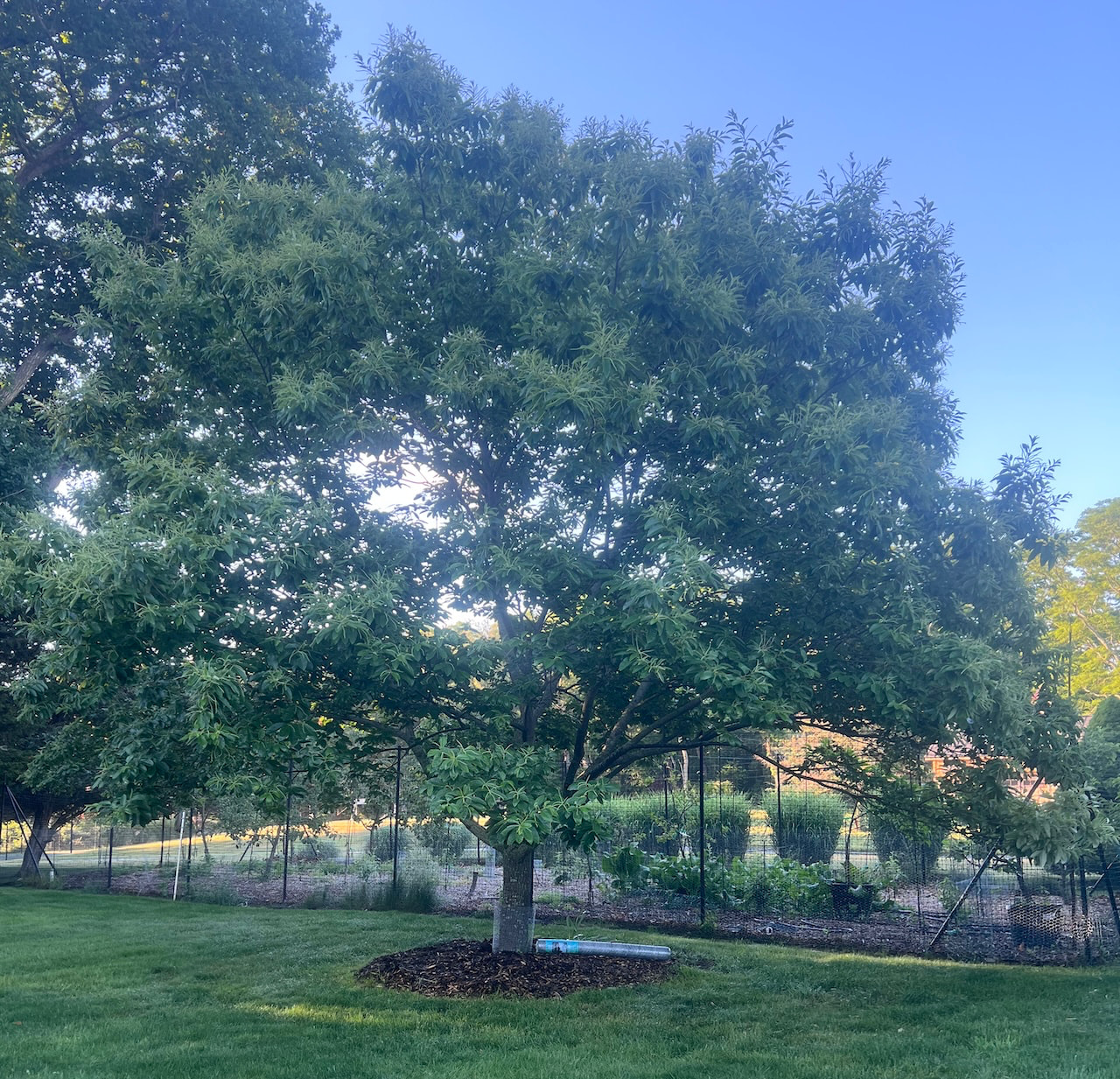
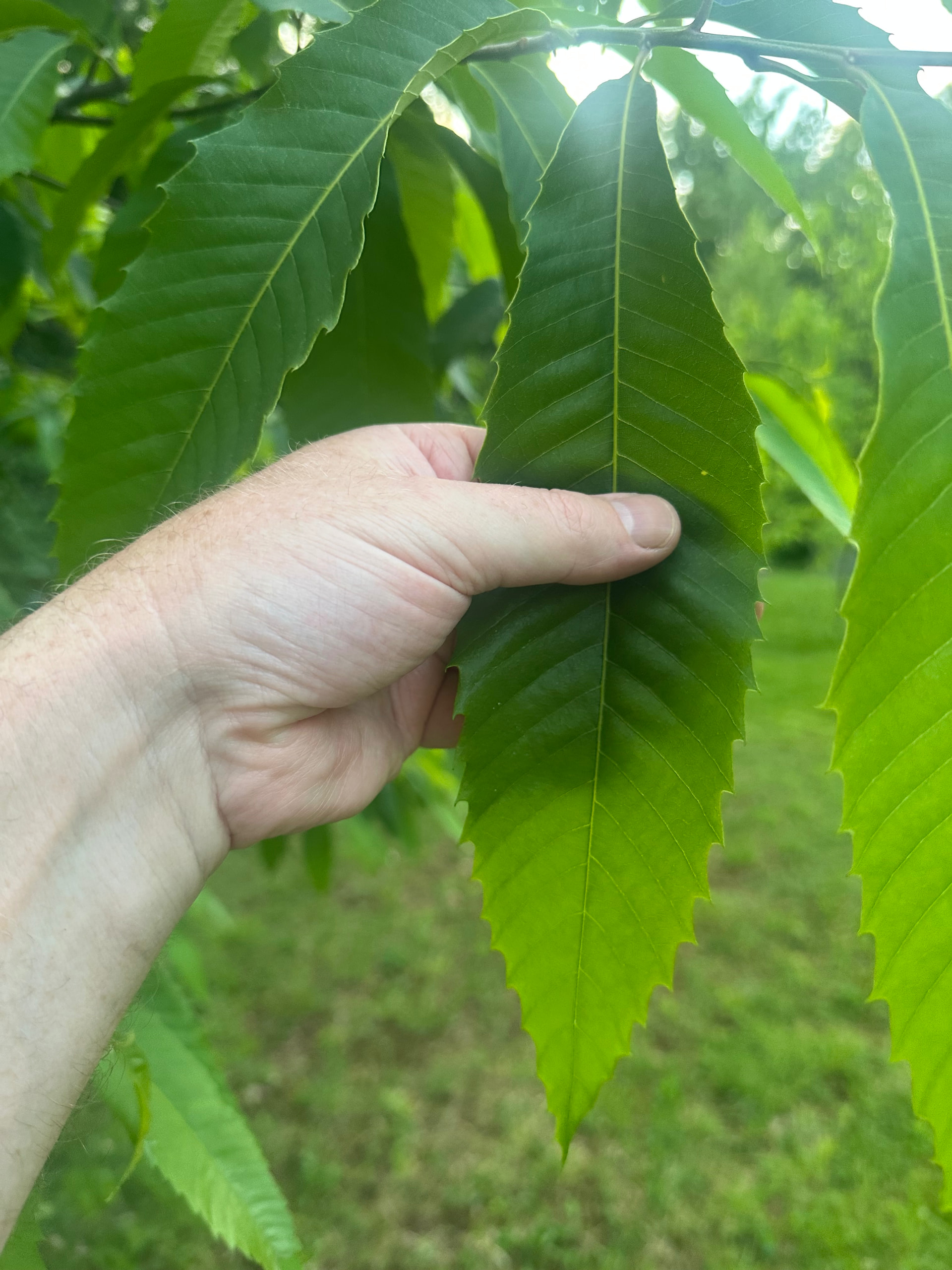
In 2015, I planted two Qing seedlings. They’ve grown well. One is a very prolific bearer, producing tasty nuts. The other is less prolific, but works well as a pollinator. I get roughly 1000 nuts from #1 and 300 from #2. Here’s a pic of #2, blooming now.
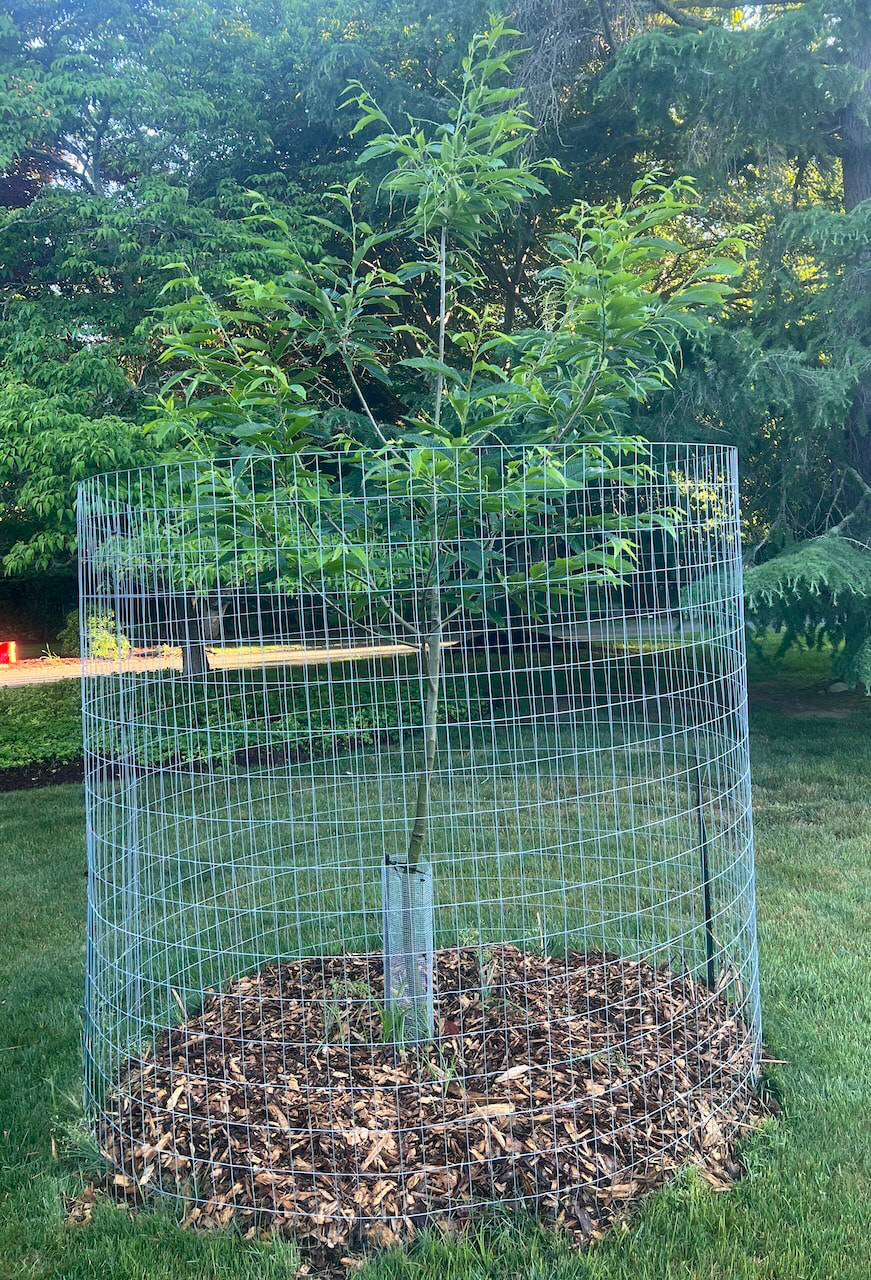
That’s more chestnuts than one family needs, but I was curious about other varieties so in 2024 I planted two seedlings of Hong Kong and one of Mossbarger. To my surprise, one of the Hong Kong seedlings is blooming. That’s a 6’ fence.
FWIW I’ve seen no evidence of disease and only the very slightest insect damage. These trees are trouble-free. The harvest window is short, however. I need to be vigilant or else squirrels and deer will eat more than I do.
Looks like my one dentata that has bloomed the past few years is on its last leg. It got blight near the base last year and cankered. This year I tried to mudpack it and the stress attracted ambrosia beetles. Now the other side of the tree is starting to crack and canker. The canopy still looks healthy, but it’s only a matter of time before it dies. There’s a lot of sucker growth below the canker too. I think I’ll keep letting it die…no use in keeping a tree that succumbs that easily. I have more dentata seedlings to plant.
I’m just hoping one of the other trees will flower this year and that I can get one year of nuts before the aforementioned tree dies.
These pure American trees are a novelty to me. I expect them to die, but I enjoy watching them grow.
Since squirrels are getting your nuts let me know when you start finding seedlings growing in your woods and hedgerows. A have planted oaks on one half of our property from the red oaks that my father planted almost 30 years ago.
Those Qing look fantastic. 1000 nuts from one tree is a solid haul. Curious how the Hong Kong seedlings do in comparison once they start producing properly.
I’m not an expert with American chestnut, but I think you can copace them to get healthy growth again.
If I’m right, which you should check, you can cut the tree way down low and tar the stump when there are some warm days in the coming winter, then it should send up lots of new suckers that will be healthy until they get older.
You would think they squirrels would replant them, but unless the seedling gets enough light when it sprouts it likely wont make it. Besides American chestnuts and other chinquapins, I dont think most cultivated chestnuts have the genetics for surviving in closed canopies(waiting for an opening). There are lots of older Chinese chestnuts in my area, but you can tell they were all intentionally planted. Have yet to see one sprouting out of a fencerow(but that would be awesome).
Yeah there’s a lot of suckers coming up from the base now that look healthy. I just mean that this tree’s specific genetics didn’t enable it to survive much into maturity. Maybe it would’ve made some nuts before it was blighted if the others had been flowering, but I’m hoping for a little more fight from my trees. A lot of these next gen seedlings from hand pollinated trees develop, what the dentata guys call, “cruddy bark”. The trees try to heal around the damage and survive above the attack. This tree of mine folded like the Spurs with one infection at the base originating from a dead, shadowed out twig of a branch.
If they want to impose some hypovirulence in my fungal strains up here I’ll gladly let the suckers regrow.
If you could graft low enough you could probably use suckers as rootstock for blight resistant chestnuts. Blight doesnt grow below the soil line.
That way you could grow a lot of varieties in a smaller space, and if you ever wanted the American back for whatever reason you could just cut the grafts and let it resprout.
LOL. I guess I can respect the passion. But personally I just have no interest in anything other than a tree that will still be alive and bearing fruit after years of care.
Actually the squirrels aren’t getting my nuts because I do pay attention to the ripening window. When the burrs open, it’s easy to knock out the nuts or even the whole burr. So that’s what I do. I either pick up the fallen nuts or break open the fallen burr to remove the nuts still inside.
Ha…I hear ya. Thankfully there’s no care involved. They have a corner of the field where they just grow as shade trees near the edge of the back woods. I’ve got enough fruit trees to give me headaches elsewhere on the property. I just have a thing for endangered native trees. There’s a lot of white ash, beech, and american elm surviving here too.
Yeah, me too. But I’m doubtful that the various species can survive without some directed evolution. Like I can imagine an American x Chinese hybrid that is resistant to blight, backcrossed repeatedly to Americans, with offspring selected only if they show continued resistance. Hypothetically, we could end up with an American phenotype with resistance.
I know nothing about actual breeding efforts. Probably an effort along these lines in in progress.
It’s not hypothetical! There are 7/8ths American hybrids already, and they are virtually indistinguishable from American chestnuts!
As soon as I can I’d like to buy seedlings from these guys and plant them all over. Definitely on every edge of my parents’ property and my sisters too so that they spread everywhere, but are protected from being cut down.
There’s a lot of growers of pure dentata out there that are getting nuts. For decades they’ve been handpollinating trees across state lines of large trees eastern trees and growing the nuts out in orchards.
John at GoNative is on his 3rd generation of trees now.
I know a few others that have stands of 100% dentata with 40-50ft nut producing trees. Some of them get blight and find a way to fight through the infection. Some of the most resistant trees are being grafted as well.
The GMO Darling 54/58 trees hit a roadblock because they mixed up the labeling of the trees before they went out into experimental orchards. I was emailing with William Powell from SUNY EF occasionally a couple years before he passed away. The Darling 58 trees showed great resistance and growth rates similar to the regular trees. The OxO gene was inserted so that the wheat gene only turned on if it detected the blight stress. Unfortunately he got sick soon after and passed, the trees got mislabeled, and Darling 54 went out to test orchards and D58 got lost. The test trees all showed poor growth in field tests…turns out the D54 trees had the OxO inserted which caused the wheat gene to be “turned on” all of the time. So the tree was sort of always in a stressed “fight mode”. TACF backed out quickly, but SUNY EF is still pushing forward to have the D54 trees approved by the government.
So a lot of us are growing pure dentata and are just trying to improve the resistance the old fashioned way. If we can get trees that can consistently survive to maturity before succumbing that would be a big step as they could at least somewhat get past the “functionally extinct” point even if they aren’t becoming huge canopy trees again yet. But our group is strongly anti-hybrid when it comes to trying to make an american chestnut tree that is suitable for reforestation. Even the 15/16 dentata hybrids struggle to compete with the larger hardwoods in forest settings.
It’s definitely a long game. I don’t expect a miracle in my lifetime, but I enjoy the trees while they’re alive nonetheless.
A GMO monster would be the worst possible version of the American chestnuts “surviving”. I hope every last GMO tree dies as fast as possible by any means necessary before they infect nature irreparably like the GMO Papaya has destroyed most of the world’s Papaya outside of Thailand.
I can’t imagine what the thinking of people is who would rather have the American chestnut crossed with wheat, which is nothing like a Chestnut tree, than crossed with Chinese chestnut which is 99+% genetically similar to American chestnuts already.
A lot of good discussion on American chestnut, personally I’d love to have them back, but most of hybridization efforts for the last hundred years focused on the wrong germplasm(not their fault, its what they had). Personally I don’t see any issue with hybrid chestnuts, animals will eat the nuts either way, but the challenge with restoration is having a tree that can tolerate low light levels in a forest canopy. Then once the canopy opens up outcompete the other trees present, so it can get large enough to produce nuts. I suspect that if the US had gotten timber type Chinese chestnuts including Henryi, the hybrid breeding approach could have possibly worked. I would be skeptical of anyone selling blight resistant pure or nearly pure Americans. They are more likely escaping blight rather than resisting blight.
@weatherandtrees Im a big fan of planting pure Americans to keep the germplasm alive, but what good is a nut tree with no nuts? I was thinking maybe grafting Ozark chinquapins or Allegheny chinquapins. Pure wildlife food that might actually have a chance to establish a population. At the end of the day they are yours to do as you see fit, just throwing out some ideas.
This is where natural selection will really come in, if we plant ones that look Americans, produce lots of medium size nuts that taste American, and the tree grows like an American chestnut, but is fully blight resistant, then their of spring will have to start competing, and when we find the best re-wilded specimens, those are the ones we should graft and grow to produce seeds and even for everyone to keep planting in the forest, but perhaps the American Chestnut Foundation and Tom Saielli’s chestnut program will be lucky and it will be done already, I’m sure there are some people with mature American chestnuts who will want to try to make further crosses and get to 15/16ths or higher, and good luck to them! But if we ever get to 31/32nds, it is for all practical purposes, a pure American Chestnut again.