Drip irrigation and various tree watering needs questions for SoCal 10a

I am going to be planting a variety of trees in a row and drip irrigation is being set up for watering - but it’s still not set up and I have never used drip irrigation before, so it will be totally new to me. I was going to have a ring installed around each tree, but I recently read that one weakness of using the ring is it may not get water close enough to the trunk for a young still growing tree, and I also read that for trees in a row it is better to use a double line system.

But if the trees are different varities with different watering needs, is a double line system still advisable? I can see how that would work in an orchard where all the trees are the exact same, but mine will be all different kinds. Some trees will need more water, others less. It also seems as the trees get larger you will still need to be able to adjust watering, giving fruiting trees more water, for example. How is this customization done when you using a drip system? Is there a way to control the amount of water going to individual trees?

1 Like

I don’t irrigate my hobby orchard but I’ve been irrigating my veggie garden for years with drip irrigation.

I run a 1/2 inch main line to all my plants and run 1/4 drip tube off the mainline with an individual dripper. you can run more than one dripper per tree and use different speed drippers to regulate how much each plant gets. some good mulching and a long slow drip before sunrise will do just fine for most things

What trees are you growing and in what climate?

When you say you are using a ring what are you talking about? Like a ring of drip line? I’ve used drip line before but I’m not much of a fan of it. I find with cleanable drippers you have more control of where and how much water is given.

These are the drippers I like.
https://www.dripdepot.com/ceta-cleanable-pc-dripper

2 Likes

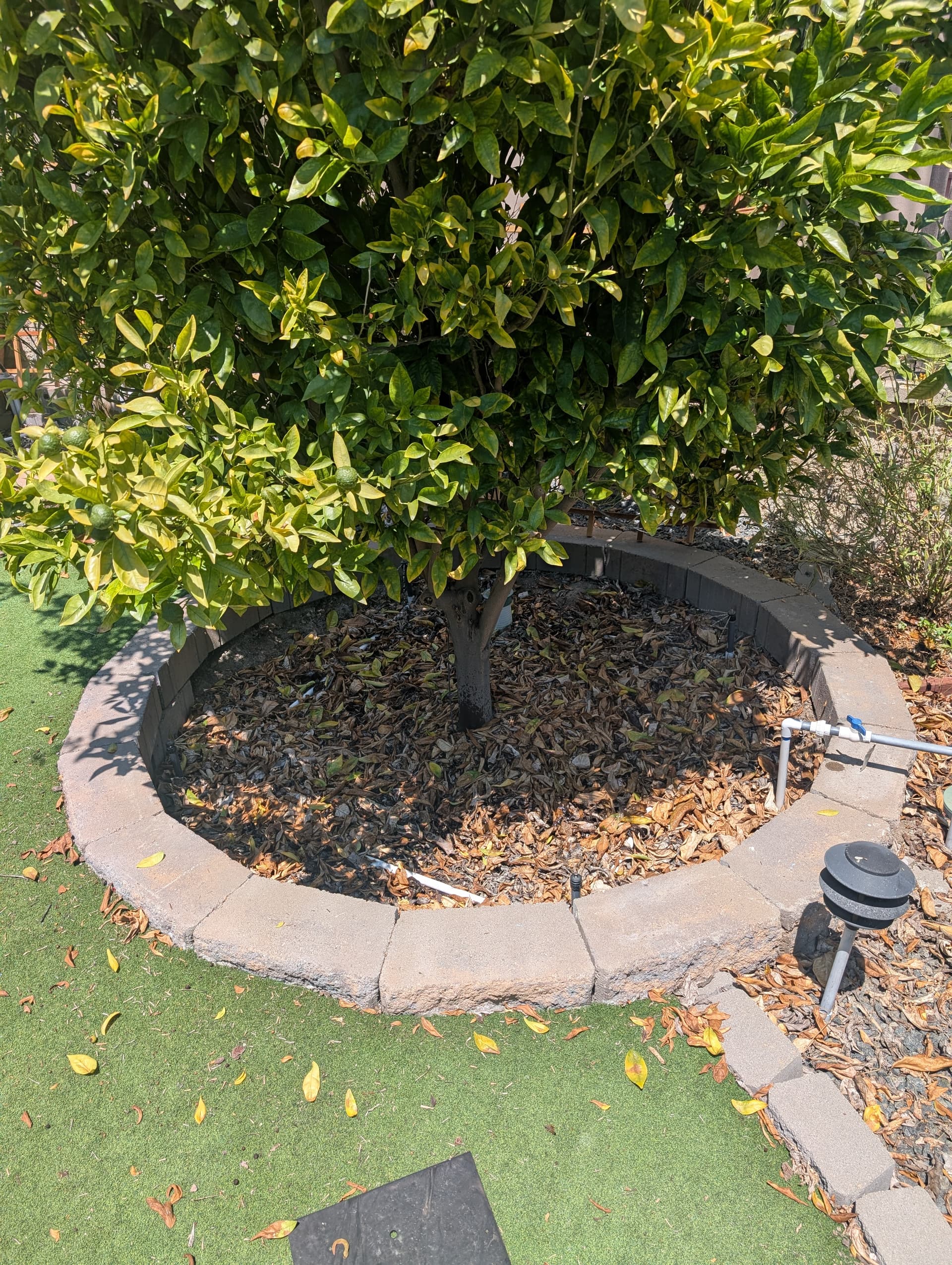
In our climate, drop irrigation is sufficient for ornamentals but insufficient for fruiting plants. The volume of your harvest will be proportional to the volume of roots. In our climate of high evaporation, water from drip emitters percolates down, creating small loci of moisture at which roots congregate. A better approach is to build basins around your trees filled with 1" conifer bark and flood them with water once per week in cooler seasons and twice per week (as necessary) in warmer months.

3 Likes

I’m in socal 10a, by the coast. average temps most of the year between 65-75, very little rainfall, often high humidity. I have wide variety of trees: fuji apple, white vernon sapote, vietnamese cherimoya, manila mago, reed & GEM avocados, royal crimson cherry, viollete de bourdeaux fig, and a number of citrus.
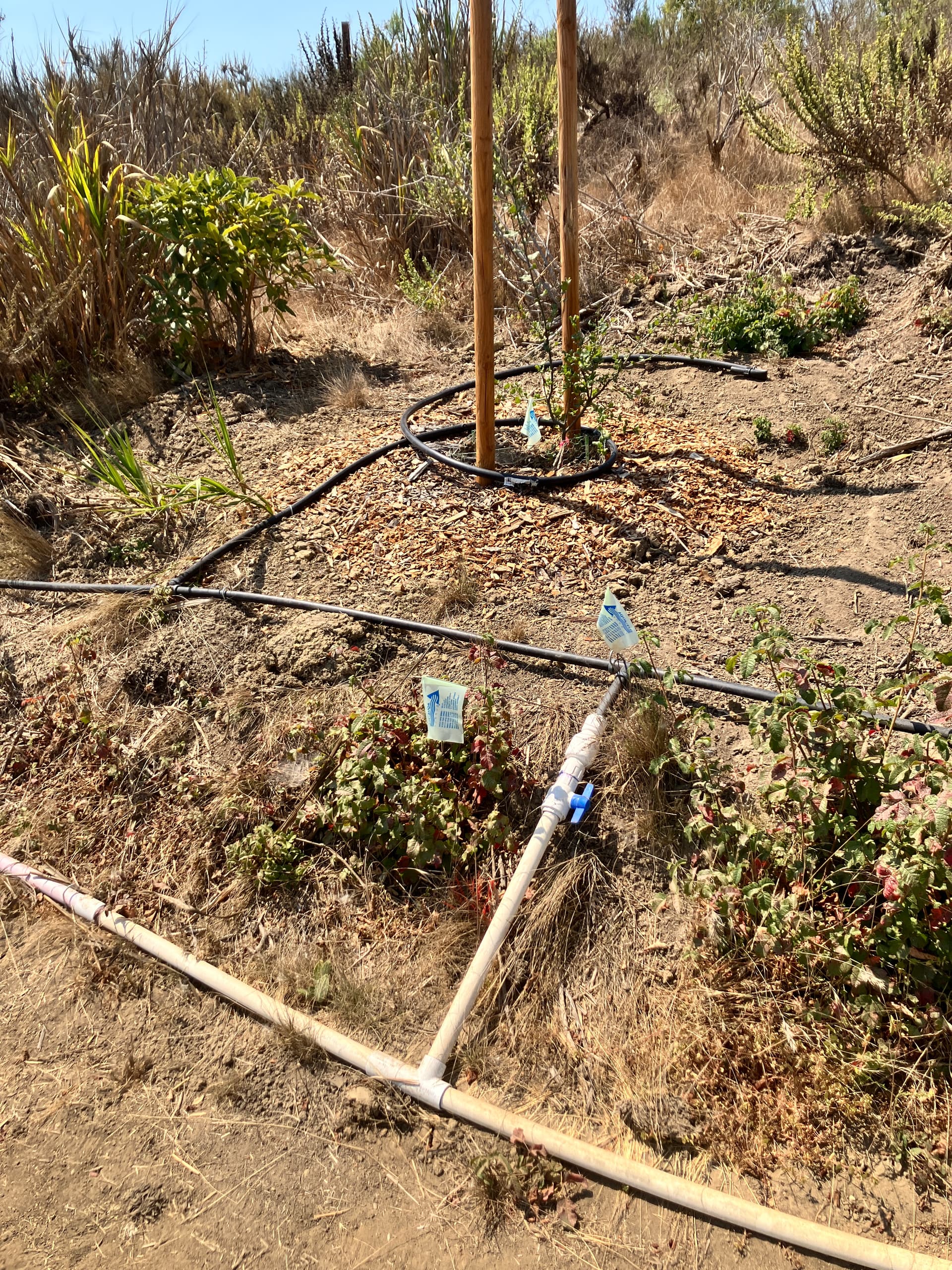
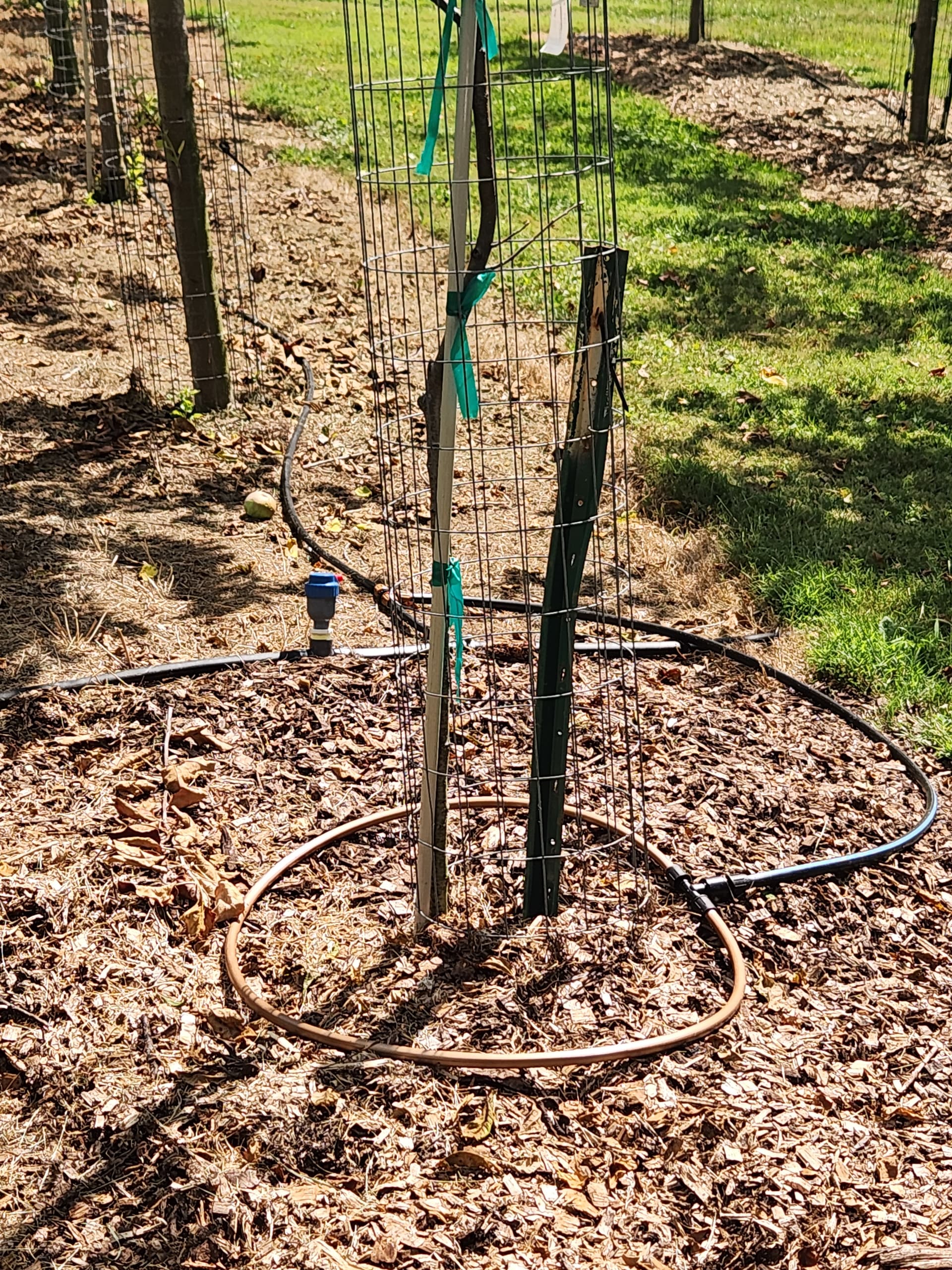
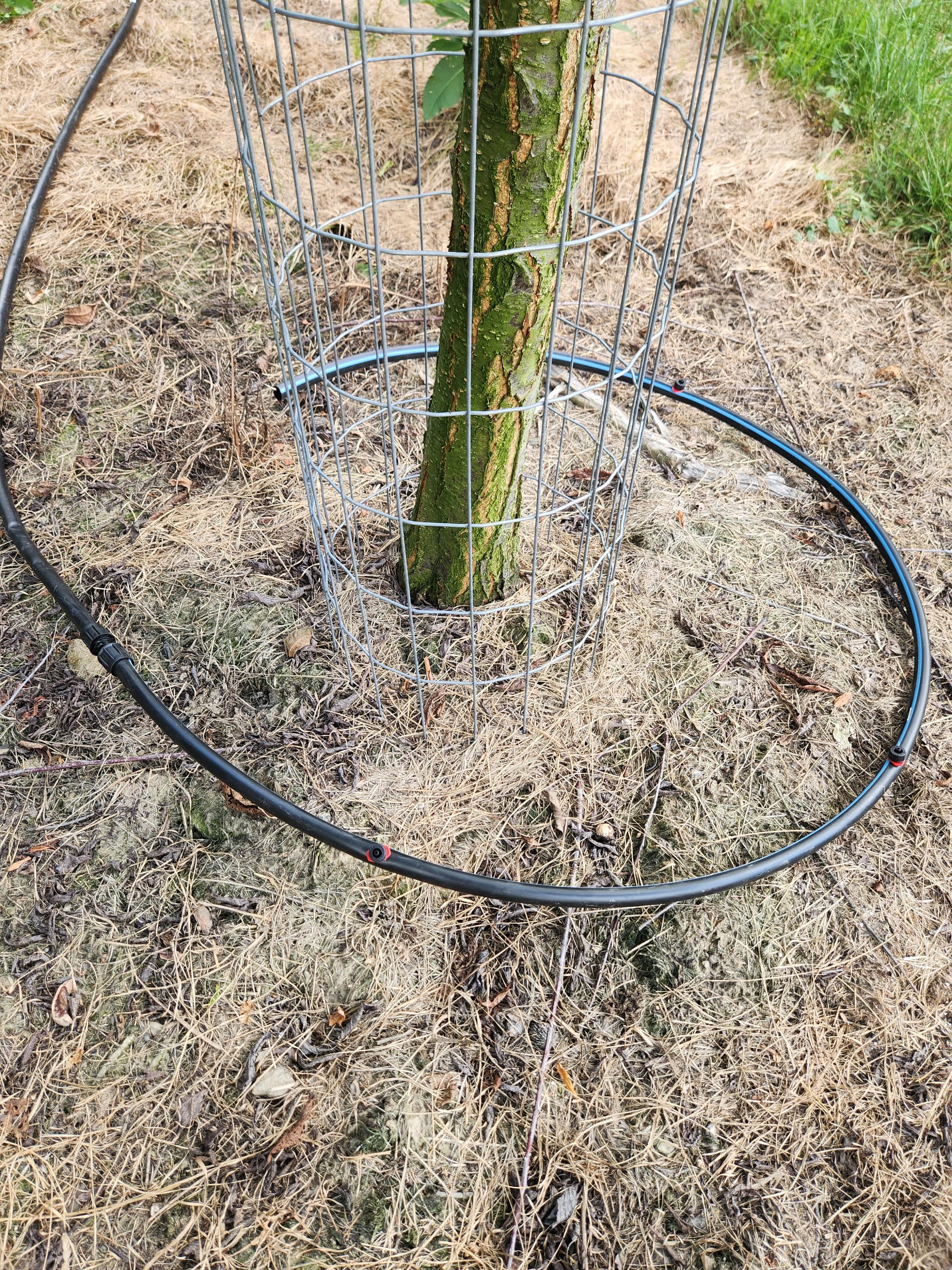
I meant making a ring around the tree with using drip irrigation tubes. I saw they did this at a park nearby where they planted new trees, though these were ornamental trees as Richard mentioned. They took a tube and basically made a loop around the tree, which had I think about 3 emitters inside.

not great news, since they’ve already installed most of the infracstructure for drip. is there some way in which it could still be useful, so long as I use other watering methods as well?

when you say flood the basin, what’s the best way to do this, just leave a hose running near the tree? or spray on a shower setting for a certain amount of time/

for 1" confier bark, would the timberline “pine nuggets” work? how wide and deep do you recommend making the basin around each tree?
and if you have a basin filled with bark around the tree, how do you apply fertilizer?

Do you feel microsprinklers would be superior or drip, or they wouldn’t be effective either?

1 Like

I warned you about infrastructure and you laughed it off! My basins each contain four 1/2" risers with shrub streamer heads. They remain on long enough to saturate the basin. If your soil is clay-like, then you’ll need to remediate it, plus install sock-covered french drain pipe about 3 feet below center of the tree basin that leads off somewhere downhill. For top dressing I use Sequoia (brand) pathway bark. It is sold by suppliers to the horticultural trade, e.g. Nutrien Ag.

Drip is way better than micro sprinklers.

I can’t speak to 10a + drip (when I lived there I used a garden hose) and watered in the super early AM. However, I have drip set up now around my young trees. I also have mulch or leaves or dry grass or something around the base of them to help retain water. I still only water at night or early morning to avoid excess evaporation.

I started with the rings but they annoyed me because repairing them meant cutting them off. I have spirals (it’s just a piece of drip line with a plug at the end that I circle around the tree where the tree’s drip line is) or drippers.

I feel like the spirals are better because they get more of the root area, but deficit watering studies have shown that doesn’t matter much for what I’m growing (peaches). You should look up some studies for whatever you’re growing and maybe that will give you some insight.

I do what @Bigmike1116 does and I have 1/2" line and then run the 1/4" off of it. I use a section of non-drip 1/4" then attach the drip 1/4" or a dripper. The furthest I run the non-drip 1/4" is about 3 feet . You can run it further pressure-wise, but it doesn’t stay down, even when I use the lawn staples, and I end up running it over with the mower or string trimmer or something.

For each of the newly planted peach trees, I know I need to give them about 5 gal of water every 5 days or so, if it doesn’t rain. I don’t actually like to do the five gallons all in one day. So I made sure to put the correct drippers so that if I watered an hour they’d get ~2.5 gal. You might have to size your system smaller depending on how much water you’ve got - I’m on a farm with a well so mine is sized for my well head and flow rate.

Also, the idea of getting a “deep soak” which is what I think @Richard is talking about, is recommended for some fruit trees and you can do it with the drip irrigation. You just have to properly size and run your system.

You can make small rings, multiple rings, or spirals like I described above and it will get close enough to the trunk.

Probably this is true at a commercial scale. Especially in terms of cost. I have some drip tape in my system and that stuff is great for row things and cheap but I don’t use it for my trees.

Yes, you can just change the number or type of dripper/ drip line. You do have to swap them out if you want a tree to get more or less water later.

2 Likes

There is more than one way to skin a cat so don’t be too intimidated by all the advice- take and do what you can. While I’m sure there is some difference in the type and brand of mulch -you’ll see people using all sorts of mulches on this site. The idea is to put something to keep the moisture there, to suppress weeds, and perhaps it decomposes and adds some nutrients back depending on what your mulch is.

However, don’t ignore an underlying piece of what @Richard is saying: some trees really hate having “wet feet” so make sure that they have proper drainage. It can be accomplished by putting in drainage or building on a mound or raised bed. It’s also worth examining your soil (clay, sand, loam?) and potentially having it tested.

The same way you’d do it normally. You can put granular fertilizer around the base in the bark. You could put liquid fertilizer when you water or use foliar fertilizer. You may not even need to fertilize depending on the condition of your soil. When I lived in so.cal I had good soil without any remediation.

2 Likes

thanks for all the detailed info, benthegirl.

I’m wondering if the one I saw at the one park here is actually the spiral type you are describing. I’m attaching a picture I took. Is that it? Or if not, do you have a picture of link to a picture of the spiral type?

When looking for studies do you have any recommended search terms to get this info? Or just search “drip irrigation study” and name of tree?

All my trees will be growing in a long raised bed filled with sandy loam with drainage built in - so that part at least is taken care of!

At the Fair Oak Horticultural Center in the Sacramento area (zone 9b), there is a high density fruit orchard, run by master gardeners, with open gardens monthly thought stone fruit season. Last I checked, they run a few shrubblers per tree, and run for 45-60 minutes 1-2x per week.

I’ve emulated them and for the last 4-5 years my trees have been doing well with this.

I’m currently watering 1x per week (2-3 shrubblers per tree) for my established stone fruit. For new trees, I water more frequently. I water my citrus and avocados much shorter durations, but daily. I’m sure there are better schedules (and I’m still trying to work on that), but my trees are alive and look happy.

1 Like

What is the current setup? Is it just mainline going through your trees?

There are so many different kinds of emitters that could meet whatever need you have. I left my garden for 2.5 months with just the drip system going and it watered all my potted and in-ground plants with a combination of drip emitters, micro sprinklers, stake sprinklers, micro jets, spot spitters, etc.

You can run smaller lines line Bigmike advised and then put whatever emitter you need. There are different flowrates to them as well.

I did on my drip setup. You can get an idea of what the different emitters can do: https://www.youtube.com/watch?v=zUyU2sNdbt4

I am also in 10A in SoCal :grin:

2 Likes

I think that what is in the picture is the same as what I do. It looks like 1/2" line - I have 1/4" with emitters built in.

The stuff I read was done in CA on peaches and almonds. I wasn’t actually looking for things about irrigation but ended up reading a bunch of studies where they tried different irrigation methods to see under what conditions the trees would still grow properly and produce.

I usually start with google scholar if I’m looking for studies. But honestly, that seems like overkill and probably isn’t relevant since those things are for commercial producers who are trying to maximize production under pretty limited circumstances.

Here is a guy who has posted a lot of information about drip irrigation and his fruit trees: Watering fruit trees with drip irrigation - Greg Alder's Yard Posts: Southern California food gardening and he’s in so. cal. So maybe his stuff will help you.

2 Likes

I was installing some drip tubing today and thought of this post. I thought I’d put my two cents in.

Your quote,

I recently read that one weakness of using the ring is it may not get water close enough to the trunk for a young still growing tree, and I also read that for trees in a row it is better to use a double line system.

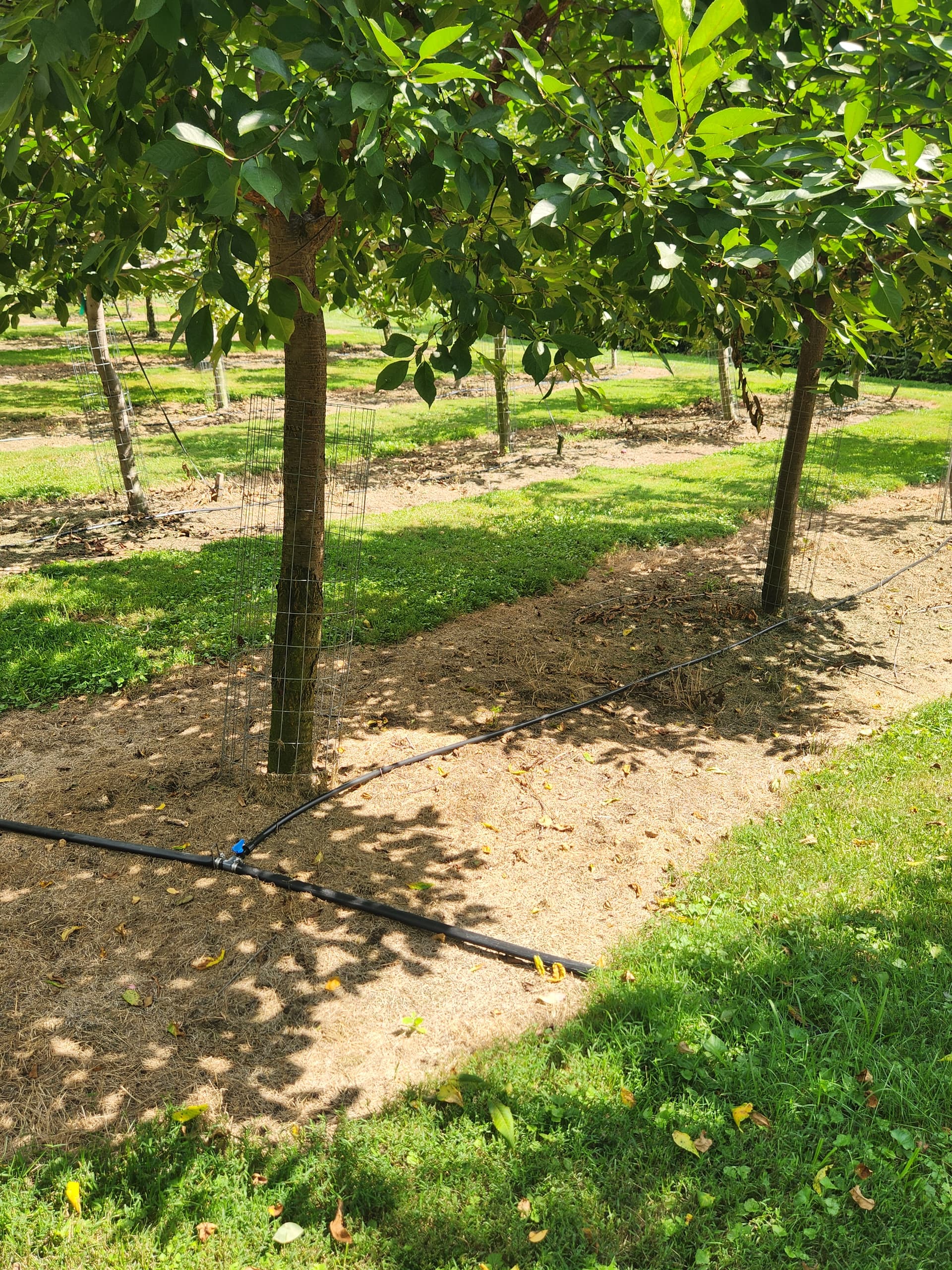
The water coming from the emmiters in the drip tubing doesn’t go straight down, but it spreads out through capillary action. Like a cone. If you see where it drips and then dig down a little you will see water has radiadted outward and creating a band. My suppliers would tell me the width of the band will be about the same distance that the emmiters are spaced. So my drip tubing with 24" emitter spacing will lay a band down the row about 24" wide. It sometimes looks dry on top of the mulch, but damp below it. So it doesn’t need to be right up to the tree, just close. Two lines are not necessary. Maybe if you have sandy soils, ours is a silt loam to clay. It doesn’t hurt to use two, but would cut you run time down. I’ve always found one line is plenty.

I ran some 1" lay flat tubing as my main line, and 1/2" pressure compensating drip tubing for my laterals.

I have some areas that get heavy pressure for water from some neighboring trees in the tree line. One is a pig nut hickory 4’ in diameter and a 30" walnut. They suck up all the water. In those locations I want extra water so I add and extra emitter to that tree and other times I use a ring.


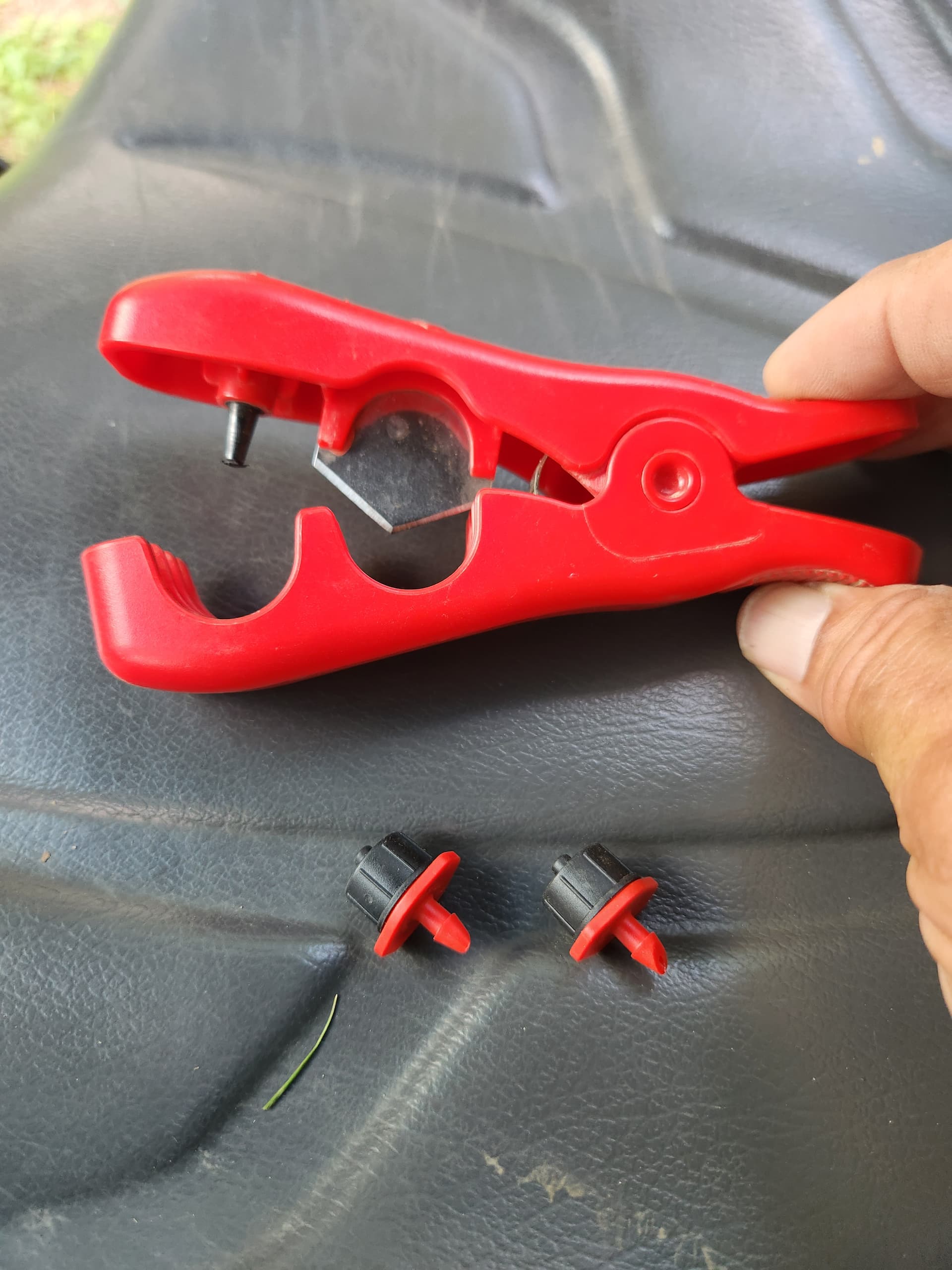
I used this punch and put a 1/2 gph emitter into the tubing. Usually right at the trunk. Just adding a little extra water. I think my peaches need a little extra so I may add one extra emitter if its in the same row as apples.

I use these rings sometimes, they add expense but work well and will deliver a lot more water around the tree. I use the 1/2" tubing, and a tee. The tee end is smaller for the 6mm Rainbird emitter tubing that I create the loop with. They aren’t easy to remove if you need to.

At the end of the lateral lines I make a little pig tail loop. The tubing naturally wants to lay like this and that gives the last tree a little extra moisture, since the tubing doesn’t continue on past it. You could create loops in this fashion. Here I ran out of drip tubing, so I used regular poly and punched in 3 1/2 gph emitters.

As tree mature you may have to increase your run times. The key is to not let it dry up, and give them enough moisture and the roots will find it and distribute it out to the whole tree.

I use PC tubing and not tape. Tape has a lesser mil value and is less permanent. Crows will come in and poke holes in the tape, just for a drink or a shower. Knowing them maybe just to aggravate me. I’ve seen them poke a hundred holes in an afternoon where I use to work. The tubing is much more durable for orchards long term needs. It will last for years. I think tubing is 45 mil and tape is as low as 5 or 7 mil.

I also use 1/2" poly and punch in the emitters at each tree in some areas, 2 per apples 18" apart, and 3 for peaches. It works pretty well, but is more expensive and time consuming. I put the lay flat tubing and laterals in on 13 rows last Thursday and it only took 3 hours. If it wasnt drip tubing I’d have to go back and punch in 120 emitters. Big time saver.

I’m watering 175 trees at a time, and the system is feed with 200’ of 3/4" garden hose, with the pressure turned up at the well to a 40-60psi cycle. Plenty of water to spare. I will run the drip tubing about 8 hours a week in long sets and my tall spindle apple trellis 2 hours every other day if needed.

You said you never installed drip and this is how I do it. There are a lot of way to do it, and none are perfect or fit everyones needs.

Good luck.
5 Likes

Thanks for your feedback. Nothing is set up yet - just in the planning stages. So I can still make changes.

1 Like

Thanks for going into such detail about your system. Very helpful, although I don’t know all the terminology yet - I’m sure in the near future it will all make sense!

1 Like

Grouping trees by similar water needs is a good idea; i.e. put lower-water stuff like pomegranates together on a separate line or in one end of the bed with a shutoff valve. Or if you use a ring like the one @JAF showed, you can put a T with a valve to shut off water to individual trees you don’t want to irrigate.

1 Like

Hi, I was a landscape irrigation designer in SoCal. Actually went to school for it.
Here are some thoughts.
First remember that 1/2 inch tubing will generally flow about 300 gallons/ hour. You should really use only about 75% of that volume. Drip rings work fine, but are a bit better on larger trees. Commercial orchards use micro rainbirds, not because they are more thrifty, but because an orchard worker can see if they are working driving down the row. Make sure you install a pressure regulator and filter. Rainbird makes the best emitters in my opinion. All of them are barbed on both ends. They can be installed with out a punch. One end is sharp. How you set up the drip on each tree depends on your soil. On sandy soil you will need more than one usually. Clay soils will need maybe only one, but longer run times. I would start with the rainbird 5g/hr emitters. Adjust your run time depending on weather and soil. Also keep your irrigation lines on soil surface if you do any heavy cultivating. Just move them, run your tiller or tractor and then put them back. Keep track of how many emitters you have running. Try not to gonover the 75%.

3 Likes

i always see orchards have them hanging the mainline in the air so that they can mow, trim, prune etc around the lower part of the plants w/o damaging the irrigation in any way.

1 Like