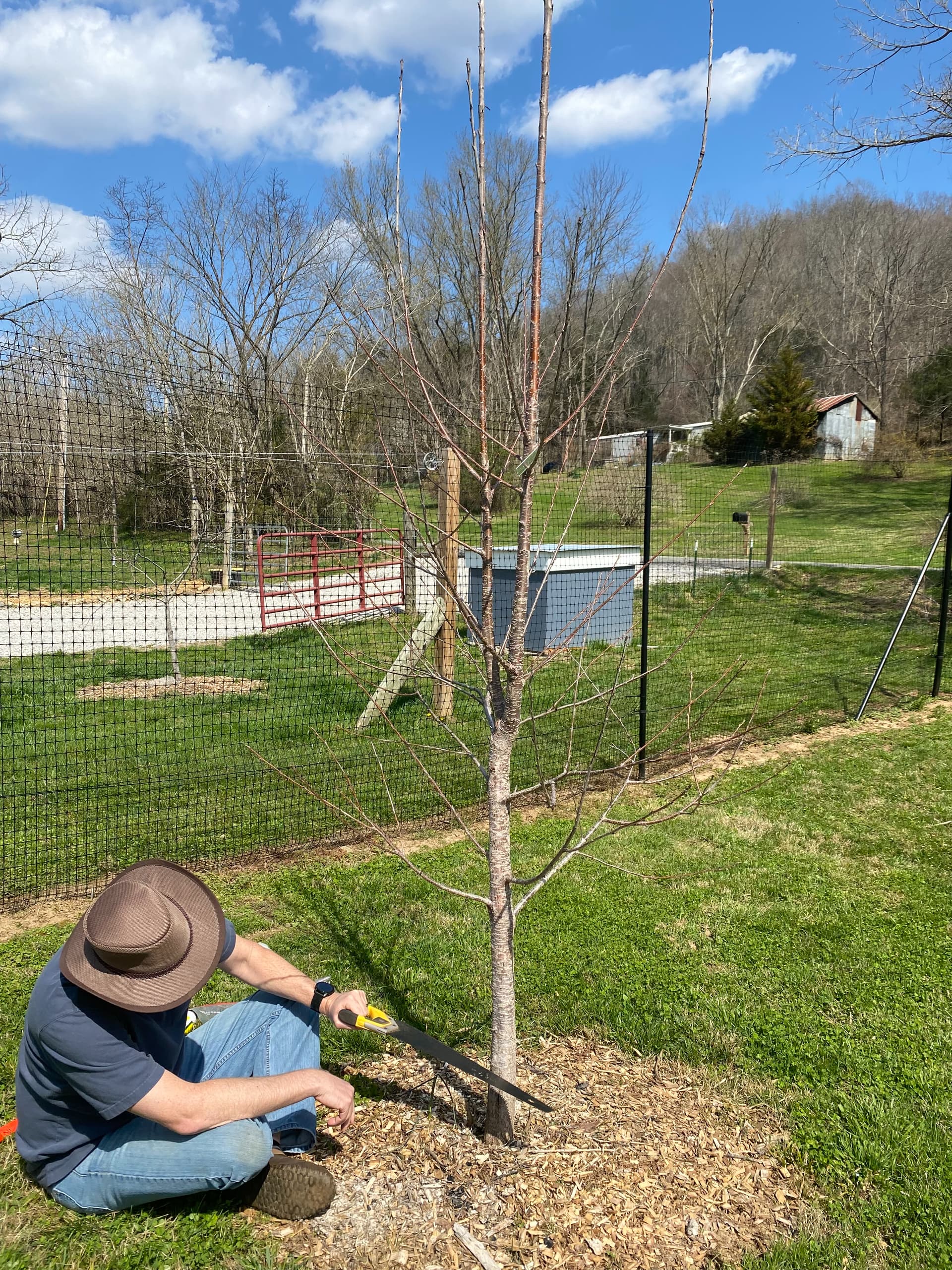
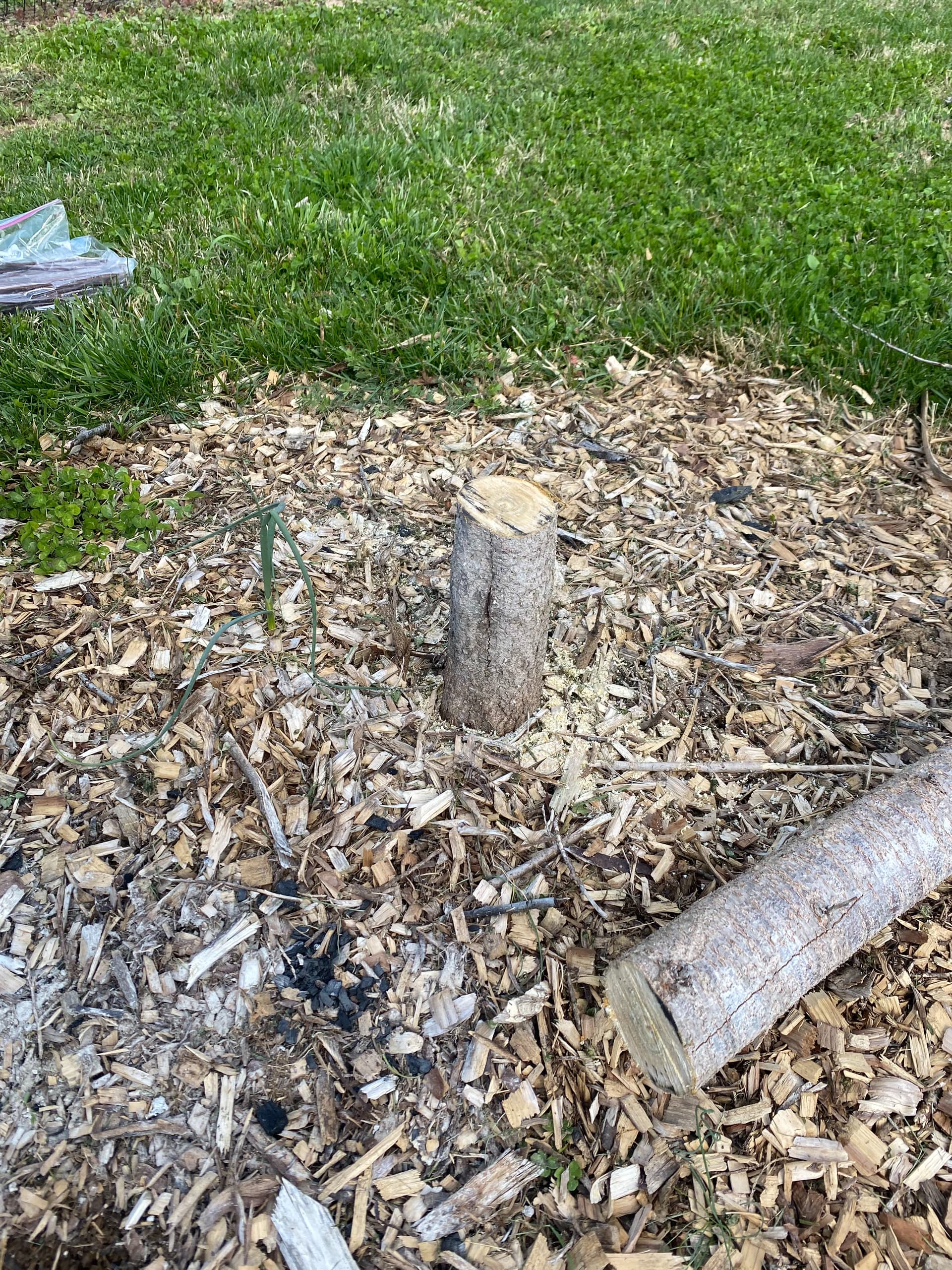
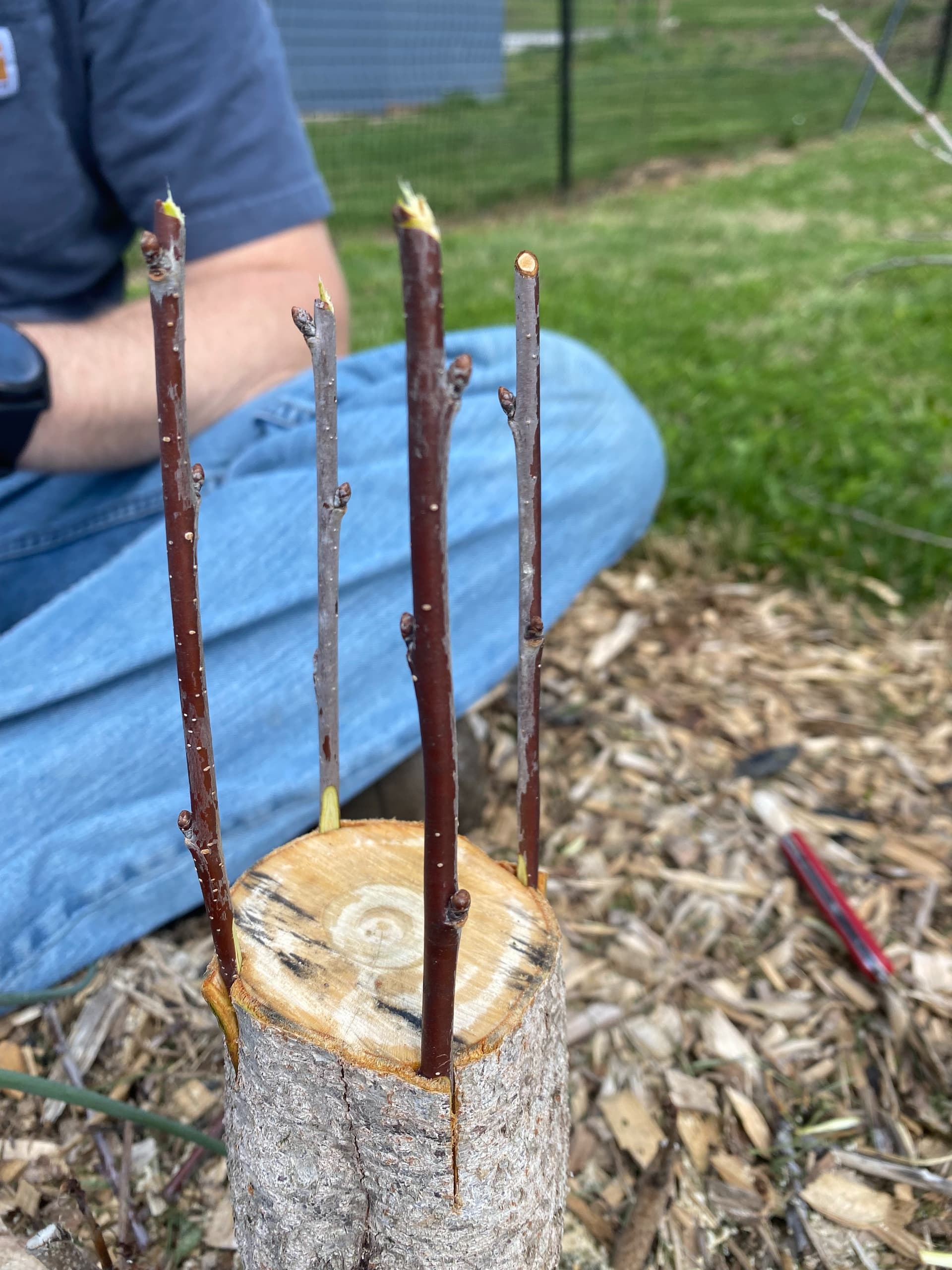
Mazzard cherry rootstock with scions from an unidentified sour cherry locally. Any feedback/suggestions is welcome!

10 Likes
Good luck!
1 Like
I don’t know anything about cherries but shouldn’t those scions be parafilmed?
1 Like
I don’t think the parafilm is strictly necessary for any grafts, but it is good insurance.
5 Likes
From the photo, the scions are cut too far above the rootstock leaving a green strip nearly an inch long exposed. It is best with bark grafts to ensure the scion is pushed down into the bark flap far enough to cover the cut area. Otherwise, should be successful!
4 Likes
Is the bark slipping? It looks to me like it’s torn, but maybe I’m wrong. The most left graft looks like it was cut into wood.
The cuts on the scions are exposed too much; at best, you loose the cambium contact surface.
My opinion is that bark grafting is not ideal for cherries - when bark start to slip, it is somewhat late for grafting because there’s a lot of sap flowing into the graft, flooding it, at least in my region.
Good luck
1 Like
Shouldn’t the young medical intern consult the experienced expert surgeons for advice before the actual surgery? 
2 Likes
Where? Where? I don’t see any signs of intelligence anywhere on this planet.
2 Likes
Appreciate the good feedback so far, everyone.
4 Likes
Both these comments made me laugh first thing in the morning. Thank you for that
2 Likes
I have tons of wild cherry trees. In my zone [4b or 5, depending], however, sweet cherries just do not make it. I had a Danube cherry, well, 3 actually and they struggled and died. I’d prefer to have plums. the European Mount Royal is making it but I’ve lost some of those too. as long as I have so many wild cherries making it, of which I can distinguish 2 very different kinds, one being sweet enough to eat out of hand when ripe.
I though I should try to graft the prunings of my Mount royal to 2 different wild cherries we have around here. Cherries and plums are all “prunus”, so it might work? What do you think?
I’m a bit new at grafting but I’ve done 3 successfully out of 7, so practice makes perfect?
1 Like
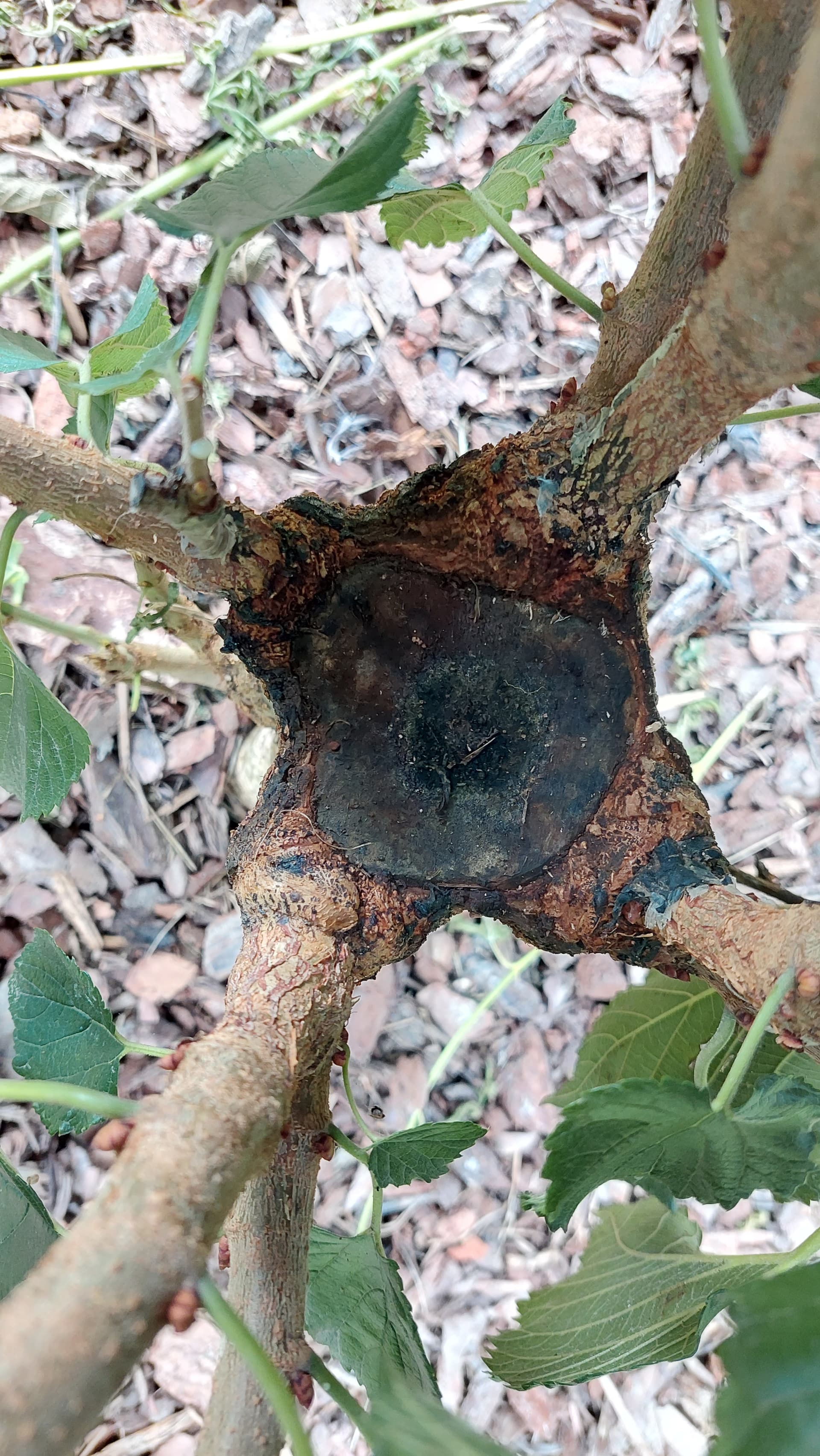
@Tngrower … my first graft was a bark graft … similar in size to yours… but with mulberry.
I had about a 3 inch diameter stump and grafted 4 scions of gerardi mulberry to it.
A few pics of mine… below…

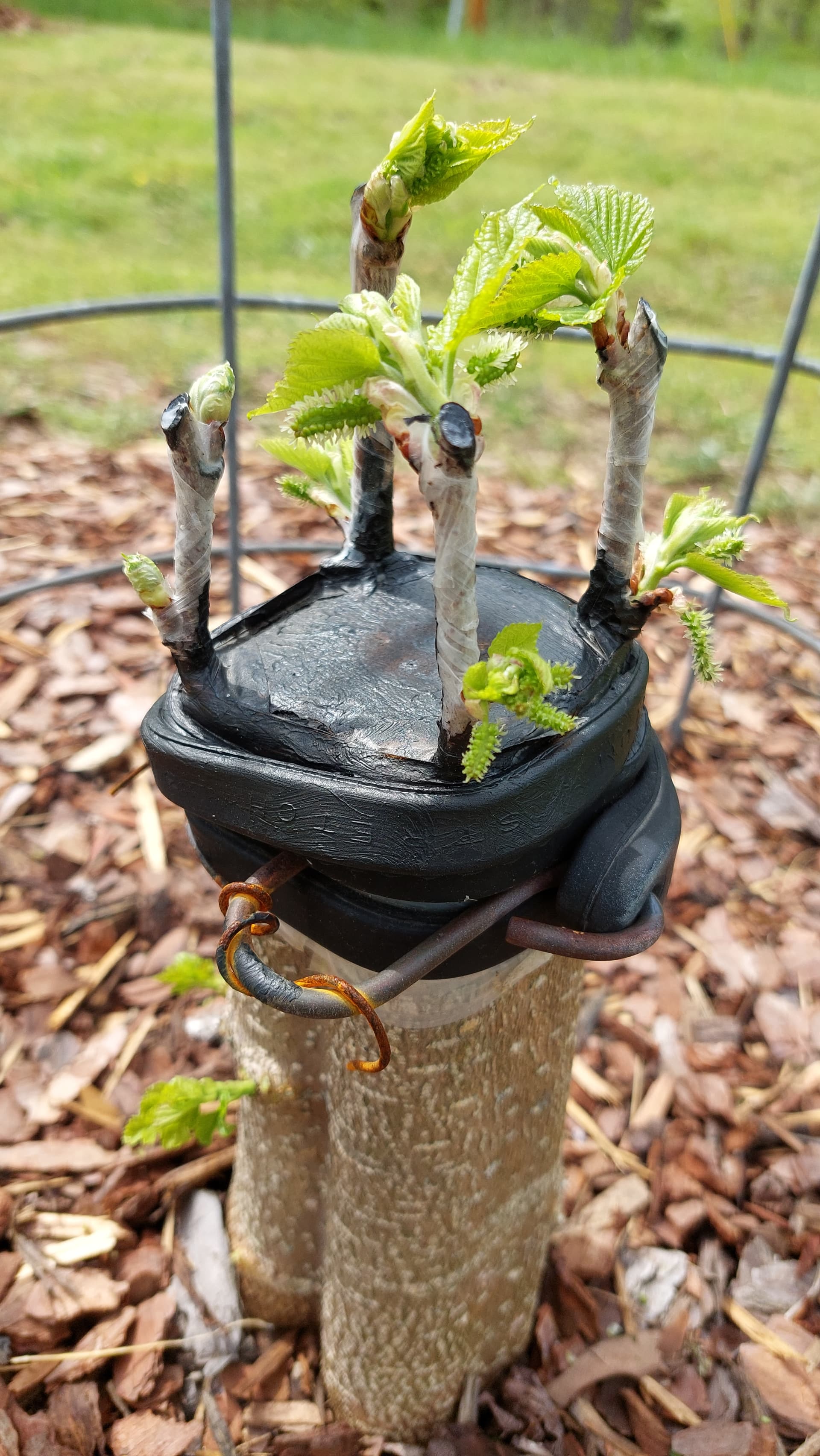

I noticed you have 4 scions and at least 3 buds per scion… possibly more
I had 4 scions with 2 buds each.
Notice how much growth i got year 1. Each of my 8 buds total grew 5 to 6 ft by seaaon end.
And this was gerardi mulberry which some say is a slow grower.
So just a caution to you on the amount if growth you may get from 12 or more buds your first season.
It will take it a while to produce growth to fully cover that flat top of the stump. Untill that fully heals all of that top growth will be highly succeptable to wind damage… that will cause large wind catching shoots to rip off at the stump.
Be sure when you do start getting some tall and thick growth that you put in place some serious wind support.
A mid to late summer thunderstorm can have some serious wind on the front end… and can seriously wreck a graft like that…
Good luck to you !
TNHunter
11 Likes
Thanks @TNHunter for the pictures and advice. This mazzard cherry root stock was very vigorous since planting as a bare root whip, so I’ll heed your advice on wind support. I hadn’t realized the impact of # of buds per scion. Would you recommend cutting them small now, or just wait and see what takes?
1 Like
Do you recommend another grafting method for cherries this size?
1 Like
When the buds start growing, pinch off all but one per stem, where 4 scions were set so let 4 buds grow. This will encourage vigorous growth and enable the wound to heal rapidly.
3 Likes
I was going to say that Gray Martin seems to always prefer to go to the single bud. I haven’t done a lot of grafts myself (yet) but of the 3 I did on my Meyer Lemon last year (grafted Yuzu), 2 took and one seemed to have multiple buds popping so I clipped to the bottom most bud that was popping and that graft is about 2-3 inches now.
Gray Martin’s video series (found on Greg Alder’s Blog):
1 Like
In my case i wanted my gerardi mulberry to take on more of a thick bush form with multiple limbs starting from low on the tree.
Lots of fruit developing in (grandchildren picking range).
But in your case with a cherry tree you probably want a single trunk tree going up so far then scaffold branches forming.
To get that you will have to pick growth from one of your scions (strongest grower) to be your main trunk… favor it… and prune the other growth back some from the other 3 scions… just keep it much shorter.
That short growth from the other 3 scions will help that stump top to heal over. You need to keep them in place until that stump top has healed over then you can eliminate them.
The one (strongest growing scion) that you favored… let it develop into your new cherry tree.
Keep that wind protection in place untill that stump top has completely healed over nicely.
That may take 2 or 3 years.
Good Luck !
7 Likes
I tried this but then woodchucks (i.e., ground hogs) stripped all the leaves, using lower branches as a ladder into the upper tree. Their weight broke branches and even broke on graft (1 tree of three). You wouldn’t think a “ground” hog could climb, but they do. Removing lower scaffolds doesn’t eliminate the risk but it reduces it.
No problems with ground hogs here…
17 HMR
Young ones are good as chicken fried.
There are plenty of them here in the creek bottoms. Never even seen one here at our ridge top location.
For this size, but also for smaller and larger than this I recommend side graft.
As I mentioned earlier, cherries need to be grafted early in the season; so, with this method you don’t have to wait for the bark to start slipping, and it’s also a very convenient way of grafting.
There are a few other methods that can be used, of course…
1 Like