Frankentree (apple) advice

Hi everyone,

I’m new to grafting and I’ve decided to turn one of my apple trees into a frankentree :slight_smile: both to play with grafting techniques and to sort of park a few scions until I decide if I want to graft new trees with them or not.

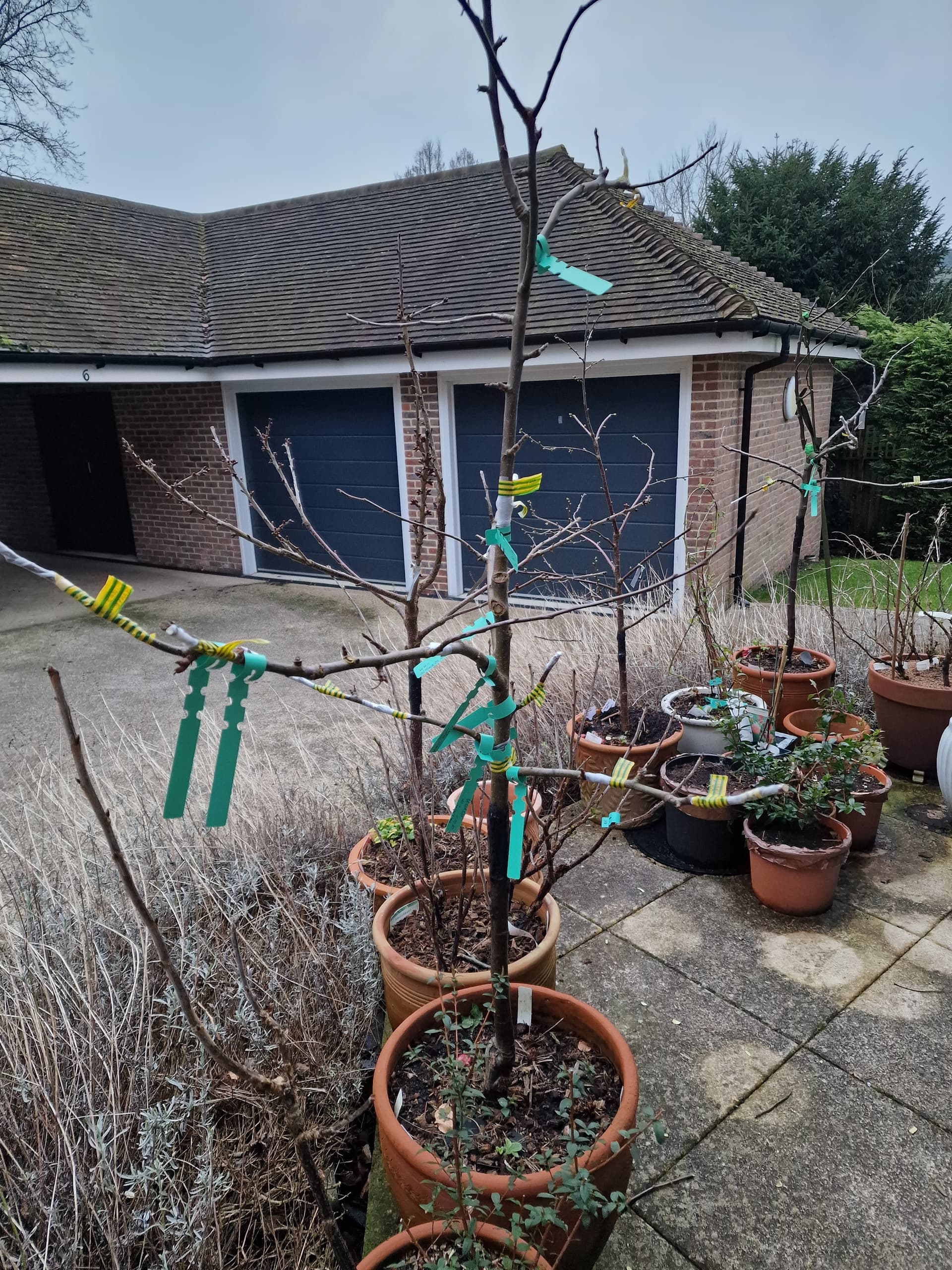
The tree I’ll be working with is about 4-5 years old; the rootstock is MM106 and the grafted variety (entire rest of the tree for now) is ‘Pitmaston Pine’ aka ‘Pitmaston Pineapple’.

I’m sorry for the poor pictures- this is as sunny as it’s been here for months (!) and the first day it’s not been driving rain.

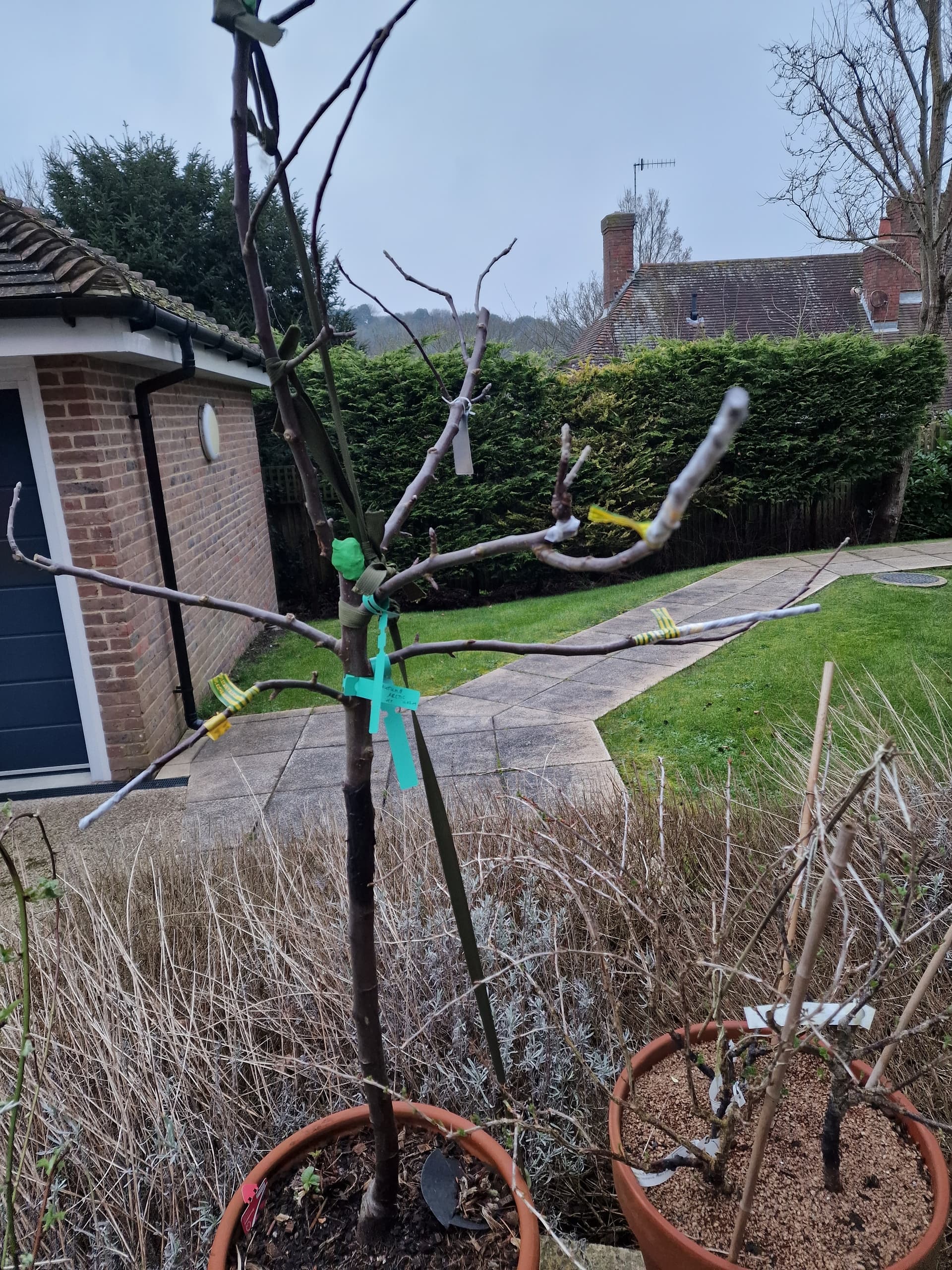
I had to train a new leader as debris snapped off the old one during a bad windstorm; there’s another branch near the top that might form the leader instead, and I’m sort of going to see how they progress this season before committing to one or the other.

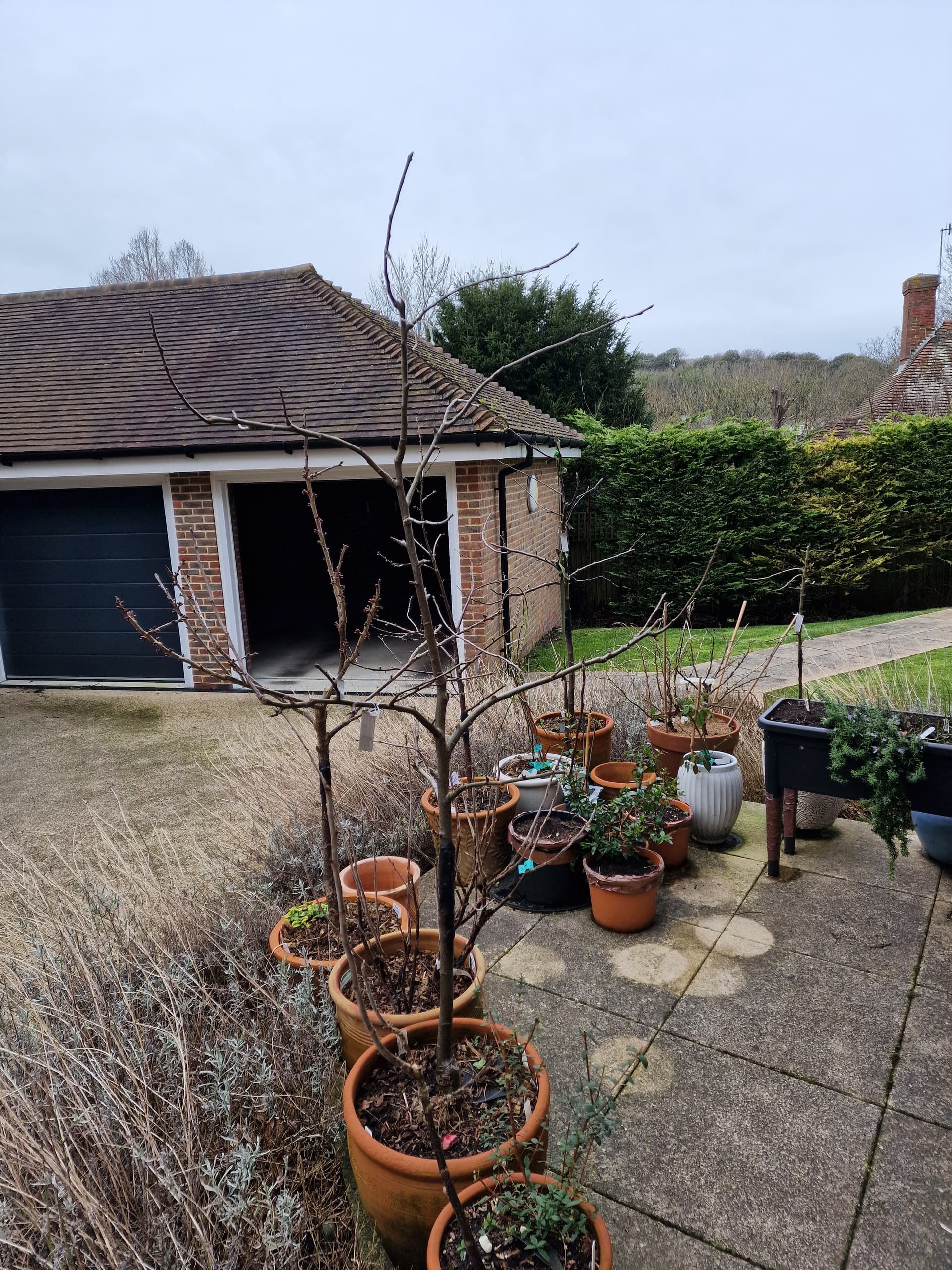
Here’s a snapshot of the whole thing:
Since there’s a bunch of confusing background plants to make this hard to see, here’s a marked up snapshot of all the current branches, marked from 1 (lowermost) to 9 (topmost / might become the new leader). The dark blue arrow indicates the tied-in new leader; yellow arrows are those branches pointing/growing to the right from where I’m standing; red arrows are those growing to the left; teal at growing away from me; and magenta are growing towards me:
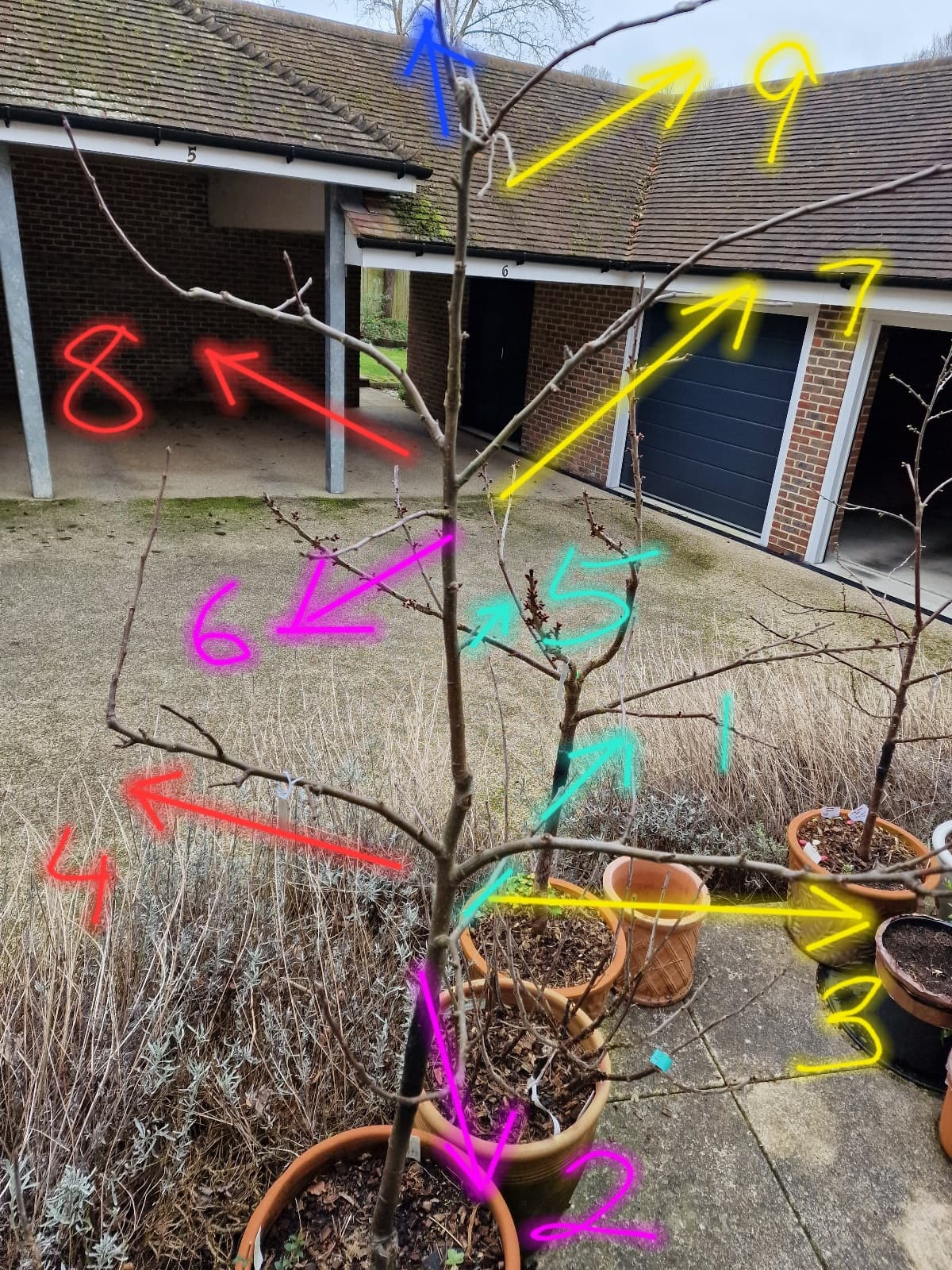
I’m going to stick 10 varieties on here, and I just wanted to get some opinions:

  1. If I understand correctly, the most vigorous varieties should go on the bottom scaffold (ie branches 1-4)?
  2. Moderately vigorous varieties on 5-6, and least vigorous on 7-8 to benefit from apical dominance?
  3. I’m going to leave 9 and the leader alone, but I’ll presumably be okay grafting onto everything else?
  4. Should I consider bud grafting anywhere along the trunk, like between 4 & 5, to fill this out a bit?

There are some really wonky branches on this tree (check out 4 and how it goes off at almost 90°) so I’m happy to really use it as a learning curve, and not too worried about making a mess / needing to fix things later.

Most of the pruning I did was during the summer, to remove some broken and crossing branches, but it was light; I’m not expecting too much water shoot mess. The tree produced its first apples this past autumn; I had to thin it three times and only let it set about 15 fruit total, but this is a really productive variety, so it wanted to do way more - I think I had over 90% fruit set from the blossoms!

We’re just starting apple bud swell here (sour cherry is about a week or two from bud break, for comparison); overnight lows are around 7-8°C (44.6-46.5°F) and aren’t at all likely to go below 5°C (41°F) again this year. Highs are around 9-12°C (48.3-53.6°F).

I have pollinators to cover all the scions. They should be arriving tomorrow and I’ll stick them in the fridge until I’m ready to graft…

Thank you for all your advice, and I’ll keep this updated with my progress, for better or worse. :saluting_face:

  • Ari
2 Likes

Hi Ari,
You are very near the optimum time to graft apples; (Apples/Pears – 13-18 deg C. ( 55.4 to 64.4F)), so anytime now would do fine.
Generally I like your plan, based on scion vigor. I cannot tell the tree height but its character tells me it’s near its ultimate height. So waiting on a decision about the top is ok but if you plan to top the tree now is better than waiting for this reason and related to your question about chip budding the main trunk: I would personally like to see fill in around the lower scaffolds which by the way have nice strong crotch angles (ability to support large fruit loads). The spacing of your scaffolds is not bad, especially if you can get more lateral branches on each! If you have native growth buds that have not yet grown due to growing in a pot, I would do the following to unleash the rootstock’s vigor:

  1. Plant the tree permanently in a sunny location with hood drainage.
  2. Mulch the tree with woodchips out to your future drip line which for a semi dwarf is about 6-7’ from the trunk. Allow no grass or other plants in the mulched area so the feeder roots can avoid competition for nutrition.
  3. Tip prune each scaffold to encourage lateral growth and notch key growth buds with lateral orientation to encourage fill in by new lateral limbs.
  4. Where there is an absence of growth buds to achieve fill in I would chip bud the scaffolds with new varieties.
  5. Top the tree so the vigor can go to your new growth as planned, this will eliminate the pain of using a ladder later on. I might be inclined to graft the top now with your least vigorous scion variety.
    Good luck
    Dennis
    Kent, Wa

Hi Dennis,

Thank you very much for your help!

I realise I should have mentioned the current size; I’d say the tree is about 6’ from soil level, and my understanding is MM106 naturally tops out around 12’. I was going to give it one more summer but I guess I could top it this summer. I tend to do as much of my pruning as possible in the late summer so as not to get too much of a vigorous water shoot response.

I’ve worked hard to get those branch angles trained, so I’m glad they’re looking good! This variety & stock combo seems nicely malleable (I have a ‘Spartan’ on M26 that’s ridiculously brittle).

Here’s where things get a little tricky; unfortunately where I currently live is a flat (like a condo, I guess?) and I have use of this patio, but I can’t plant anything in the ground - which is a shame, as the freeholder (building owner) only does the most perfunctory landscaping/hardscaping. The lot has tons of potential, but not for me to touch, alas! So I’m stuck growing in pots until we save up enough to sell / move / hopefully buy a freestanding home in the next few years.

I’m managing vigor with summer pruning, branch training, and of course the pots themselves. I know that the older the trees get, the less successfully they might eventually transplant, so I’m conscious that closer to the time I’ll need to graft backups and consider leaving some in pots permanently. Hardly ideal, but that’s where we’re at. :slight_smile:

Bearing that in mind, it sounds like I’ll aim to top the tree this summer, and maybe go up at pot size next winter. It’s happy at the moment and I’m just about to do a good spring feed. Last year I mulched and that was a bit of a disaster; I had such a surge in pillbugs / woodlice, and it was the first time I’ve seen them actively go for fruit. I know that normally they only eat damaged or decaying matter, but I’m guessing there were so many that they had to resort to eating undamaged plants… The year before that I “mulched” with shallow rooted annuals (marigold, dwarf alyssum, etc) and that worked better: I kept the trees fed and have drip irrigation for the hot months, so I’ll revert to that this year again. Doesn’t sound logical, but it worked better for me, at least.

If you have any advice on tip pruning and scoring to encourage lateral growth, I’d really appreciate it!

Best wishes,

Ari

I finally had a dry-ish day (raining, but not pouring…) today so I got to field grafting - does a patio count as a field? - the apple scions that I’d received.

I was hoping to put them all on my MM106 (with ‘Pitmaston Pineapple’) but some of the scions were really thick and I decided not to push the top of the canopy too much.

I was pleased to see that the bark was just starting to slip, so I did three inverted T-buds too, just for fun and to see if I can fill in some bare patches.

Since I couldn’t put all the scions on one tree, the others went onto M26 with ‘Spartan’ - it hasn’t been the easiest to train (the wood is really brittle) and I’ve wanted to test whether that was down to the rootstock or the variety.

So! Here’s the MM106:

The scions on it are:
:black_small_square:︎ Acme
:black_small_square:︎ Cornish Pine (aka Cornish Pyne)
:black_small_square:︎ Ellison’s Orange
:black_small_square:︎ Beforest
:black_small_square:︎ Bravo de Esmolfe
:black_small_square:︎ Sweetings
:black_small_square:︎ Cigany Alma (aka Cigányalma)

And here’s the M26:

The scions on it are:
:black_small_square:︎ Autumn Arctic
:black_small_square:︎ Pink Parfait
:black_small_square:︎ Bakran

I’m particularly curious to see if I have any compatability issues with Bakran because it’s such a different cultivar - not only is the apple red-fleshed, but the seeds and stems are, and sure enough the wood was purply-red when I cut into it! Really cool and very unique.

I really wanted to work on whip & tongue since all my bench grafts were modified cleft. A few looked really good, and a couple were pretty ugly. I marked the ugly ones :crazy_face: so I can see whether my idea of “ugly” is still viable. I made sure to cross those sightly to maximise cambium contact, and maybe I’ll have beginner’s luck.

I probably couldn’t have timed this better: we had a cold snap last week with a few days around 0°C (32°F) but now we’re firmly entering spring down here; all the scions were fully dormant but freshly cut by a colleague up north, where it’s significantly colder. Today I spotted proper bud swell on the apples, and the aforementioned bark slip (just), so that should set me up well I think.

3 Likes

Love some of the scions you got. Fairly unusual ones too.

I am not real confident of my whip and tongue either. Some were eh. Plus cutting myself a lot does not help. My hands are not as steady after decades of rotory hammer use. So I lòok forward to the cheap grafting tool coming in.

I was pretty happy to get some of the unusual scions - ended up with more than I really needed because I couldn’t resist :sweat_smile:

Weirdly, I caught myself more with the bench grafting than today - I didn’t cut myself at all this time, despite thicker scions and my knife not being the best (or sharpest).

Hope the grafting tool works out for you! I know there’s a pretty vocal group saying they’re not ideal, but I have a physical disability and to me anything that increases access for someone is great - I considered one too, but figured I’d see how dicey I was with knife work, and turns out for the most part I’m okay. Definitely any thicker scions (some today were pretty marginal) and I’d want a tool, or at least a really good pair of secateurs…

I couldn’t find my groove with the Parafilm-M though; half the time it wouldn’t stretch enough, the rest it’d tear. I doubled up a lot on electrical tape to compensate.:crossed_fingers:t2:

2 Likes