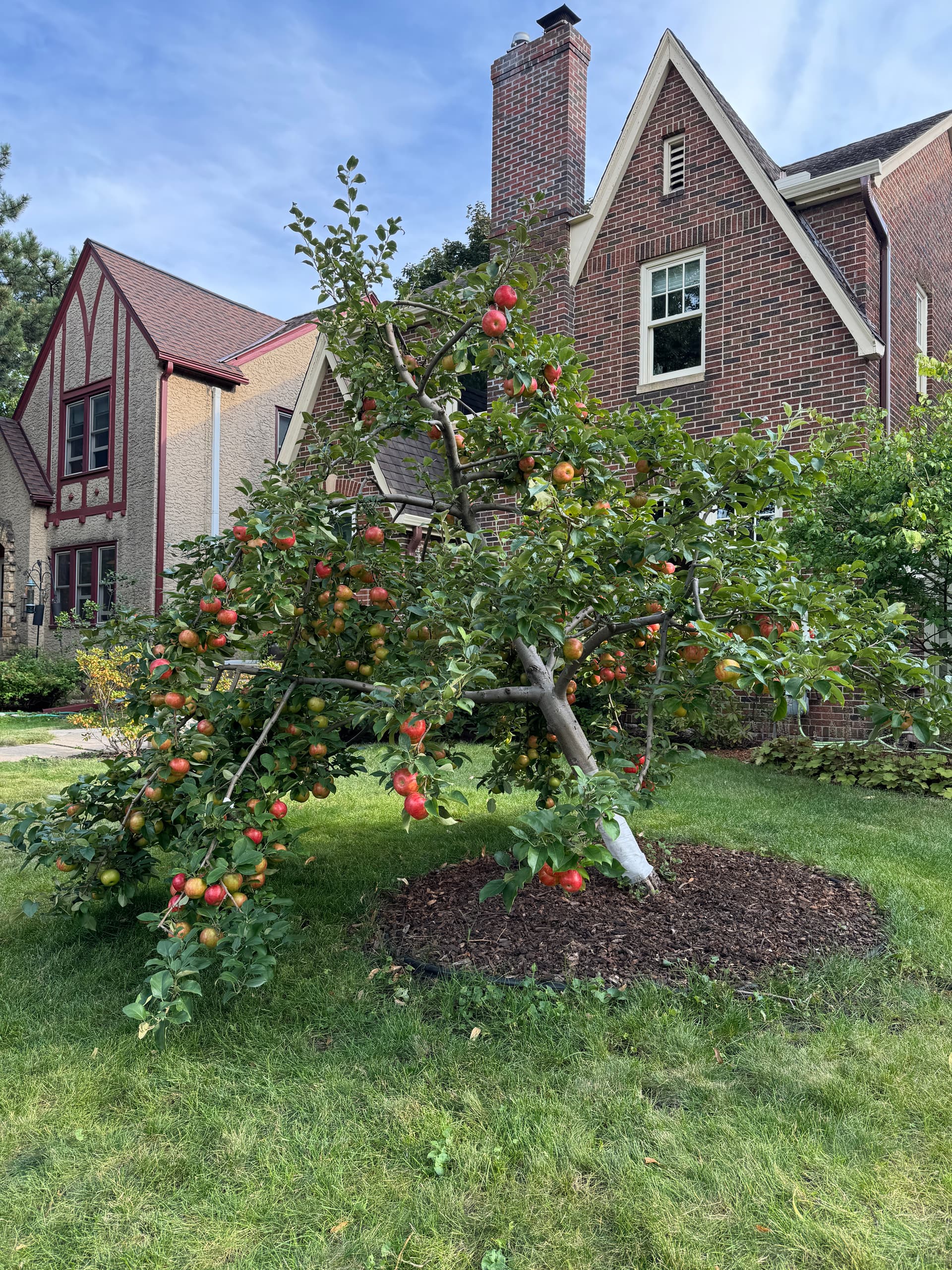
First question, new to the forum! I love the wisdom here and I am happy to pick all of your brains and learn from your experiences. Bless all of you who take the time to help others on this thread, you the real MVPs!
Question: I have several apples grafted on G41 and some plums on Krymsk1 on their first year. Does anybody have any experience with these rootstock in an attempt to make a free standing tree? I recognize most commercial orchards build a trellis system to take care of the leaning and wind issues. My FIL is an arborist and he is of the opinion that a tree should be supported only for a year or two and allow the tree to grow ‘strong’ from the epigenetic pressures, if you will. Cummings recommends support and based on what some of y’all say, it appears that these rootstocks should be trellised their whole life? What if I pruned to open center and tried to keep it balanced as much as possible as well as ‘Anne Ralph’-ing the tree to a short stature…I would really hate to take the gamble and lose a tree but what my FIL said kind of makes sense too…
I have a Fuji and a Rubinette on G11 and B9 respectively, trained to open center and free standing. They are 4/6 foot tall, and they are loaded with apples this year. Both are fourth leaf trees and are vigorous growers. I will support them if they lean, but so far no leaning. Also have a Kidd’s Orange Red on G935, similarly trained and free standing, even bigger tree, more vigorous and loaded with apples too.
G41 has a poor reputation with non-commercial growers due to its weak graft union. The weakness can be further amplified depending on the variety grafted to it. Whip and tongue grafting helps strengthen the union, but overall it’s still weak compared to others. It’s a fantastic high yielding and disease resistant rootstock but must be firmly trellised.
Maybe an oversimplification, but my takeaway is that dwarfs are just smaller and therefore weaker (duh!). A smaller trunk cross-section coupled with high-yield will result in tree loss unless supported. Additionally pruning commercial vs non-commercial is way different. A non-commercial tree sprawls out, while a trellis tree might be 4’ wide max.
There are heated posts on the subject throughout the forum, but in each instance of tree failure there’s an accompanying structural deficciency.
Personally I went with G214 over G41… I am not commercial, though my trees are trellised best I can.
All of the dwarf apple rootstocks need permanent support. It’s not something they will outgrow and in fact once they start fruiting the need is greater. Dwarf apple trees have a smaller root mass so they aren’t as well anchored and there is no getting around that or “toughing up the tree”.
G.41 has a reputation for breaking off at the bud graft union. A bud graft is a weak graft but it’s quick. Growers use it for efficiency but it’s always the weakest part of the tree and the reality is that it’s not just a problem on g.41.
There are some mid sized trees that generally grow into needing no support. But even on those I’ve heard of tipping over. I will opt to support all my trees. M26, M7 and P.14 attain the free standing goal. I would wager B10 will too.
I am going to fool with Malus Brevipes next year. I understand it is a very portly, thick trunked, well rooted shrub of a tree. Only reaching 3 meters tops height.
Here’s my free standing m7 honeycrisp after 15 years. I removed the t-posts after 4 years. Oops. They lean in heavy soil pointing away from the wind. Walking through my neighborhood you see this repeatedly although mine is particularly bad.
No. I am in very South of Georgia of the USA. I saw there is a variety sold in the UK as “Wedding Boutique” that is Malus Brevipes. It is clearly a very showy Crab variety.
Which means ornamental interests may like it. It used to be a museum curiosity. But even here in the States it has popped up in prefered crab apples for urban plantings.
Sort of odd the named UK variety manages to get an extra meter of height,
Right now, landscaping companies sometimes offer it. It is available via the Cornell collection and a number of other U.S. collections for commercial use. Mine is coming from USDA-GRIN for a root stock project. It is also valuable for avoiding scab and fire blight.
@Ahmad Thank you for your reply, do you do anything special to these trees such as extra thinning as well to keep them unsupported? Do you do anything different to those G11/B9s versus your G935s with regard to pruning, etc?
@toad I love the practicality/logic you bring to the conversation! Thank you. Especially when the small rootball has a huge load of apples above it, one can easily see a breakage occurring. Was there a specific reason you went with G214 over G41? I actually have a Braeburn bud grafted to a G41 and I totally forgot Cummings recommended not doing that (I guess we will see what happens lol). I got too excited to have more Braeburn apples I guess and I simply forgot!
@boylan Thank you for answer! What kinds of materials do you use to ‘fasten’ the tree to the t post and do you just use one t post or two? I can see girdling the tree being a problem if one does it incorrectly or doesn’t check on it regularly during growth.
I only make a U around the trunk so I don’t think girdling is in the cards although if you used something super thin for the tree tie that might become an issue - like wire.
I have not found the perfect tree tie material. I’ve used twine, plastic baling twine, thin rope (line) and electric fence wire (in tubing).
Usually I use 1 post and put it on the windward side of tree but I added 2 posts to a Zestar this year when I realized it was in danger of snapping off due to the fruit load.
I use a wooden post with a U made from a fat uv resistant band or strap about 2 inches wide or more, then i used screws to secure the strap to the wooden post.
On paper G214 has the same benefits as G41 but without the detriment of a weak union. Both are said to be 30-35% of seedling size and have broad disease resistance. When grafting my own trees this spring I used the G214, but most of my purchased trees are on G935 and G969. Not sure I’ll be able to tell a mature G214 and G935 apart when they’re next to each other on the trellis, guess I’ll find out in a few years. I’m at 4’ apart and 14’ between rows.
I like the videos that Susan Poizner makes. Here’s one directly related to the subject: