I was thinking of copying @kakasamo and growing fuzzy kiwi on a trellis against my house (garage wall over a window, along base of porch). I’m also hoping that it helps protect them a bit from cold and is attractive. I can easily make a very strong trellis on this wall/porch so strength shouldn’t be an issue.
I looked at some pictures of fuzzy kiwi plants and they look quite big, but most advice is for hardy kiwi. Are hardy and fuzzy kiwi plants about the same size?
Most people seem to be growing kiwi on an arbor in a single vertical layer that is wide. This would be more of an espalier style since it’s against a south-facing house wall. Do you see any issues with this?
Is this a terrible idea? (I could plant other things here. You’re welcome to change my mind about kiwi).
How many feet of space on a trellis does each plant need? 20ft each ? more/less?
Do they grow like grapes or are they more “branchy” (eg. should I grow them on a single or double wire or on a grid kind of thing)?
This wall is completely south facing and gets full sun. Is that too much for them?
Do I need to worry about the fuzzy kiwi roots doing damage? I wouldn’t worry about a fig or even most other fruit trees but I don’t know about kiwi roots.
I have grown Hardy kiwi, arctic beauty, and , fuzzy green Kiwi- I think the Hardy Kiwi has more numerous branches which tangle compared to the fuzzy kiwi, but the trunk of the vine in my experience is a bit more wide and robust on fuzzy kiwi then Hardy. Overall, I think my fancy kiwis have been slightly bigger as a vine, than my Hardy, but it’s not a big difference. I have grown them along southwest facing wall in an espalier fashion. As well as on a custom trelis that is made of a ~ 2 foot wide and 16 foot long section cut from cattle panel mounted flat (horizontally) under the soffit of my garage. I do think 20 feet should be enough.
Not even close for different reasons. Hardy kiwi have radically fast growth that grow in every direction with 10 foot shoots and takes a lot of work to keep in check. I gave up trying to control them and just let them run wild.
Fuzzy are vastly easier kiwi to keep nice and tidy. Taste better also. If I could go back in time I would just do all fuzzy.
My original plan was to construct a setup over my deck kind of like a roof made of kiwi, but decided against it.
Your questions:
1-Not a bad idea if your doing fuzzy and willing to put in work keeping it in order.
2-20 foot each should be enough for fuzzy.
3-They grow spurs, branches, and branches with spurs. Branches are what you will have to control without losing to many spurs.
4-Fuzzy love full sun. Hardy can do almost full shade.
5-Kiwi have shallow roots that are no threat to anything.
Try to find youtube videos of people that did something similar to what you want and see how it works for them. What your suggesting can be done, but a regular bigger trellis would be a better idea.
If you’re going to espalier, the kiwiri videos are helpful. @xendula made a great post about it.
You have to put on translation and read, but it’s not a big deal. All the videos I watched from America made it seem like I could never grow kiwi in my space, but the European videos are great! They really keep the vines tidy and contained. I just set up a 2 panel tunnel that I’ll be growing golden fuzzy on, and this is a basic 3 tier espalier built this spring for fuzzy green. I cheated on the first layer…as he says in the videos, you can never cut too much, so, at worst I’ll start over next year! You can obviously go much bigger with your much bigger space and be a bit more lax on pruning.
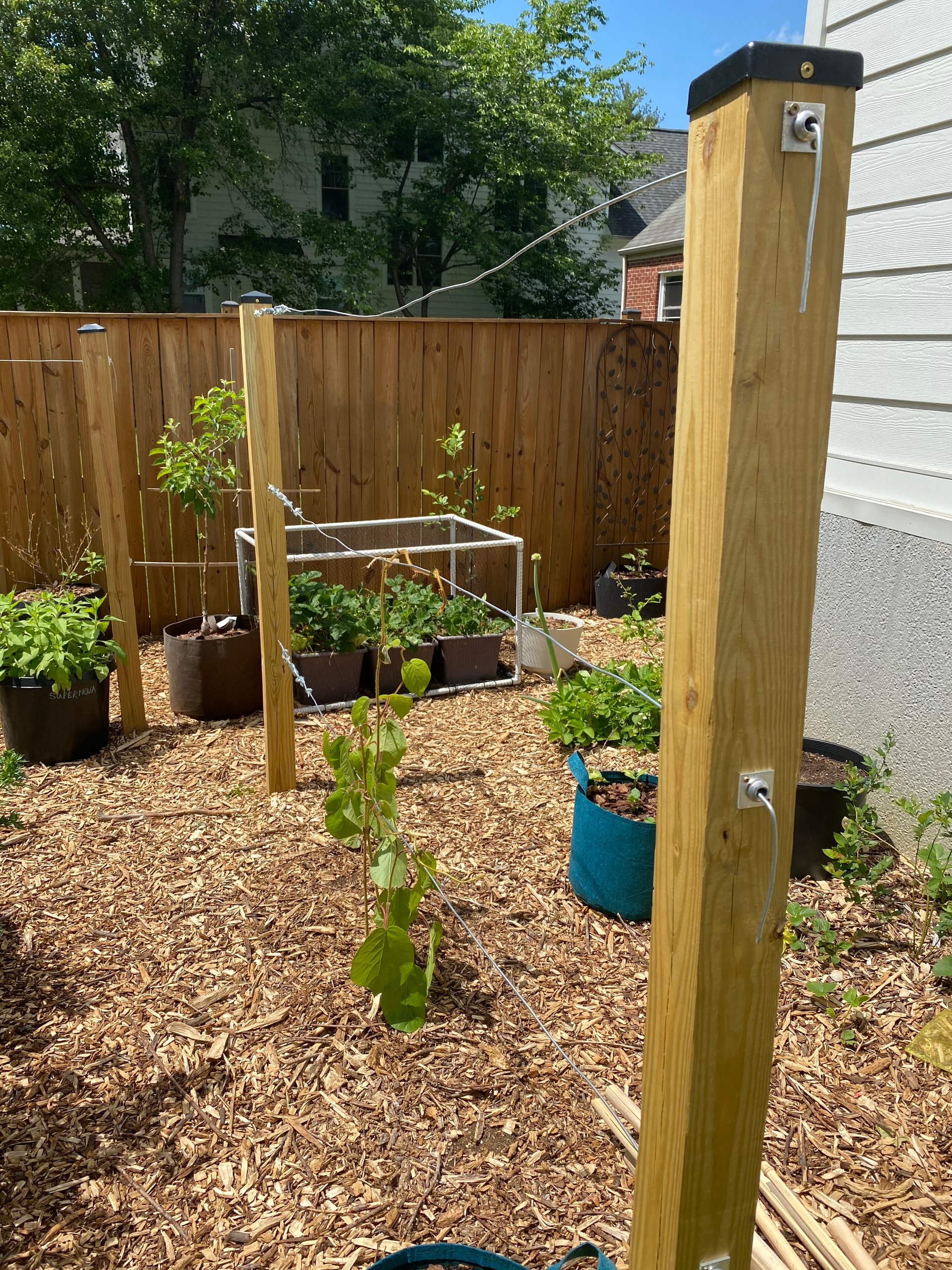
Love your set-up! It looks so professional and so much nicer than my metal T-posts (which are still waiting to be connected with wire). Also love the critter-safe box in the back!!!
Thanks. We’re not good at working with 9 gage wire, so it’s a bit wonky, but learned from grape last year how deep to set them and to use concrete! But, I did 12g for that which is much easier to work with.
Why 9 gauge?!? That stuff is pretty intense. They use it at the top of chain link fence.
Is 11 or 12.5 not enough? That seems to be what is recommended for most vineyard or orchard things I’ve seen. Also, most 9 gauge I’ve seen isn’t high tensile or high carbon so it’s not as strong as a 12.5 high tensile.
Regardless, if you end up tensioning your wire you should consider putting a spring in it (unless what I think is a turnbuckle is actually a spring). Or loosen and tighten your turnbuckle seasonally. I recently learned that when tensioning short runs you need a spring because of seasonal temp changes. I had a lot of experience with long runs of fence from working on cattle ranches, but not short runs. I only learned about this recently and it sounds really sensible. As an added benefit the springs all seem to have little tension gauges on them.
For stretching wire, I think I see a turnbuckle and a wire vice. But I assume you’re having problems getting it tight enough for the turnbuckle to matter.
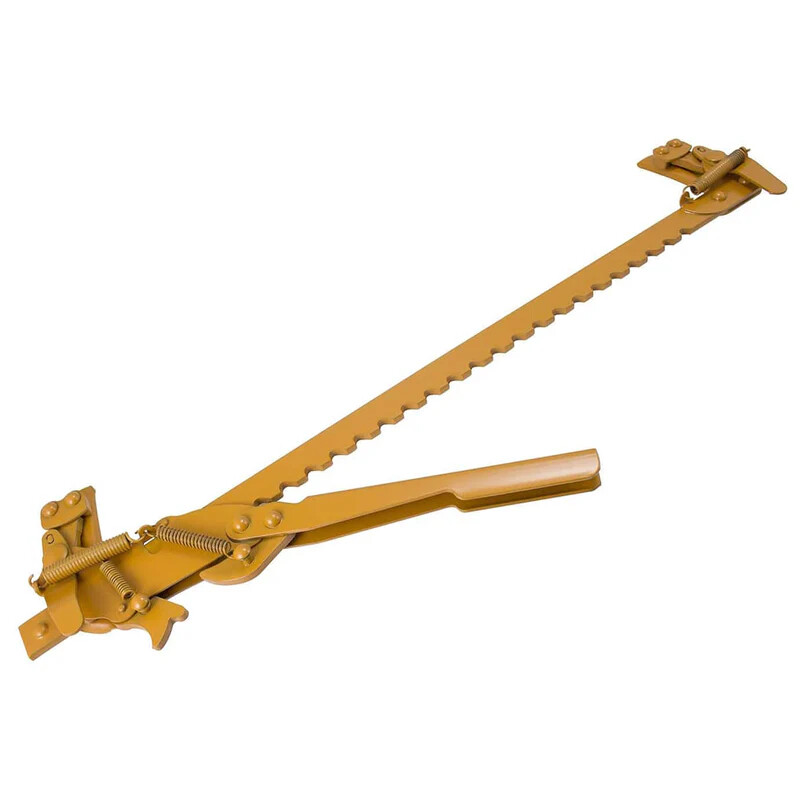
If you want to tension, you need to borrow a fence strecher/puller from your friend who lives on a farm!
You could also replace your turnbuckle setup with an inline rachet strainer/tensioner. They’re supposed to be really secure, but I always worry they would become failure points (because I’m used to securing to posts). However, I they get used constantly in my neighborhood and no one complains about them failing - so maybe I’m overly paranoid. I’d think your wire vice would fail before the rachet, so I guess it’s all moot. You can also loosen these but it’s hard to loosen them slowly without the rachet tool.
Another option is if you have a T shaped thing with a hole in the end. Strangely I can’t find a picture of one on the internet, so I drew one below. You put your wire through the hole in your post (through your wire vice). On the side where it’s poking out, you put the wire through the hole where the pink arrow is and twist the wire around that pipe.
The harder version of this is just grabbing that end with pliers and twisting the wire around the pilers. I am not strong enough to tension wire like that, but I’ve seen guys do it, though I don’t know how well they actually tensioned anything.
I like your “mini raised bed” circles. I’m totally copying this idea (unless you tell me it didn’t work out!) but want to do it with wood since I have enough scrap wood lying around.
It works; my in-bed corner certainly grows better, but those were from a different supplier and different varieties. I’d think a little bit larger area would work better. FYI - the metal I used was a single ~3’ piece ~ 1’ tall that I circled around.
The point about fuzzy being easier to manage is worth taking seriously. Hardy kiwi vigour is genuinely relentless, the shoots just keep coming and if you miss a week of tying in you’re suddenly dealing with a tangled mess. Against a wall fuzzy kiwi sounds like the more sensible choice, especially if you want it to look tidy.