I never had a Gold Rush until I tasted it from the tree. It blew me away. The flavor was so complex and interesting. It was yellow and ripe. I don’t pick them until partially yellow at least. Some have fallen off the tree and I"ll eat some of those and store some if they are perfect looking. Usually I don’t pick until November. We won’t get dangerously cold for a while yet and they are almost all green. Mine is partially shaded, because my cherry tree grew so much when I biocharred it. I can wait until quite a few are falling. I’m mostly retired, so I have more flexibility about that than I used to have.
Mine are still hanging well on the tree, although about a dozen or two disappeared a couple feet from the fence a few weeks ago - bags and all. They weren’t even ripe yet. I hope they think they taste terrible and leave them alone in the future. I try to pick around Nov 15 but rains usually cause cracking before then.
I grafted Gold Rush to Bud118 here because my conditions stunt apple trees. It grew to 11 feet some years ago and I topped it to 10’ last year. It pushed a triple head, which I may leave on, because if each has a couple apples, their weight will lay those down.
I thin about 40% in June, with heavy crops each year. Any that were bothered by codling moth caterpillars I put in a separate bag to eat before the lovely fruit. Rot is really rare for this apple in my location, even the few that lost the stem at picking, kept to May.
I find coriander or cardamom in the flavor overtones. If I were to grow a cider orchard, this would be the front runner. My favorite apple and apple tree.
I forgot: all my trees were early this year, from 15-21 days earlier than usual, including Gold Rush. A local arborist said something about a huge increase in growing days, something for which he pays hundreds of dollars to a local university to get reports.
I sampled my Goldrush today- moderate tart, almost no sweet, am gonna wait to pick. I’ve never had a problem with fruit quality lasting six months, no matter when I pick.
Looking at the pics of your (beautiful!) orchard. Do you use an espalier system? Is that what I’m seeing? Or pruned to keep it low but not trained? We go back and forth on which would be better, and right now I’m leaning toward full on espalier because of our humidity.
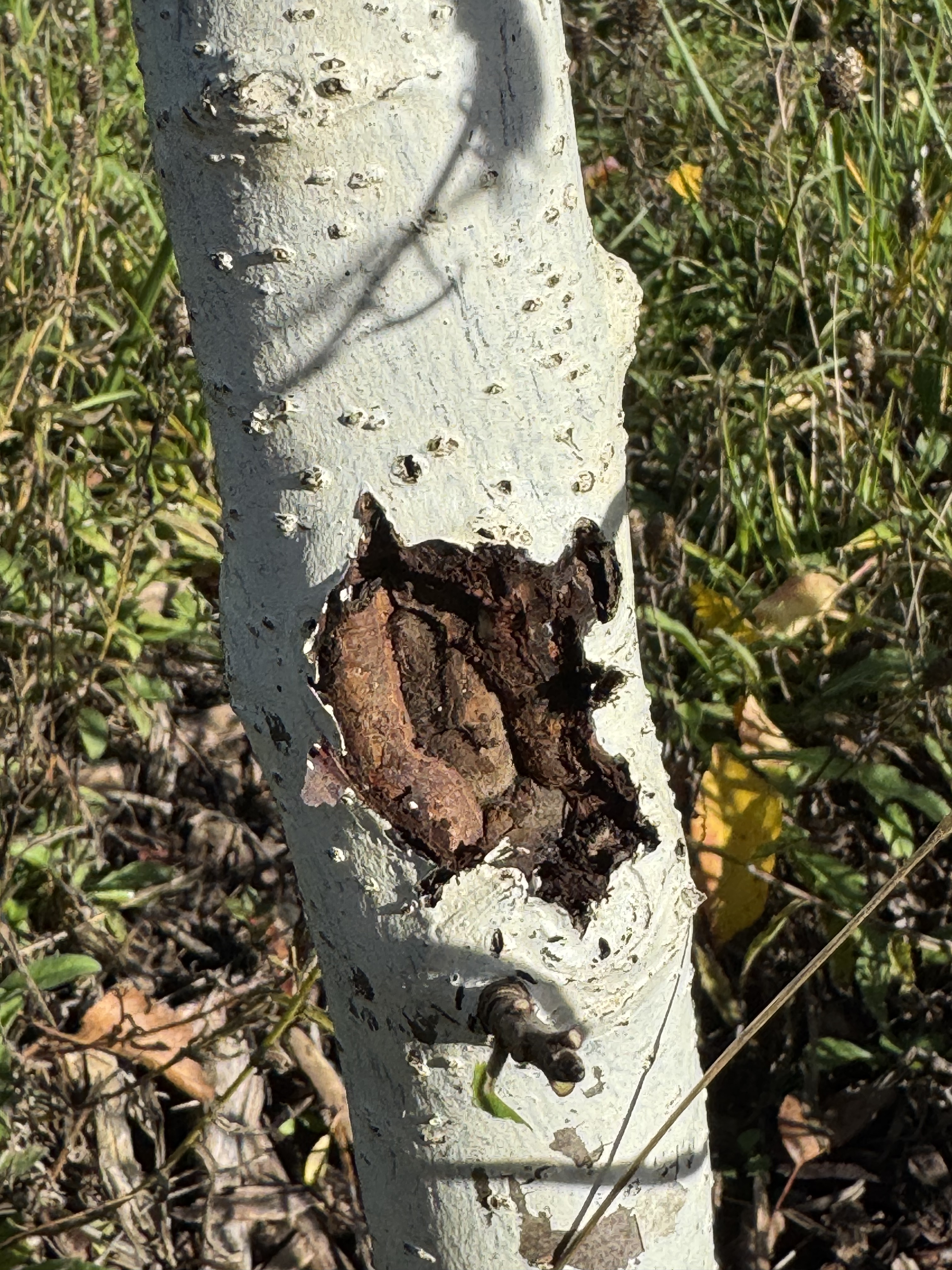
So sad! Found this canker on my Goldrush yesterday. It’s pretty powdery inside. Don’t know that I can clean this out well enough to save it because it’s pretty deep. Neighboring Ashmead has three cankers like this.
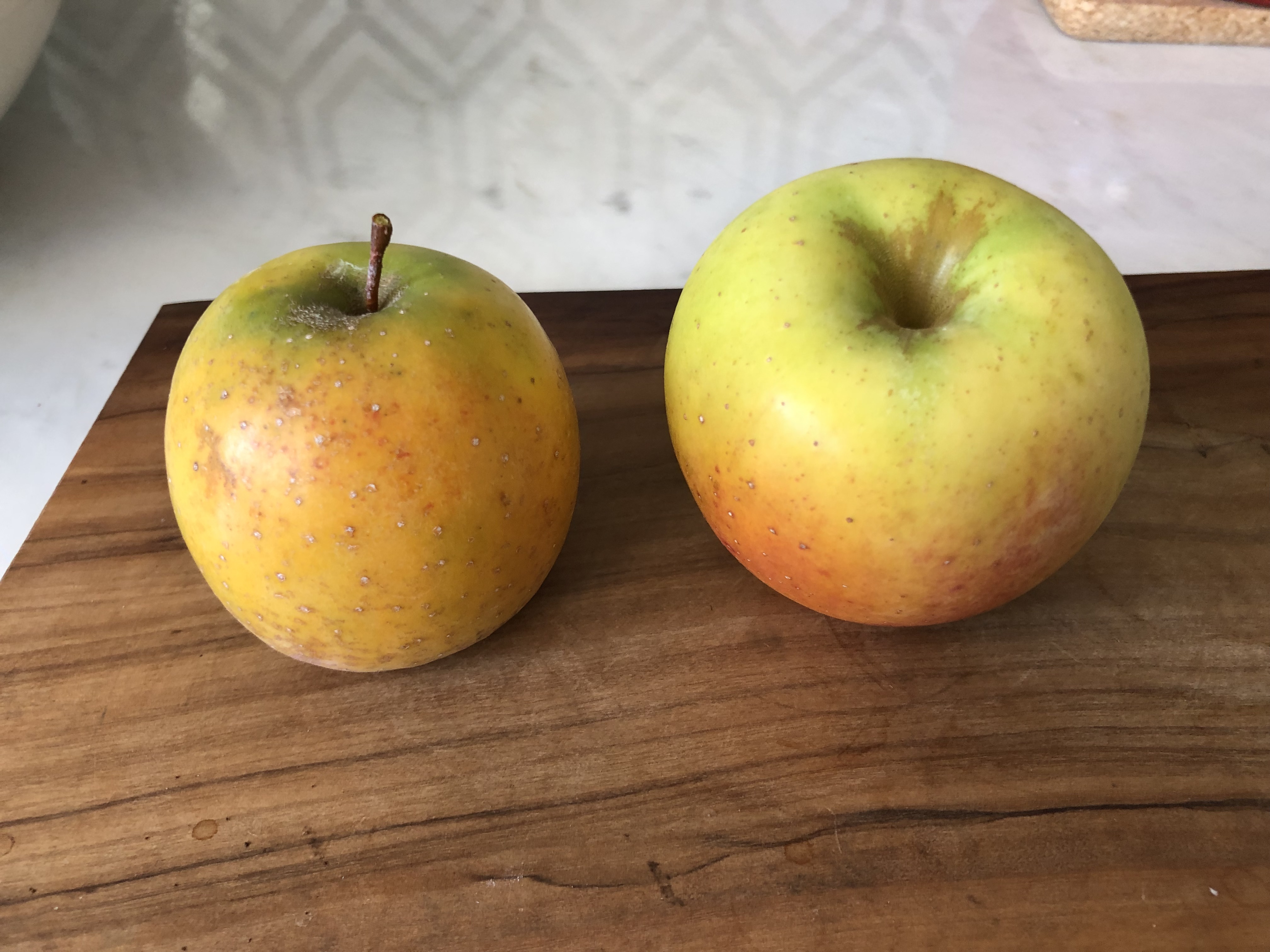
This Goldrush apple on the left fell off the tree yesterday. It’s smaller than the store bought one on the right, and a lot sweeter and more flavorful, but probably a little over ripe. Probably the right time to pick them here in northern Florida is October.
Yes, I’m going to try that with the Goldrush and the Ashmead. It may be a long time before we have a dry spell, though. We’re in an atmospheric river, and usually have flooding. We had two of those this spring.
Here’s the Ashmead. It’s really soft in the canker, though. I wonder if I can do a bridge graft over the holes, too, after thoroughly scraping out the cankers. I have plenty of little trees lying around waiting to be planted, but would also be concerned about putting them in the same holes. A Milo I grafted this year already died of anthracnose.
It’s interesting how we are so close geographically but so far apart on this apple ripening. Mine are averaging about 18 brix now and I have picked half of them.
I keep wanting to plant a Goldrush apple in my orchard. ( I did plant one last year BUT a car ran through my yard and destroyed two apple trees- one of them was the Goldrush).
However, since we get really cold temps and also some snow early in November I am just afraid that the Goldrush apple will never get truly ripe enough to really enjoy. Last year we had snow about the 10th on November. I looked at our upcoming weather and we are suppose to get 1-2" of snow on Sunday Nov 9 with night temps at 23 degrees. That is too cold for the Goldrush to finish ripening correctly. Maybe the cr taking out that tree saved me some angst of watching the grow and never producing decent fruit.
It is important that (most) fruit trees get full sun. Trees that are in full sun in zone 5b probably ripen better than trees in my zone 6a backyard that don’t get full sun.
Yes, there is more to successfully producing fruit than just the average coldest winter temps ( USDA growing zones ). It can be used as an aprox indicator of killing temps for some varieties you may not want to grow but i wouldn’t use it as any other growing comparison.
For anyone who is serious about growing varieties that may be considered pushing the envelope for maturing on time at your location I would suggest you start recording the highs and lows of daily temps for your location. You can also do rainfall which can be useful info. If your lucky enough to have a weather station VERY close to you then maybe you can use their data. Once you compile a years worth of data you can turn that data into heat units and use this data to compare your site to anywhere on the continent.
I always like to use the example of the river valley that I live and farm in, the Skagit Valley. The lower parts of the valley, that include some of the best soils for vegetable production, are all classed as zone 8a by USDA. As you move up valley you get to the WSU Mt Vernon research station which has a permanent weather station and they have been averaging 1500 - 1800 heat units over the last few decades. They also average around 28" of rainfall annually.
Eventually as you travel up valley, 35 miles, you get to my farm. My heat units averaged, over the same period of time, 2000 - 2400 heat units. Here’s the kicker though… My USDA zone is 7b, and I have more than twice the rainfall of Mt Vernon.
The research station cannot ripen a Goldrush apple unless they get lucky and have a dry fall through November. We did get a hint of what one could taste like when I worked there. Novembers like we are having now, with all this clouds and rain would definitely put the kibosh on ripening a crop.
Is there any way to shorten the storage life of Goldrush? I’m not sure what you meant by this short sentence. My ripest Goldrush certainly store extremely well if I don’t let them dehydrate.
I am very glad to learn of a commercial grower that specializes in cultivating this variety. When I discovered it many years ago the word was that the distributers loved the taste but not the size so it failed as a broadly produced commercial variety.
I’ve been touting it on this forum since Scott started it and for years before that trying to keep the variety in production by nurseries in the East like Adams County.
I had no idea how it would do in the west but I’m not surprised it does well in some areas. I’ve seen the apple take temps as low as 22F. so if you get an early deep dive followed by milder weather, it is worth keeping on the tree if the leaves are still functional and the fruit is still green.
I didn’t realize the fruit would ripen sooner on more dwarfing rootstocks… I do a lot of summer and even spring pruning (especially when I’m thinning fruit and wiping off new shoots from big wood) and maybe that is why it isn’t something I’ve noticed. If you get good light to the leaves within about 8" from any given piece of fruit, I don[t see why root stock should matter- but you may know better than I do as you’ve had direct comparisons for years, apparently. I don’t manage many trees on anything less vigorous than 7 and prefer to grow Goldrush on 111 because it is so naturally dwarfing. It invests so much energy into producing fruit, or at least fruit buds for the following years when it doesn’t crop well. .
Because this region gets such wide swings in temperature day to night, Gold Rush (and many other things) ripens faster than it might elsewhere. I find them adequate this time of year fresh (nowhere near battery acid), but nicer in hand for most folks after the turn of the year.
I just looked at Derek Mills’ 2018 orchard list and find he was already growing Gold Rush in his spot in Ohio.