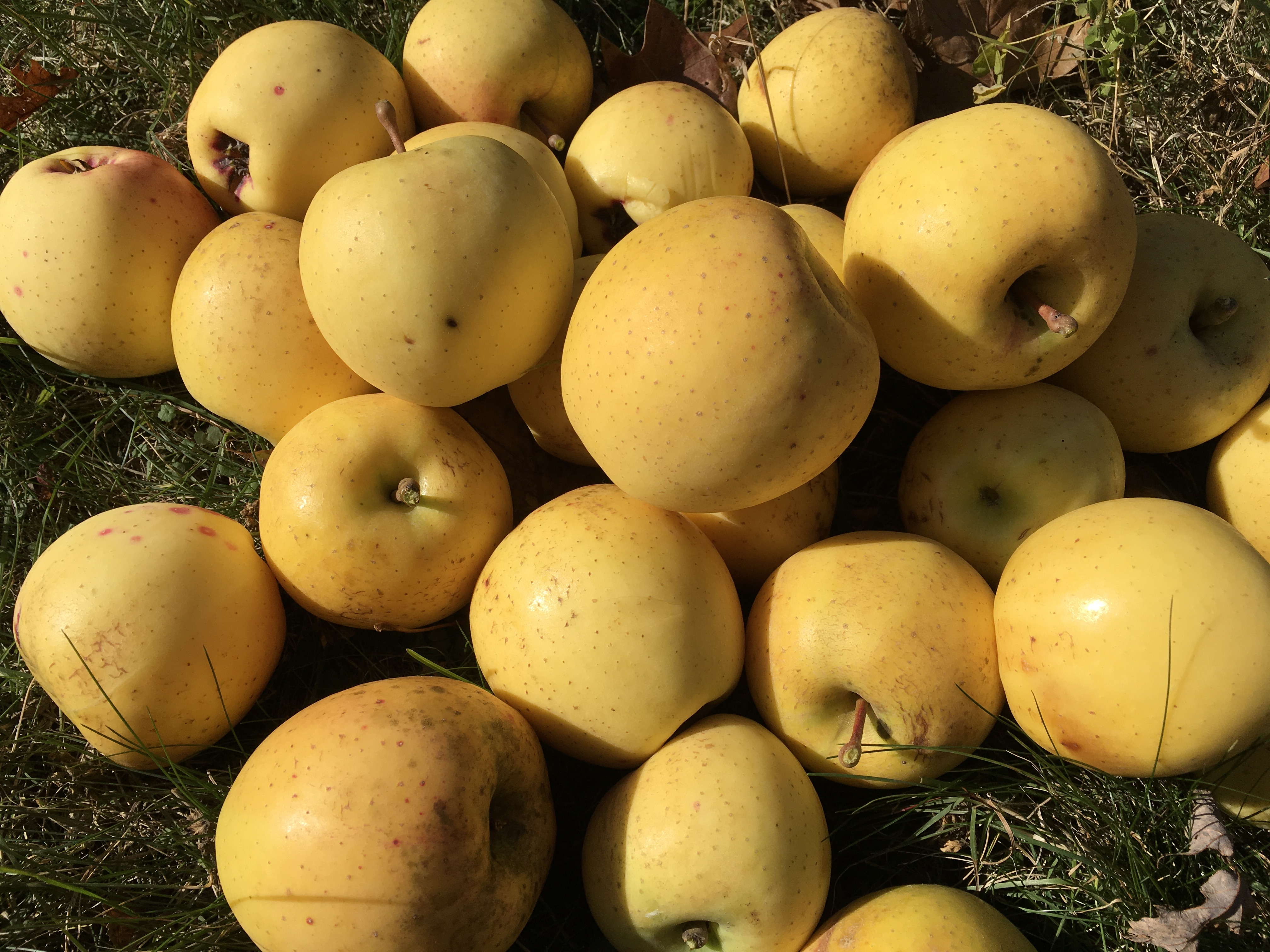
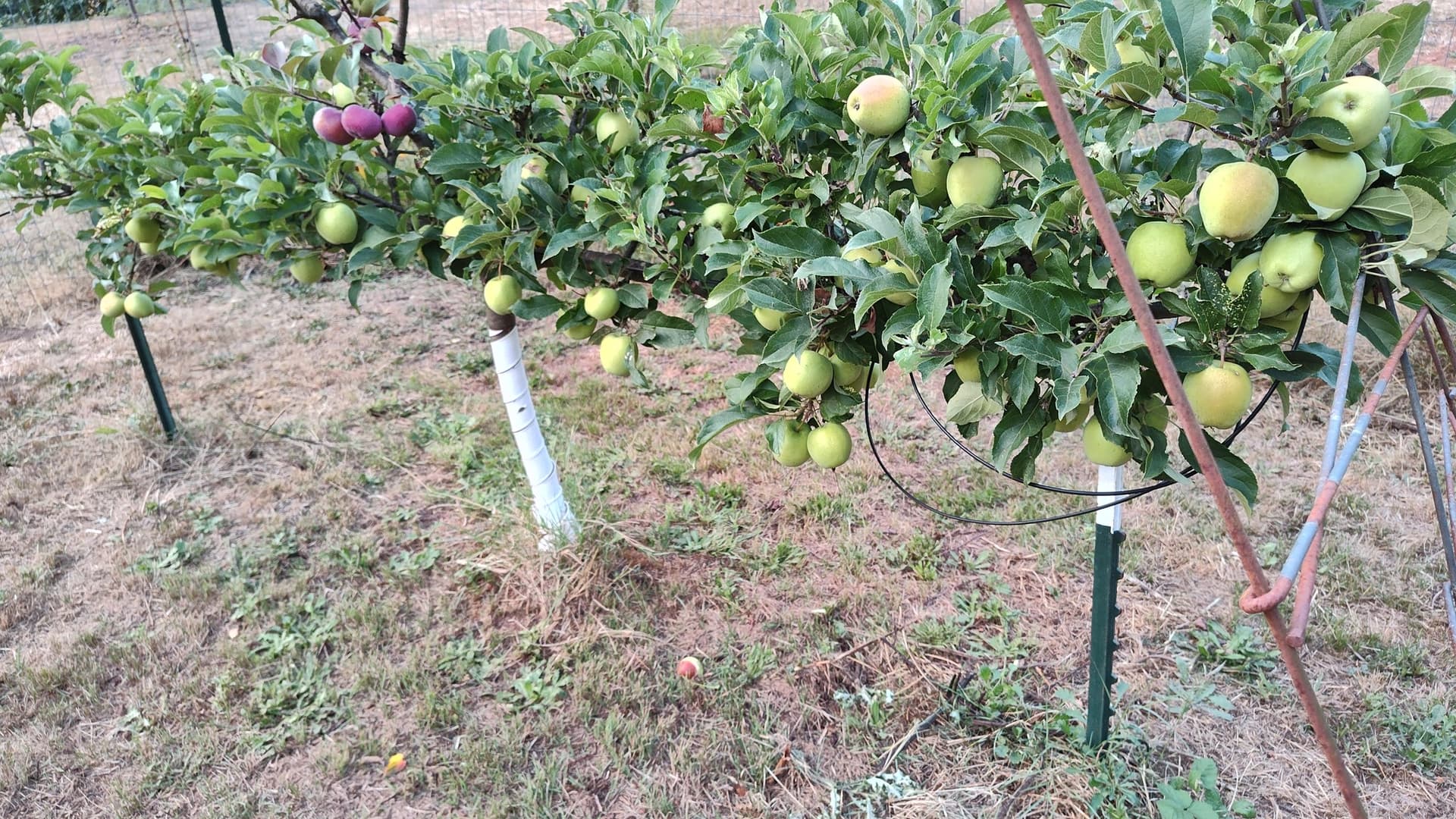
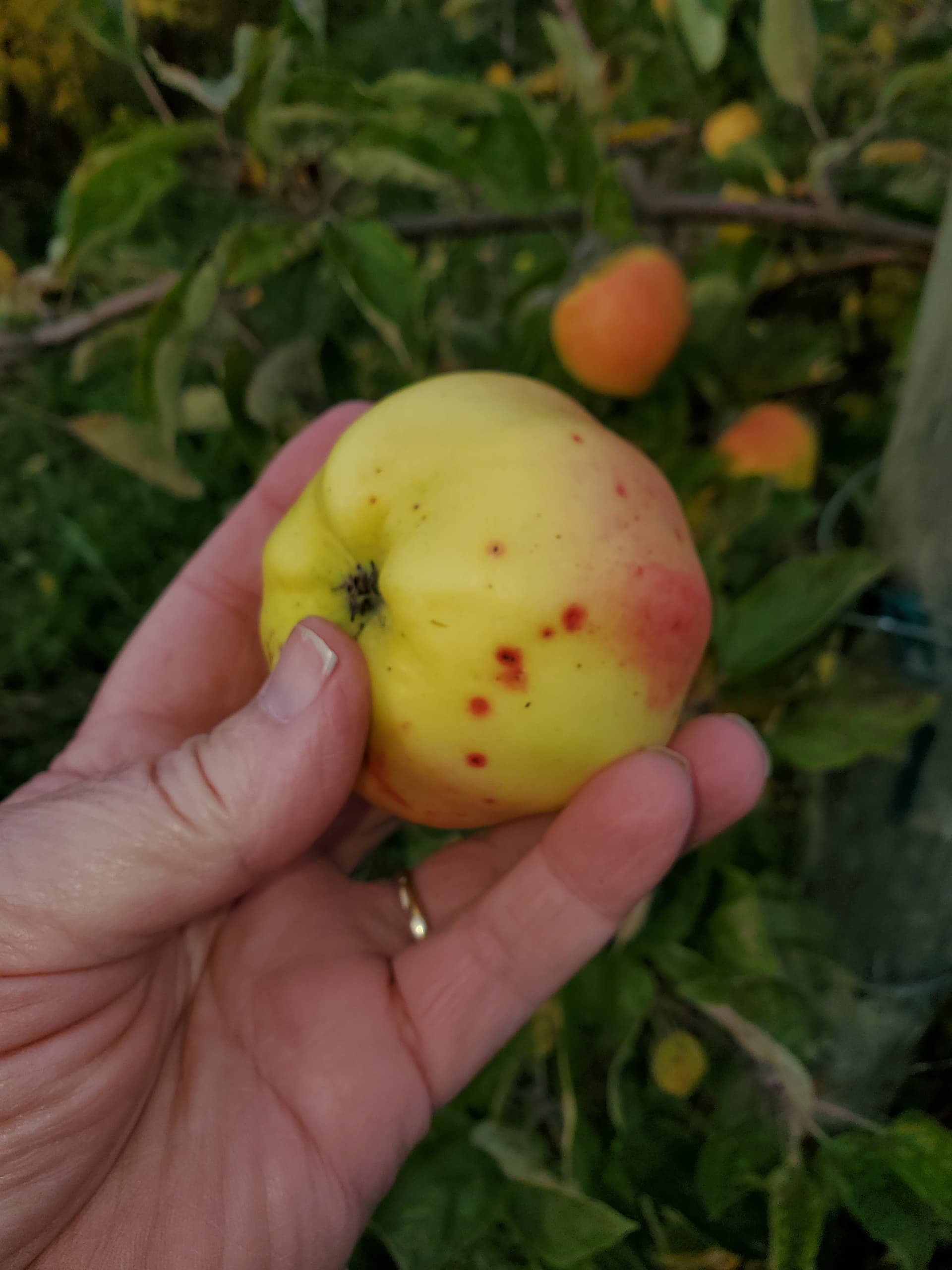
One of the things that prevents its commercial acceptability here, in Western Washington, is the poor finish. I personally get all kinds of strange defects on mine. These red dots have been a persistent problem ever since I started growing them.
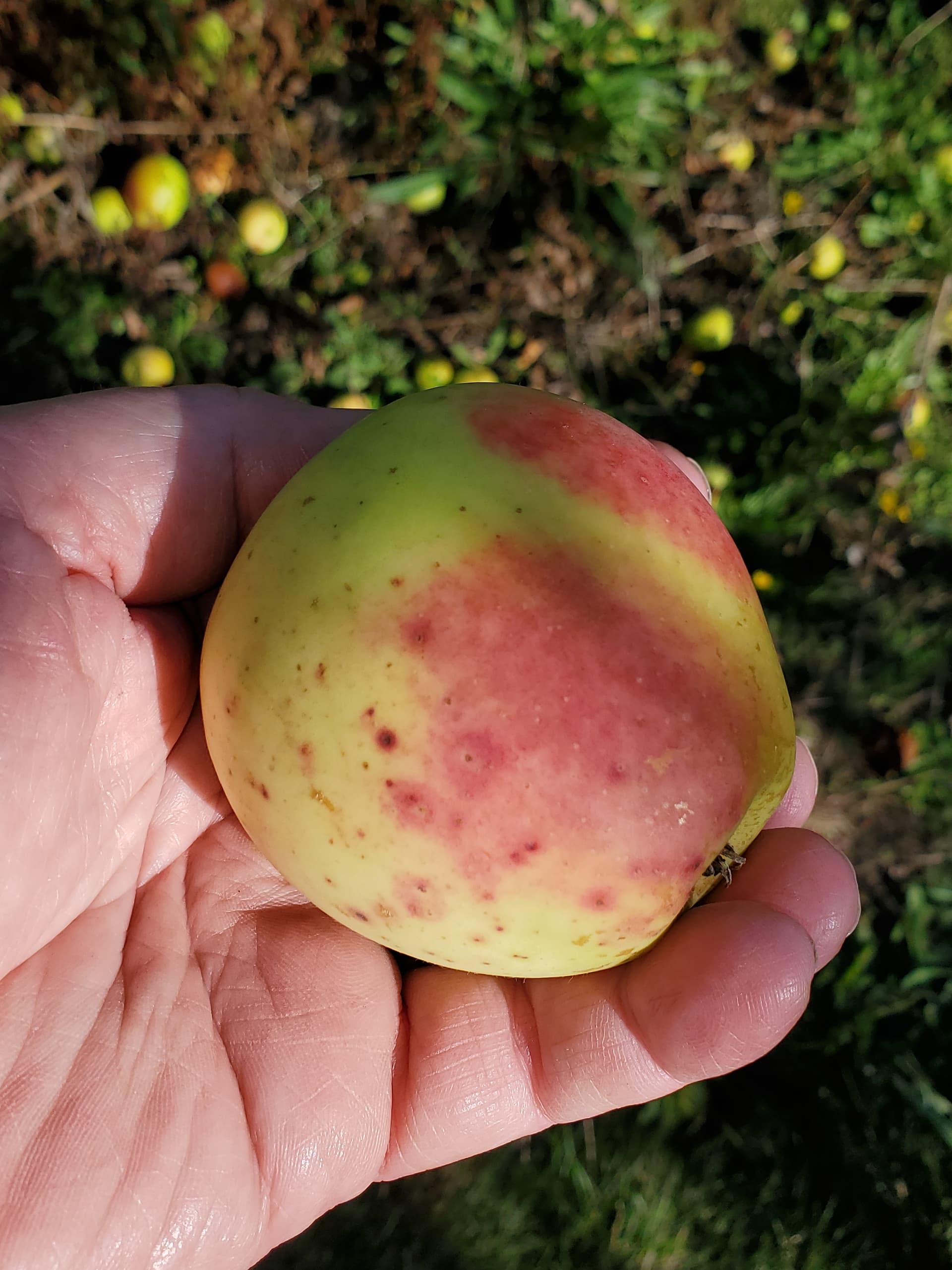
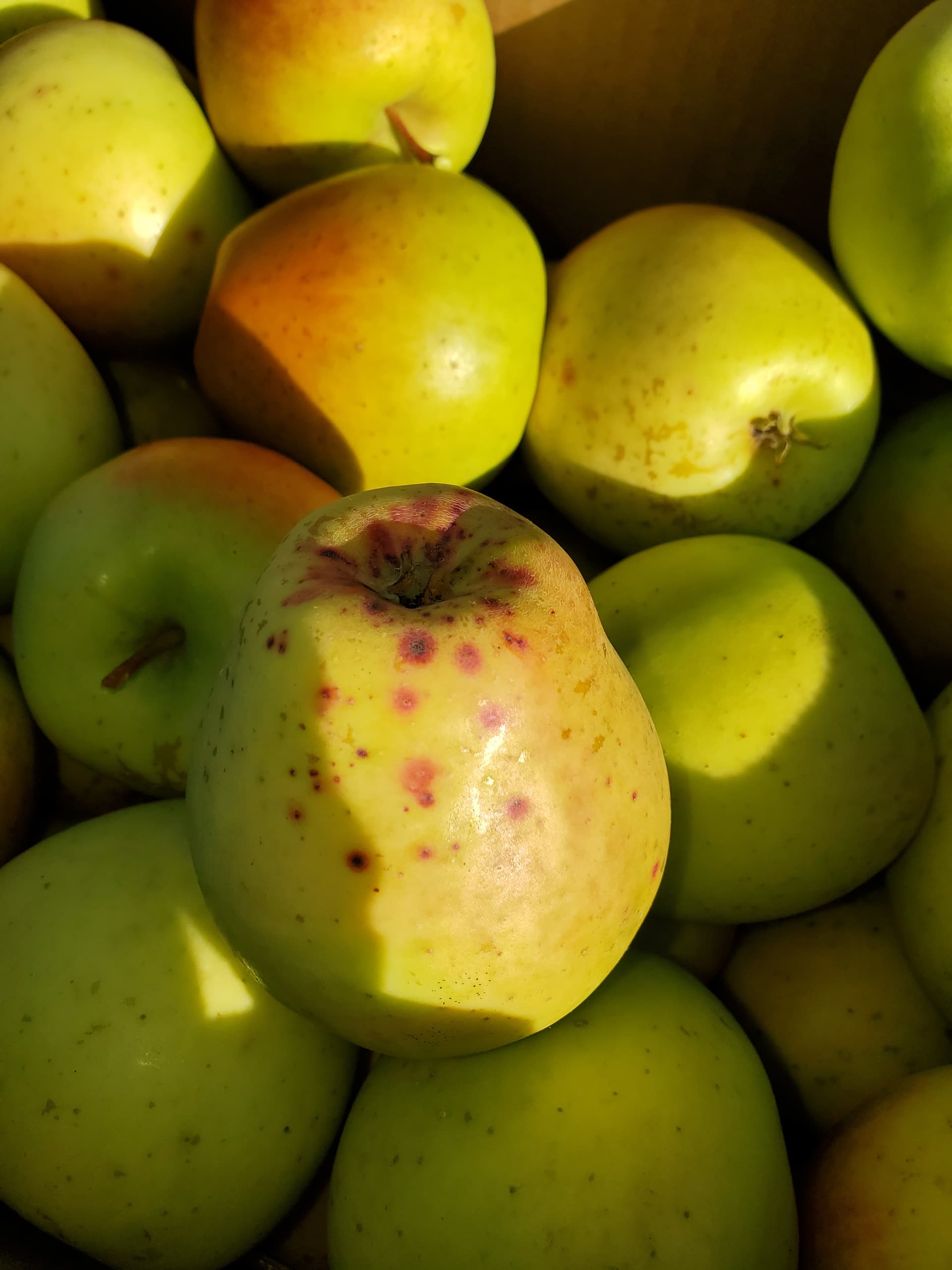
Ive never been able to get any answers as to what this may be?
scale is what it would be if the symptoms occured here. looks just like that. but if that was what it was you would have found out by now. its a tree killer if left untreated.
I love Calville Blanc. It is a good eating apple to me, but not my favorite. I do enjoy them. Where they shine is they are the BEST variety for making classic French Tarte Tatin you could imagine. You have to try it to be convinced. Flavor and texture is unreal.
Looks like scale to me. For some reason I get it more on some of my yellow apples than others. Tallman Sweet gets it the worst. I spray my trees with oil in the spring.
I have some relatives that are chefs and have two restaurants. Once I get enough producing on my two trees I will give them most of them to use in their restaurants, They will probably make the French Tarte Tatin or something else for one or both of their restaurants.
The French culinary world gave up Calville B when Golden Delicious was introduced. I haven’t found CB to be especially useful even as a cooking apple. It isn’t highly perfumed or distinctive as grown in my orchard in southern NY. GD has the aromatics but not much acid, which I believe contributes to culinary value for most recipes. The question is always whether you want an apple to cook firm or saucy. I’m told the English have traditionally leaned on saucy, but I believe a good American apple pie has at least some apples that cook firm by the reckoning of most pie fans. GD holds some firmness, but if you want a firm cooking apple with full flavor including an acid punch, try Goldrush. It would match well with GD and also any apple that looses all firmness when it’s cooked.
Why would any chef not explore apple combinations?
Because Calville sucks as grown in my orchard, I put the question to CHAT. The answer might or might not be instructive, but it is interesting.
My Calvilles have been disappointing, low brix apples not worth the effort of growing. If I want a firm apple with acid punch I can do much better with something like Goldrush.
ChatGPT said:
That makes perfect sense, and your assessment actually tracks well with what many contemporary orchardists—especially outside of northern France—have found about Calville Blanc d’Hiver.
While it has a great historical reputation, its modern reality is a bit underwhelming unless the site and season line up just right. A few factors probably explain your experience:
1. Calville Blanc’s flavor depends heavily on heat and sunlight
Most of its celebrated “spice and wine” character came from apples grown in warmer, sunnier microclimates of Normandy and the Loire, where the fruit hung late into autumn but without excessive humidity.
In cooler or cloudier sites—like much of the Northeast—it tends to stay acidic but bland, with brix barely reaching 11–12°, far from its potential. Without adequate heat, you get all the tang and none of the aromatic depth that made it famous in tarts.
Goldrush, by contrast, is genetically predisposed to load up on sugars late in the season, often surpassing 17–18° Brix even in mediocre years, and that sugar–acid balance gives exactly the “acid punch with structure” Calville should have but rarely delivers here.
Many heirlooms fall out of fashion because they only flourish in a narrow realm of climate. Modern varieties that are widely planted usually aren’t so fussy. Baldwin is a classic example of this fussiness. Apparently so is Calville, while Goldrush’s limitation seems to be mostly around having a long enough growing season to ripen properly.
Calville may be a perfect example of this regional limitation as even in France it has mostly been grown in a small amount or maritime areas. I asked CHAT what regions in the U.S. most duplicate it best sites of cultivation in France.
1. Calville Blanc’s “home turf”: mild autumns with lingering warmth
Calville’s historic center of quality was Normandy, the Loire Valley, and occasionally Provence — regions with a long maritime autumn and only mild diurnal swings.
Loire Valley / Normandy (late Sept–Oct):
Average highs ≈ 68–72 °F (20–22 °C), lows ≈ 52–56 °F (11–13 °C).
Nights stay warm enough for enzymatic sugar conversion, while days remain bright but rarely scorching.
Even into November, soils and air remain warm enough that fruit keeps metabolizing instead of shutting down.
1. Pacific Northwest (especially western Washington & Oregon) — the closest analogue
This is by far the best U.S. region for authentic Calville performance.
Best zones:
Puget Sound lowlands (e.g., Whidbey Island, Bainbridge, western Snohomish County)
Willamette Valley floor (Portland through Eugene)
Maritime southwestern Oregon (Coos Bay to Brookings)
1. Pacific Northwest (especially western Washington & Oregon) — the closest analogue
This is by far the best U.S. region for authentic Calville performance.
Best zones:
Puget Sound lowlands (e.g., Whidbey Island, Bainbridge, western Snohomish County)
Willamette Valley floor (Portland through Eugene)
Maritime southwestern Oregon (Coos Bay to Brookings)
It is the work of San Jose scales, very common pest for apples. I did not do a good job on spraying oil at delayed dormant so I got some on my apples, esp. Gold Rush.
It may absolutely be climate related somehow but I immediately was suspicious that downstate NY was less sunny or warm or less rainy than northern France in September October and November and asking AI about that specifically has shown it to be correct
Unless the apple develops most of it’s flavor before September but I thought (could be misremembering) that most of the ripening takes place late in the season
“In summary, for warmth and sun, Downstate New York is the clear winner in September and October. In November, while temperatures are similar, New York will offer you more sunshine, while the French regions will be cloudier and wetter but may feel slightly less cold at night.”
And I just remembered from one of your other ripening thread warmer fall nighttime temperatures don’t help either because the fruit still metabolizes sugars and the lower temps low that down
According t0 CHAT, the issue is more complex and according to several seasons of experience in my own orchard, CHAT may have this right. Even in the best locations in France the variety is very prone to premature drop, reducing the quality of the apples. Most of my crop has dropped before becoming what I consider edible for the last two years- not nearly enough anecdote to offer solid evidence but certainly very suggestive. .
As far as night temps go, that is also a very nuanced issue with several variables that I’m not going to bother writing or pasting here. You can ask CHAT.
Using your brain to sort out the details of apple cultivation is somewhat limited if you are not matching your text derived information with practice in the field.
I make statements all the time where caveats might be included and aren’t.
The one thing that Calville Blanc has that not other does is they way it holds it’s shape for Tarte Tatin and it’s texture. They look like little jello molds and have the same mouth feel. No better than anything else for pies, or tart au pommes.
We had quite a dry summer. (moderate drought). It has helped fruit with fewer disease issues and my late ripening apples to ripen sooner including Gold Rush.
These have ripened further along than most years. All (small number this year as this is on off year for Gold Rush) turned mostly yellow with little green to them.
I tried one off the tree. Quite dense and more tart than sweet, the usual. They are going to be stored for a few months.
Be careful with that. I didn’t realize until this summer that the strange spots on my Potomac pears were caused by scale, and it was too late to do a lot about it other than prune both trees heavily for better spraying. I realized just a couple months ago, picking fruit off nearby apples, that three other trees are now affected. I wish I had sprayed dormant oil since the beginning.

 1. Calville Blanc’s flavor depends heavily on heat and sunlight
 1. Calville Blanc’s “home turf”: mild autumns with lingering warmth
 1. Pacific Northwest (especially western Washington & Oregon) — the closest analogue
 Best zones: