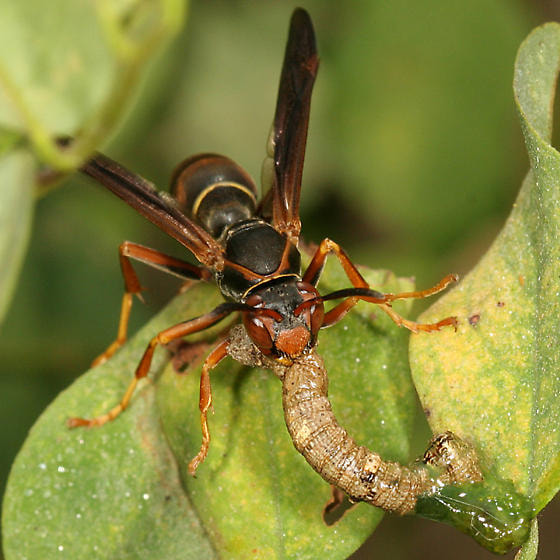
Today I was looking biocontrols (mites) for bindweed on the state’s website, and noticed they also offer a wasp whose larvae eat the larvae of a peach tree moth. As I understand this is also known as the Oriental Fruit Moth, and is different than the commonly problematic peach tree borer whose larvae look similar, but tunnel under the bark.
Anyhow, I didn’t find any postings on here about this predator, so I thought I’d share. Perhaps it’s already widely known.
I do not get to observe all of the predation that goes on while i am at work but i do get to see some. My paper wasps among other wasps that i have are voracious predators… I assume that if i did have or will have Peach moths that they would eat them too.
Unfortunately the wasps are not available commercially to the public and are very expensive to produce. Only state governments run programs to produce and release them and they don’t survive winters in most places so have to be released annually, based on info I got from CHAT… if it is valid.. I was confused by the article because it called them “peach moths” and I’ve never read those two words as a label for OFM.
There used to be a sticky poisonous bait that controlled them very efficiently. Unfortunately the bait was determined to be a hazard for killing too many non-target species who might crawl over it. The male moths were attracted to it by pheromones.
I bet they would have survived this awful and warm winter!! I think we moved from zone 6 to 8 this year.
I, too, was confused, as at first I thought it for peach tree borer and had to poke around for a bit and understand they were referring to OFM, based on their description. I haven’t clearly observed them here, but after looking at a few pictures of the peach damage, maybe I’ve had a few here and there.
I was curious if the wasps themselves would attack fruit, like the other wasps we have, as they don’t mention it. The part I find fascinating about this is that it is the larvae eating the larvae.