This was a year where my apples tended to be too damn big. I weighed a few of my largest Jonagolds and they came in at about 18 ozs. I can’t eat half of one in one sitting. Most varieties came out larger than ever. Someone said Hudson’s Golden Gem is a relatively small apple, but this year mine were as big as any fancy commercial variety in a store.
They had all the sugar of a smaller apple! That is, the same total amount of sugar in more flesh. Not a growers goal, although some varieties were still plenty good, just not the best apple you ever tasted. I hate that!
The strangest thing is that the Jonathon crop were the smallest they’ve ever been although the tree is perfectly healthy and near other trees that bore huge apples, particularly Fortune, which also were over a pound a piece
Excess water will do that. I help out a bit as a consultant on a nearby orchard. They weren’t watering enough or thinning. Improvements in both areas resulted in the biggest apples, pears, and peaches I’ve seen in west Texas. Next year I’ve suggested that they dial back the water a bit. They loved those huge fruits. I thought they were beautiful but subpar on taste.
One year I had a couple Arkansas Black in top of tree nearly big as softballs.
They actually tasted the best of all the apples on the tree…to me at least.
(Maybe because they didn’t have as much acid.)
Yeah, non-apple snobs I gave them to thought my Gulliver apples were superb. You don’t believe me, but I think you can get the brix up and have big apples if you cut off the irrigation three weeks or so before harvest, maybe 6 weeks in heavy soils.
I hear you. I personally way prefer the fruit I eat out of hand to be quite small, as I’m not into eating a massive pear or apple. However, while processing pears and apples this fall I’ve reconsidered my planting choices. Up until this point I’ve avoided planting varieties with gargantuan sized fruit. Now I’m thinking for processing of apple/pear sauce/butter, pies, canned, jams, and cider how much less work it would be to have some of the larger varieties. As you get older your hands don’t work as well, so the less work peeling & coring the better. Funny how your priorities change as you get older.
Wolf River is much maligned for fresh eating but is a very good large apple for making apple butter. My priorities are more about finding ways to use apples other than for fresh eating. Cider, apple butter, dried apples, apple pies, apple juice, etc are all on my list to find good varieties that grow in my climate.
I agree with you about the processing time for using bigger fruit. I have been making apple butter & pear butter. Using smaller fruit to do this takes a lot more fruit and 4 times the hands on time to get enough fruit to make the recipes. A lot more waste as well.
So I have been trying to get bigger fruit in my orchard. Small fruit is okay for eating but processing to use for other things is quite a chore.
If I cannot eat all of the bigger piece of fruit I can always save it for my horse to eat.
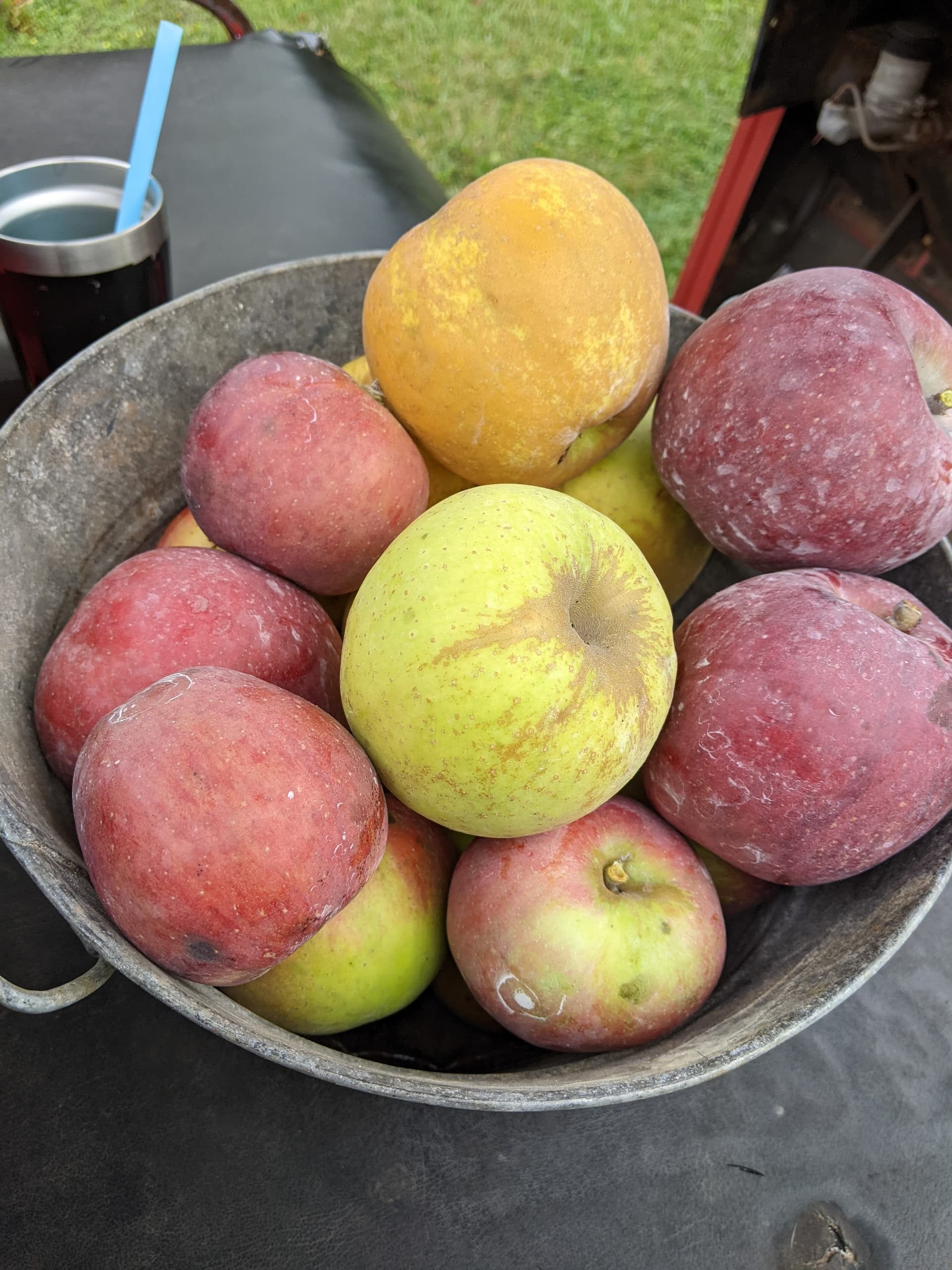
I would not call it small. Summer banana is the greenish yellow apple with the dollop of russet on the top of this pile. Compare it to the red delicious on the right, Virginia beauty underneath, razor russet above or limbertwigs on left. It holds it’s own.
I was particularly pleased with this harvest on this day. Clean apples, good size, and nice variety.
In my region it pretty much does regardless of size, which seems to diminish on older trees. Regardless of whether it achieves ridiculous size, it is consistently the highest brix Asian pear here and high sugar is essentially the entire taste of many types of Asian pears- they have a melon-like quality about them. .
I have a couple of more unusual varieties growing on my KG tree, but their thick wooden skins and lower sugar render their more interesting flavors useless. I expect in sunnier climes they would taste much better.
When I started my orchard here, Asian pears were one of my favorite fruits, but now I mostly maintain a single KG tree to share with other people. This year that tree gave me at least 200 pounds of pears, although about half of them have little pin points that rot which makes them less fun go give away. Most years, stink bugs damage about 80% of the fruit because I refuse to keep insecticide on the fruit throughout summer. Nothing else suffers stinkbug damage nearly as much, although the first 10 years I grew them this wasn’t a problem.
Taste is so subjective and Euro and Asian pears are loved by many. Some have never tasted a truly wonderful euro pear and it is the hardest thing for me to realize in my orchard most years. Harrow Sweet and Bartlett bear consistently without too many pest issues and they are good pears, but not exquisite like a Comice and others that come close to it- Sheldon and a couple of others. But they have to be picked at the precisely right time and it isn’t easy to do- at least for me. And after all these years. Seckel can be easy and quite good, but once psyla finds it, it’s another headache in the orchard.
If you think asian pears are bland, you should try the very flavorful Japanese varieties that generally feature something of a rum/butterscotch profile. Several are relatively short season types too that ripen fine here (Im in southern VT) though not necessarily in places just a bit cooler/milder than here (coastal Maine or PNW for example). My favorite one is probably Hosui. Ive not tested brix, but it gets right up there, has great flavor, fine grained crunchy flesh, and explodes with juice when you bite into it. Others Id recommend in a similar vein are Atago, Yoinashi, and Chojuro. The latter is really good in a good year, but its much more dense and gritty. It has probably the most flavor of any asian (that ive tried anyway) and it can perhaps be a little bit too flavorful for some.
Ill second @alan ‘s comment about marmorated stink bugs- they are attracted to asian pears like nothing else here. The hard spots they make is more of a nuisance than anything. I haven’t noticed it affecting keeping ability. I dont spray my trees to speak of, and Ive found asian pears to be about the most reliable producers in the orchard. I did have some pear sawfly issues once or twice, but otherwise they’ve been trouble free.
I said that. But i buy them from a pick-your-own place that doesn’t appear to thin its trees, and they often have big clusters of little apples on the trees. It might be an artifact of how they grow it, or even what rootstock they put it on. (I don’t know.)
My one bearing tree is a Jonathan, and it dropped a gazillion apples, each the size of a golf ball or smaller, this year. My neighbors thought it was a crab apple. In past years it has produced ordinary-sized fruits (when the squirrels leave any to ripen).