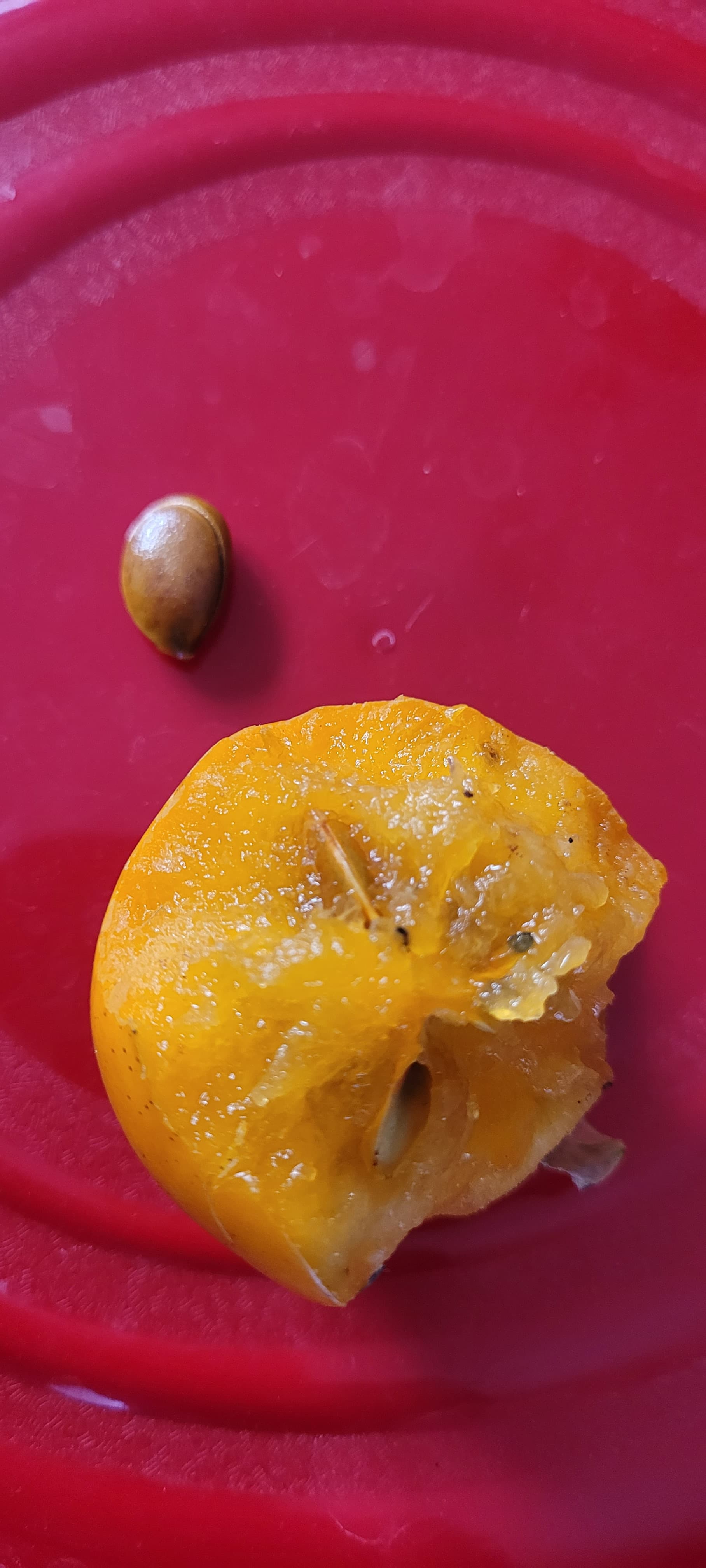
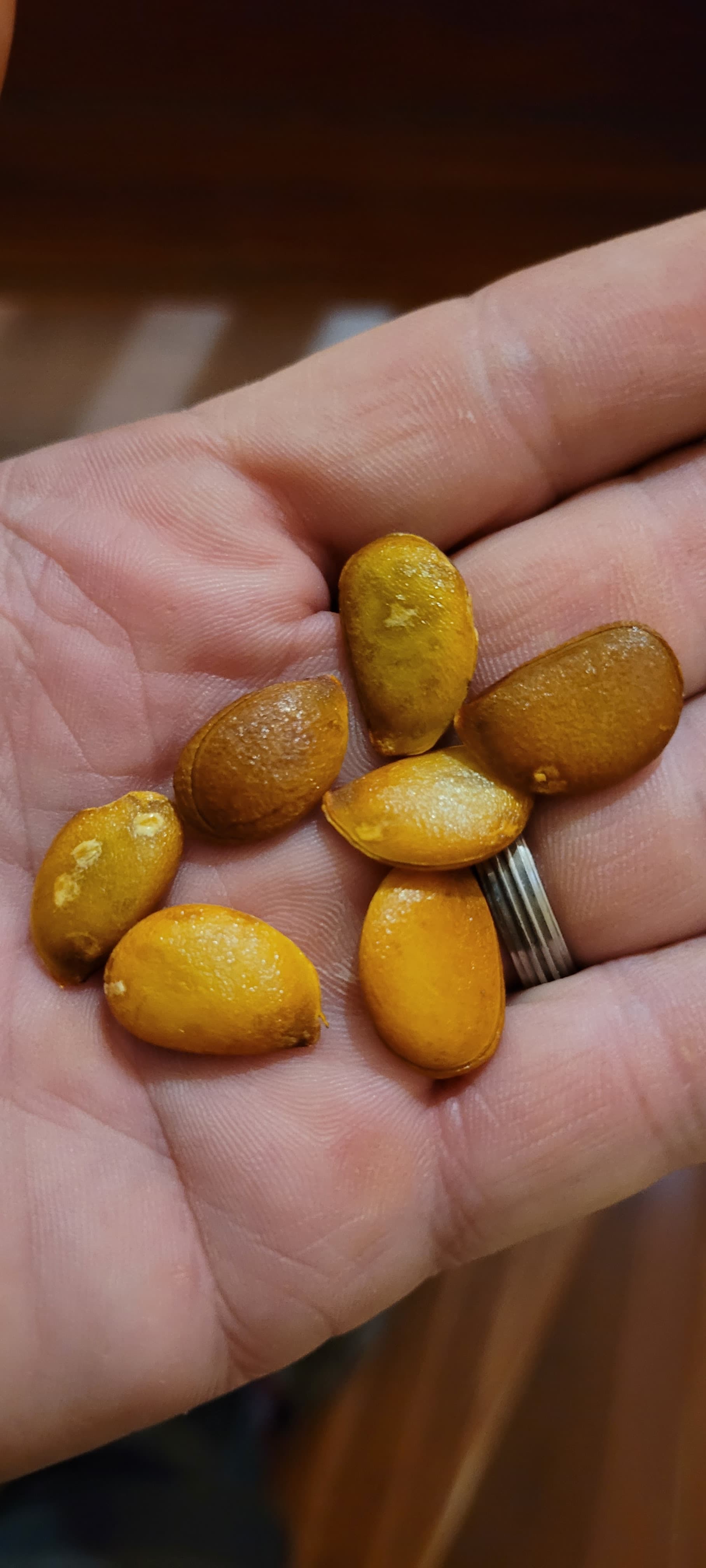
Is a non-astringent American-Asian hybrid persimmon within reach?

Well, the dose makes the poison, right? Tannins are toxic, they cause serious irritation to soft tissue, vomiting and diarrhea, and acute liver damage. Humans just don’t typically eat tannins in high enough quantities to be dangerous (indeed, the small quantities we tend to eat them in may be pretty healthful). The LD50 of gallic acid is about 5g/kg and that of tannic acid is 2.2 g/kg, but serious damage occurs at much lower amounts given chronic exposure.

That’s a good point–there are probably a lot of much easier sources of tannins than unripe persimmons. One would also want to know how effective tannin-treatment would be versus boiled linseed oil, heat-treating, or a proper alkaline copper treatment.

You know, this seems to be the case generally. Crisp apples beat out mushy bletted medlar, native but goopy persimmons and pawpaws never took off, but the comparatively firmer no-mess blueberry, also native to the US, enjoys global popularity, nobody eats actually ripe bananas because they’re just mushy black ooze, and in Asia pears and persimmons are preferred firm.

I wonder, since clearly fruit enthusiasts (so… people like us) are all about those drippy, gooey, ripe fruit, why not the general population? Sure, it might just be that people like neat and tidy and easy, but maybe part of the reason we like these melted ice-cream fruits is partly just due to the fact that they taste better? If you could have a persimmon as flavorful and rich and sweet as a fully ripe persimmon can be, but still crispy and fresh, would you prefer it? I’m thinking I might.

Crisp of course isn’t the only texture. Super creamy or melting, but with some firmness or bite, is also something a lot of people really seem to like, weather it be melon, berries, or peaches. And the way citrus fruits and aggregate berries sort of “burst” is quite appealing, much like how really jammy figs have a toothsome skin that gives way to the condensed fruit nectar inside. IDK, some kind of texture beyond “goop” does seem to be important, even if fruit-crazy people like us keep trying to trick other people into trying (better tasting!) goopy fruits.

But, hey, taste is partly social, partly subjective, and partly circumstantial. There is some objective stuff too, but it’s not the only thing going on, might not even be the main thing going on.

3 Likes

An understandable misunderstanding. My point is that people artificially treating them for centuries doesn’t mean people were also not artificially treating them for centuries. Remember, the original claim from the paper was " these fruits are inedible without artificial treatment to remove the astringency ."

Are you sure about that? I have purchased and eaten numerous astringent type persimmons in Japan that were soft, sweet, and ready to eat. Are you sure all of those were chemically treated? (Also they were cheaper than the mutant types).

:smiling_face_with_three_hearts:

OK, I’m bumping this thread just to amend a datapoint.

Somewhere in the thread, I estimated that 5% of the offspring of a back-cross of JT-02 x Taishu would be PCNA. But I recently read the attached paper from 1985, which includes actual experimental data on two such back-crosses (see Table 6). As the authors note, roughly 15% of the offspring are PCNA.

My estimate was correct if the segregation of alleles into gametes is random. But these 1985 results suggest that the NA allele exhibits what is known as “preferential pairing.” In other words, if one NA allele goes to the gamete, it tends to drag another one along. The arithmetic says that preferential pairing makes it about 3x more likely (15% vs 5%) to get no “Ast” alleles when the probability of preferential paring is 50%, which seems to be the case here.

Assuming that the NA alleles in Taishu behave similarly to the NA alleles in the PCNAs used here (which include Fuyu and Jiro), then the odds of PCNA offspring from a backcross of JT-02 x Taishu are better than I estimated – ~15% rather than 5%.

Those are the odds (15/100) of a non-astringent hybrid from a JT-02 x Taishu back-cross. Actually, any male-flowering PCNA would probably do.

54_39.pdf (803.7 KB)

6 Likes

there is strong evidence that C-PCNA chinese PCNA varity
did not segregat alleles randomly.
it seems like there are 2 type of chorimosome in C-PCNA
like AABBBB .
so there is indeed a precedent.

hav’t once did the preferential pairing comes to my mind.
and this is my job!
now we have a good theory to explain the werid thing !
very helpful.

5 Likes

My Taishu appears to have male flowers. My JT-02 appears to have female flowers. Now the question is whether I have the ambition and energy to try to produce a controlled cross.

Assuming that we can extrapolate from Japanese research that crossed and then back-crossed Kaki PCA x PCNA, the likelihood that any one seed is PCNA would be ~15% (see above).

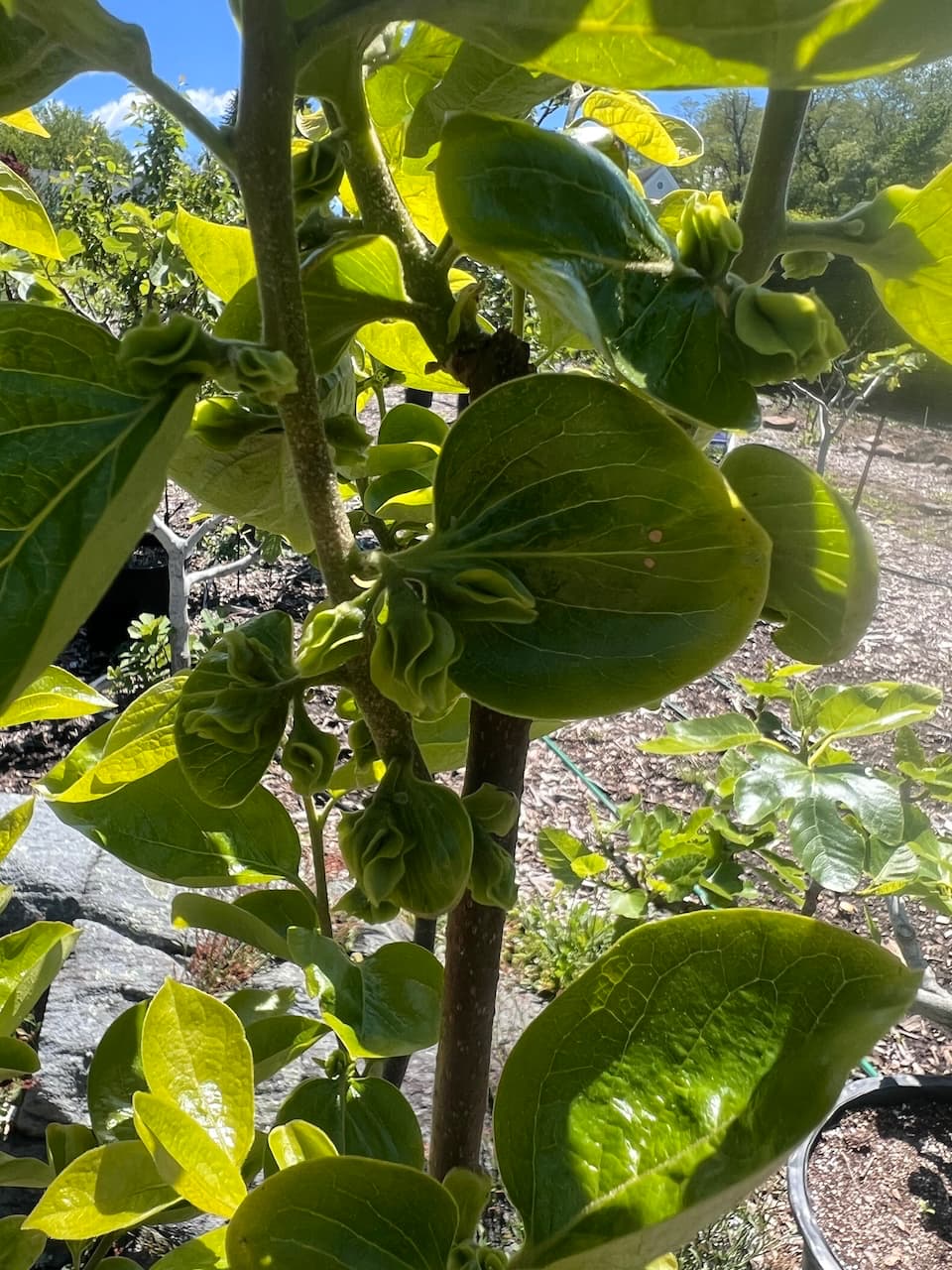
Here’s Taishu:

10 Likes

FWIW: I had no success harvesting pollen from the male flowers. They dropped, withered, whatever. If I plan to try this again, I’ll have to figure it out.

But in the end, it wouldn’t have mattered. I bagged roughly 20 branches on JT-02 containing maybe 100 female blossoms. Overall, the JT-02 trees / grafts dropped 80-90% of their blossoms but still there is a crop. But inside the bags, not a single blossom remains. Leaves look good, just no fruit. So if I had managed to hand-pollinate the female blossoms on JT-02 with pollen from the male flowers on Taishu, it might not have mattered. Unless pollination itself affects the odds.

2 Likes

I didn’t know about persimmons but with citrus pollination seems to make a pretty big difference in if a fruit holds.

3 Likes

To be clear, there was a Chocolate and a Coffee Cake nearby, along with the Taishu, so there should have been an abundance of pollen outside the bags. Last year ALL of the 1000 or so fruits on a nearby Kasandra had seeds. So the 80-90% drop on JT-02 was despite pollination.

I take your point, nevertheless, that with pollination I might have had 10-20% fruitset on bagged blossoms on JT-02.

4 Likes

Here seeds Luo tian tian shi cross ( Kurogaki x Rossey)


6 Likes

Can you describe the flavor of Luotian Tianshi? Is it much different from Japanese PCNA kaki?

1 Like

My Great Wall tree produced about a dozen fruit this year and I left them on the tree through a couple of frosts that burned a few of the fruit. That is, there were some soft translucent spots although most of the affected fruit had at least 90% sound flesh.

I was afraid the damaged spots would start to rot at the point of injury so tried one when still firm. Zero astringency as was the case with every injured fruit I ate after.

CHAT suggests this is a rare occurrence that was likely the result of some combination of a mild fall and the fact that the tree is growing against a south facing wall that is built against a hill on the north side. The hill starts at the top of the wall adding greater stored warmth.

I will let all know what happens next year. This tree has survived sub-zero temps and that wall couldn’t have completely protected the tree from -7F… It isn’t tied to the wall and branches at least 18" from the wall were not hurt. A couple pieces of fruit formed a few inches above the wall entirely.

1 Like

I ate the first fruit two years ago. I was impressed because the fruit was still green but very sweet.
When fully ripe, it’s like jiro. No strain. But, and there’s always a but:… the fruit is small, a bit like Nikita’s Gift.

1 Like

It tastes very sweet—uncomfortably sweet. brix reading 26~33
The flesh is very sandy and hard to chew.
The seed is very large in proportion, and the fruit itself is too small.
I would say it is awful.
it suposs to give you a astringency aftertaste. but they taste bad enough in first bite.
i did;t chew it for long enough to felt the aftertaste.

BUT. we grow it in sub tropical area.
and it is already known that soome varity tase way worse in hot climate.
so take this with grain of salt.

1 Like