So in researching Ka-Bluey from Gurneys, I came across some rather intriguing information and was wondering if anyone else knows more. Here’s the USDA ARS on it for your reference: https://npgsweb.ars-grin.gov/gringlobal/accessiondetail?id=1841344. I saw the pedigree comes from US 73 x G-526 and cannot find any reference to these anywhere outside of this mention. I’m intrigued what the parents were (as in were these ever named) and if its possible to get an accession of one of them. I also noticed all Gurneys did was buy the patent, but Univ. of Arkansas was the original breeder with credits going to J.R. Clark, J.N. Moore, and A.D. Draper. Some seriously big names in blueberry breeding. Also, does anyone know why this never made it to commercial markets if the flavor and disease resistance is so raved about. Thanks for any info related to this and hopefully I spur some interest in this blueberry. I’ve noticed it’s rarely talked about on our forum, only four posts I could find on it.
Thank you for this information. I had looked at this variety to buy.
I was able to get a few Ka-Bluey accessions from Corvallis,a few years ago,along with some other varieties.Out of the group,they were by far the most successful at propagating.
No help on your questions yet though.
Good work sleuthing that out. I wonder if you could somehow reach the researchers themselves. It looked like one of the websites said the appearance was not good enough for commercial. Not sure if that is the real reason. I really like Sweetcrisp blueberry but it produces about 1/4 of the crop I get from Emerald and I could see why commercial growers don’t grow Sweetcrisp. It wouldn’t surprise me if the Gurneys explanation is the real one - not pretty enough.
Correct me if I’m wrong here, but I’m fairly certain some of these researchers are no longer with us. So that’s most likely a dead lead and if not, good luck getting a university to release unnamed test cultivars to a public entity  . I do see they label them as medium to medium small berries, I’m still intrigued why appearance here might turn away commercial growers. From what I’ve researched it sounds like a mix of ‘Razz’ and ‘Hannah’s Choice’ given the flavor profile. I wonder if it suffers the low yield of ‘Hannah’s Choice’ or the unsuitable shipping abilities of ‘Razz’ that turns to mush quickly…it mentions good scar so that’s not the problem nor is disease (they claim it gets zero disease and grows in amended soils well). Sorry if I’m rambling here, just trying to understand what the downfall is. I grow many oddity blueberries for sale to my local community, which gets me around some of the issues of what I call “eccentric” homeowner varieties.
I might be able to ask Arlen Draper about Ka-Bluey.He retired in Payson,Arizona and if things work out,one of my neighbors is moving there next month and may want my help,getting him there.
Fruit productivity could be a shortcoming with this one.The plant grows very well.Mine is over four feet tall,but hasn’t produced a lot yet.
I have several Kablueys, but they do not seem to be hardy enough here at the northern edge of zone 4. They have only produced a few berries after mild winters. Gurneys gave me a refund on a couple.
I’m located in Zone 6b, I have quite a few on order to trial them, but the more you know the better off I’ll do here. I would love to know anything he may respond with and thank you so much for your response. I wasn’t sure if any of these researchers were still around that’s truly amazing you know Dr. Arlen Draper!
I only know of Dr.Draper,as his name is mentioned a lot,in Blueberry development research articles.
I have another interesting one I’m researching on the pink fruited end as well. G-435 it goes by. If anyone knows how to obtain this accession please feel free to chime in. I’d look for Catawba or Redskin but it seems they’ve been lost to history. If anyone knows if these exist anywhere, I’d love to acquire Dr. Coville’s original pink fruited blueberries.
G-435 also goes by Pink Champagne.
I’m not sure about the date of this article or if they’re still available,but there is mention,that contacting Mark Ehlenfeldt might be helpful.
https://www.ars.usda.gov/northeast-area/beltsville-md-barc/beltsville-agricultural-research-center/genetic-improvement-for-fruits-vegetables-laboratory/docs/pink-champagne/
I checked on the ARS Corvallis website,for some possible pink berry matches and besides Pink Lemonade,there is one called Grandfather Mt NC,from North Carolina of course.It’s interesting,because they have three photographs and the fruit are pinkish,except in one,a single berry has a darker hue.
I’m guessing these are available,as they are grouped with all the others,but their listing is historic and I’m not sure what that means,in obtaining some.
Thank you, I did not notice Grandfather I’ll look into it and let you know what I find. I did see the USDA letter regarding the pink champagne mix up, was planning on calling Dr. Mark Ehlenfeldt today to see if I can make any headway there too.
When saving those photos of the Grandfather plants,part of the description was “unripe fruit”.So,they probably were all taken at an immature stage and most likely do get darker,as they age.
I show this email for John Clark. jrclark@uark.edu I last exchanged emails with him 9 months ago. Also, Margaret Worthington is the current bramble breeder at UARK. mlworthi@uark.edu John is most likely to be able to shed light on the parentage of Ka-Bluey
Any chance there’s been any update to this? I’ve been curious as well
https://lists.ibiblio.org/sympa/arc/nafex/2014-04/msg00020.html
from a nafex discussion in 2014
“kept as a parent because of the dark color”
“a high degree of southern highbush germplasm on both sides of the pedigree”
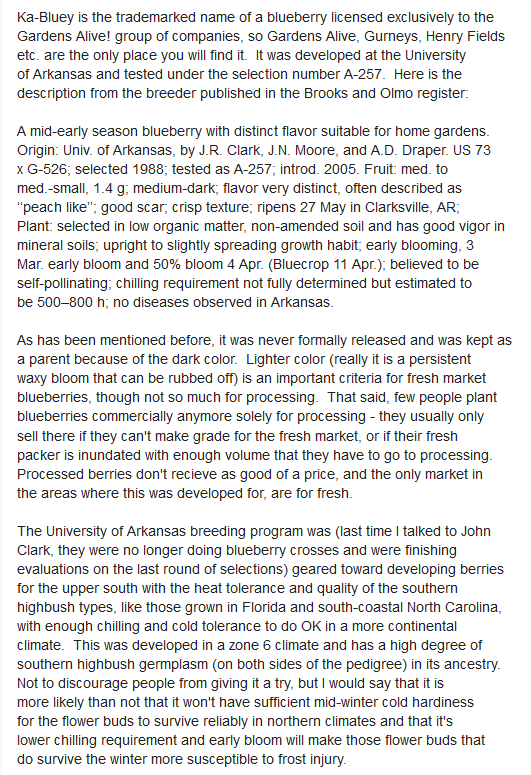
Thank you  i usually don’t do small blueberries but i may consider this one since it looks like it’s different flavored.
I’m glad you found this. I’ve said a couple times that Ka-bluey is my favorite variety, and so far every person I’ve toured my patch with has agreed; after a decade of bearing that has to be hundreds of people. If you ask them their second favorite they’ll disagree, which is equally interesting to me – both the “more tart” and “more sweet” preferring folks converge on it.
As for why KaBluey never went commercial – I mean, they never tried is probably the answer. Looks like from your quote they didn’t think it had the right color for what the marketers are looking for, so they recovered some of their investment by selling the rights to backyard growers. There’s a reason grocery store fruit has a reputation for looking better than it tastes.
Before I read this, I had assumed it was because the berries are medium sized and its ripening window is fairly broad – they peak in mid to late June, but I get berries on these for most of June and July, and I see modern commercial varieties advertising more concentrated pickings. So it might be that it’s just a better fit for backyard/PYO.