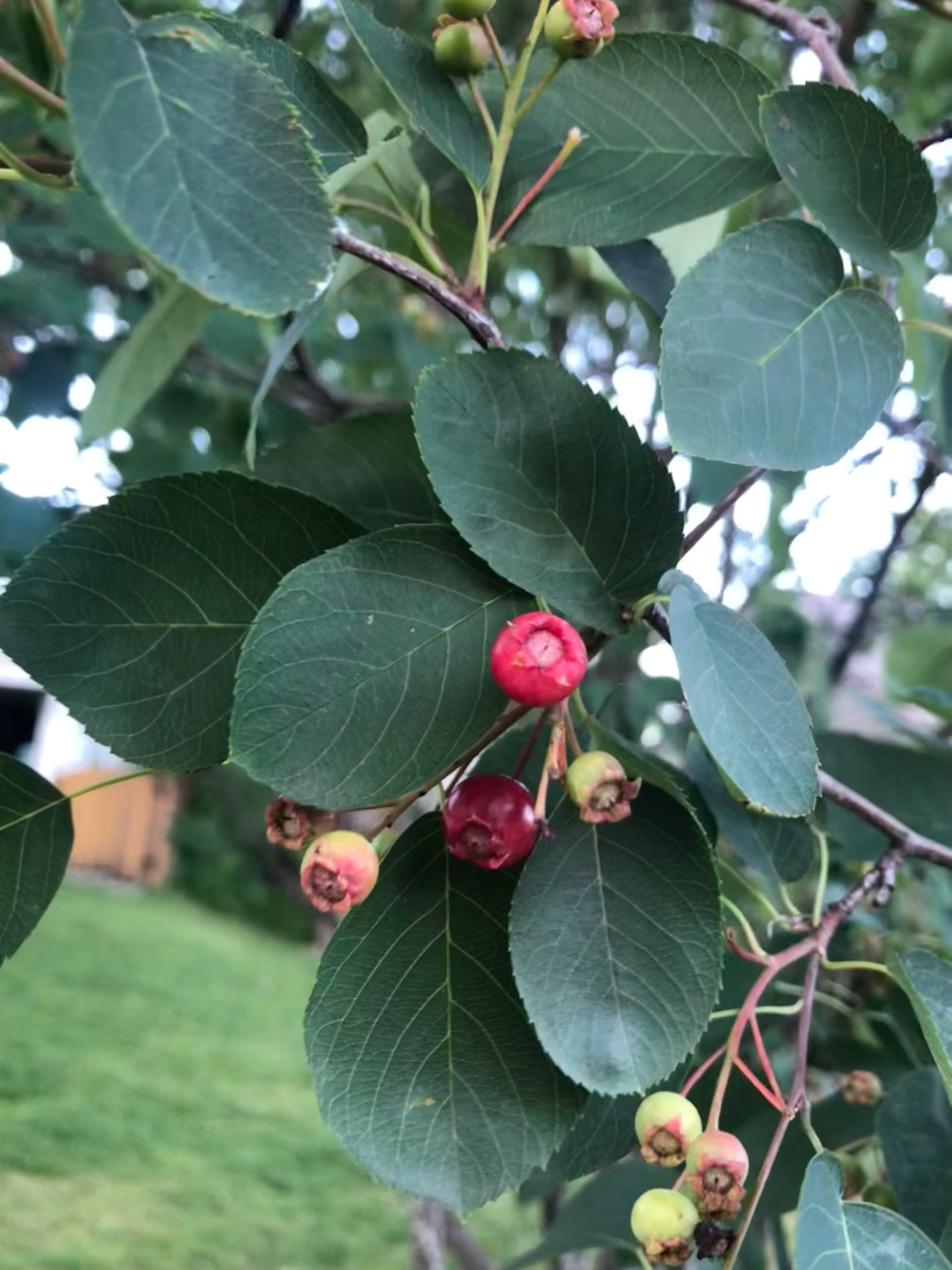
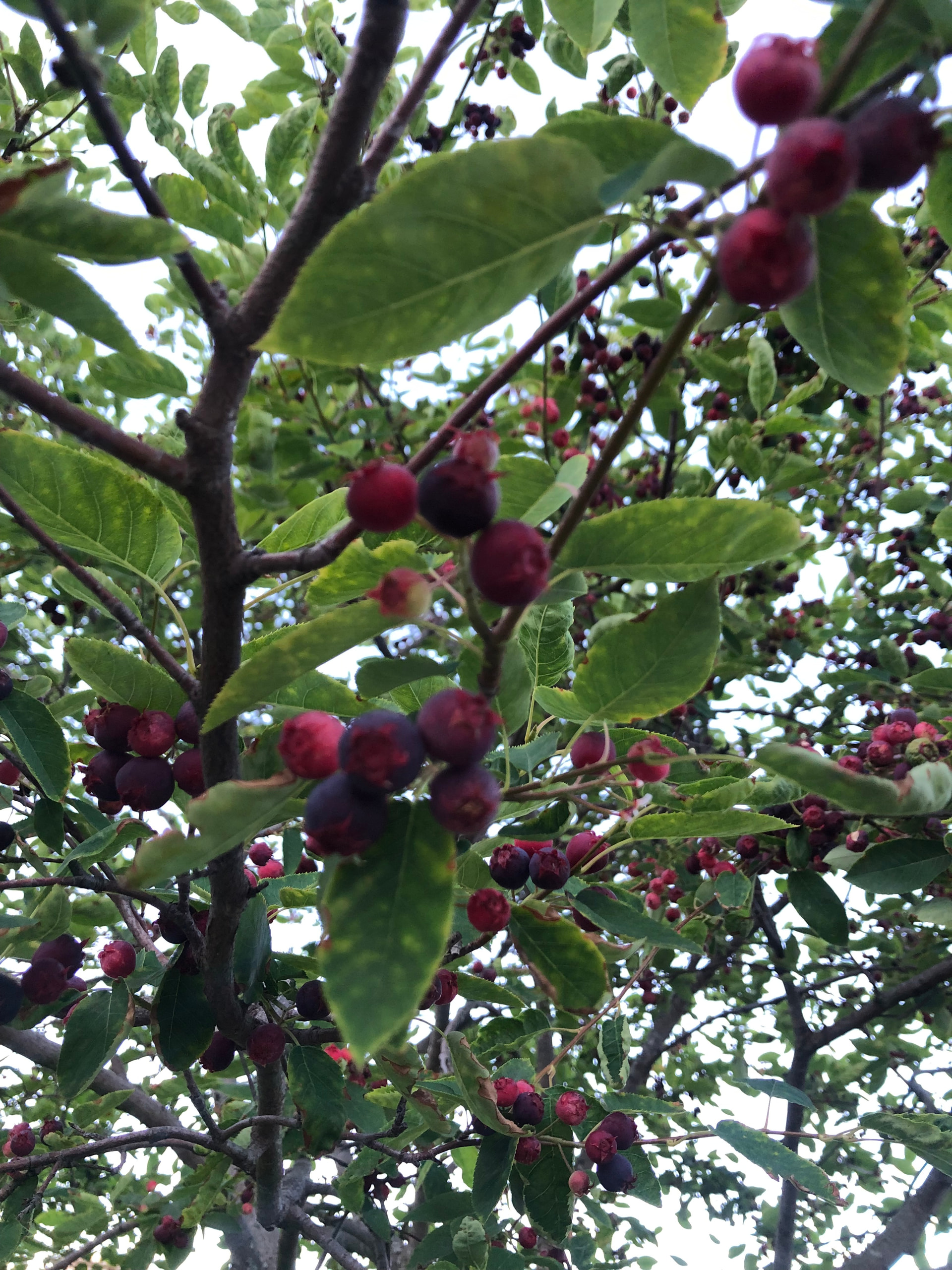
I’ve got two breeding projects I’m starting this year, the first is trying to breed cedar apple rust resistant serviceberries with fruit I find tasty, and the second is to create intergeneric hybrids between various members of the Maleae tribe to try to introgress a variety of traits from diverse species into stuff like apples, pears and serviceberries, as well as potentially producing completely novel fruits.
I’m currently only growing a few plants but should be getting a variety of seeds later this year
Current plants in my garden that are part of my project
- Black chokeberry Aronia melanocarpa variety Ground hugger
- A rooted American mountain ash cutting, Sorbus americana
- Several serviceberry seedlings I found growing under a rust resistant serviceberry tree
- Several cuttings from suckers of the rust resistant tree
Seeds I will be getting later this year and will be attempting to germinate
- Seeds from wild diploid populations of Amelanchier canadensis
- Seeds from the rust resistant serviceberry tree mentioned above
- Toyon, Hetermeles arbutifolia, seeds
- Peraphyllum ramosissimum (rather ambiguously and a bit misleadingly known as wild crab apple) seeds from the wild
- Indian hawthorn, Raphiolepis indica seeds from nearby cultivated plants
- Wild American Mountain-Ash, Sorbus americana seeds
- Diploid Crataegus suksdorfii seeds
- Cotoneaster seeds from various nearby plants (exact varieties currently unknown and ploidy is know to vary between varieties)
- Hopefully some wild diploid Aronia melanocarpa seeds but I don’t currently have any concrete plans for getting them yet depends on if I travel to where they are this year
- Some wild tetraploid Aronia melanocarpa seeds
- Diploid Amelanchier pallida seeds
- Firethorn, Pyracantha sp. seeds from a variety of local plants
- Maybe callery pear seeds but I don’t really think it’s necessary to grow them myself since there’s already too many mature ones nearby
- Possibly Osteomeles schweriniae seeds
- Wild Greene’s Mountain-Ash, Sorbus scopulina, seeds
- Wild California Mountain-Ash, Sorbus californica seeds
- Wild Utah serviceberry, Amelanchier utahensis seeds
So for the rust resistant serviceberries I plan to place seedlings in a spot with very high rust pressure due to someone planting a bunch of junipers next to a bunch of hawthorns, crabapples and serviceberries (I’m not sure who thought that planting those all close together was a good idea) and discarding any that get infected, I’ll also be hand pollinating the main tree with pollen from serviceberry trees with more palatable fruit and pollinating several other serviceberry trees with it’s pollen starting next year.
As for my more exotic breeding plans the main plan is to cross a variety of species with Sorbus americana and potentially other Sorbus species if I can get my hands on them since they are known to hybridize even with more distantly related members of the tribe and then from there to cross the hybrids with each other and their parents and select for various traits
12 Likes
I’m also looking for suggestions for other species in the Maleae tribe that might survive growing outside in my area. Along with potential sources for either seeds or saplings of them.
2 Likes
If youre interested i can send some berries of my amelanchier arborea. Its not the species you mentioned but it appears to be quite rust resistant. Im also air layering for affn. Currently has no signs of rust though it was a dry spring. Last year was extremely wet and I lost about 10% of the berries to rust but otherwise had s good harvest
4 Likes
Love a toyon
I have nothing productive to add to this conversation, but they sure are nice and pretty in fall
2 Likes
I’m not sure how well toyon will do in my area (I think it rains too much and the soil is too poorly draining for them) but if growing in the ground fails then hopefully growing in a pot or in a greenhouse where they can be kept drier will work
1 Like
I think you’re probably right and I’ll raise you that they’re used to summer drought (not just the amount of rain, but a 4+ month period with no rainfall). Not sure how they’ll take the humidity, but they sure are nice and pretty on a scrubby fall hillside
1 Like
It’s not so much the amount of water that is a problem but the water plus high temperatures encouraging root rot pathogens that kills them. Starting with a sterile potting mix should help. Toyon grows fine in containers in nurseries here where they are watered all summer long. In the ground, they take more summer water than many other California natives without dying from root rot, but you could always try grafting them onto something like Photinia or loquat. That is a strategy people in eastern Australia use to grow western natives. They are quite fire blight susceptible though.
4 Likes
All of my CA native are potting mix to
Just another data point here—I have several CA natives in containers using fresh potting mix + pumice (roughly same price and more available than perlite in garden centers here, though I gather not so much out east). I’ve had no problems and lush blooms, but I’m in the native range and don’t have to deal with the rains during warm temps
2 Likes
I’m getting Malacomeles denticulata too.
I wonder if Malacomeles denticulata and Peraphyllum ramosissimum are able to easily hybridize with Amelanchier species, since Malacomeles and Peraphyllum are genuses closest related to Amelanchier
2 Likes
If you’re interested in seedlings, let me know this fall. I should have quite a few available to ship bareroot.
3 Likes
Additional goals for serviceberry breeding
- Slightly larger fruit
- Calyx abscission so they aren’t scratchy or maybe just having the calyx be a certain shape
- Not dropping fruit when it’s ripe
- Reduced tendency to tear apart when picked, (firmer flesh and thicker skin perhaps?)
- Maybe softer seeds or thinner seed coats? Idk I don’t have any issues with the seeds but I hear some people dislike them
- Flowering at an earlier age (to facilitate breeding mainly) (Although I am also looking into ways to control flowering I’m not too hopeful to be able to do it without a lab and significant funding)
3 Likes
I’m always interested in having more genetic diversity to work with. Cultivars may have nicer fruits or appearance but wild plants have much more diversity
1 Like
How does it compare to other trees in your area?
I have never seen one not lose its whole crop to rust
4 Likes
This is very exciting. We planted out a few dozed serviceberry seedlings four years ago with a vague goal of maybe finding CAR resistant varieties, but with no luck. Many actually died from drought that summer but the ones that survived are definitely affected.
We have TONS of eastern red cedars with CAR galls on them so if you start circling some varieties that seems promising and want to trial them elsewhere, I’d be happy to plant them out here and keep notes for you. We are located near Bloomington, IN Zone 6B.
2 Likes
I found two more trees that seem to be the same kinda as the first resistant tree I found, there’s no sign of anything CAR on them and the fruit looks about the same and has the same somewhat bitter or maybe astringent flavor w other serviceberries around here don’t have, they’re all deliberately planted trees so I’m going try to track down where they came from (I know the first tree I found was planted by the county) or maybe I can ID them as a specific cultivar or species (If it’s available at nurseries then people can try ordering it themselves). Here’s a photo of the second tree I found showing the leaves and fruit
There’s also a tree that that seems somewhat resistant in a park that has considerably more palatable fruit but it’s not terribly healthy this year so I’m hesitant to use it’s seeds or take cuttings
3 Likes
Huh I should probably rename this thread to something less stilted. Maybe ML’s breeding projects.
Anyway wanted to report that I’ve currently got a cutting from a parsley hawthorn in some water, I took it on a whim, but if it roots it might be a good rootstock since part of my yard tends to be pretty damp and it’s known for growing in wetlands
4 Likes
Found a serviceberry tree with foul tasting seeds today (I gnawed on the flat seeds since they’re not viable), guess that explains why some people complain about the seeds, previously I’ve only have ones with an almond or slight cherry flavor. (Yes I know the seeds are mildly toxic, but I’m not gonna stop eating them since it’d take a lot more than I eat to cause issues)
2 Likes
Collected fruit from twelve wild serviceberry trees (assuming I counted correctly, it was quite hot and I was out from about 8 am to 4 pm so I might have skipped a number without realizing and I’m now too tired to check for a few hours), although not very much fruit overall, its fine though since I just want the seeds.
2 Likes
I’m going to try collecting seeds from the wild ones around here for another forum member. If I do manage to get ahold of some, I’ll send a few your way too.
3 Likes