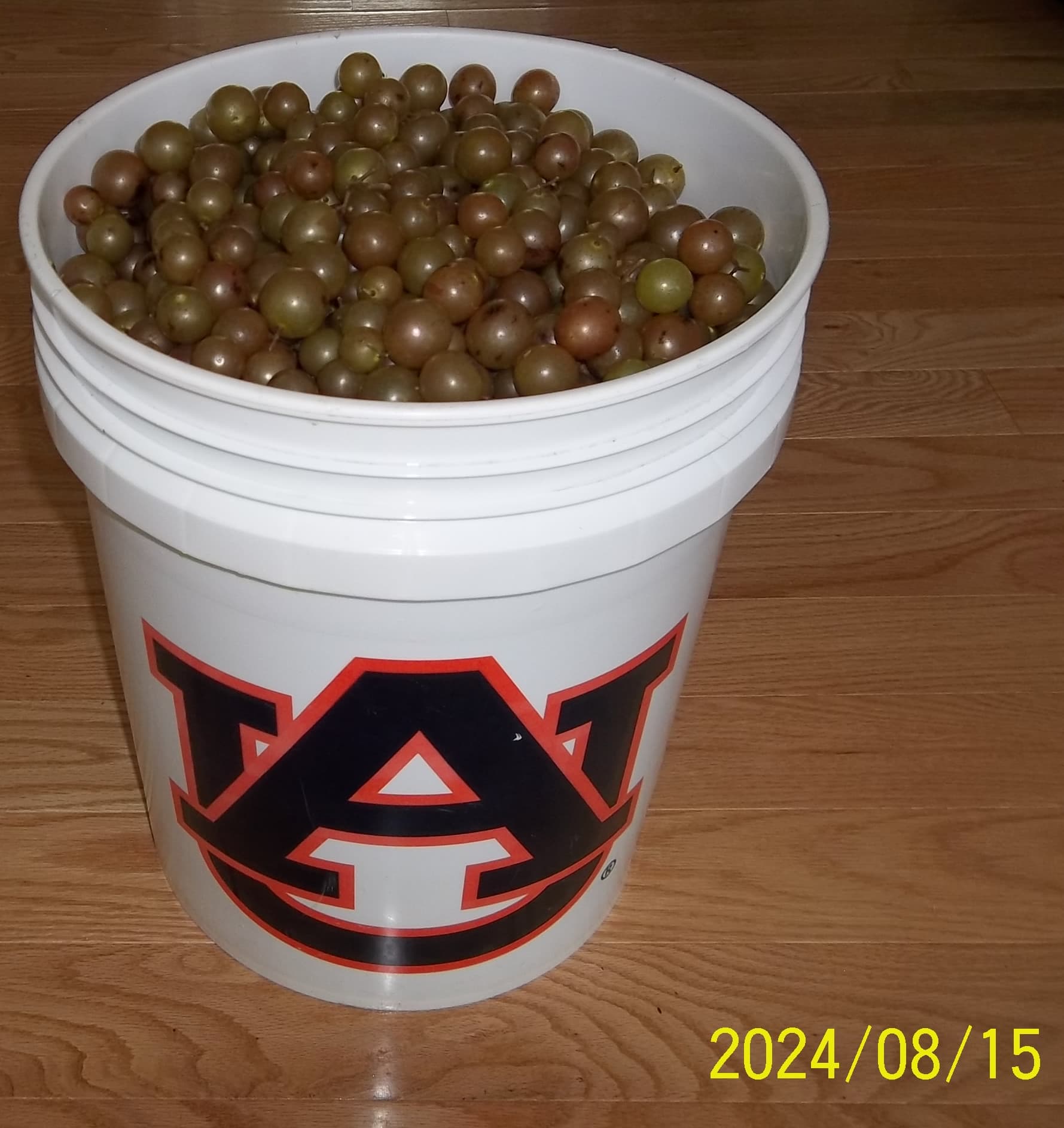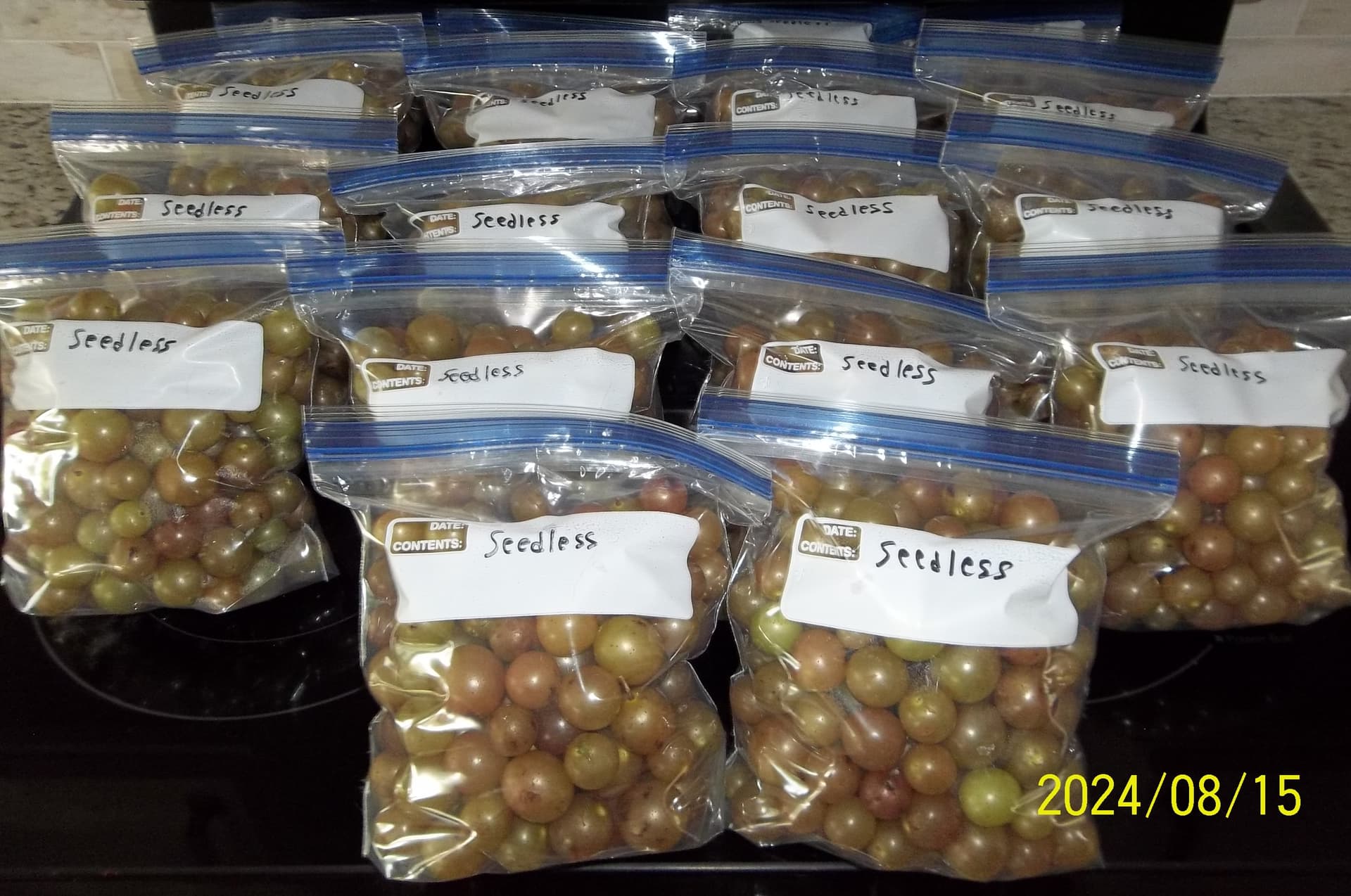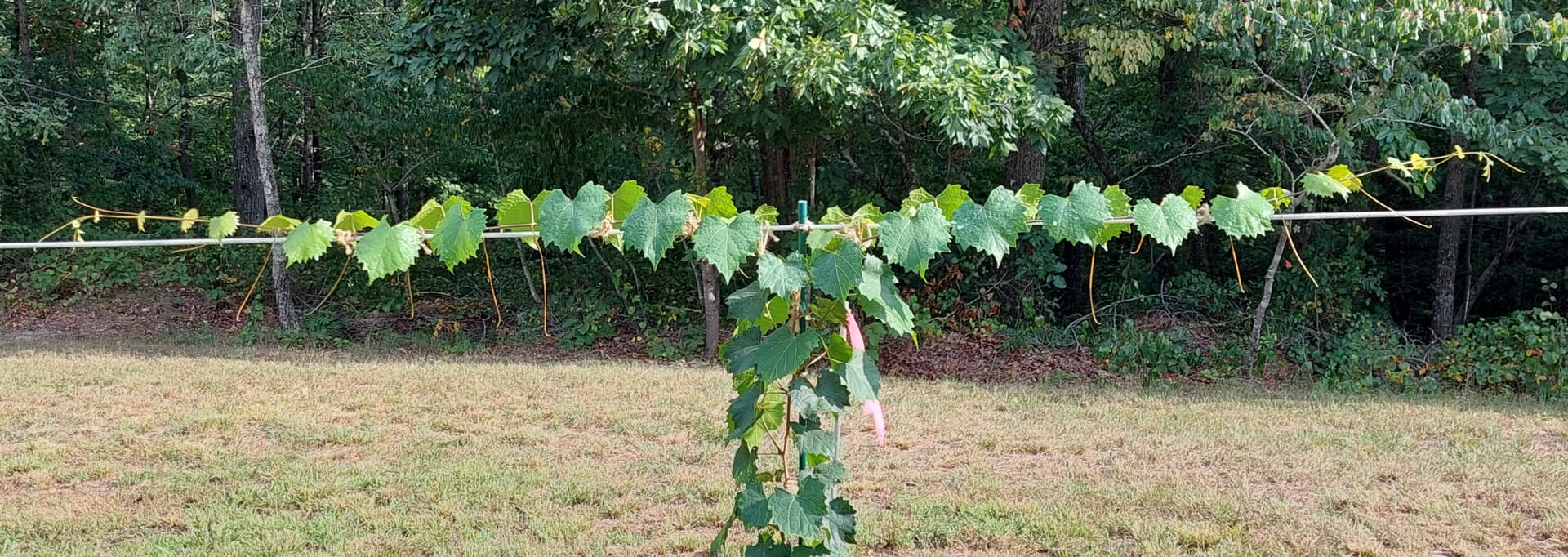
Isons…
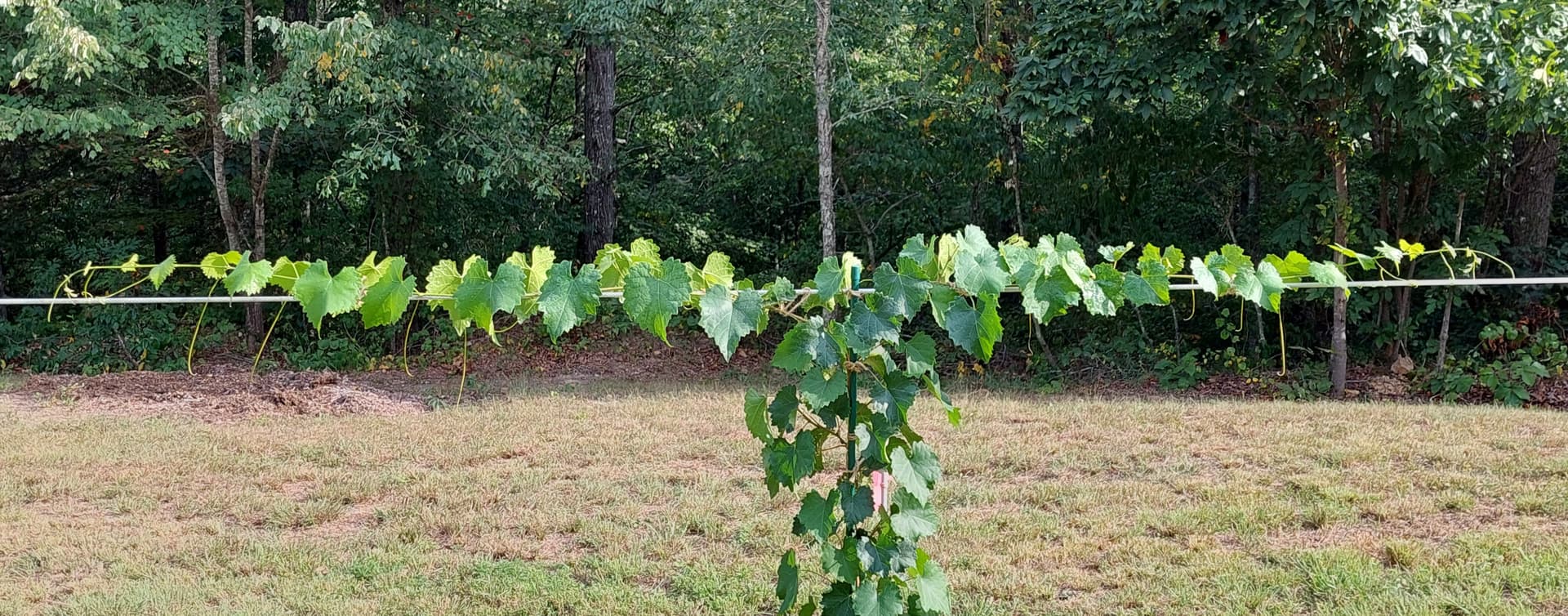
Oh my… getting on down the line.
TNHunter
The single non-forked tendrils can be seen on your pictures which is the same on my wild muscadines. Well, except for the poison ivy and some other plant that I transplanted. Don’t know exactly what they have.
Thinking that in all of my wild muscadines, if I should get at least one female, it should be at least as productive as my scuppernong vine. Which is fine with me since the scuppernong is essentially a wild vine unchanged genetically from the mother plant and those in the wild from North Carolina. Am I correct on this?
Something that I have been wondering about that I haven’t been able to look up is whether a breeder has any control over the resulting offspring as to the flowers. Meaning as to the sex whether offspring is perfect flowered (self-fertile), female or male. I would suppose that it would always be random although I don’t know for sure.
Perfect flowers is a highly heritable trait. Wild muscadines are 100% male or female with no perfect flowers. A few perfect flowered wild vines were found @100 years ago and used for breeding. Breeding programs today are highly focused on selecting perfect flowered varieties as the trait increases production significantly.
Male (M) > hermaphrodite (H) > female (F). Self-fertile vines are the result of a mutation in a gene in a male, that turned on ovary development, while maintaining pollen production. The male allele is dominant over all others. Crossing a female (FF) with a male (MF) will result in ~50% males and 50% females. Crossing a female (FF) with a perfect flowered vine (HF) will produce ~50% females and 50% self-fertile IF the self-fertile is heterozygous for perfect flowers (HF). Some self-fertile vines have two copies of the self-fertile allele (HH) and will produce 100% self-fertile offspring (HF) when crossed to a female (FF). This method is often utilized by breeders to simplify the breeding and maximize the efficiency.
If a wild male pollinizes a self-fertile flower, you can get males that carry the perfect flower gene (MH), along with females (FF) and self-fertile offspring (HF). Using an MH male on a female will result in 50% males (MF), 25% perfect (HF) and 25% females (FF).
Picked and bagged the 2 gallons picked this morning. All these will be gifted to my neighbors tomorrow. Most are surprised at how good they taste.
Your neighbors are fortunate to have you nearby.
I’m usually at my Cowart vine at daybreak with my 20 gauge each morning. Think I’m fighting a losing battle with the squirrels. Last year I left the apples unguarded, and the squirrels got them and left the muscadines alone. This year I’m somewhat protecting the apples with an electric fence, but the squirrels are getting the Cowart muscadines even though I’m there with my shotgun.
My first year wild muscadines are looking better. Hopefully in the second year I’ll be able to tell the females from the males. Right now, some are reaching about 5 feet high but are bushy. May decide to prune them to 1 stem this December or wait until spring.
The obvious question there is how does the breeder identifies the self-fertile vines with two copies of the self-fertile allele (HH)?
My guess is that it is the confirmed result of multiple trials.
The old fashioned way was to do progeny testing to see which parent produced all self-fertile offspring. That took at least 2-3 years for enough seedlings to bloom and a lot of resources. There are now genetic markers available that can be used to screen young seedlings, so you only keep the ones with the desired genotype.
Are you saying that there are now genetic markers that identifies in young seedlings the desired genotype but there aren’t genetic markers that identifies whether a wild muscadine is male or female?
If there is I need one!
/me tests tennessean for HMF genotype. It comes back inconclusive. 
I haven’t looked up labs for grape testing. I have had chickens tested for the blue egg gene and used the results to cull undesired birds. Look around on the net, you may be able to find a lab that can do the tests.

You did give me an idea! That is to take samples of 3 or 4 of my wild muscadines to my local extension agent to send to their lab for testing to see if they are male or female. Several years ago, I took some diseased bunch grapes and pear samples to them to see what the matter was with then. After they sent them to their lab and after about a week or so they came back with their answer. Didn’t cost me anything! Couldn’t I do the same thing with my wild muscadines? Heck I could do all 20.
I doubt there is a lab outside of a muscadine breeding program that could do it, but it doesn’t hurt to look around. Keep in mind that markers for bunch grapes won’t work for muscadine. Your best bet would be contacting someone at the U of Arkansas doing muscadine breeding.
You can learn a lot from other forum members. For a couple of years now I have been applying a post harvest fertilizer to my muscadines and I think that this has set them up to come out strong the next year. Some of my varieties are finishing up fruiting and I’m about to put out a little 13-13-13 around the vines. Thanks for the tip @Fusion_power.
Do you also post harvest lime your muscadines?
Though my vines are older than those of @Auburn my production has always been miniscule. This year I ignored the usual advice to prune to one or two new buds and left 3 or 4 instead. My production is still a lot smaller than it should be, but at least I’m harvesting bowls, if not buckets.
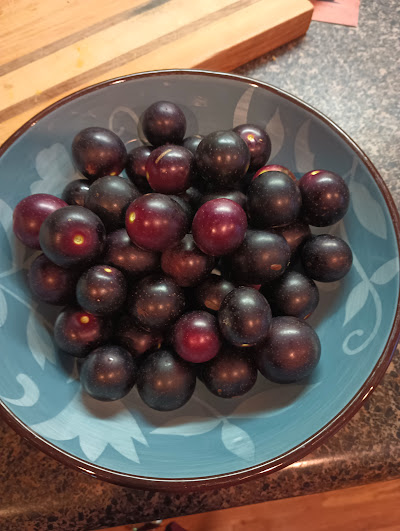
What varieties do you have haldog?
I’ve got Supreme and Black Beauty fruiting. I had Late Fry until last year, when it leafed out early, was hammered by a late freeze, the main vine split, and it died.
Female varieties can sometimes be hard to get good pollination. My self fertile varieties like Hall, Paulk, and Oh My always sets a good crop. My Black Beauty does okay but not great.
As I suspected and Auburn picked up on right away, pollination is likely a problem. Any chance you could get a self-fertile like Ison or Paulk?