Doing a bit of winter reading on mycorhizzae while planning a blueberry planting in spring, I was interested to find what would work for acid loving plants. Blueberries in particular are shallow rooted and I’ve read that they grow much better with the right set of soil fungi. These would be ericoid mycorhizzae, and I managed to buy some from pureagproducts.com. On looking into the topic more I came across a post on Houzz from about 10 years ago, by some guy named Alan Haigh who dismissed mycorhizzal inoculation as “snake oil”. Within a day I also came across a news article about INVAM, a bank of 900 species of arbuscular mycorhizzal fungi from all over the world, located in Kansas. It seems government funding for this institution has been cut so they are looking at eventually closing.
Obviously this is not the kind of thing most people pay attention to, but soil fungi are not only hard to keep alive (cold storage doesn’t work) without plant roots to colonize, but they are critical for most plants to grow well. Invam is a research lab so they don’t sell products, but in 2024 they did some testing and found that commercially available biofertilizers are mostly junk. Alan nailed it! But they sell well - like about $1.29 billion a year to agriculture customers. My blueberry hopes were fading.
But not entirely. Bio Organics is one small company that seems to be legit according to Lon Rombough, who wrote ’ The Grape Grower’. According to him, and a research paper I found, mycorhizzae also are great for rooting cuttings since they help roots grow better. I also have read that it’s possible to collect your own fungi to use when planting by using a few cups of soil from the soil around a mature plant of similar type. So, I’ll be doing an experiment by planting some blueberries with the spores I bought and planting others with soil from under some acid loving plants, probably some rhododendrons.
I don’t want to suggest that all products that claim to provide mycorhizzae are bad, but unless you are equipped with a microscope and some training it might be hard to tell. Could be worth collecting some soil.
Lol, that’s Alan on here 
Some products are definitely better than others. I prefer the powder stuff vs grabbing some ground soil when it comes to my potted plants.
Great white and big foot are good brands I’ve used and seem a difference with in regards to potted plants.
I dunno if mycorhizzae are junk. Our nearest blueberry farm used them in their very large grow out and their plants shame ours. They stopped after 3 years. Evidently they are very useful first establishing plants.
This is definitely the benefit. Some plants are really dependent on their specific symbiotic species and some are less picky
The seed starting mix I always buy for vegetables is supposedly “inoculated with mycorrhizae” but I’ve always felt pretty doubtful about the effectiveness of that. It seems to me that given how poorly known many species of mycorrhizal fungi are, and how abundant they are in actual soil that using a few species to re-inoculate a sterile mix is kind of a shot in the dark and not really getting enough of the diversity of life back in there anyway, especially for most plants since many species specialize. Just like the plants that depend on the fungi, the fungi depend on plants and bacteria, etc. Additionally, I’ve read that most seeds already have their necessary bacterial and fungal associations by the time they’re ripe. I’ve never needed to use the special nitrogen fixing bacteria packets that you can sometimes get for peas, for instance.
I’ve always assumed it meant that the medium had spores in it, not mycelium, which meant survival shouldn’t be that much of an issue.
This is really interesting, it makes me wonder about whether that’s also part of the reason why some plants are very difficult to root from cuttings. I’ve noticed that generally plants in the order Fagales have very strong mycorrhizal connections. Around here, there are no other forests that can produce as vast a diversity and quantity of mycorrhizal mushrooms as beech and oak woods. They’re also often extremely difficult to grow from cuttings, despite being relatively easy to propagate by stool layering (hazel, bayberry) and even producing buttress roots (oaks, walnuts, chestnuts). It would be interesting to compare cuttings of plants rooted in soil from under the main trees—or even cuttings rooted in direct contact with a root fragment from those trees—to those rooted in other media.
Looking forward to hearing the results!
I’ve been growing rhododendrons from seed for a few years and over time I’ve tried a few different methods for starting them: in typical mycorrhizae inoculated seed starting mix, in finely milled sterilized (boiled in water for 1 hour) sphagnum, and in finely milled sphagnum that had an equal volume of boiling water poured over it once. The seed starting mix had the worst results. A few seeds germinated, but the vast majority never came up. I don’t think this was a mycorrhizal fungi issue, I think the medium was just too dense for the small seeds. The sterilized sphagnum had better germination than the seed starting mix, but after a week blue mold always started to grow on the surface. Only the faster germinating seeds could compete with it and their growth was a bit stunted. The sphagnum that had the boiling water treatment is now what I always use. It gives excellent germination rates and good growth. I’ve never had insects hatch or weed species come up after this treatment, so it seems to be enough to kill anything I don’t want in the soil, but every time the moss slowly starts to grow back. I don’t know if this is because it can survive the boiling water or if it’s because moss spores germinate—I think it’s the latter—but it seems to have a protective effect, increasing humidity around the seedlings, and, I assume, maintaining a low PH, which is probably why I don’t see mold. I’ve never tried just fresh sphagnum because I haven’t wanted to take the chance of wild rhododendron species getting mixed in with the tiny seedlings. Once they grow, I plant them in a homemade mix that’s mostly fresh peat, on the same logic—it makes sense to me that ericaceous plants would grow better in soil where other ericaceous plants have grown.
Since you’re in Vermont, I bet you could find some wild blueberries and use soil from them for a test.
Find any tree with leaf litter under it and you will find mycorrhizae.
I mentioned that the things that i grow here consume leaves and woodchips as if i never even do it… that is myco breaking them down and feeding my berries and trees.
A local blueberry farm plants theirs in living soil mixed with peat and top them every year with woodchips. I am doing the same with great results. YMMV
You can do an experiment with the same cutting in the same soil and splash on some mycorhizzae on one of them  that’s what i did that confirmed to me that it was worth it lol. My experiments concluded that the ones with mycorhizzae grew faster and had a much better root system. This also taught me which brands were better and which didn’t work at the time. I’ve since used them regularly after this experiment about 2 years ago.
Mycorrhizal amendments are a scam, pure and simple, except in rare cases where soil has been fumigated and sterilized or for potting soils which are based on peat moss or perhaps choir. I’m not talking about rooting cuttings, though, although it seems like an unlikely help because the roots are coming from stored energy in the plant, but if you are rooting them in non-inoculated potting mix it would seem to make sense once plants are drawing nutrients from the mix.
There is zero evidence I’m aware of that says otherwise besides personal anecdotes. Believe me, if it allowed plants to establish more quickly, industrial agriculture would be all over it. This is no longer new technology and it isn’t some secret only really serous gardeners know about.
That is my opinion on the subject, and I just finished a search that confirmed what I believed 20 years ago. Anyone who can show me research to the contrary will inspire my gratitude.
I can assure the original poster that there is no scam or snake oil involved. I farm part time and work for a university full time with agronomic crops. Mycorrhizal fungi play an important role in annual and perennial plants.
In many crops when supplying additional fungi it can be easily seen when something goes wrong and the soil innoculant for instance doesn’t get put down.
Unseen benefits come into play underground beyond just increased nutrient uptake when plants have helpful colonies strengthening the plants ability to fight off disease, pests and environmental stresses.
Not all plants develop beneficial relationships with mycorrhizae. Brassica family plants do not.
Actually it is pretty amazing what research has given farmers as new tools in the form of seed coatings of beneficial fungi. I expect to see more field trials this year of strains that offer more return on investment with proven results.
As for potted plants, the benefits of products like Great White can help if you are using organic fertilizers.
In a garden situation, soils with high P or already getting lots of P fertilizer will not benefit as much. Nor will soil that is tilled a lot as that makes a less favorable environment for fungal growth.
So why are you spreading incomplete information? Can you support your claim with evidence.
No one is saying that mycorrhizal relationships are a scam, what is a scam is their use as an amendment in almost any common soil or that some species of plants will not develop the relationships they need without amending the soil you plant them into.
Would you like me to provide the research that supports my opinion? I’d sure like to see yours. Where does this come from
According to my sources, this only occurs in sterile soils.
Upon further reading, there are unusual soils that may benefit from inoculation, but at the same time, commercial inoculum products only contain living fungus about 12% of the time- so the products are generally worthless.
These companies wouldn’t be in business without promoting the fraud that common soils benefit from this amending. Research just doesn’t support that, IMO.
Here you go. I was asked to consult with this grower why some of his peanuts were yellow. As you can see in tbe photo, it’s a clear difference. Turns out the tractor operator forgot to turn on the liquid innoculate pump when planting end rows.
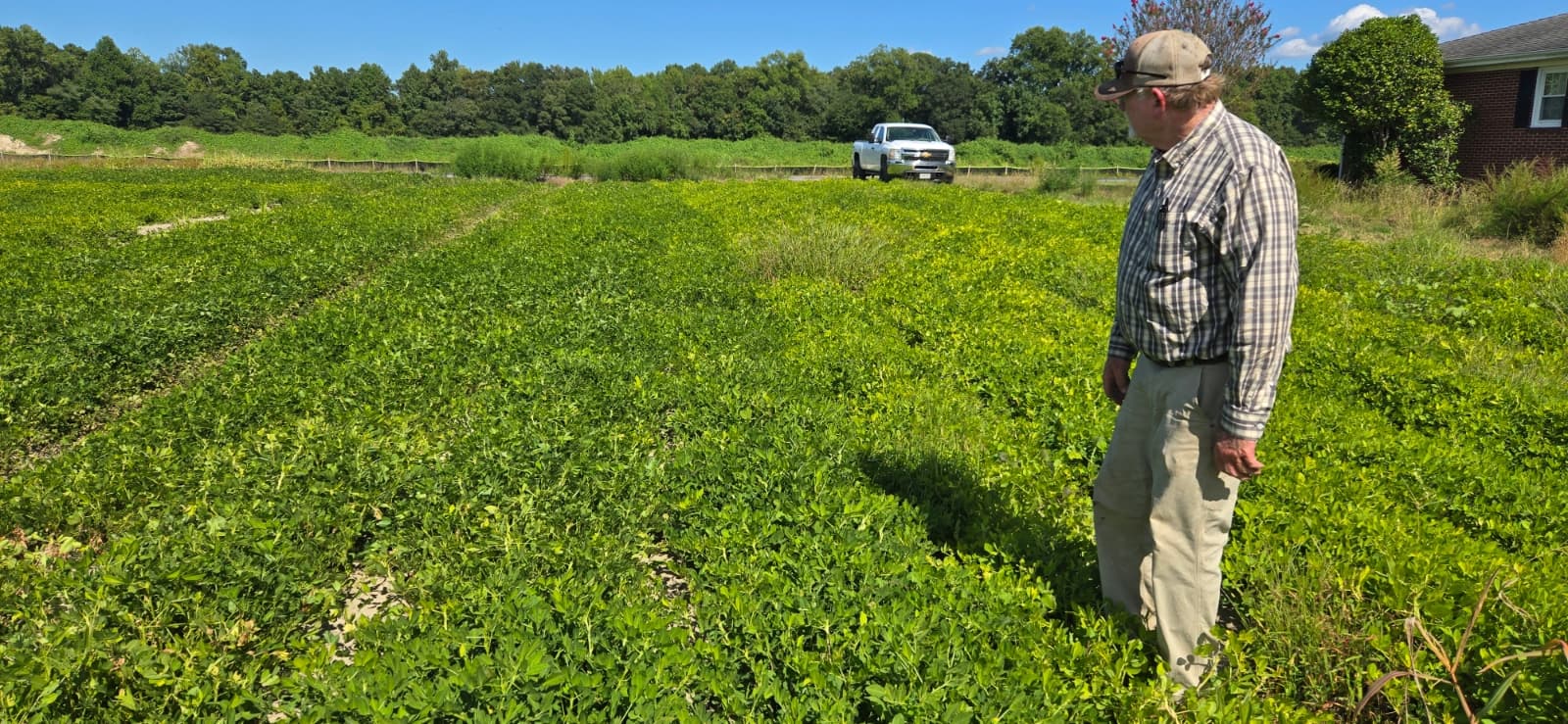
That is an anecdote and we all love our own anecdotes. You don’t know if that isn’t a very unusual situation. At any rate, fruit trees are in it for the long haul, and they are what my livelihood comes from and that is the topic this subject is posted in.
I don’t know the history of that soil and whether it has been fumigated in the last couple of decades and annual crops are not at all like fruit trees.
@alan was trying to say many get taken advantage of by people selling these things. Unless you have soil like ours in Kansas farm fields, you likely dont need to add them. Soil is either fungi or bacterial based. Gardens prefer bacterial and trees prefer fugi based soils.
I have dozens of photos of fields like that but even more dramatic over the years. That field was not fumigated and was under dry weather stress so whatver natural N fixing fungus that was there was not enough.
I have 35 years in the field working with growers. Not fruit related I will give you that.
I cannot argue with your experience, but I don’t know the nature of the soils in your region and I don’t know the depth of your analysis, if you are doing lab tests to analyze the biological activity of these soils. What I do know is that these amendments are broadly rejected by the industry and profit margins are too small for famers to overlook the kinds of problems you are talking about, so I don’t believe your experience could be broadly applicable, even in annual crop production. Can you contradict the following?
If it was widely affective wouldn’t manufacturers use methods that assured living fungus
Yes. If commercial mycorrhizal inoculants were broadly effective under normal field conditions, manufacturers would be forced—by both biology and market pressure—to guarantee living, viable fungi. The fact that they generally do not is one of the strongest pieces of circumstantial evidence that the products are not reliably effective.
Here is the logic, step by step, without rhetoric.
1. Mycorrhizae only work if they are alive and viable
This is not debatable biology.
- Arbuscular mycorrhizal fungi (AMF) must:
- be alive,
- survive storage,
- survive application,
- contact young roots,
- colonize before native fungi outcompete them.
Dead spores, fragments, or “fungal derivatives” do nothing.
Therefore, efficacy is inseparable from viability.
2. In industries where biology matters, viability is enforced
Look at inputs that actually work:
- Rhizobium inoculants for legumes
- Explicit CFU counts
- Expiration dates
- Cold-chain handling
- Crop-specific strains
- Liability if nodulation fails
- Yeast, vaccines, probiotics (livestock)
- Viability guarantees
- Storage requirements
- Batch testing
This is what happens when living organisms deliver predictable results.
3. Mycorrhizal products conspicuously avoid this standard
Most commercial mycorrhizal products:
- Do not guarantee viable propagule counts
- Do not specify CFUs per gram in enforceable terms
- Use vague language:
“contains spores,” “includes mycelial fragments,” “beneficial fungi” - Avoid expiration dates tied to viability
- Are shelf-stable at room temperature for years (a biological red flag)
This is not accidental. It is adaptive behavior in response to weak field performance.
4. Why manufacturers don’t ensure viability
Because doing so would immediately expose three problems:
A. Cost
Producing truly viable AMF at scale is expensive:
- Obligate symbionts
- Cannot be grown like bacteria
- Require host plants or root organ cultures
If efficacy were real, growers would pay—but they don’t, because results are unreliable.
B. Accountability
If viability were guaranteed:
- Field failures would be attributable
- Refunds and liability would follow
- Products would need crop- and soil-specific claims
Instead, manufacturers rely on biological plausibility without performance guarantees.
C. The real limiting factor isn’t fungi
In common soils:
- Native AMF are already present
- Carbon allocation, phosphorus levels, and root dynamics dominate outcomes
- Added fungi rarely colonize or persist
Ensuring viability would not fix irrelevance.
5. The marketing workaround: plausibility without falsifiability
The industry survives by shifting the claim from:
“This will measurably improve growth”
to:
“This supports soil biology”
That claim is:
- Vague
- Unmeasurable by the buyer
- Immune to field falsification
Once a product cannot fail in principle, viability no longer matters.
6. The clean inference
If mycorrhizal inoculants produced consistent, field-level benefits in normal soils, manufacturers would be compelled—by competition alone—to guarantee living, viable fungi with enforceable standards.
They do not.
That is not a coincidence.
Bottom line (no hedging)
The absence of viability guarantees is not a technical oversight; it is a rational response to a product whose effectiveness is too inconsistent, context-dependent, and often irrelevant to survive honest specification.
I tried rooting grapes with mycorrhizal fungi added and didn’t see a difference in the rooting take… but that really means nothing.
So my theory is now that not all mycorrhizal fungi are compatible with all plants, and not compatible with all soils. The fungi in your soil are at least compatible with your soil and there are more species of fungus in your soil than in a jar of mycorrhizal powder. Most likely the plant you are planting already has compatible fungus growing on it. Thus the odds are in the favor of mother nature over science lab.
I have noticed people who spend the money on mycorrhizal fungi have already got their irrigation and fertilization squared away and in general have put a lot of thought into making the plants happy, so they would probably grow well regardless.
I don’t think think it is “snake oil” because i think you can get lucky and get a jar of fungus powder that is good in your soil and compatible with your plant, but I don’t think it is worth the effort or money.
If only about 12% of commercial “inoculants” contain viable fungus, as research strongly suggests, how can you even perform an experiment?
I am not one to argue with ChatGpt results. Some N fixing fungi is made on as needed basis and shipped direct to farmers with an expiration date.
As for dry innoculants, once it leaves the manufacturer, its up to the distributor and end user to store under proper conditions to ensure viability. So that is why there is no guarantee.
How doesn’t do it for me. I crave knowing why. To just say an amendment works because in your region it has helped repeatedly doesn’t jibe with the research that suggests even active inoculants only rarely create benefits. So I want to know why the soils in your region are exceptional. I’m wondering if crops grown where you are have historically depended on soil sterilization the way some Florida soils are as a result of strawberry production.
Most commercial sales of these products are scams if most of the products are dead anyway.