It definitely had viable fungus, you could see the hyphae. I just didn’t see a difference in outcome.
I know my area of the state does not have wild blueberry or related plants. I would think the fungi is not here. But then again I see the blueberry bee or think it was. It looks like other bees. Hard to tell but man sure looked like one. A smaller bumble bee like bee. So maybe the fungus is here too?
I think the soil and prior land use play a large roll. Most of the blueberry farms here are on old coastal hay plots. They likely had no fungi population before.
1 Like
if you go under any evergreen and scratch up the duff layer, its full of acid loving mycorhizzae. place a few handfulls of it around your blueberries and they have been inoculated for free. Dr. Bryant Redhawk gave me that tip 10yrs ago on permies.com. hes a native with a phd in soil science. all kinds of soil info. he passed on if anyones interested in reading about it. if you dig up soil with plants already growing on it, chances are that soil has mycorhizzae already growing in it.
11 Likes
i recall a few years ago when, in my experience, mycorrhyzae was a new product.
i say in my experience, because my experience tells me that many things come around in cycles. since i have not been around since the beginning of time, i don’t know if my first recollection was early in the process or if it was just another crest of ever recurring cycles.
i became exposed to myco products through growing trials of greenhouse crops. one with myco, one without, grown side by side in the same growing environment, all other treatments (eg, water, fert, pest/disease control) the same. the results were dramatic, and that was before the statistical dry mass analysis.
it was shortly after that i saw the first wave of myco products packaged for sale.
i’d be extremely cautious about buying any of the products. would i rule it out categorically? nope. i’m a solid believer in use of starter fertilizers when establishing long term planting. nope, no tests, trials, or studies, just my own experience where i use things or don’t. repeat a few times.
since i am not an academic, i read other studies, i don’t write them. i would encourage strong critical thinking skills, and i would exhort understanding of philosophical arguments.
i would say, you have to know the host and you have to know the product. if they aren’t compatible, it can be better than sliced bread and it won’t matter. and the fun part is, pretty much, you have know this. no one is going to be able to tell you. many will offer their expertise, but i have opinions about the relative value of advice from gardening gurus.
what i know about fungi in the ground tells me that if you’t have myco, you shortly will. if your site is that difficult to establish, you likely know this, and there’s a lot of things to do to help you. myco may be part of it.
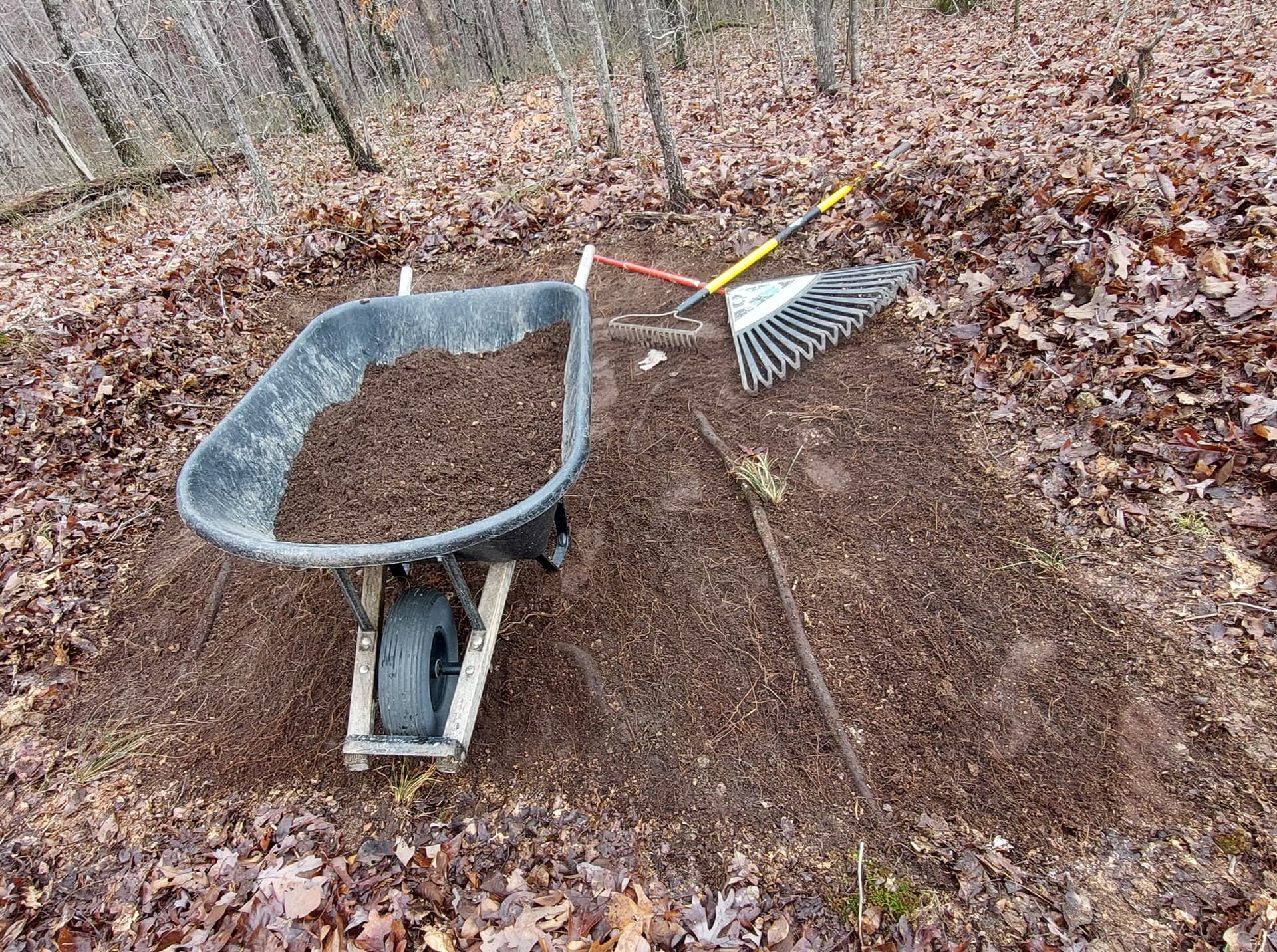
I collect my own… from my woods.

See em… no doubt billions in there 
Good add to the compost pile.
TNHunter
7 Likes
Your disdain for “anecdotal” evidence is quite interesting given your reliance on a technology that consistently and verifiably spits out specious information.
1 Like
I have been collecting soil dander 2 years thanks to your tip. It goes right in our soil mix now.
4 Likes
@dannytoro1 … i put a bunch of it around my 30+ fruit trees last spring.
I learned about woods compost from my forest farming adventure’s.
Planting wild simulated ginseng.
TNHunter
3 Likes
its my understanding that theres different ones for different plants, but still no idea how different they are etc
I didn’t want to go too much into the details because the post was long as it was. Yes, the only reliable way to package and sell mycorrhizae is by selling spores. Keeping spores viable is somewhat like saving seed. At INVAM each species is regrown each year on Sudan grass ( they have about 900 species) then induced to produce spores by letting the soil dry out… Perhaps I should also provide links to my sources, such as the research article that the scientists at INVAM did https://www.sciencedirect.com/science/article/pii/S0929139324002907?via%3Dihub about their look at commercial products.
1 Like
Thanks for the suggestion of getting soil from wild blueberries. Duh, didn’t occur to me, even though I pick wild berries every summer! Those are lowbush blueberries, but a pretty good chance that it would be a close match.
I’m interested in your Rhodi project. Growing them from seed is almost beyond my imagination. The seed is like dust! Are you breeding them?
1 Like
I have a forest farm and I agree it’s full of fungal species of all kinds. I also use tons of wood chips and they are usually full of white mycelium. But I have calcareous soil so blueberries need all the amendments I can find.
2 Likes
Yep, I was pulling Alan’s leg. But I knew he would add information to the debate!
1 Like
I want to make sure that people aren’t confused by this:
It is a bacteria that helps legume plants “fix” the nitrogen (N). There are special bacterial inoculant products that can be purchased and applied to or with the legume seeds in order to accelerate or foster that process, especially if the crop hasn’t been grown in that specific soil recently. In certain cases you can purchase seed that is already coated with the specific bacteria that performs that function. Here’s a picture of a bacterial inoculant that can be used on those peanut plants that were mentioned above.
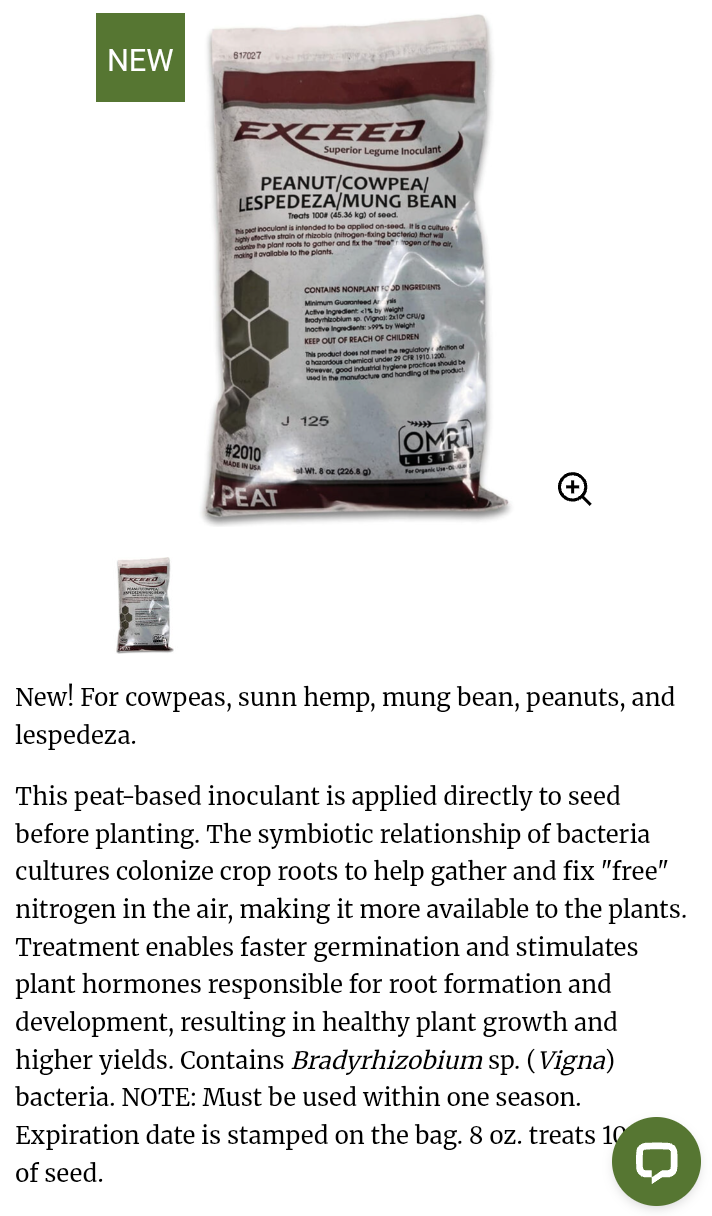
The expectation is that the lower level of nitrogen in the soil were the bacterial inoculant was not applied is the cause of the lower level of green growth in the peanut crop pictured.
3 Likes
I have no disdain for anecdotal evidence beyond the fact that the internet is saturated with anecdotes from people swearing by all manner of products and materials. In the dark ages we relied on anecdotal evidence- some were eventually endorsed by controlled experiments some not.
Physicians swore by blood letting for many centuries… they witnessed their patients healing very often after performing the procedure. Some of the most intelligent men of their eras endorsed this method with absolute faith in its efficacy.
However, I don’t question all anecdotes- clearly Jerry had a good argument for using the inoculants, but, as I said, I want to know why they worked for him. Without the why you do not really learn to be as good a grower as you could be, in this case, to know if the products might work in your particular soil. Clearly they don’t consistently work in most soils based on wide spread experiments- results with living mych amendments have not been at all consistent. I asked him if the area had a history of growing crops that required sterilizing the soil but he never answered.
The primary nutrient nychs are celebrated for delivering to plants is P. In all my years of managing orchards in my region, I’ve not witnessed a single tree with a P deficiency. For some vegetables, such deficiencies are common in cool soils.
I have seen many fads come and go, and for a while a product called Roots was hot… supposedly it contained active mych spores and lots of people swore by it… however, it also contained water soluble nitrogen. People seemed to like to believe it was the fungus doing the magic.
2 Likes
If anyone reads this far I’d like to expand on the idea of using Myco spores to assist in rooting plant cuttings. It’s true that the plant must initiate a new root, but once that begins the spores of a suitable species of mycorrhizae quickly become a root multiplier. That is, the fungus establishes an exchange with the plant bringing the plant nutrients in exchange for carbohydrates. Some types of plants even put less effort into growing roots, instead depending on the fungal network to substitute for fine root hairs.
Here is a link to a paper about the use of ericoid mycorrhizae to help root a Rhododendron species, but the idea is probably useful in other plants
Ericoid mycorrhizal fungus enhances microcutting rooting of Rhododendron fortunei and subsequent growth | Horticulture Research
2 Likes
Appreciate the link!
Ericoids are probably outliers where there can be a large impact. Same of course for many orchids of course. And of course legumes though that association is bacterial. Ditto for alders, wax myrtles, Elaeagnus, cycads, buckthorns, ceanothus, the various nitrogen fixing rose family species, etc.
With other plants, it’s probably more circumstantial. Soil will be a big deciding factor since crop fields and open grassy land is bacterially dominated whereas wooded land is fungal dominated. Sterile potting soil might still have spores that germinate so it’s probably going to be tricky and complex.
3 Likes
Yes, as it can extend lives in some cases. It’s not completely meritless. Men should do it actually. One way is to donate blood at regular intervals. It helps the blood supply and helps men get rid of iron. Since women menstruate only men benefit from blood letting. It’s been found that with modern supplements that it’s easy to consume too much iron. As a man unless ordered by caregiver don’t consume iron supplements.
3 Likes
Good, test things out. Better yet is if you could test out a few varieties with and without. Either they will work for you or not. Back when I started to grow fruit trees in 2007, I was told I would get no peaches unless I sprayed the trees. I had believed them and had given up before I started. Then one day I decided I could gamble $25 for a tree, I stuck it in the ground and gave it a go. If it is not going to kill you to experiment, take a chance and let the thing tell you, instead of letting the detractors tell you it can’t be done.