Mycorhizzae scam?

I bought my blueberry plants from Blueberry Bushes for Sale - Buy Blueberry Plants in the pine barrens of NJ.

While there weirdest family member put me off to there whole business.

The bushes I transplanted to Washington DC into red clay soil I amended have survived and done well over the last 10 years. The Homedepot etc bushes did not.

I was a bulk scale tree planting contractor for a few decades. The mychorrizae products always sounded enticingly probably helpful. But a simple thing turned me off to using them much - all the suppliers of them ran down all the other suppliers of them. “Only ours work,” was the gist of it.

The next problem I ran into was simple bad luck in that wherever I would run a little trial of a given product, I would randomly lose access to the planting site later due to ownership change or other unrelated unexpected events. Some of these would have been outstanding test sites - large stockpiles of soil created by mining, but with the deep, completely sterile soil placed on top (poor reclamation practice).

Overall I went with the idea that with natural soils never far away, the needed spores would colonize the disturbed planting sites soon enough.

Now though I have been wondering about a different concept. In a bare-root nursery, beds are routinely treated with fungicides to stop fungal problems on the emerging seedlings. What I ponder now is whether these repeated applications might reduce the beneficial fungi a bit too much, and whether one of the guaranteed live/fresh products might help with a few difficult-to-grow species. As we grow several species that only sell in the 1,000 stem range, I doubt there will be any serious research on such esoteric products.

4 Likes

Here’s and interesting take.

Mycorrhizae (often spelled “mycorrhizae”) are not a scam or snake oil—the symbiotic relationship between these fungi and plant roots is one of the most well-documented phenomena in plant biology, with decades of scientific research supporting its benefits.

What Mycorrhizae Actually Are and Do

Mycorrhizal fungi form mutually beneficial partnerships with the roots of about 80-90% of plant species. The fungi extend thread-like hyphae into the soil, acting like an extension of the root system to absorb water and nutrients (especially phosphorus, nitrogen, zinc, and others) that plant roots alone might struggle to reach. In return, the plant provides the fungi with sugars from photosynthesis.

Key benefits backed by research include:

• Improved nutrient and water uptake → leading to better growth and higher yields in many crops.

• Enhanced tolerance to stresses like drought, salinity, heavy metals, and temperature extremes → through mechanisms like better osmotic regulation, antioxidant production, and soil structure improvement.

• Increased resistance to some pathogens → by competing for space or triggering plant defenses.

• Better soil health overall → via compounds like glomalin that bind soil particles, reduce erosion, and store carbon.

These effects are particularly strong in poor, degraded, or nutrient-limited soils. Reviews in journals like Frontiers in Plant Science and studies from institutions like NCBI/PMC confirm these advantages across crops like maize, wheat, tomatoes, and more.

Why the Skepticism Exists (Especially with Commercial Products)

Your friend might be reacting to the many commercial mycorrhizal inoculants sold in garden stores—these powdered or granular products promise miracle growth but often underdeliver. Here’s why there’s valid criticism:

• Many products have low viability: Spores may die during manufacturing, storage, or shipping. A University of Kansas review of commercial trials found 88% failed to establish fungi on roots or boost growth. Tests on popular brands showed colonization rates as low as 0-12%.

• Wrong fungi for the job: Most plants form arbuscular mycorrhizae (AMF), but products might include mismatched species or too few viable propagules.

• Unnecessary in healthy soils: Gardens or fields with undisturbed soil already have abundant native mycorrhizae. Adding more does nothing extra (and high fertilizer use, especially phosphorus, can suppress them).

• Overhyped claims: Some marketing sounds like snake oil, promising huge growth boosts without evidence. Independent tests (e.g., from garden science blogs citing peer-reviewed work) often find no significant benefits for typical home gardening.

In short, the science of mycorrhizae is solid, but many products are ineffective or situational at best. They’re most likely to help in sterile potting mixes, heavily disturbed soils, or stressed conditions—not as a routine additive.

Specifically for Cuttings and Propagation

Evidence is more limited here. Mycorrhizae don’t act like rooting hormones—they colonize existing roots, so they won’t directly speed initial root formation on unrooted cuttings. Some studies show benefits when added to rooting substrates (e.g., better establishment once roots form, or improved survival in certain species like grapes or trees). Commercial guides sometimes recommend applying to rooted cuttings or transplants.

For best results with cuttings:

• Use a sterile mix? Inoculating with a high-quality product might help long-term vigor.

• Many experts advise skipping it and focusing on good propagation basics (humidity, warmth, clean tools) instead.

If someone wants to try, look for third-party tested products with guaranteed viable spore counts, but expectations should be realistic.

The underlying biology is absolutely real and valuable (it’s why farmers and ecologists care about preserving soil fungi). The “scam” perception likely stems from disappointing commercial experiences, which research increasingly validates as common. If your friend has sources calling it outright useless, they’re probably overlooking the distinction between the natural symbiosis and flawed products.
3 Likes

@Ged ,

@alan always has my respect , sometimes, we disagree. Mostly the differences are region specific. Alan lives in New York in an area known for wonderful soil and conditions for growing fruit. I’m from an area where land was repeatedly injected with anhydrous the last 50 years. I would start reading here first

They’re surprisingly easy to start from seed! I started a few years ago when I found out some rhododendron society seed exchanges are open to the public. Now I get a few seed packets (usually only $2-$4 each!) every year or two and grow whatever is on offer that seems interesting. They germinate relatively quickly (under a month) and I find they’re easier to care for in the garden than other plants. The roots of many are hardy enough to stay in pots on the ground in the winter.

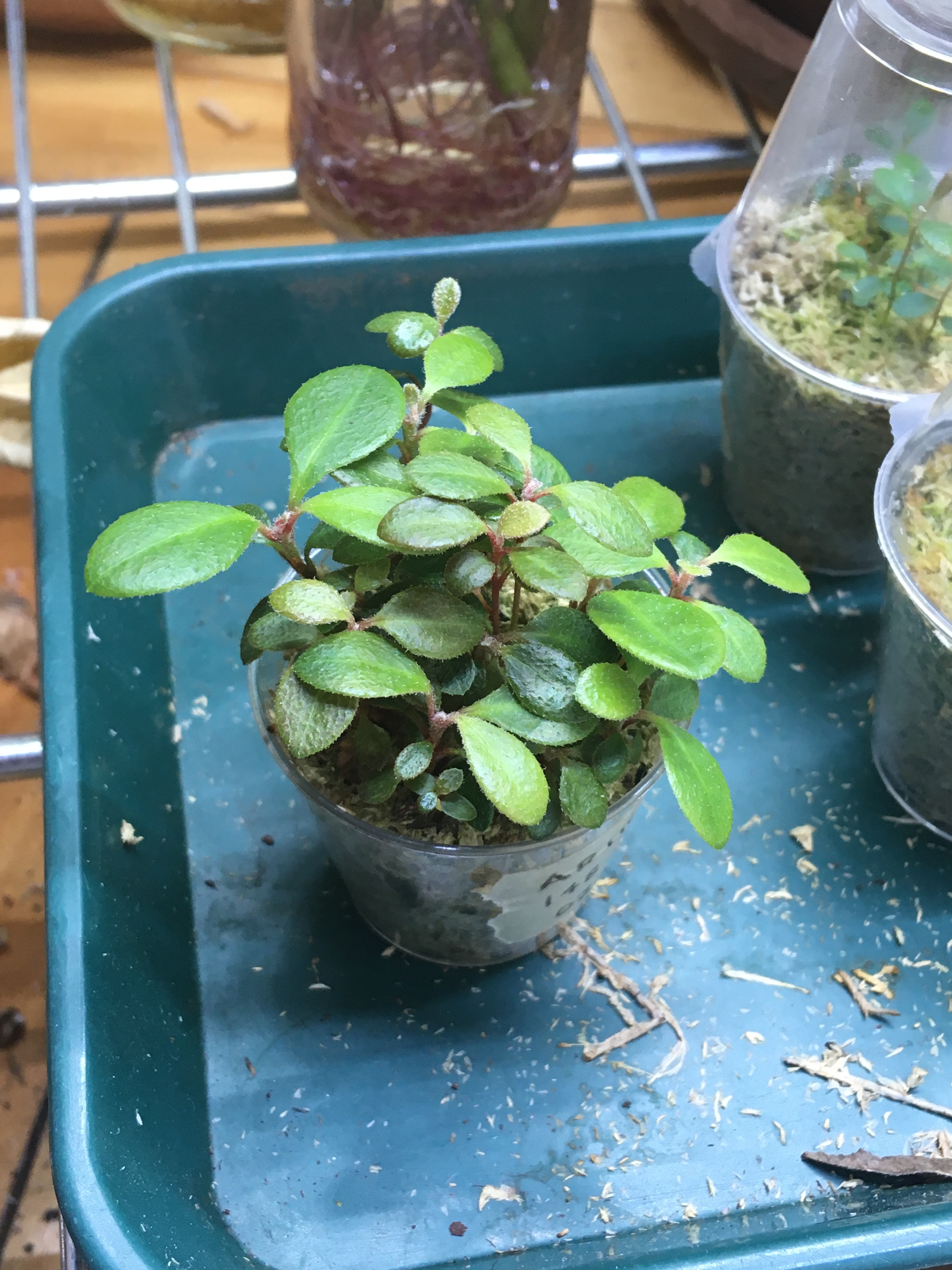
Here’s what about 20 one year old seedlings ready to be potted up looks like:

The cup on the right has the same number of month old seedlings.

I’d like to do my own crosses in a few years when I have more mature plants with flowers. I’m interested in zone pushing the big leaf types and also rhodos with unusual leaf shapes, and fragrant flowers, so I’ve been collecting whatever species and crosses I think seem cool.

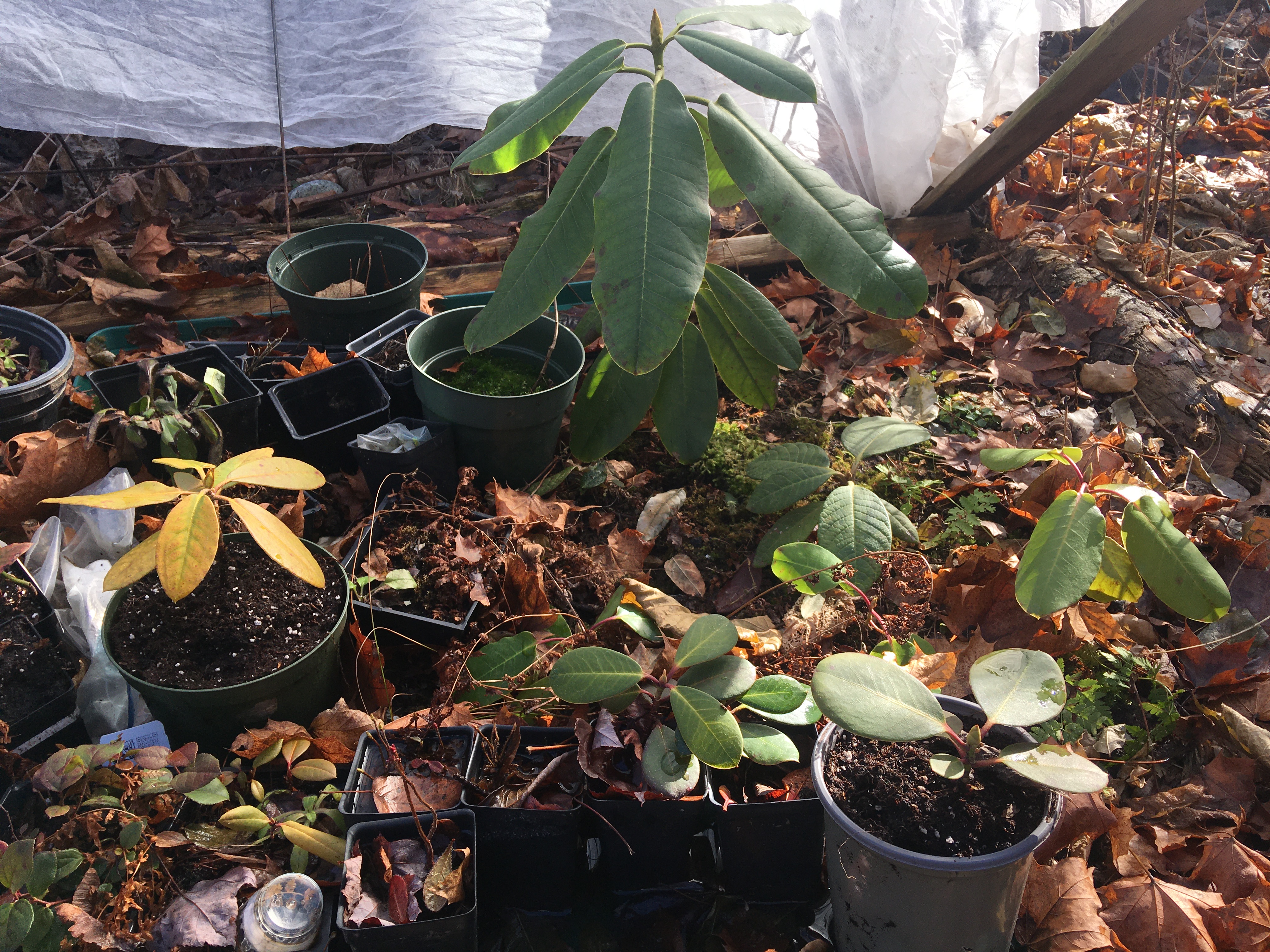
It’s all a bit haphazard, but fun. Here’s what a corner of my nursery bed looks like right now:

Clockwise from the top are seedlings of: R. hemsleyanum (5 years old), R. kesangiae (4), R. fortunei (4), several (R. yuefengense x platypodium) x qiaojiaense (3), several various deciduous azaleas (2), something I’ve forgotten, some salal, and (‘Scarlet Romance’ x R. fortunei) X (‘Dexter’s Peppermint’ x R. glanduliferum) (3).

1 Like

I’ve been a grower all my life- like you, to make a living and out of love for the whole world of plants and soil. Most of what I knew was from experience and books until a went to school at the NY School of Horticulture at the New York Botanical Gardens. It was there that I first read about mycorrhizal relationships which was one of the most fascinating things I learned in that whole experience.

Even back then, inoculants were deemed ineffective in most soils because a little inoculant was like pissing in the ocean. In the years since I’ve not encountered anything in the literature to change my assumptions.

Now a professional agricultural consultant in our forum is claiming to often use inoculants successfully, which is interesting, but his source is directly from the manufacturer on custom orders, so even if his observations are complete his source is different than the vast majority of us have access to. Most of us are trying to grow fruit and not peanuts, in any case.

However, upon questioning him, I didn’t get an answer for what made his soil relatively devoid of existing mycorrhizal populations, a question I would expect a professional consultant to ask. Without context, it’s pretty hard to evaluate information like this.

As far as having excellent soil for fruit trees in NY… that is far from a universal experience in my business. I have installed orchards in blue clay soils and in almost pure sand, with everything in between. One site even had standing water where I created 4’ tall mounds to serve the trees I installed- they established very well.

A common practice here is for contractors to remove all the top soil from construction sites, sell it and then replace it with just enough soil to grow grass. What amazes me is this practice is often done even in the construction of estate type homes.

Every installation I make involves the use of a top layer of local compost (from wood chips and yard waste) and a layer of shredded wood mulch, also locally sourced. Combined, they add up to about at third yard of natural soil amendment in a way that duplicates a forest soil that is a kind of parfait of contrasting layers. This usually goes a long way for compensating for any issues with the soil and I have it delivered to my own property underneath maple and tulip trees which probably assures these amendments are pretty well inoculated, in case the composting process sterilized anything.

That would pretty much make me a bad source for information about the need for innoculant. Most of my sites are surrounded by forest trees as well.

4 Likes

@alan

I agree with everything you said there. I think if i innoculate my soil once with good results and at an inexpensive price, im not being scammed. If a person is spending a lot and not getting good results, they are not doing things the right way. If there are forests in the area, there is no need for innoculation, as you mentioned. If a person wants to gather forest mulch is doesnt cost a thing, and they can innoculate with that.

I do nearly exactly what you do now. I use age cow manure and wood chips.

“Every installation I make involves the use of a top layer of local compost (from wood chips and yard waste) and a layer of shredded wood mulch, also locally sourced. Combined, they add up to about at third yard of natural soil amendment in a way that duplicates a forest soil that is a kind of parfait of contrasting layers. This usually goes a long way for compensating for any issues with the soil and I have it delivered to my own property underneath maple and tulip trees which probably assures these amendments are pretty well inoculated, in case the composting process sterilized anything.”

1 Like

Yes, I can see how prairie soils might be devoid of the specific fungus species that are symbiotic with trees, but research I’ve seen doesn’t seem to validate this issue. That said, research is never conclusive in a way that promises to be valid in every existing condition. However, this is the conclusion CHAT draws from the research. It is the academic take on the subject.

For apples and peaches specifically (both arbuscular-mycorrhizal, AM, species), the weight of evidence says the following—quite consistently:

In established Midwestern or Northeastern soils that have supported vegetation for decades, deliberate mycorrhizal inoculation rarely improves establishment, growth, or yield, unless a very narrow set of conditions applies.

1 Like

After all this the posts in this thread indicate that yes the fungi helps if needed. That seems very clear to me. As far as when needed, what type, and how viable the product is needs to be determined for each situation. The last hundred posts or so go about saying such in every possible way. So most can skip those posts.

1 Like

How is it sufficient to know that sometimes it is helpful without knowing what conditions render that verdict? Also, in this conversation I only recall one convincing testimonial of its efficacy in real soil. That is, something approaching a clear cause and effect.

To me, the real takeaway is that if you purchase an inoculant there is about a 99% probability you are wasting time and money and buying into a scam. Research on available products already puts that at about 88%. How do you propose one determines beforehand if a product contains living materials?

2 Likes

it comes down to the health of your soil. if its fertile with alot of organic matter, it wont make a measureable difference in the mycorrhizzae by adding more but in depleted sterile soil with low organics, adding some will likely boost production. composted manure is narturally full of it.

2 Likes

Which begs the question: If this isn’t effective, why pay for it?

Dimly I recall my Dad’s sprinkling milled peat infused with inoculum on soybeans and stirring it in thoroughly. These were seed beans loose in the pickup bed, which had been slightly dampened, and it was done just before loading them into the planter boxes. Later, he became more blase about it and just sprinkled some on top of the beans in the boxes. 60 years ago, seed beans were not bagged with inoculum. I suppose these were open-pollinated races saved out of the previous season’s crop. At first, I think soybeans were not necessarily raised for harvest but perhaps as a plow-down, nitrogen-fixing cover crop — hence the need to ensure inoculation. They were drilled solid, but I remember when they were planted in rows so they could be mechanically cultivated. This indicates to me that my recollection begins after there was a market for beans as a source for plant-oil. They weren’t fertilized back then. They were expected to provide their own nitrogen and leave a little behind for the next season’s corn. This was the origin of the corn-beans-Miami rotation practiced by mechanized farmers today.

1 Like

That is amazing. I have seen Rhodie seedlings in one park I used to live near, so I tried collecting seed and starting it, without success. What temperature have you found work best for germination? I don’t know what species grow in the Himalayas, but they are tree size with bright red flowers.
I was just rereading the research article that I linked to above and the use of ericoid mycorrhizae actully helps root cuttings of acid loving plants because the fungi produce chemical precursors that stimulate root initiation as well as increase mineral uptake. They suggest commercial possibilities for propagating rhododendrons, blueberries, and cranberries.

1 Like

I’ve read that 65-70F is ideal and the room I start mine in is typically around 65F, which I’ve found good. It’s really nice that they don’t require stratification. I’ve tried to germinate red huckleberry seeds and I had trouble keeping the medium fresh and at the correct moisture level during the long cold stratification period.

The most important thing is high humidity. I tape two clear plastic shot glasses together so that one is the pot and one is a humidity dome and leave them like that until the seedlings reach the top of the dome. As long as there’s enough water to see a bit of condensation on the top cup they can just be left alone.

That sounds like R. Arboreum. I remember seeing seeds last year from someone in Ontario who was crossing that one with a hardier species to get a cold tolerant hybrid.

That is so cool! It makes a lot of sense too—it’s easy to see how that’s a beneficial mutualistic relationship. A mycorrhizal fungus that can accelerate root formation in whatever live plant material is nearby will have faster access to food, and a plant that can form roots in the presence (and direction) of mycorrhizae will also have faster access to food and better defence against disease in the very susceptible new roots. I can also imagine how stimulating nearby plant material to grow might help mycorrhizal fungi prevent parasitic fungi from weakening or killing their associated plants. If a fallen stick grows roots it is less likely to rot and that rot is less likely to spread to the other plants nearby.

I always forget that I could collect seeds this time of year! Now I’m remembering a patch of interesting yellow azaleas on an abandoned lot that I’ll have to check soon.

Also, in response to one of your earlier comments:

Have you considered planting ericaceous plants into a peat based mound on top of (non-limestone) rock or a tree stump, rather than amending the soil? Blueberries often grow on shallow layers of peat less than 1/2 inch thick on top of granite or cemented soils. I also remember reading about rhododendrons in alkaline areas growing entirely on mounds of organic matter, never actually rooting into the soil. (This is coming from someone who has endless access to peat, of course. I can see how it wouldn’t be a sensible approach if you can’t easily get peat or rotted wood to do this).

Well, peat comes in bags here, but I do have access to an almost limitless supply of wood chips for the hauling. I finally did give up on planting in the slim clay soil and now just lay down thick piles or mounds just as you suggest. So far used about 24 tons of chips and plan to bring in at least that much more this year! I like your example of blueberries growing on top of rock. On my land everything has to since bedrock (Dolomite) is down only 8 inches on average. Don’t ask why I’m trying to grow anything, but trees do surprisingly well.

3 Likes

another thing ive been researching is the use of diluted molasses to increase soil microbe activity. besides the sugar in there it has alot of micros to also aid in soil life support. i only add a tbs per 2 gal water container and feed in mid summer when growth iis at its peak. ive done trials in my raised beds. the ones that got it regularly showed greener and more robust growth compared to the ones not added. both were fertilized the same way with the same soil amendments. pot growers have used this trick for a long time now but regular gardeners havent caught on. it turbocharges the soil life in there for a short 2-3 week period. done regularly it would eventually bring in pests and deplete the soil but if used sparingly it really helps. not much scientifically has been researched about its use but ive seen the results many times myself. not sure of the effect it would have on fungi but i would think it would work similarly. i may try it on a few struggling trees to see what happens. there.

According to articles from the university of Tennessee and North Carolina State University blueberries do not need Mychorhizzae. A while back I published a sheet on how to properly plant blueberries both in the north and in the south. You can probably find it on this list Serve that you’re on right now. But basically it’s digging a hole 20 inches across and 15 inches deep in a cylinder not not curved at the bottom or anything like that. Fill the hole with wet Canadian sphagnum peat moss. Then make a hole with your shovel in the pee, moss to put the rooted blueberry plant in. You might also want to stake the plant until its roots have given it a good bit of stability. You can also find this information at Truevine blueberry farm in Kansas City.

3 Likes

True Vine Ranch is a blueberry farm located in Kansas City and is run by Doug Wiley and his wife and family. I’ve been purchasing northern high bush blueberry bushes from them for several years and they always do very well…especially when the voles(in league with satan) leave them alone. Check with Doug. He has all the information in how to plant and care for blueberries.

2 Likes

Part of my graduate research was with blueberry mycorrhizae. I found the requisite fungi to be ubiquitous to the point where it was hard to prevent infection on test plants. I agree with Alan; it’s generally snake oil that’s sold. To get a benefit from inoculating with mycorrhizal fungi, inoculant has to be more effective than naturally occurring fungus, and be the right species of fungus for the particular soil and environment.

4 Likes

Contamination by microscopic spores is easy to imagine, and hard to track down. Just ask anyone who grows mushrooms. Every time we get a really strong wind I wonder what’s blowing in. Winds from Africa have been suspected of bringing soil microbes across the Atlantic Ocean. So I can see that some species of mycorrhizae compatible with blueberries could be present almost anywhere, at least potentially. I pick wild lowbush blueberries at a place about 20 miles from my house. I could easily be bringing spores home on my shoes, picked up where the soil has been disturbed. Of course, the plants I buy could very well have others. So it does come down to how far you want to go to tip the odds in your favor. The highbush blueberries I planted 5 years ago have struggled but are slowly growing. Having lived in Michigan where blueberries were a big crop I expect better. So I’m loading the dice for the next roll, getting irrigation set up, using a lot more peat moss as well as wood chips, etc. I will add some mycorhizzae (8 species in the package, sorta, maybe). We’ll see, but I’m sure I’ll never know exactly what tips the balance.

1 Like