isnt incarnata vegetation used as an herbal supplement and anxiolytic?
Yeah, but people should really just be using the flowers and not the leaves. Microdosing on cyanide isn’t the worst thing in the world, but it’s not a great idea, especially for the kidneys.
5 Likes
good idea, hopefully I get some vining by the end of the season. they are really taking off now I’ve been watering and fertilizing
2 Likes
I’m actually going to be doing the same here shortly with Lady Margaret and Fato Confetto since I’ve got both in ground but I’m unsure they’ll make it through the winter.
Same plan with them, I want to backcross to incarnata to improve hardiness.
I could try to make some extras if anyone wants either of them btw.
6 Likes
Fata Confetto should be fully hardy for you. LM will be borderline. I’ve had one survive a mild (8b-ish) winter, but it still struggled to recover from the roots.
Pollinating Fata Confetto with incarnata pollen tends to induce selfing, so best to emasculate. LM backcrossed to incarnata will produce mostly strange hybrids with lots of genetic issues. It may take a lot of seedlings to make any progress.
2 Likes
Good to know. Is there a particular reason for that? The parents involved, or just because LM is already mostly sterile?
The parents involved are in different sections, so not closely related and chromosomes in hybrids don’t pair or pair incorrectly during meiosis. LM sets fruit easily, but only 1-2 seeds are usually produced. On rare occasion you may get many more seeds with the right incarnata.
3 Likes
Just curious… Can you cross any of the below two and get anything interesting. Basically something that’s hardy and fruits. It’s what I have available, So I thought I’d ask.
Passiflora ‘Blue Velvet’ is a P. cincinnata x P. incarnata selection.
Or SnowPop
or PinkPop (which im guessing those two are just Incarnata)
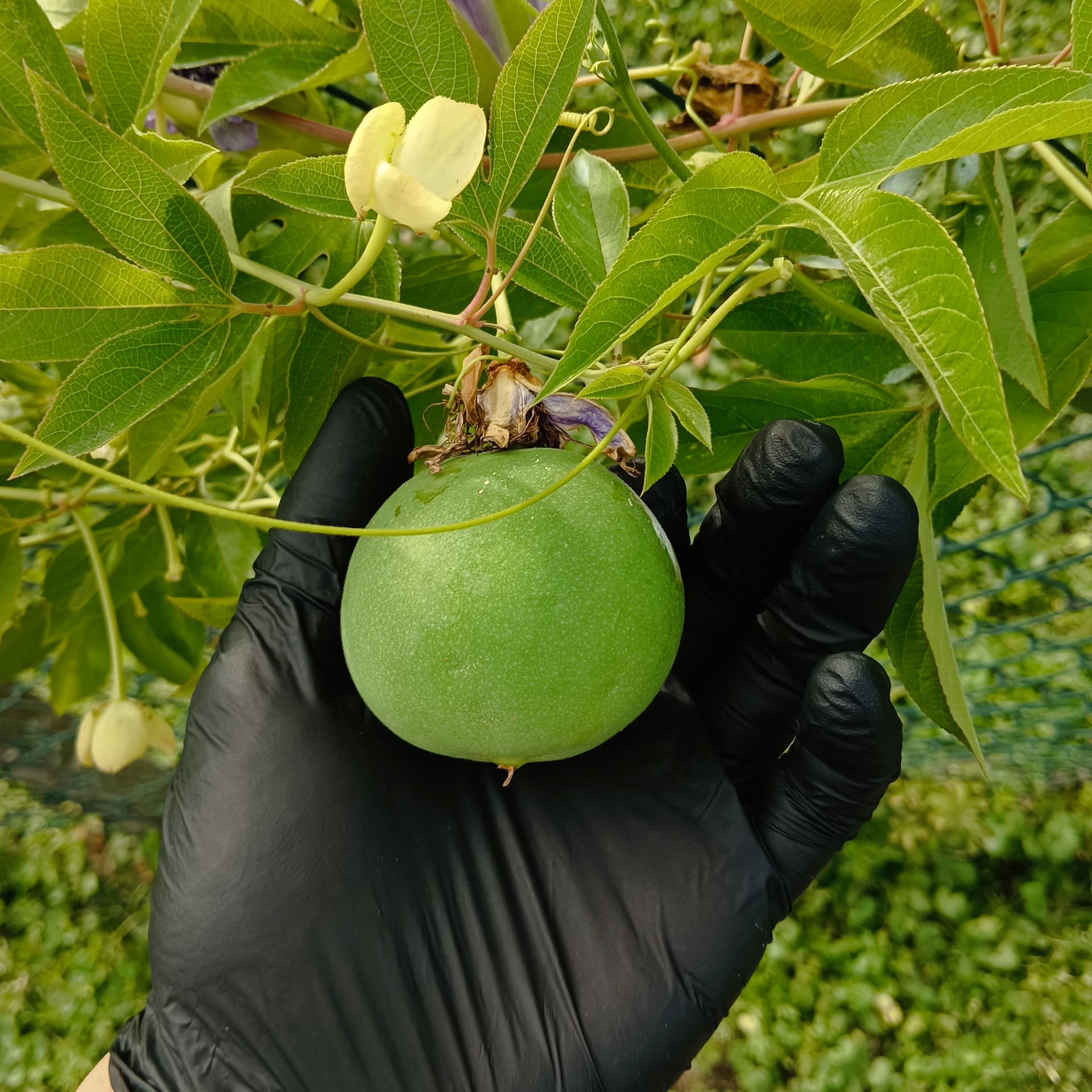
Fata Confetto Fruit, pollinated by incarnata.
I Cannot pollinate the incarnata with the Fata Confetto pollen, could be pollen sterile?

10 Likes
I have 1 passion fruit on a black knight or purple possum that i didn’t pollinate this year. But this is the first year I’ve had a ton of bumblebees around me.
My hybrid is still alive  i need to check on everyone…
I’ve managed to keep the flavicarpas alive as well so far through neglect
3 Likes
i was just looking more into maypop edibility and ran across this: Passiflora - Wikipedia
Passiflora incarnata (maypop) leaves and roots have a long history of use as a traditional medicine by Native Americans in North America and were adapted by European colonists.[28][4] The fresh or dried leaves of maypop are used to make a tea that is used as a sedative.[28] Passionflower as dried powder or an extract is used as a dietary supplement.[28] There is insufficient clinical evidence for using passionflower to treat any medical condition.[28][4]
Passionflower is classified as generally recognized as safe for use as a food ingredient in the U.S.[39]
and here: Passiflora incarnata - Wikipedia
Safety
A 2013 literature review found that the herb has “a good safety profile”.[22] One study found that a daily intake of 800 mg of a dried alcoholic extract, taken over the course of 8 weeks for anxiety, appeared to have been safe.[22]
Passionflower is used as a natural flavoring agent in food manufacturing and is generally recognized as a safe substance (GRAS).[25]
P. incarnata is also listed in the European Register of Feed additives as an animal feed additive.[26]
Interactions
Possible interactions with following medications:[23][27]
- Sedatives
- Anticoagulants
- Monoamine oxidase inhibitors
P. incarnata may increase main effects or side effects of medications listed above.[27]
For oral consumption, pregnant or breastfeeding women should use caution and seek medical advice before orally consuming P. incarnata. The effects of oral ingestion of the plant compounds on reproduction or on unborn child have not been tested.[23][25]
the chemistry: Passiflora incarnata - Wikipedia
Phytochemistry
P. incarnata contains flavonoids and alkaloids,[23][28][27] with leaves containing the greatest concentration of flavonoids. Other flavonoids present in P. incarnata include chrysin, apigenin, luteolin, quercetin, kaempferol, and isovitexin.[29]
The main bioactive substances identified in P. incarnata include polyphenols, flavonoids, carotenoids, anthocyanins and other natural antioxidants.[citation needed] The polyphenols mainly belonging to the flavones C-glucoside class are present in P. incarnata and these phenols and flavonoids have high potential antioxidant properties[30] that exhibit significant free radical scavenging activity.[31]
1 Like
I reached out to Roman a few months ago and again recently. I’ll reach out to the folks on Facebook.
3 Likes
I grow P. incarnata from a local nursery and I’ve always been floored by the exquisite aroma and flavor of the ripe fruits. I also grow the Pink Pop cultivar and have noticed that those fruits are smaller, oblong, and perhaps less aromatic than the species. Pink Pop fruits are also a little harder to peel: the peel fragments into little of little pieces whereas the peel of the species can come off in just 2-3 pieces, almost like the white flesh sack within is “freestone” relative to the peel.
I’ve never had any other hardy passionfruits, so i have no idea if my P. incarnata plants are mediocre compared to others.
2 Likes
This is creating a bit of confusion for me, and I suspect I am going to realise I’m missing something a bit obvious when someone replies with my education…
What is to peel? You either cut it in half or rip a segment of the exocarp off and either way you basically have a “cup” full of juice and arils. The rind is generally considered inedible.
All of my treats so far were purchased varieties of the less hardy passiflora, but treatments of edulis vs incarnata have generally been the same beyond the hardiness zones and a greater variability in flavors incarnata plants.
1 Like
This seems to be genetic as I have one or two seedling vines that do this. Kind of annoying TBH!
I’m think this is directly related to my comments above.
Some vines make fruit where if you try to tear them open with your fingers, the outer shell pulls away and leaves a white spongy sac intact around the arils.
I never use a knife, just my fingers to tear open the fruit.
2 Likes
Hmmm, I just use scissors, figured that’s what most people did?
1 Like
My wild incarnata does the same- we just tear open the skin and squeeze or suck the pulp out. Sometimes it comes out in its own white sack.
2 Likes
This makes sense to me. I do usually use a knife, but even when I tear it, I can generally tear off what I want. I would not describe that as “fragmenting.”
The sacs I’ve dealt with are all thin, inside the shell. They generally tear where I tear the hull, but if I am using a spoon, they are noticeably variable in how well they try to adhere to the emaining hull. My experience trends toward all or none, but sometimes they have only a few places where they seem to adhere. I have assumed this was a matter of ripeness/dessication rather than attributable to individual plants.
2 Likes
The shell/peel of tropical passionfruit is much thicker than the one for hardy passionfruit. I don’t think I’d even try to peel tropical passionfruit - I’d cut it like you do. For the hardy variety, though, it’s quite easy to pierce the peel with a finger and then pull it off the inner sac in pieces.
Really? Maybe I’m misunderstanding your post. I’m more annoyed by having to remove lots of little pieces of peel that adhere to the part I want to eat. For me, it’s a breeze to peel my straight species passionfruits, kind of like when you’re peeling the shell off of an egg and it comes off cleanly in just a couple pieces.
Interesting. For hardy passionfruit, I find it easiest to keep the sac intact when I peel off the shell and then just pop the sac and fruit into my mouth. The sac part is completely tasteless and very tender, so I only really notice the fruit nodules inside when I’m eating it.
2 Likes