Not to discount what you are saying, but if one pays attention (and not just mow them down) they will find seedlings and suckers to continue to propagate nearly any fruit. Pawpaws are just a bit more “persistent” as to the suckering. For some reason I continue to propagate trees even though I do not have any more room for them…
7 Likes
Here’s a list of Pawpaws from the University of Pennsylvania,which most are probably gone and only a few recognizable names.
https://www.sas.upenn.edu/~dailey/Pawpaw_Missing.htm
1 Like
Lifespan is influenced drastically by site and soil conditions. On a ‘good site’ in pawpaw territory, a quality grafted tree can go strong for 15-20 years then quickly starts to fizzle. Especially if it has been heavily pruned or had any damage to the trunk (large pruning wounds, storm damage, etc.) Seedlings can live for decades because they just keep suckering and renewing themselves. The grafted portion of a tree can die back and rootstock suckers can take over as you mentioned, and extend the life the tree, although the graft would be gone.
4 Likes
I’m not sure who John B. is…?
Nolin Nursery
2 Likes
The late John Brittain (sp?)
2 Likes
Sadly, yes.
1 Like
Oh yes, I met him. I tried to arrange to go to his nursery and be mentored by him but never got a response back. It’s sad when the super skilled and knowledgeable elders do not pass on their legacy with the younger generation, even when asked. His collection by now must be covered in weeds. I don’t think he had a huge amount of pawpaws growing, but was a pioneer in the pawpaw nursery thing. He also was a nut expert and the world is very short on nut grafters and special selected nut trees… at least in the USA.
2 Likes
Cliff England has a new American persimmon cultivar that makes blue fruit. He named it “Brittain’s Blue” in honor of John.
6 Likes
well my Susquehanna survived and it’s budding after planting this time last year. sadly the companion I think a sunflower died, it’s dry through. and now I went to look for another and all are sold out everywhere- it’s perfect bare root or tree plant time right now, might end up without one again until next year. I ate them as a kid just wild in the woods back east and have been trying to get around to get some going here.
milder is better for me, I like the less flavored ones from my memory
1 Like
Are you at all close to @Bradybb @ramv @Seattlefigs? I would have assumed one of them would have suckers popping up that could be transplanted at this time.
1 Like
I’m in Washington state but not near Seattle, I could try to find out! thank you
What’s best depends on your environment.
The sweetest most aromatic phenols & terpenoids pawpaw at 26% Brix is Susquehanna at an avg of 175grams & only 4% seed by weight.
It is the most firm fruit with longest shelf life.
It is the most self-fertile at 13%, Sunflower is at 11% .
It however, is a low bloomer in most locations.
It is the most heat tolerant, Mango 2nd & Sunflower 3rd.
It is best to have multiple cultivars close to each other.
Sunflower is a good pollinator with 3 times the blossoms of most.
Blossoms are hermaphrodite, yet are 2 stage, first female then male.
Whip-N-Tongue best grafting method.
Cuttings don’t root & air layering only 1% take.
6 Likes
Hum, thanks, you are a good researcher & resource of information.
My apologies for getting a little bit triggered.
How big is your Susquehanna?Is your place near Spokane?
I saved some seeds that came from fruit that just JustPeachy sent me.I could grow them out and send some small plants,in the Fall or even seeds now.
I also save pollen,if yours needs a donor.
1 Like
I would love that! it’s about a foot and half tall, not big at all. it has leaves and is chugging along though. I’m in Spokane. I could try seeds or if you want to make effort to grow them out? is it difficult to get the seeds started? I’m always interested in trying
Mailing seeds is the easiest,less expensive and more surer way of starting trees,instead of sending live plants.
Pawpaw germinate fairly easily.I use tall tree pots or take 2 liter plastic drink bottles,with the top cut off,near the collar and a few holes punched at the bottom for drainage.
A mixture of Pine bark mulch,peat moss and some chunky stuff,like perlite or small pumice,maybe even rice hulls will work,in about a 50/40/10 % ratio.
The pots can be placed outside,especially in your warm environment,80F is premium for soil temperature.I usually start them inside,a little earlier in the year,after stratifying in some damp peat moss for about three months in a refrigerator.My pots are put in a Tupperware type tub,with bottom heat.No light is necessary,until they start popping up.
When leaves begin to develop,keep them out of direct sunlight for a year or two.
If seeds are wanted,PM me your address.These have been stratified,so they are ready to plant.
5 Likes
I’ll pm you. that doesn’t sound difficult at all.
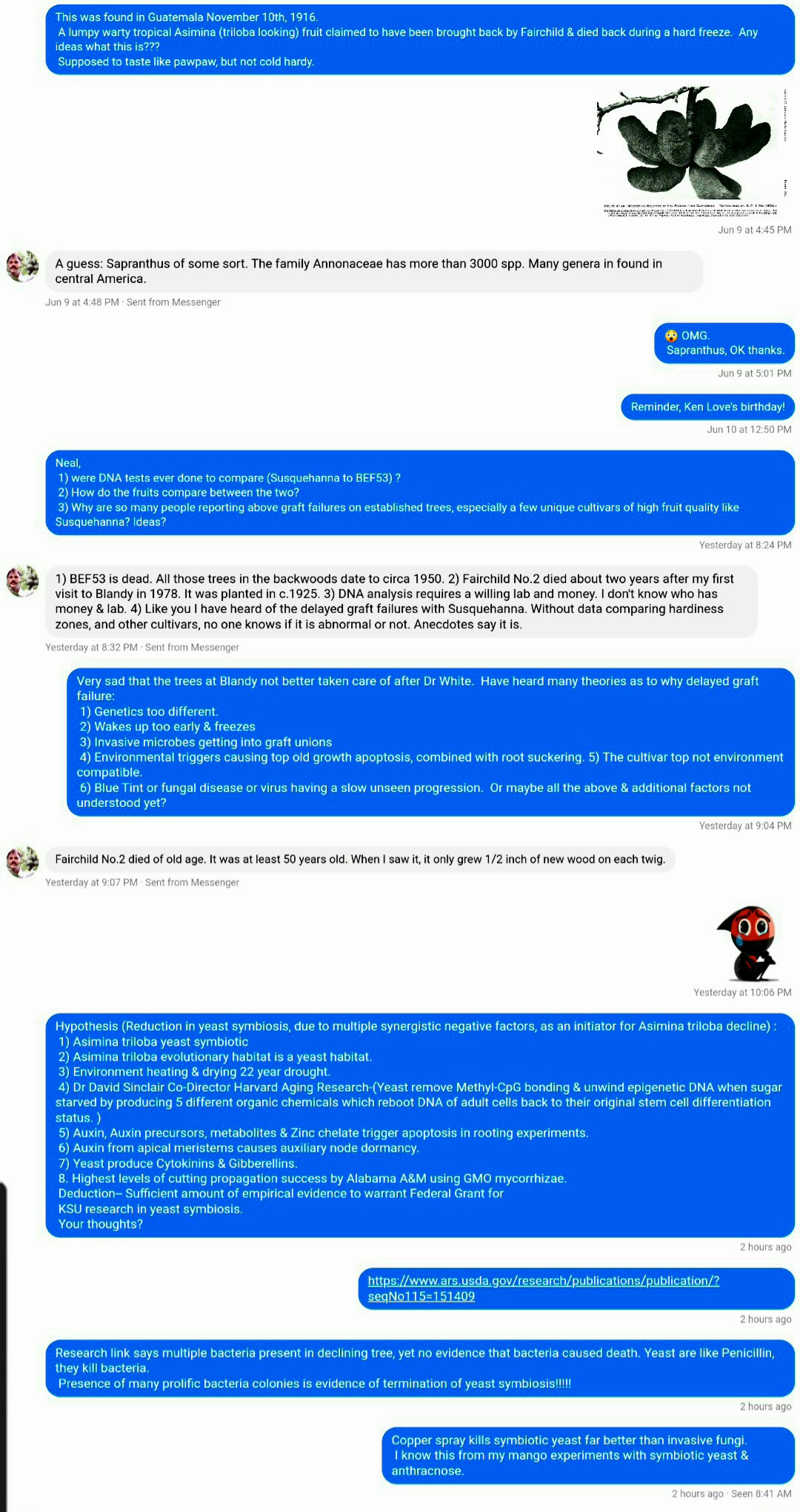
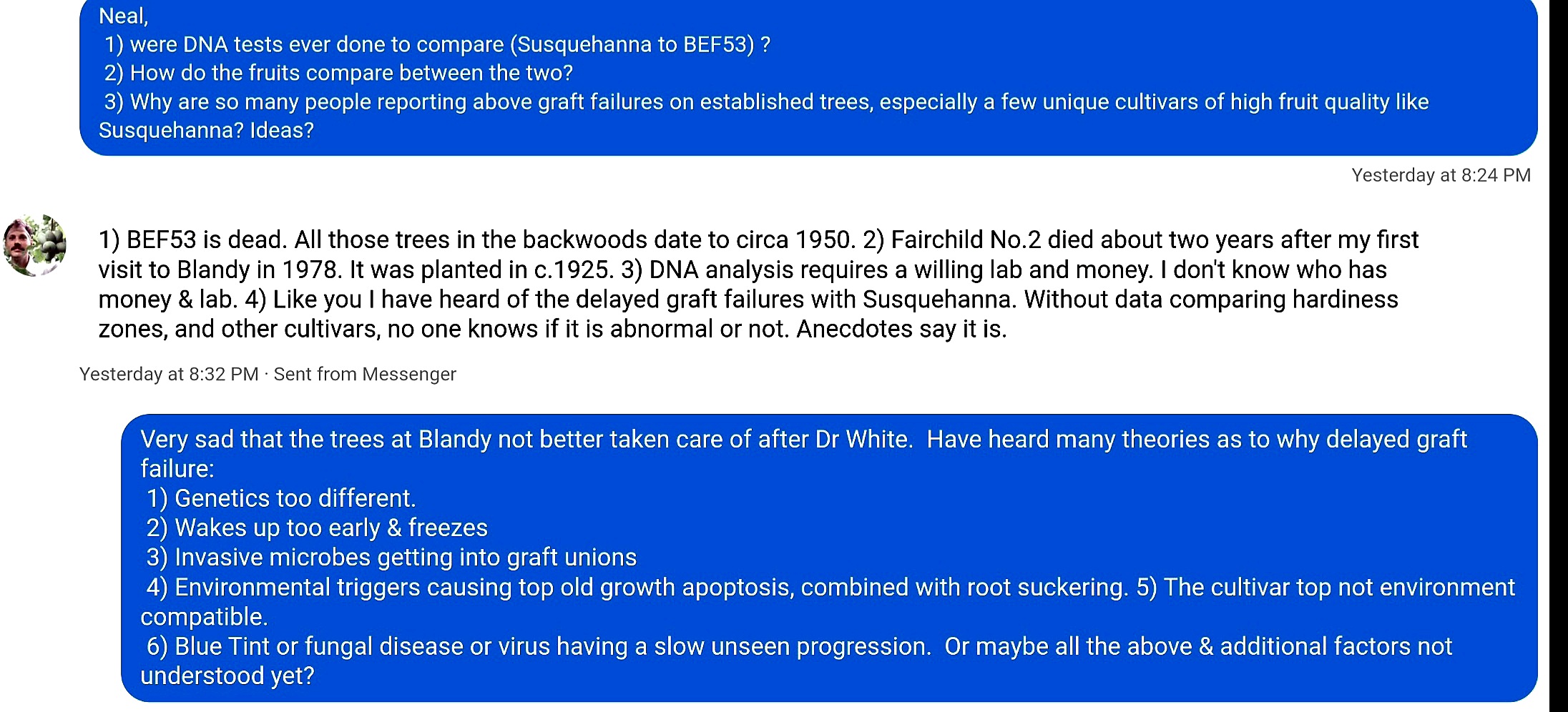
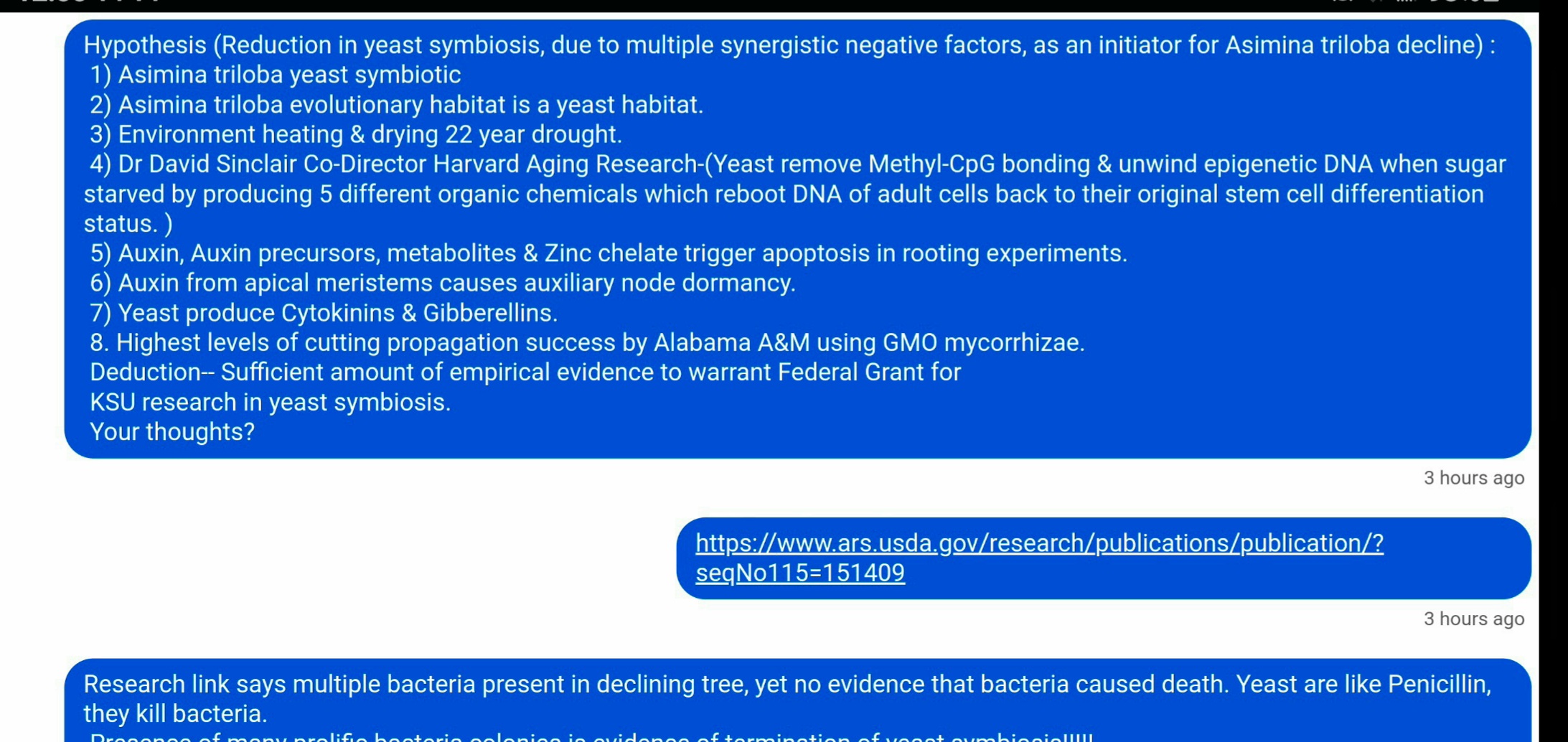
I have been in active interactions with R. Neal Peterson on dozens of Asimina triloba topics:
- Cultivar origins.
- Genetics.
- Breeding
- Symbiosis
- Decline
- Graft failure
- Heat tolerance
- Cloning & tissue culture
- Apoptosis
These are easier to read, zoomed in
2 Likes
I highly recommend Susquehanna as a cultivar.
It is 26°Brix per KSU
It’s 13% self-fertile per KSU
Susquehanna has the richest most complex flavor of all other cultivars.
Make sure however that is is grafted to a seedling of Susquehanna, or Sunflower or Mango or a wild root sucker.
A loose free seed white flesh pawpaw.
Mair Farm-Taki
Yakima County, WA 98951
The article didn’t mention cultivar name.

1 Like