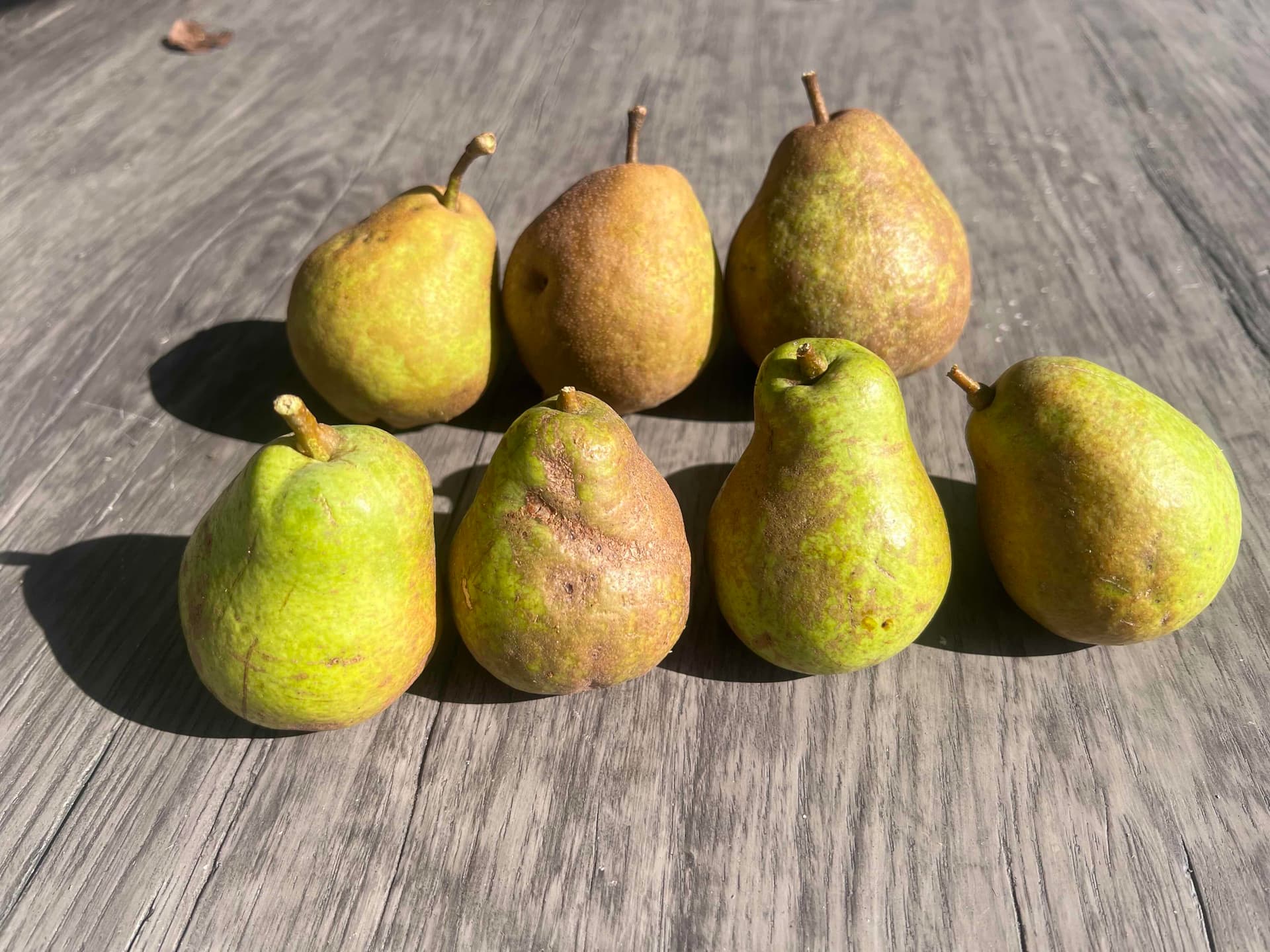
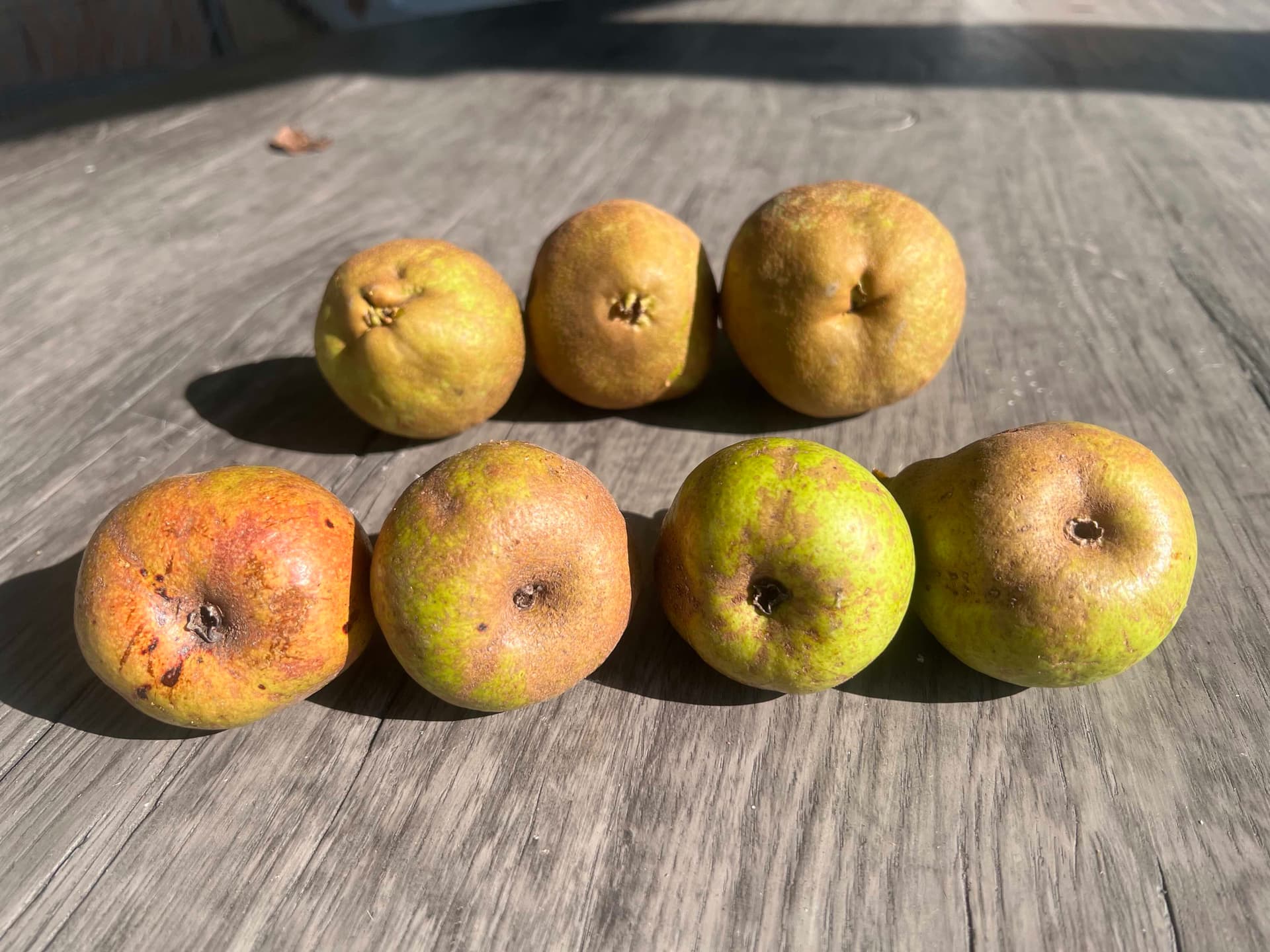
I didn’t want to waste time propagating the abandoned pear at Colt State Park without evaluating its fruit. So I braved the ticks, climbed through the brush, and knocked 4 pears from the tree. For comparison, I also picked 3 pears from the abandoned tree across the street.
Here are pictures of (1) the 3 pears picked from the tree across the street (Post #28); and (2) the 4 pears picked from the tree in Colt State Park (Post #52).
Remember that the pear pictured in Post #28 comes from a tree grafted from a scion taken from the tree across the street. So these three pears should look similar, except for insect damage.
My observations: These represent two different varieties. Despite the distorted perspective created by the camera in my phone, the pear in Post #28 (top) is larger. The body is plumper and the neck tapers gradually. The calyx (using belly button terms) is an “outie.” In contrast, the pear in Post #52 (bottom) is smaller. The body is narrower. The neck narrows further but then stays relatively broad at the top. The calyx is an “innie.”
I tasted both. Neither pear is ripe but the Post #52 pear seems closer. The flesh is sweeter and slightly less dense.
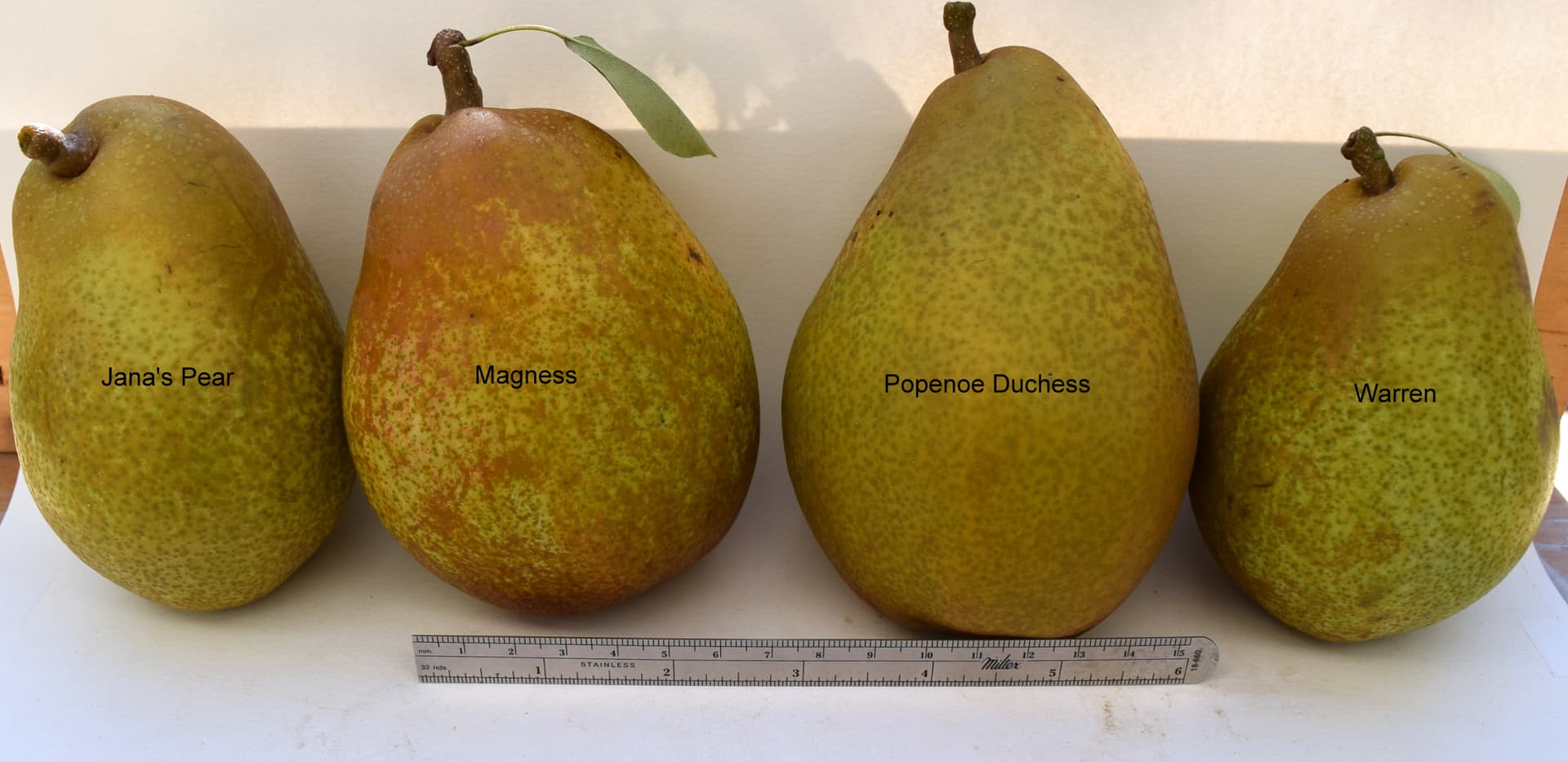
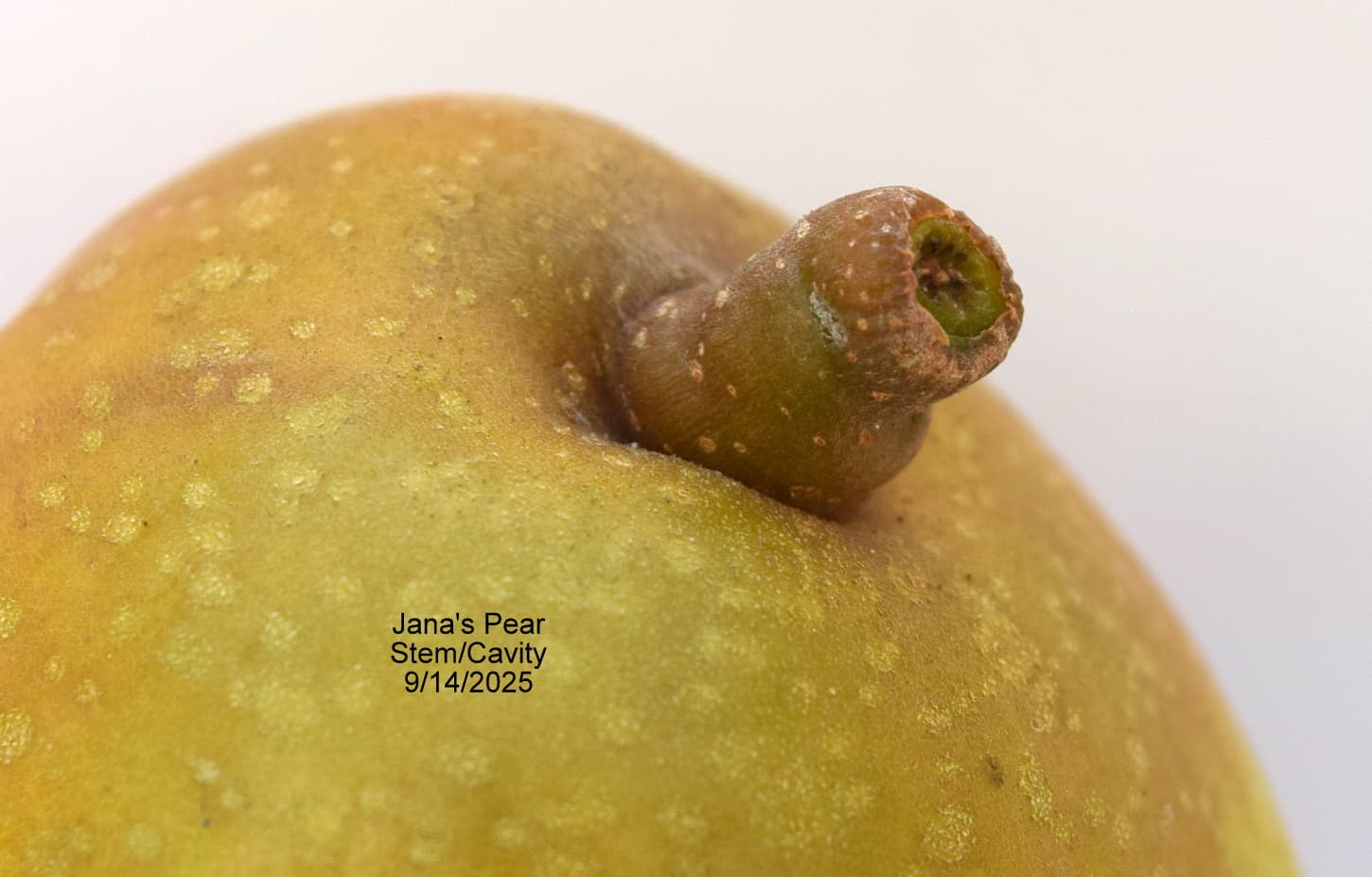
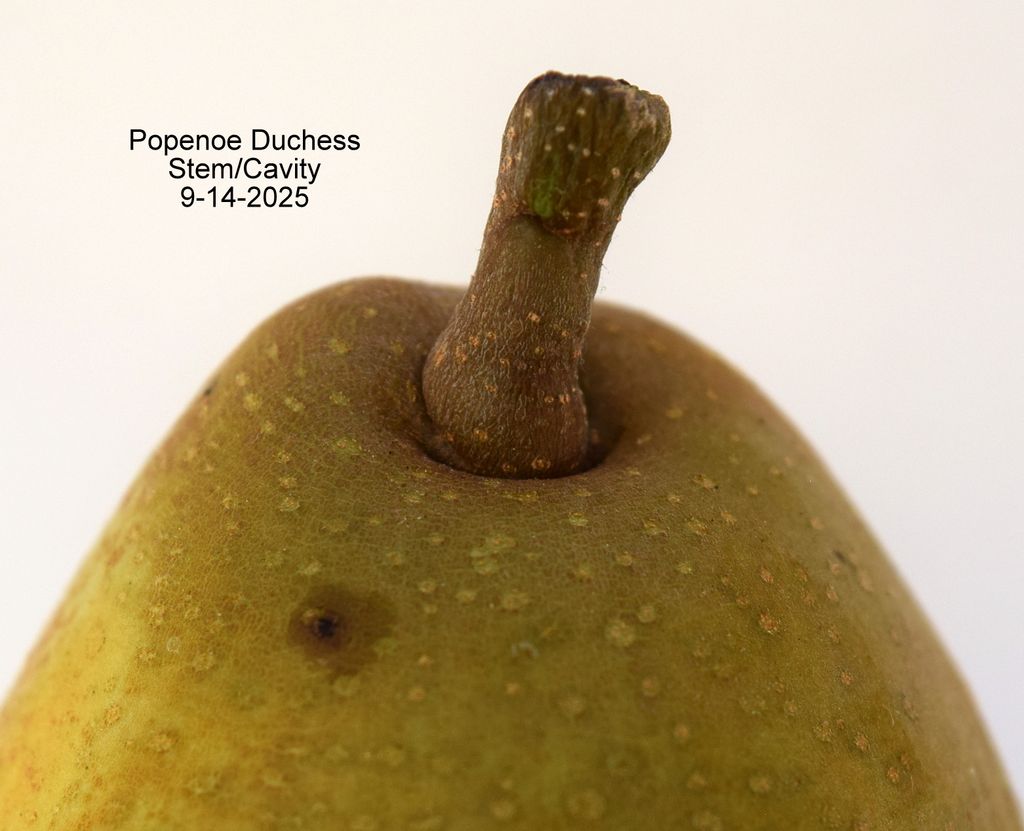
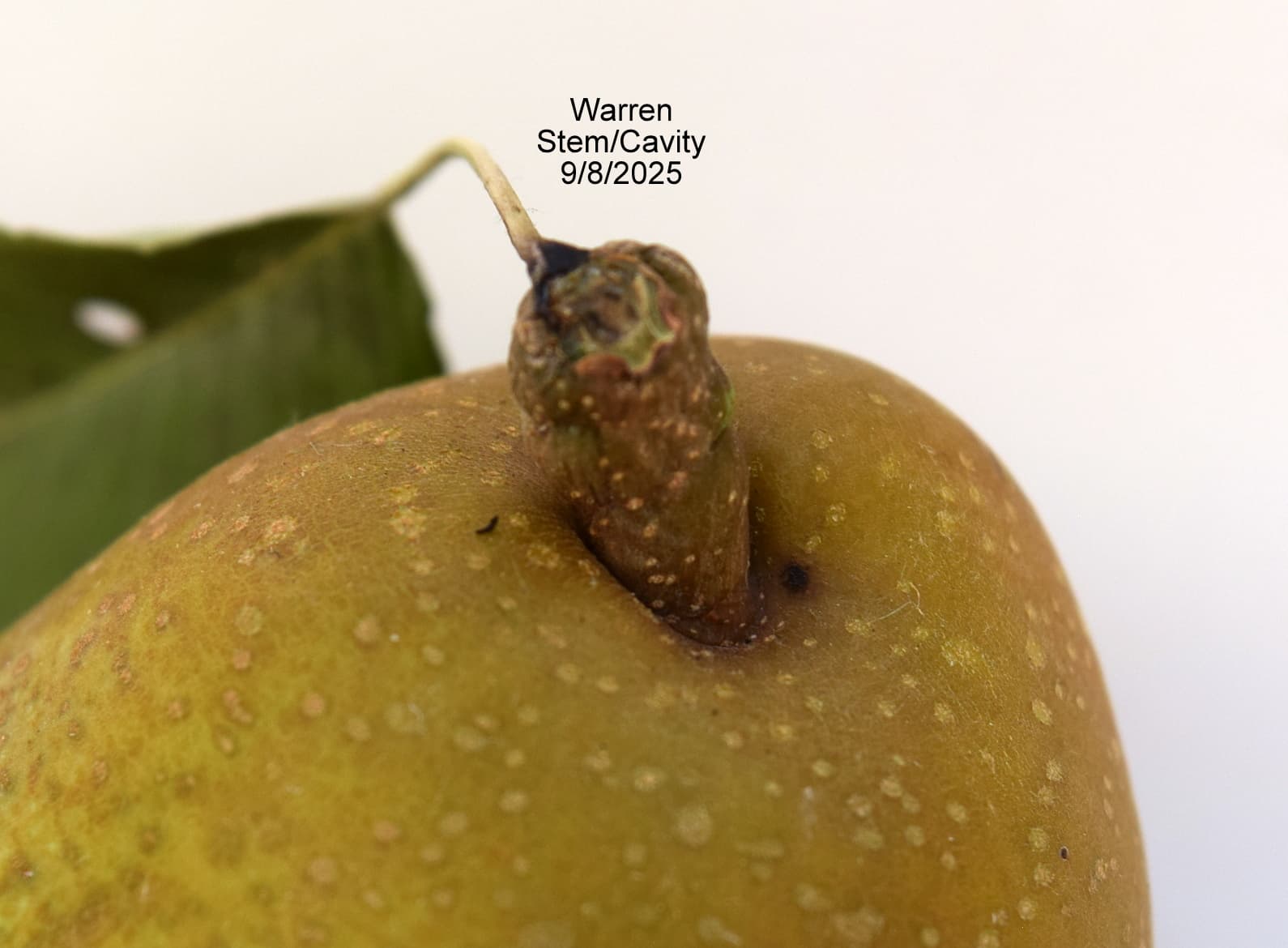
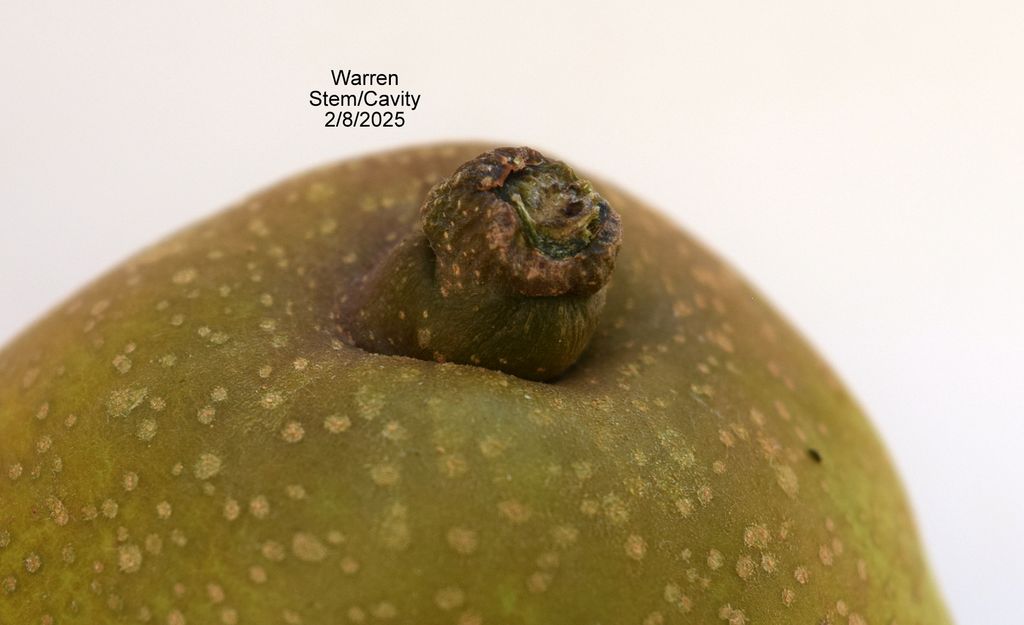
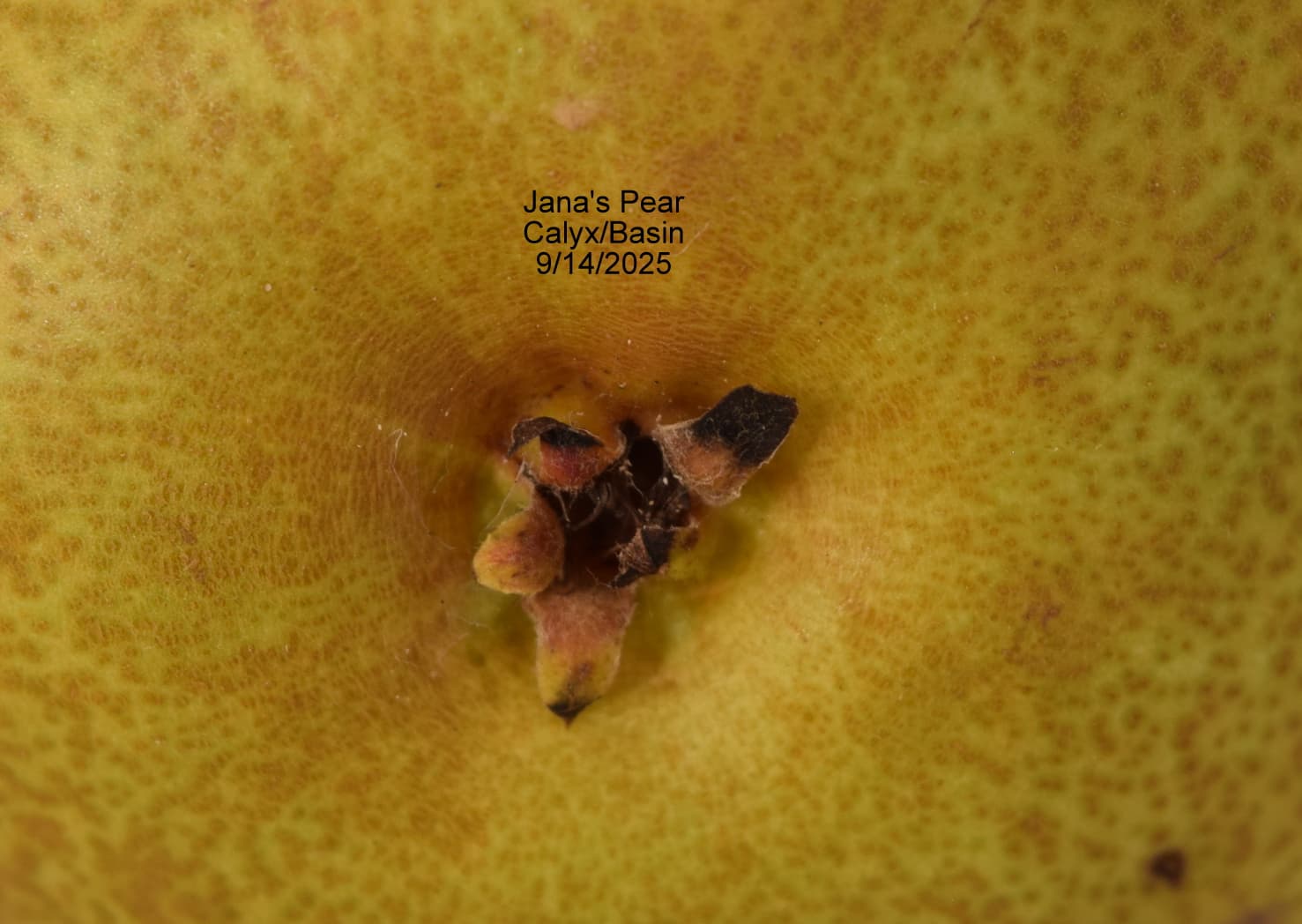
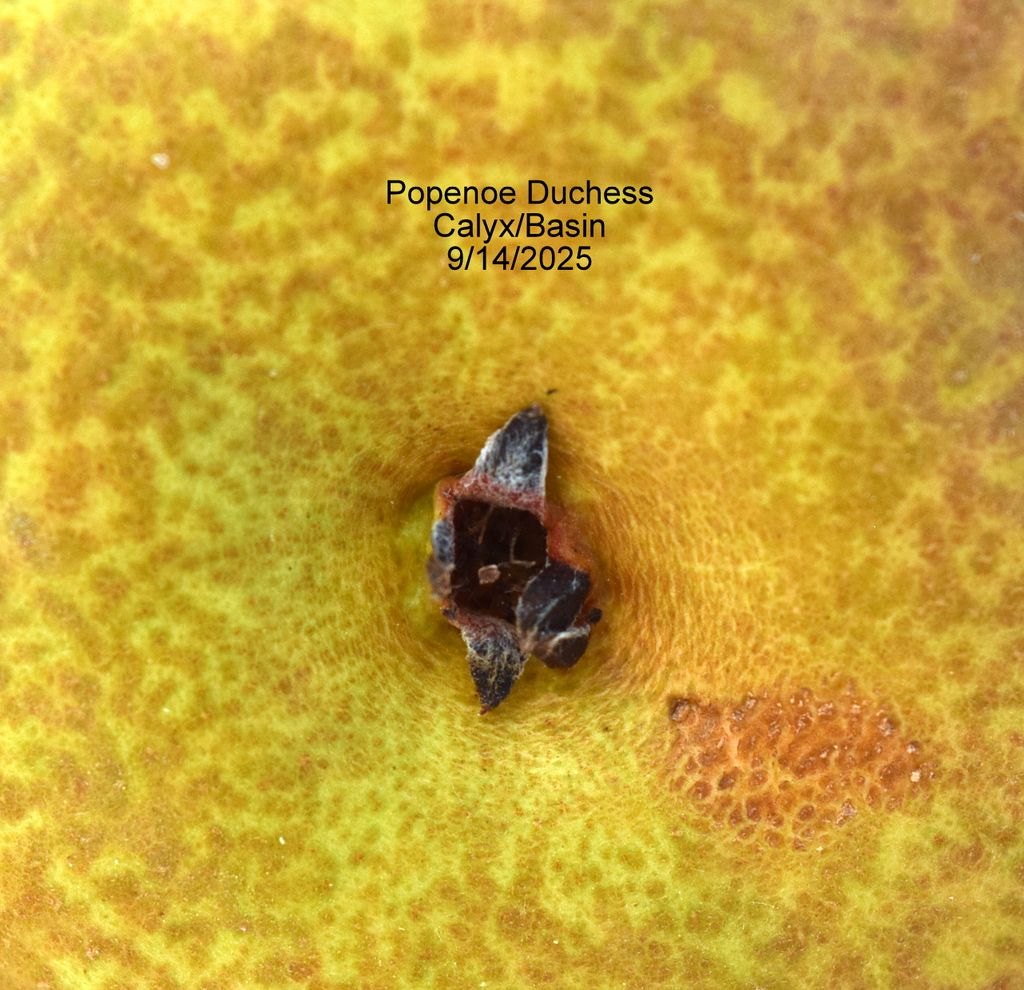
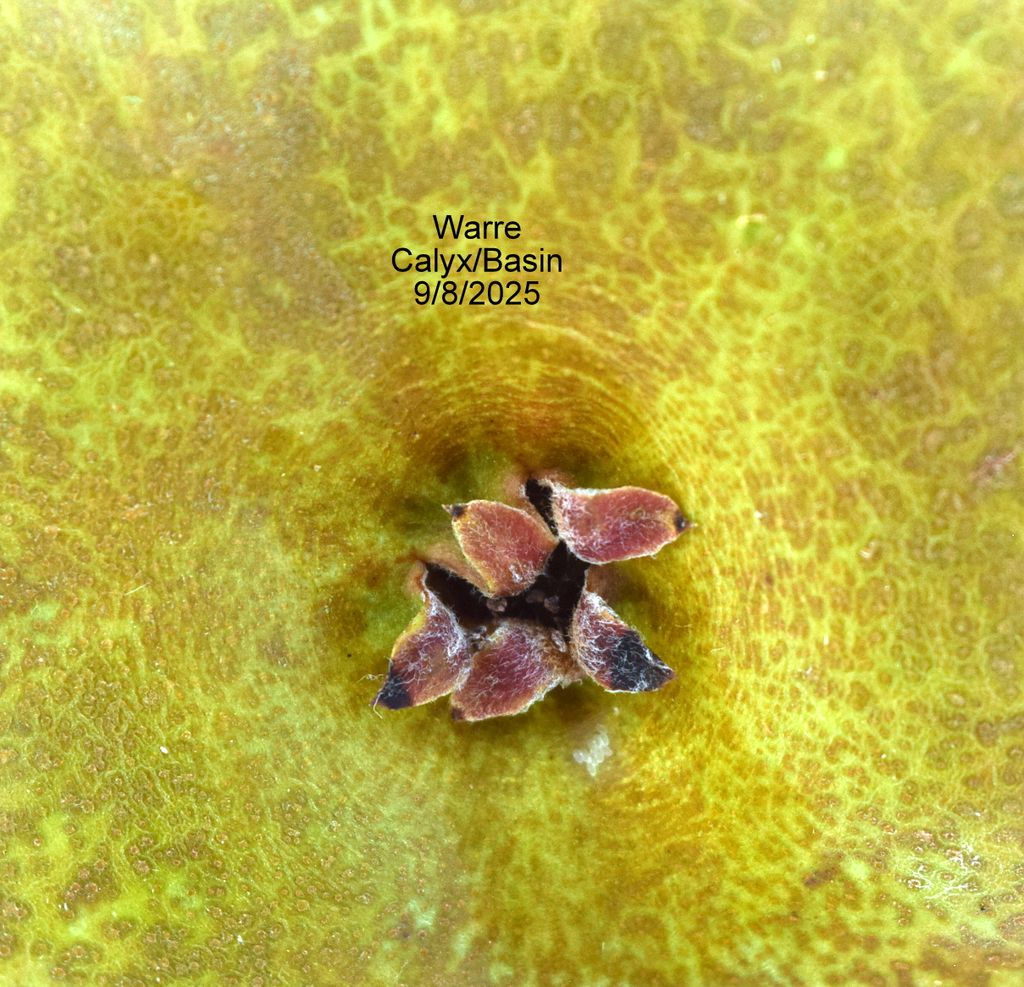
The first week in September 2025, Magness, Jana’s Pear, Warren and Poponoe started falling. It took us a few days before we started picking. Warren had a light crop so I was able to pick all of the tree on September 8. I started picking Magness the next day and have picked it several times since. I picked a nice box yesterday, 9/16/2025. They were firm, crunchy and sweet. A few pears remain on the tree. Wife, Jana, started picking “her tree” on September 6. On 9/17 it also has pears remaining. The fourth tree in the group is a pear named by an old Golden Gate CRFG member. Paul Popenoe. It was growing on his property when he bought it. He called it Popenoe Duchess. I asked him at one of our scion exchanges what he thought it could be. He said, “My brother thinks it is Warren”. I do too. We picked it on 9/13 and 9/15. It is a vigorous growing tree planted on the west side of my property. It always has a very light crop as there are no pear trees upwind to pollinate it. It can have huge fruit
So, here is the quadrad:
Magness is obviously unique in that group. Jana’s and Warren are very similar but really need more pictures. Popenoe Duchess to me is not the same as Warren or Jana’s.
The only way to 100% answer ID questions is to DNA test the tree and find out if it is a known cultivar.
Warren and Magness certainly are similar and yet very different in terms of production. Magness is a light producer in my climate, and Warren, the heavier of the 2 pears. I received my scions from the USDA and feel good they are the corrrct species. I would like to grow your 4 pears and see what is what in comparison to the ones i have.
More pictures are coming. The problem is what known cultivar that ripens at the same time as Warren/Jana’s tastes as good. We have done taste tests between Jana, Warren and Magness but never added Popenoe. Maybe I should do that this year. Whatever Popenoe is, it is a good pear!
Maybe we should make a really great thread called the mystery pear series Pear Harvest 2025 - #37 by clarkinks . I think if i ever write a book to make sure my content is unique i will do it over unknown pears only like those you mention. Imagine we put together 1000 unknown pears! @Auburn had an unknown asian pear he grows. @jrd51@Phlogopite brought up some great unknown pears. I have some really unique types i grow.
Clark, I’ll send you scions of the 4 trees in question. For me, Magness has been the best producer most years, but I have had limb-breaking crops on both Jana’s and Warren. But, with Karl’s Favorite grafed just 20 feet upwind of the Warren, I expect that to change! BTW, it is growing very well - now, the central leader is almost 10 feet tall.
Your going to really like that karls favorite pear i think. It is one of my favorites. It always does well for me though it is true i grow it because of warren.
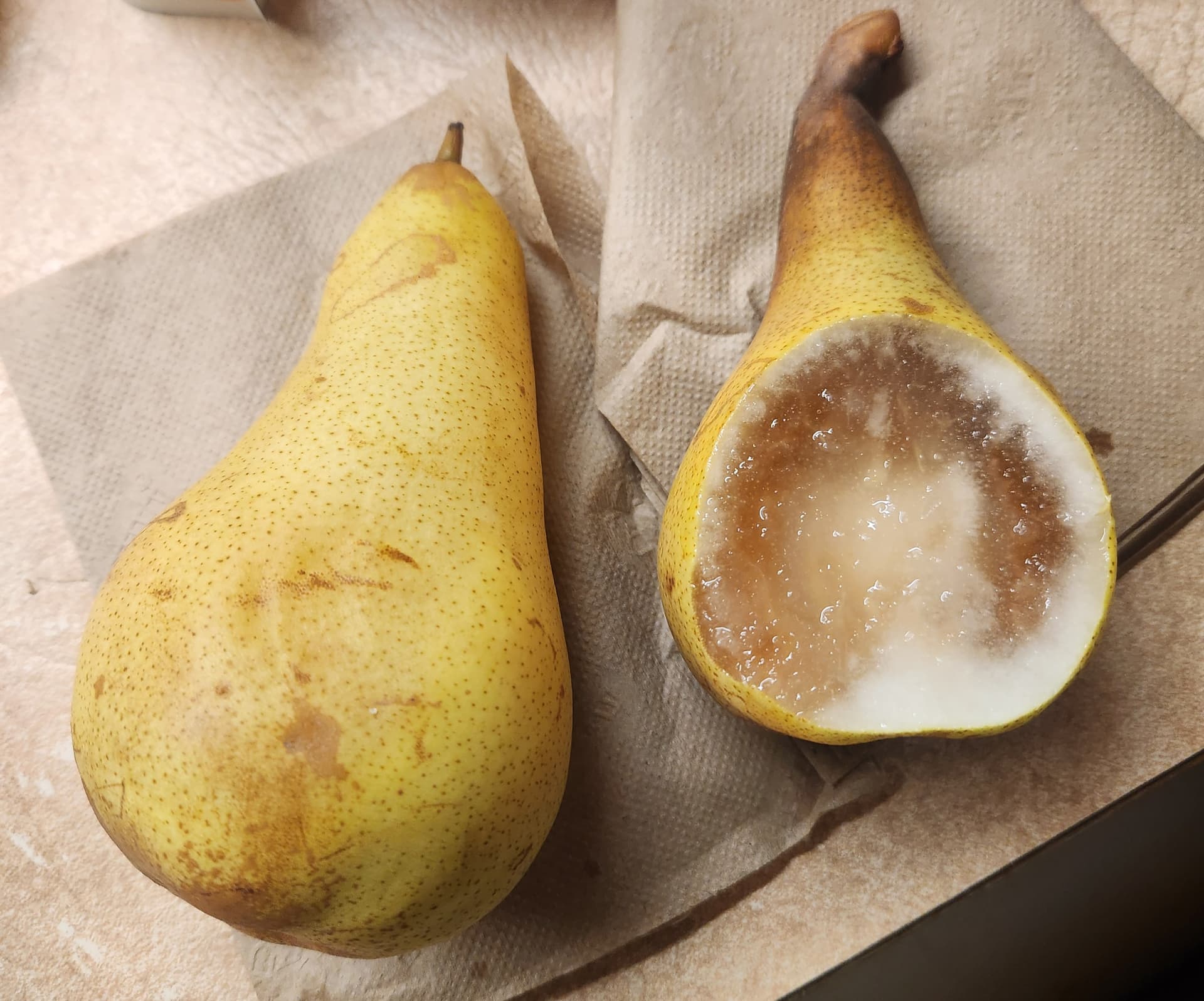
Here is a photo of one of my Abate Fetel pears. It appears to great BUT has been basically cooked/baked on the tree due to the excessively weeks of high heat and humidity. It felt mushy on the tree and when I cut one open. Ugggg. Not all of them were like this, thank goodness.
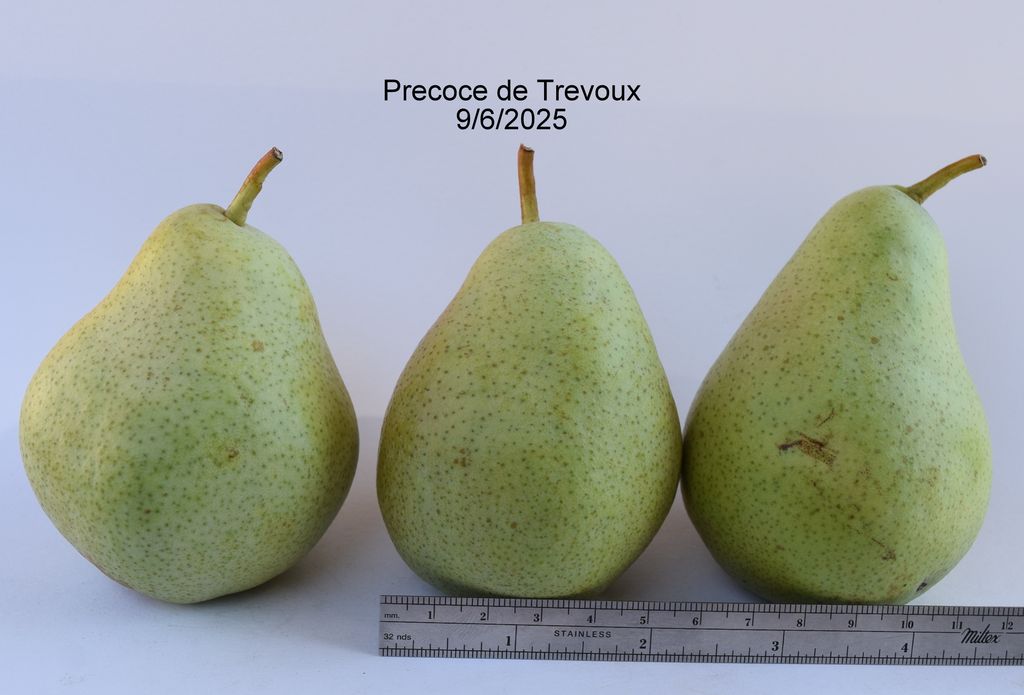
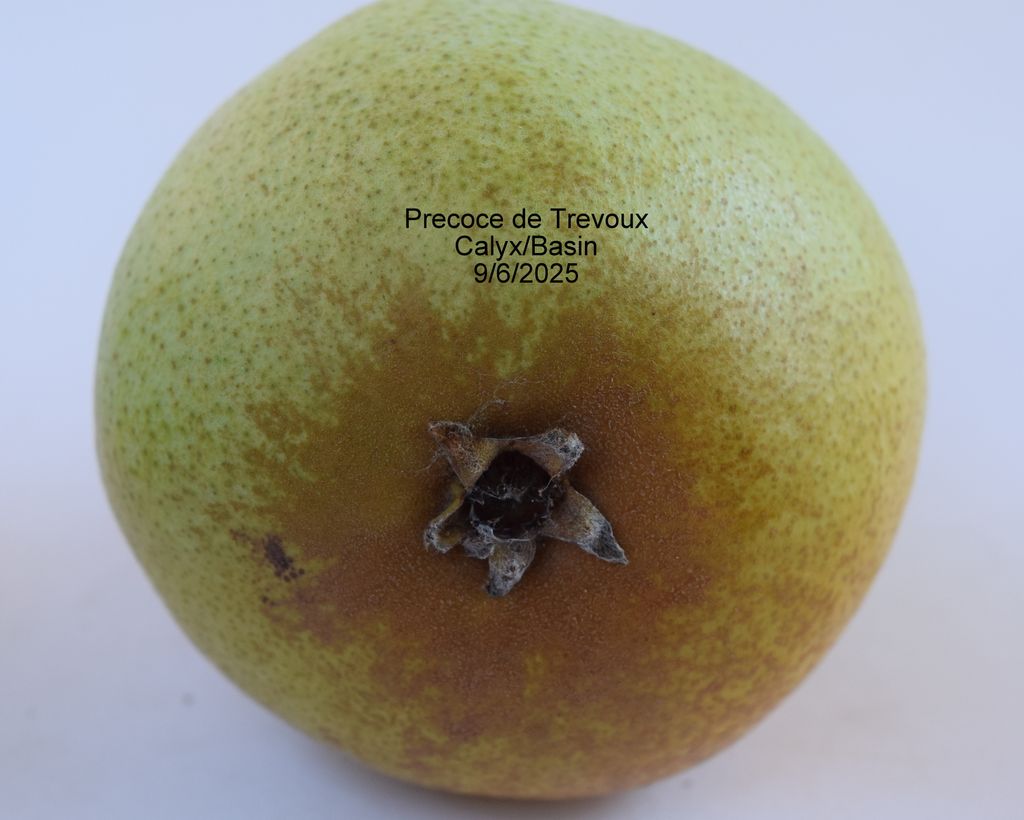
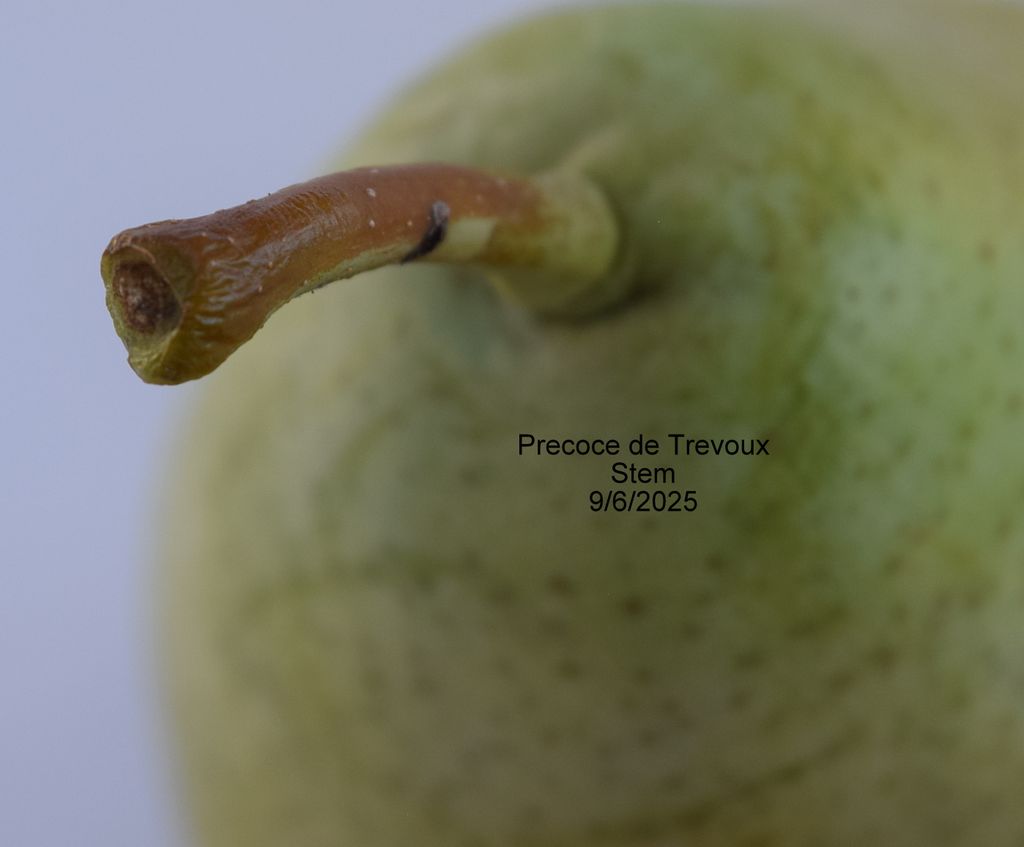
I don’t think I posted Precoce de Trevoe. It was picked on 9/6/2025. This narritive is from Hedrick in the Minor Pears section of The Pears of New York. Précoce de Trévoux. 1.Cat. Cong. Pom. France 328. 1906.
Obtained by M. Treyve, Trévoux, Ain, Fr., and first published in 1862. Fruit full medium size, pyriform-truncate, fine and tender skin of a vivid yellow, very finely dotted with green and washed and streaked with carmine on the side next the sun; flesh white, fine, melting, juicy, sugary and richly flavored, agreeable perfume; good to very good; beginning of Aug.
I’m still waiting to taste it this year. Staying firm but the color is changing. I’ll try it tomorrow.
"The Warren pear tree was named for Thomas O. Warren, a founding father of the North American Fruit Explorers (NAFEX), who discovered this gem in Mississippi, in 1976. The Warren pear is medium to large, long-necked, drop-shaped fruit is faded green with an occasional red blush in full sun. That said, the Warren pears can vary in size and shape. The pears are rated equal to Magness by many. The Warren pears are sweet, spicy and very juicy, buttery, silky flesh with no grit. Pyramidal tree shape. Fire blight resistant. One of the best for providing a source of pollen to other European pear trees. "
And just were did they get this information. That is just not true! Catalogs are often just copied from other sources. The nursery owners often don’t really know. They grow and sell trees. They don’t usually have producing orchards.
I have asked on other threads for a scientific publication that has reported on the pollen of Warren. No one has replied. Its sister seedling, Magness, is pollen sterile and I think Warren is also. Bees are not often seen visiting the blossoms - not much, if any, pollen there.
Sometimes I think they list a variety as a prolific pollen source so people will plant them with a bunch of other varieties to mask the pollen problems. Sounds reverse, but almost looks true.
Magness is a real problem for me. That makes me question like you if the expertss really have any expertise that we dont. One thing i have heard time and time again from growers all over is warren is one of the hardest pears out there to pollinate. Frog hollow i think has trouble as well in California with warren where trees like bartlett turn parthenocarpic. My karls favorite is really prolific. I get lots of pollen and pears from the tree. Some things i cant prove one way or the other except by my observations like you. I have the ssame problems you do with warren. Could it be great pollen for other trees? I really cant prove its not a great pollinator either.
I’m really becoming more convinced guys like @mayhaw9999 and you and i are the expert pear growers. Unfortunately i dont have a lab to prove my observations. @Richard is the best plant scientist i know.
@clarkinks
Thanks, but I’m certain my skills are very limited in comparison with persons here and elsewhere. One realization I’ve had is that there are many hands patting the elephant: botanists, agriculturists, genomists, functional biologists, pomologists, horticulturists, evolutionary biologists … and so forth. It’s difficult to get the whole picture, or even find a specialist in any specific cultivar. I’ve only known a few in my lifetime.
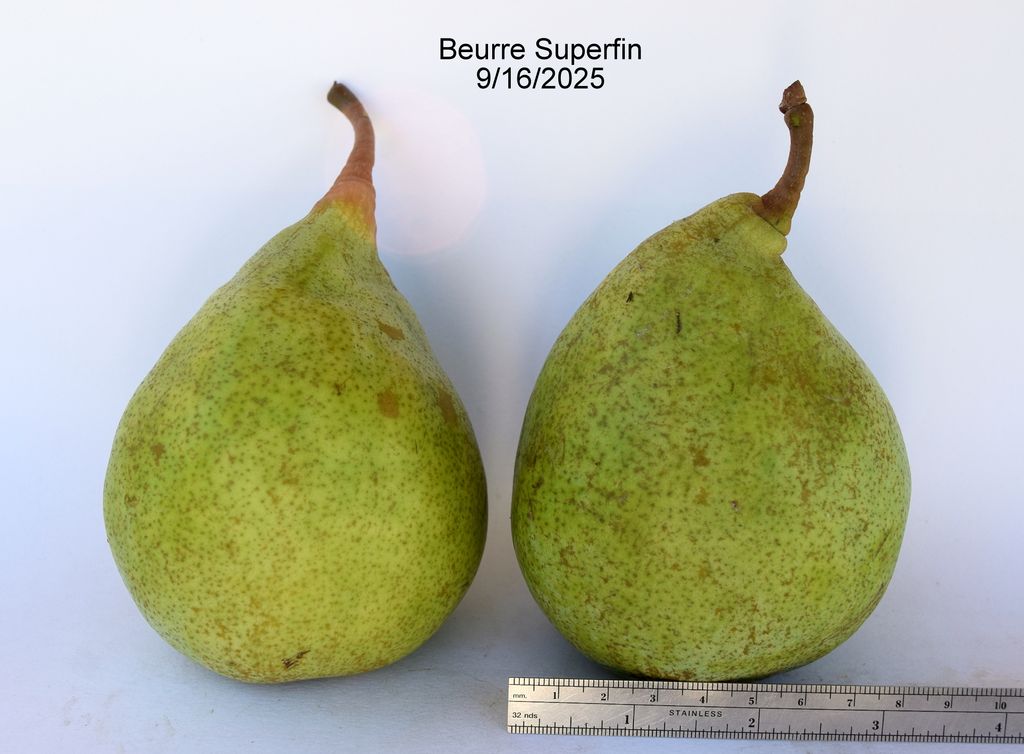
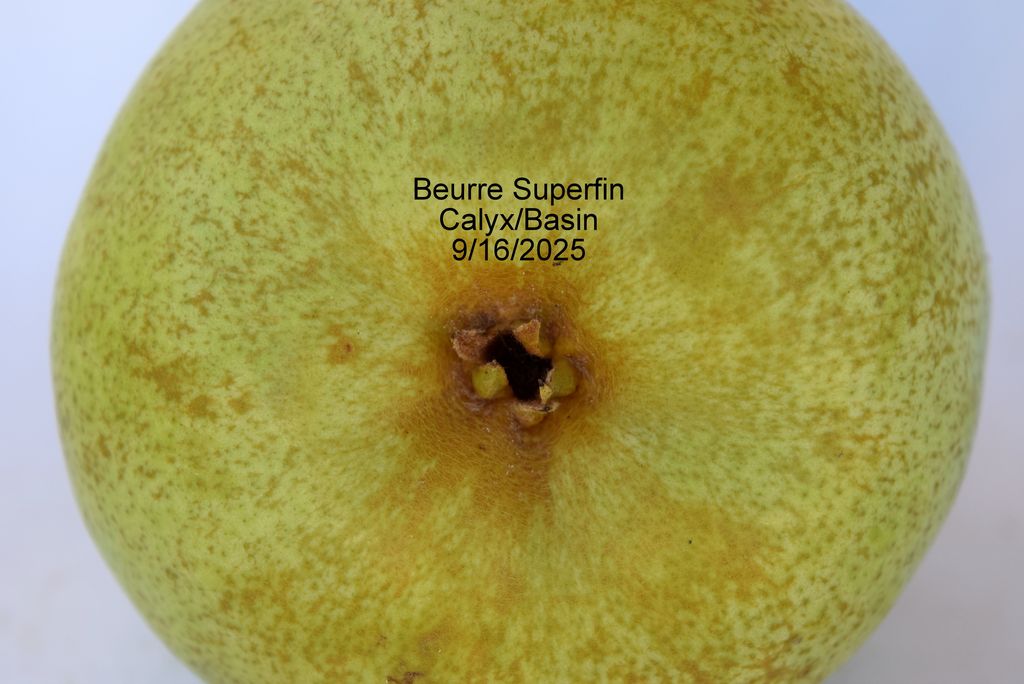
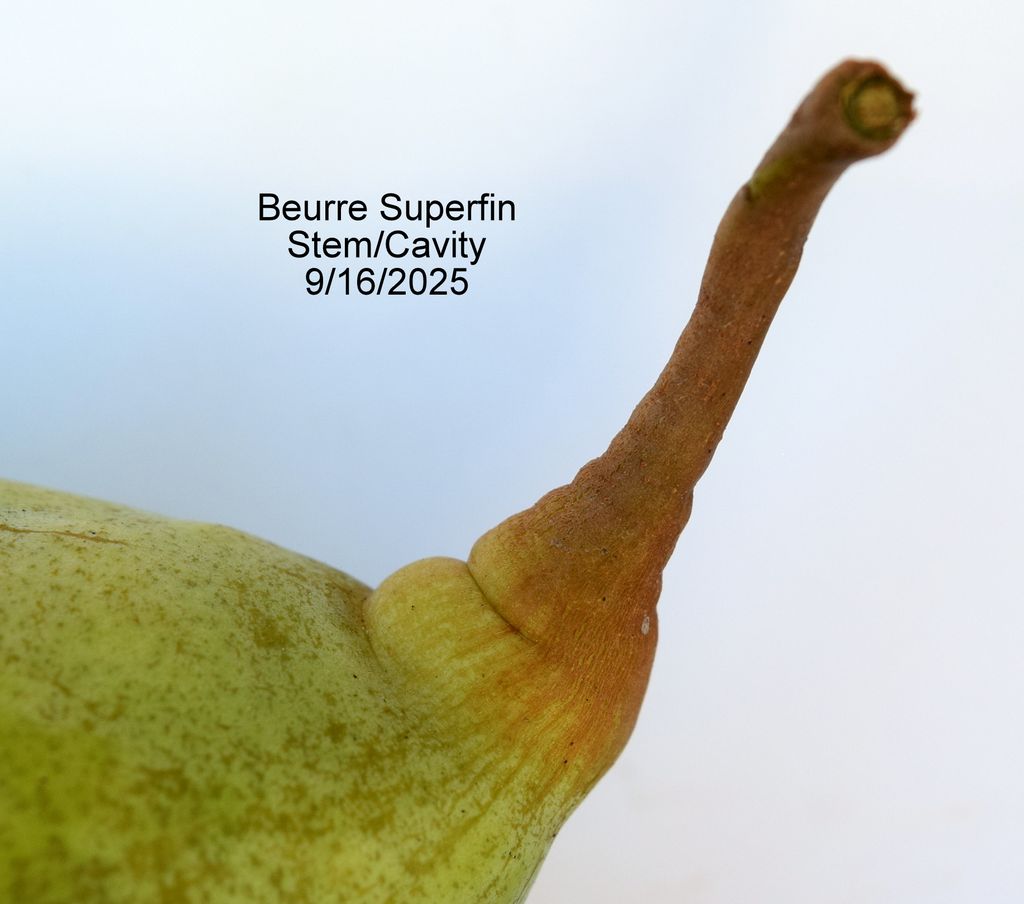
Beurre Superfin was picked first on 9/15/2025. Some of the fruit were too ripe on the tree, but most were perfectly mature. I cooked some yesterday, along with Onward and Magness in a pear upside-down cake. They have more acidity than most pears, which I like when cooking, but they softened more than the others. When ripened to perfection, this is an outstanding pear. But I have found that it is one of the hardest to ripen properly. It won our CRFG taste tasting in one of the years that I ripened it well.
Here are notes:
A round, conical, medium-sized green pear with flesh tapering to the short stout stem, which I regard as of the finest flavor - sweet, melting, juicy, perfumed. The late Dr. Howe, co-author of The Pears of New York, once described it to me as probably the best flavored of the European pears as grown in this climate. Bunyard called it 'one of the best half-dozen pears, by some preferred to Comice.’ Originated near Angers, France, in the middle of the 19th century. Late September. Can be brought to ripeness in about 30 days. – Robert Nitschke, Southmeadow Fruit Gardens Catalog, 1976.
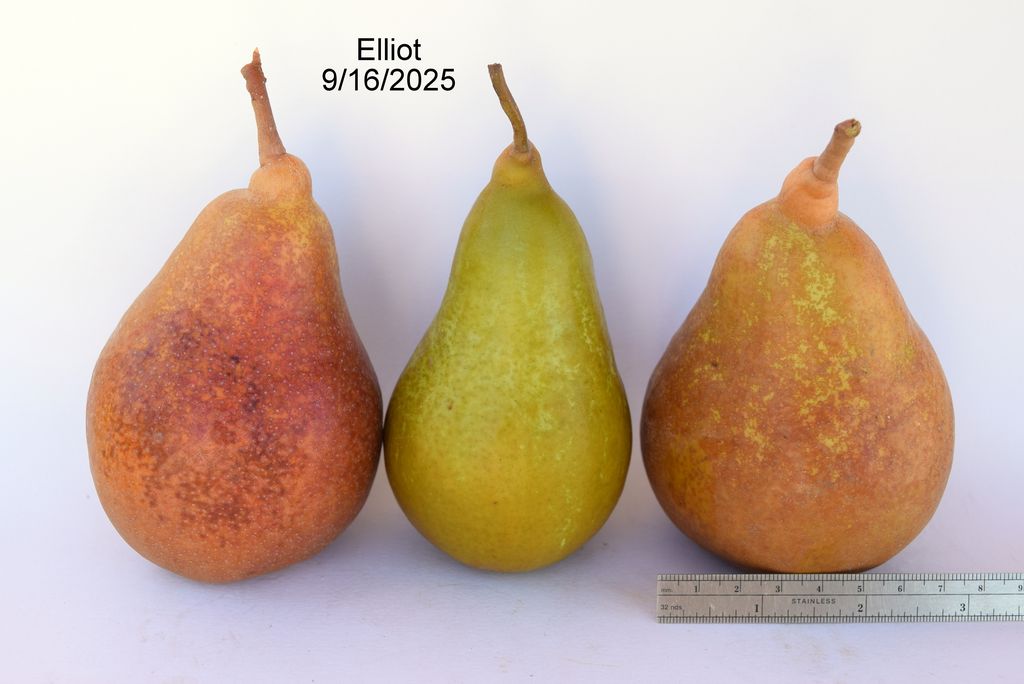
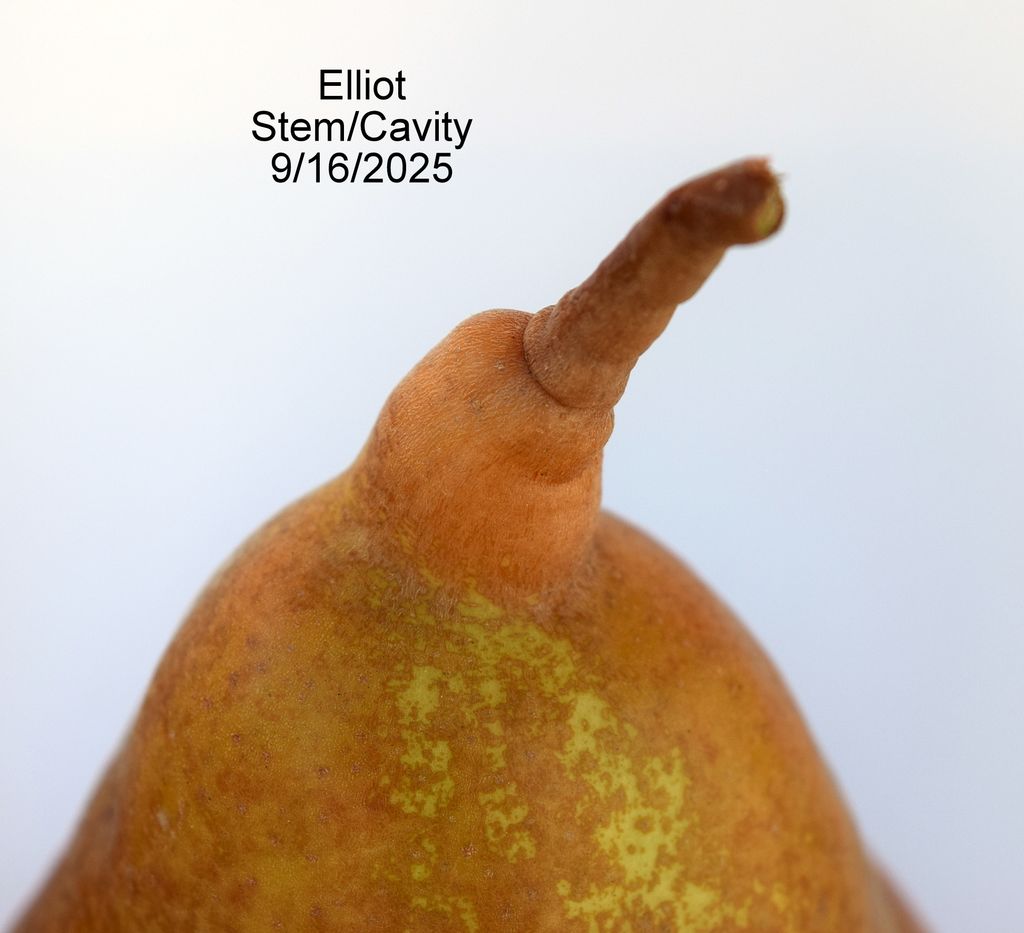
On September 16, I picked Elliot. I now have a nice small tree that produced a box of fruit and a graft on a vigorous multigrafted calleryana rootstock. Those pears are shaded and are shown as the center fruit in the photo below.
Elliot (CPYR 2624).-Originated at University of California, Davis, by Kay Ryugo; released in 1988. Elliot #4 x Vermont Beauty; cross made in 1964. Plant patent 6452; 6 Dec. 1988. Fruit: 50 to 60 mm in diam.; shape pyriform to conical, similar to Comice; skin yellow-green, 50% russeted. Buttery texture; flavor similar to Bosc; soluble solids to 18%. Ripens 2 to 4 weeks after Bartlett; stores 16 weeks at 0 C. Tree: upright habit; no fire blight during 20 years of observation, apparently resistant. – Brooks and Olmo Register of Fruit and Nut Varieties.
Do any of you remember the thread in Is It Worth Growing Warren Pear a couple of years ago about Warren being self-pollinating? I did a citizen science experiment during the bloom season 2024. I reported my results to that thread in post 277, April 2024. Here it is.
Last year we discussed doing the self-pollination experiment. So, before any Warren blossoms opened, I put Agribon bags that my dear wife sewed for me over two small limbs. I removed the bags today. Warren blooms are all off the tree and pears are forming on other branches. I did not manually cross-pollinate the blooms in the bags but shook and tapped the bags often. Not a single pear set on either branch. I’m sure that a pomological scientist would find fault with my methods but I think this experiment indicates that Warren is not self-fertile. The control is the rest of the tree.
Did anyone else do the experiment?
So, for me, the next experiment is to take the blossoms of Warren and cross-pollinate several varieties of pear trees that have the blossoms isolated before and after pollinating with the Warren pear flowers. See if fruit sets. Who is willing to experiment with me?
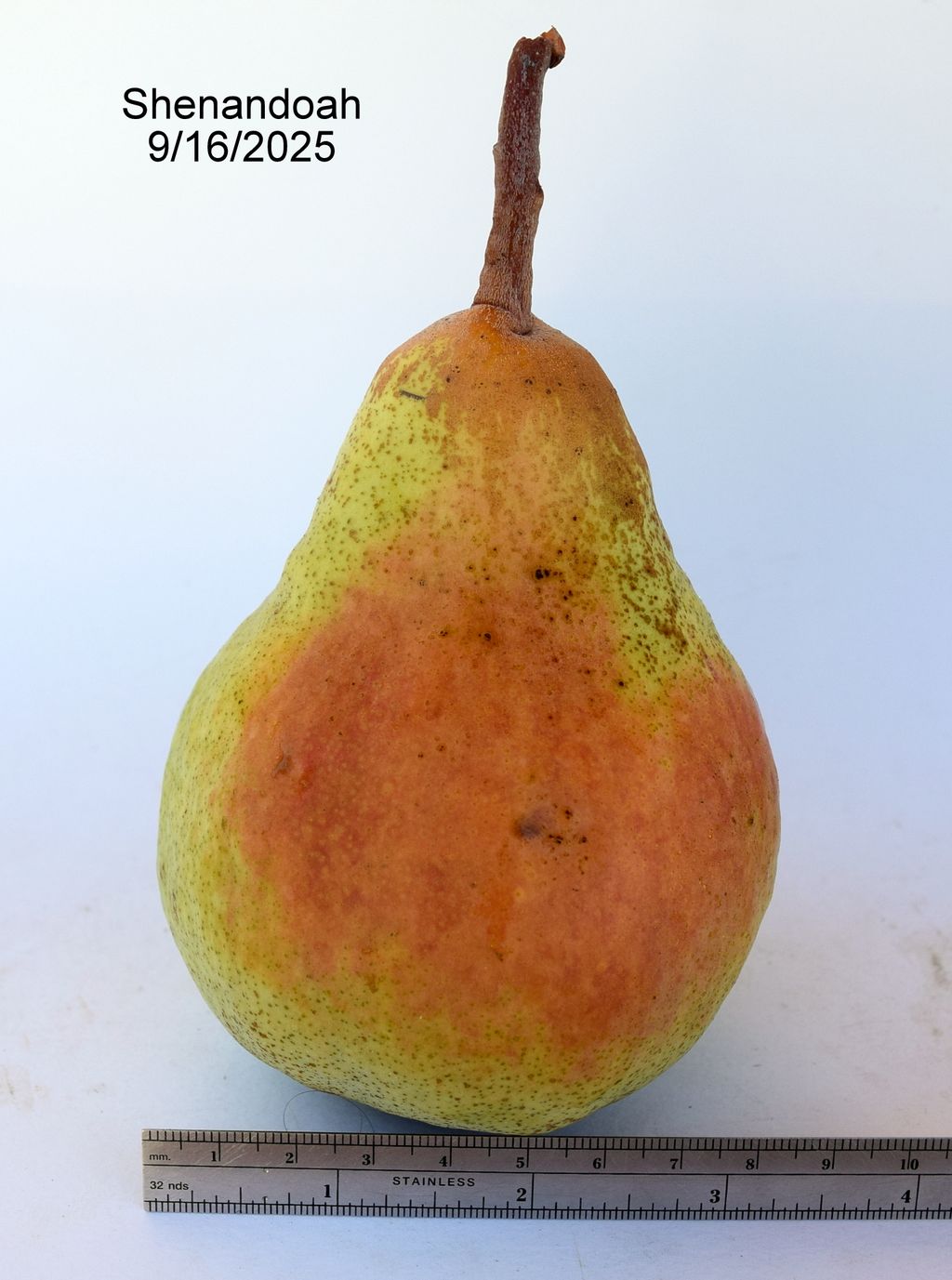
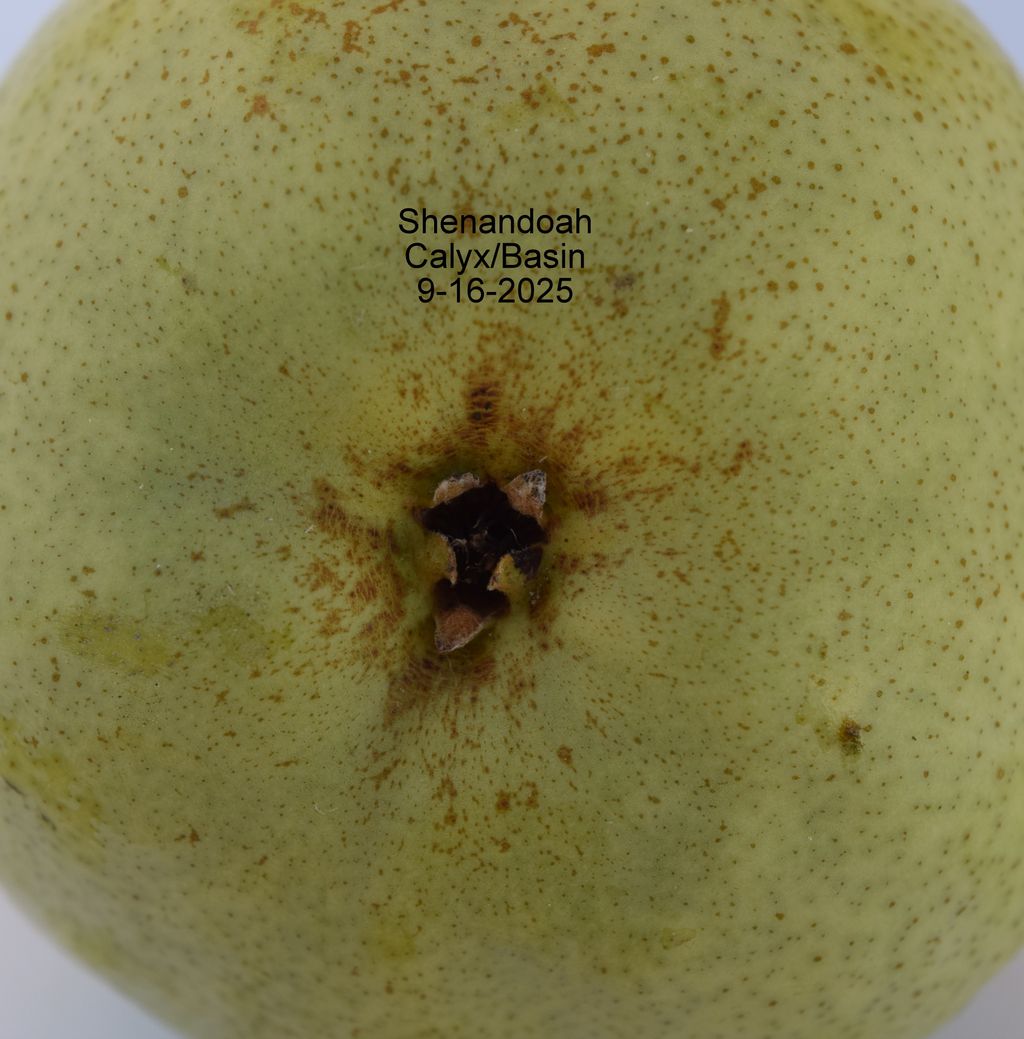
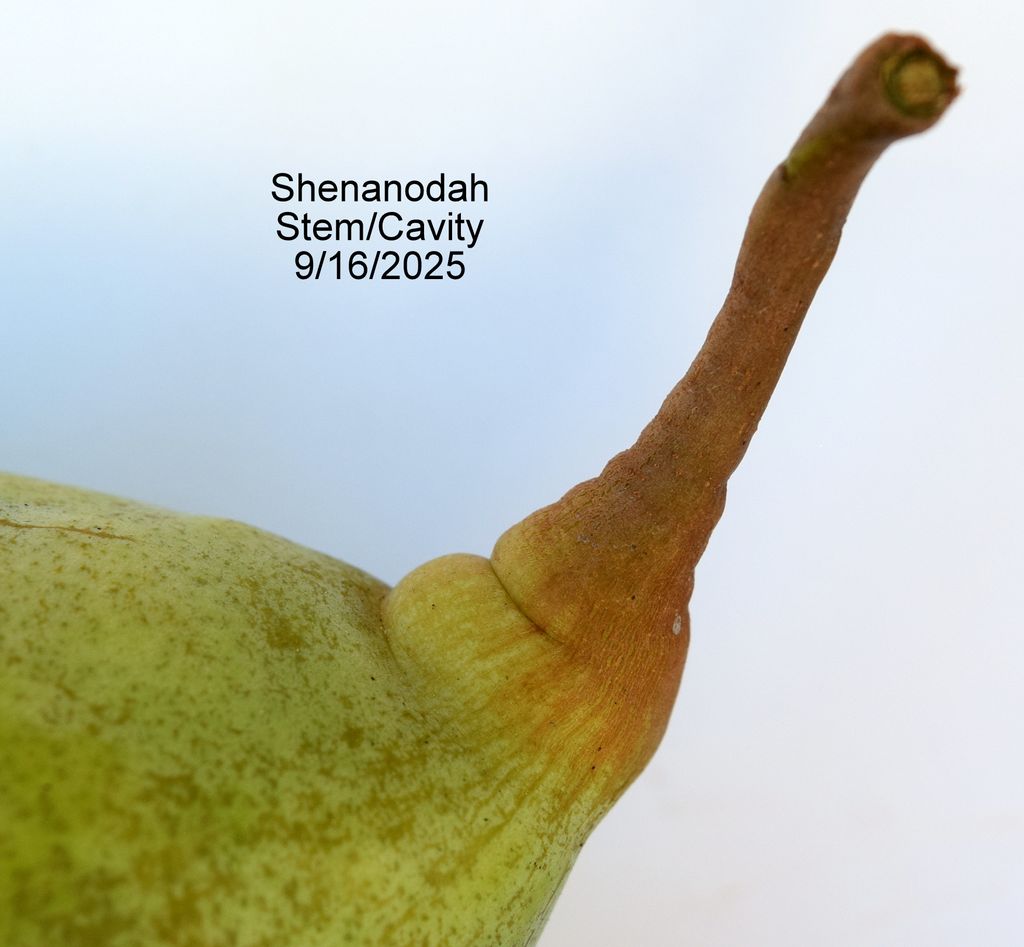
Also on September 16, 2025, I started picking Shenandoah. It had dropped a few fruit over the prior few days. Because of its acidity, it has become one of our favorite culinary pears. I make a rustic tart using Jacques Pepin’s recipe. I asked the family a few days ago if they wanted an apple or a pear tart. Apple please, unless you have ripe Shenandoah pears!
In 2022, I noticed a lot of blossom blight infection, but no run into the twigs. The tree seemed to set a normal crop.
Edited narrative from GRIN:
Harvest maturity occurs about four weeks after ‘Bartlett’, and the fruit will store in refrigerated (-1 C) air storage for at least 4 months without the development of core breakdown or superficial scald. The flesh texture is moderately fine, juicy, and buttery. Grit cells are moderately small and occur primarily around the core and in a thin layer under the skin. The flavor is aromatic, similar to ‘Bartlett’, and is moderately acidic during the first 2 months after harvest, becoming to subacid after longer storage.
Yield has been moderate to moderately high, and precocious, with first fruit setting 1 to 2 years after planting.
Fire blight resistance is similar to ‘Seckel’ with infections extending no further than 1 year old shoots. Artificial blossom inoculations indicate a moderate degree of blossom resistance to fire blight infection.
I want to offer some references to support information you mentioned
In 2015 i struggled to decide if i would grow Warren or not because i had only heard very positive things about the fruit and mostly negative things about its pollination and growth habits. This is that thread you brought up.