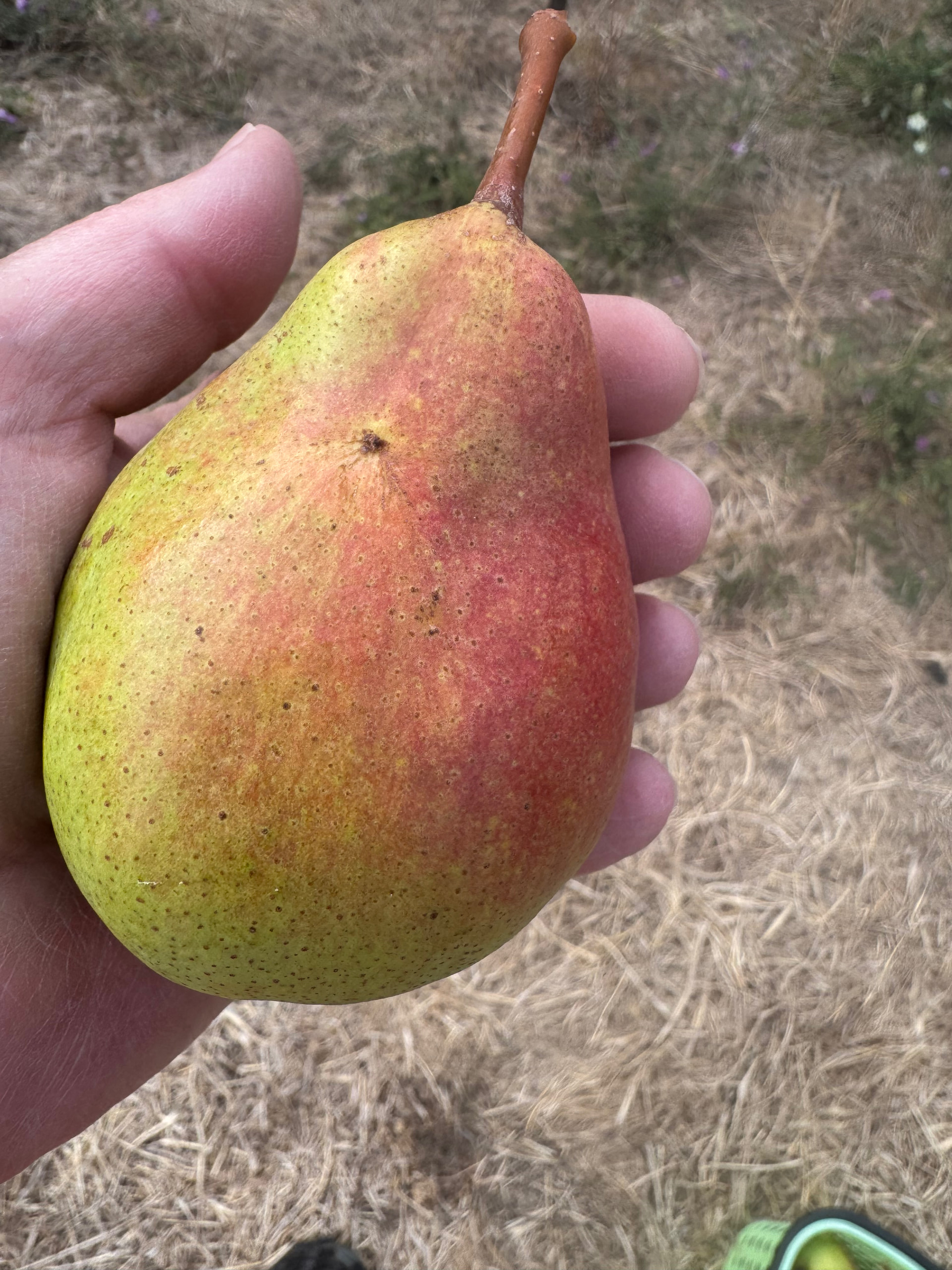
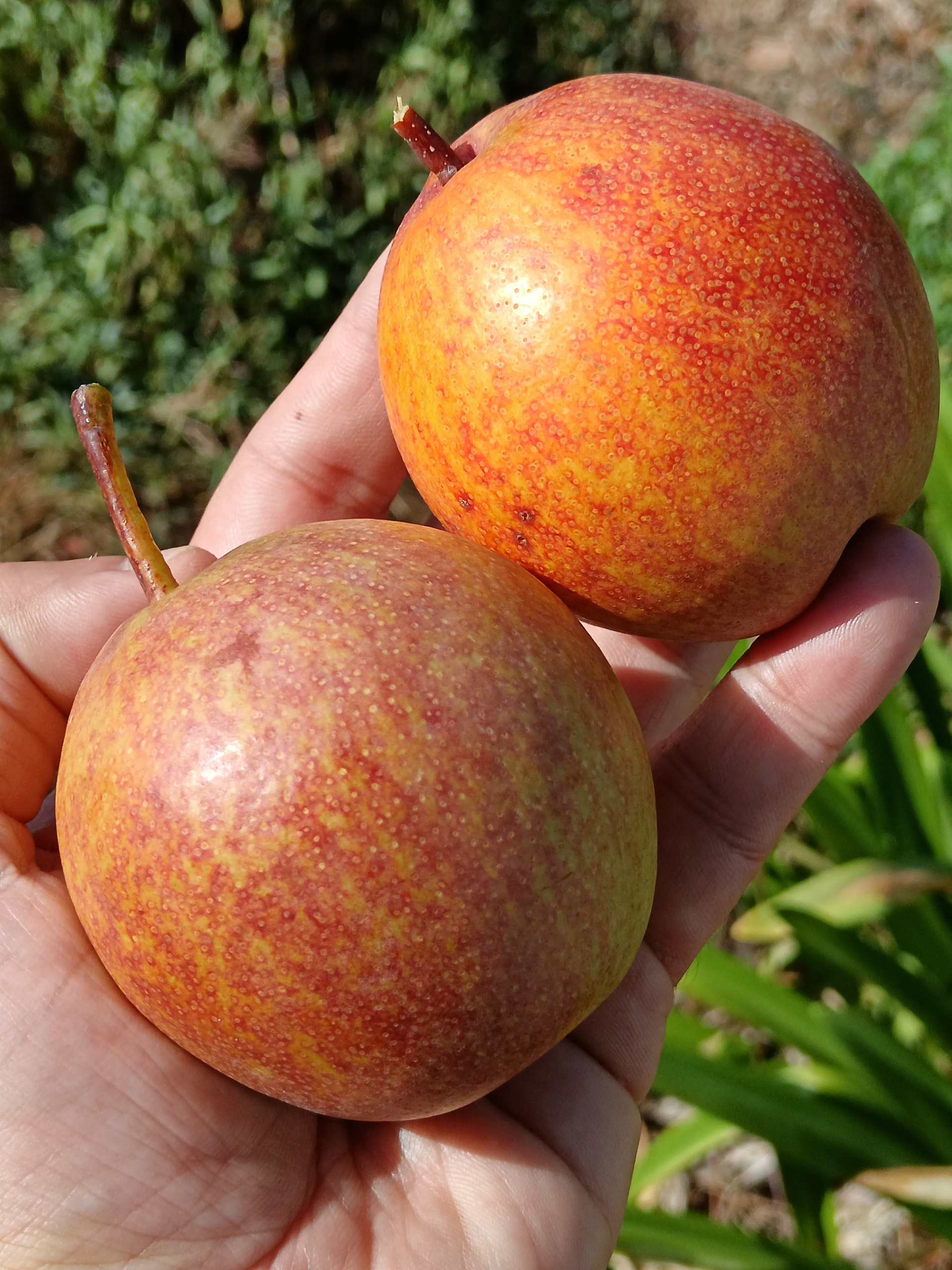
Orcas pear. I picked the 6 biggest and will leave the rest on the tree a couple more weeks unless they come off easily when lifted.
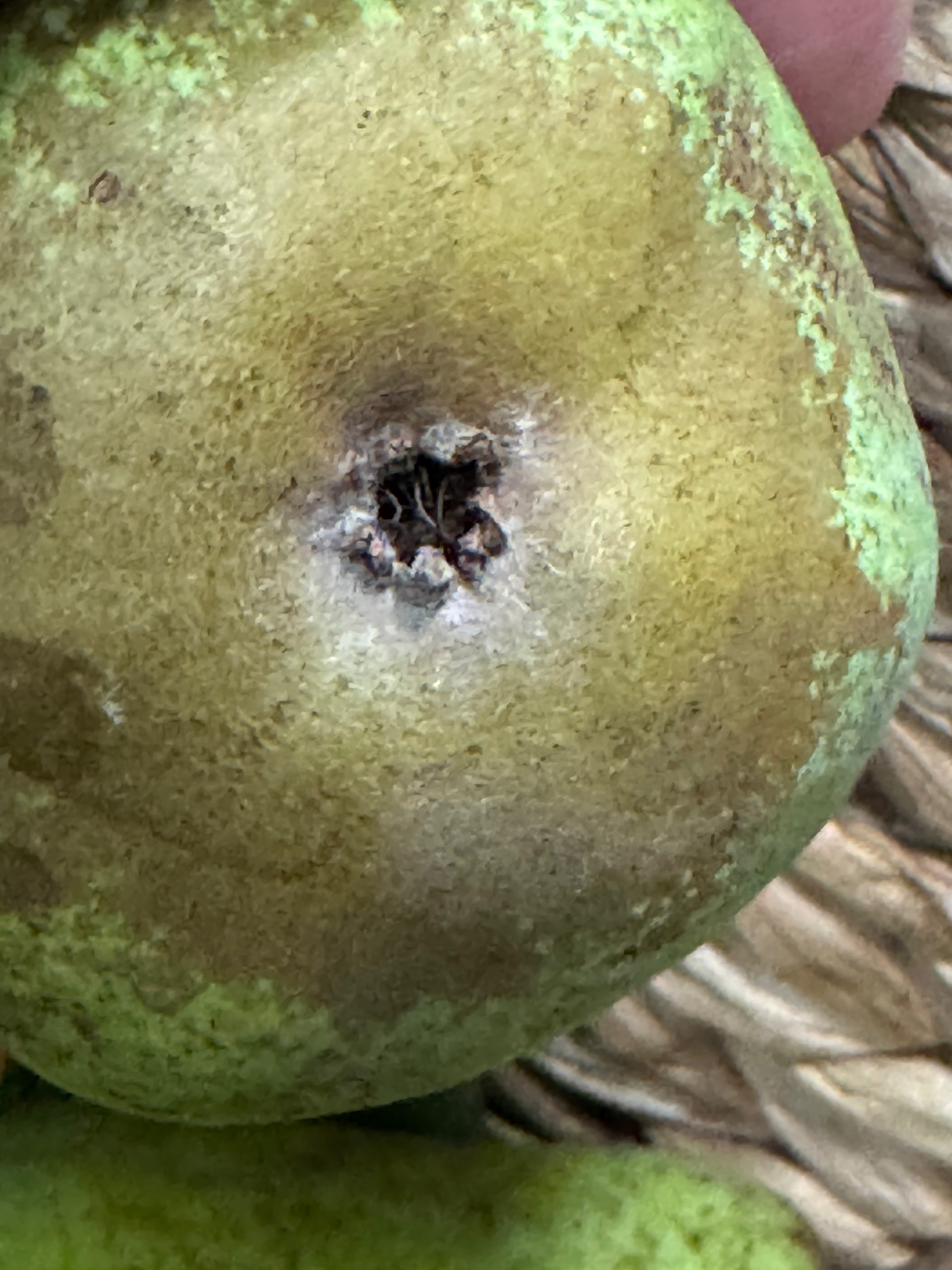
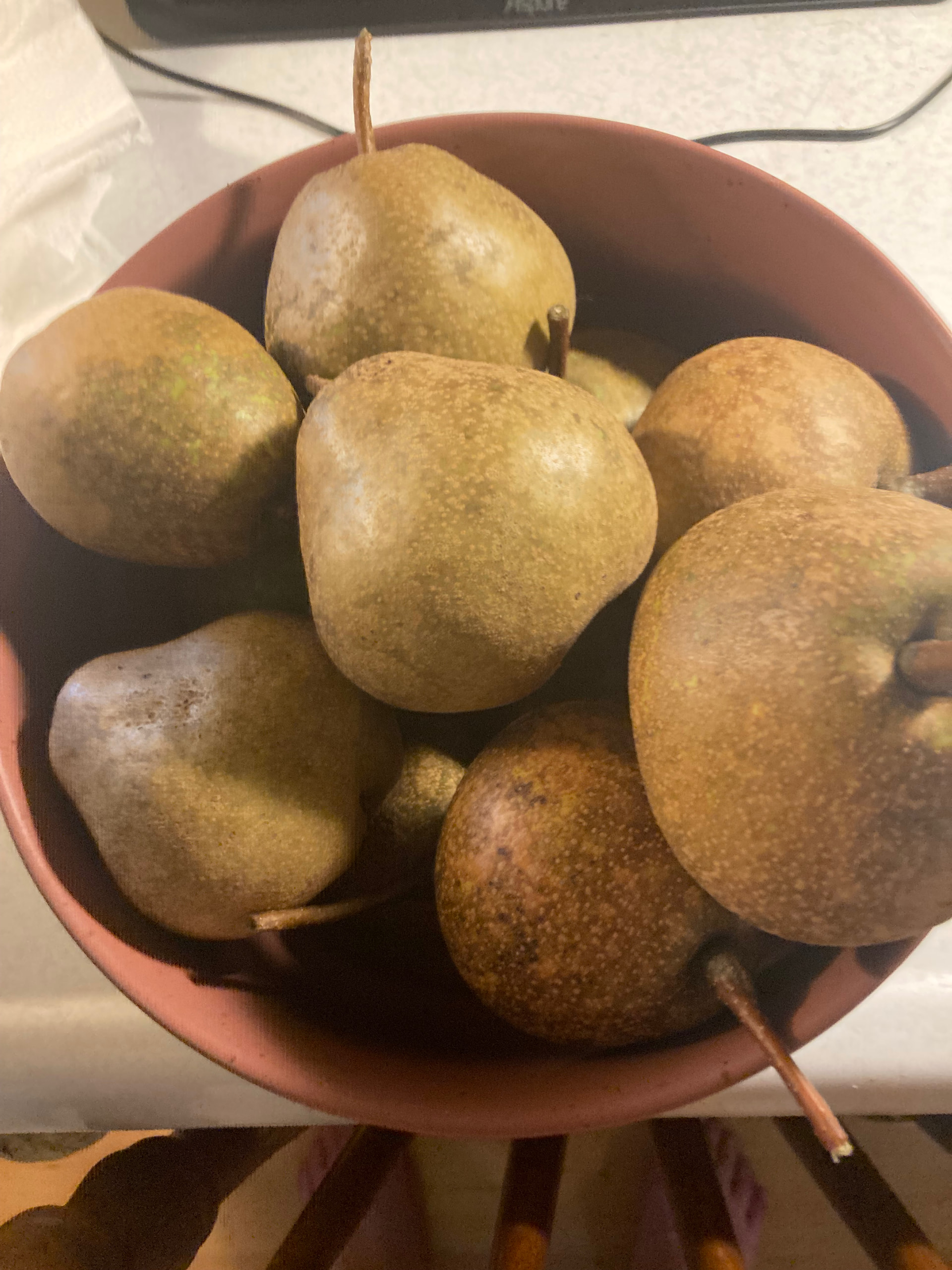
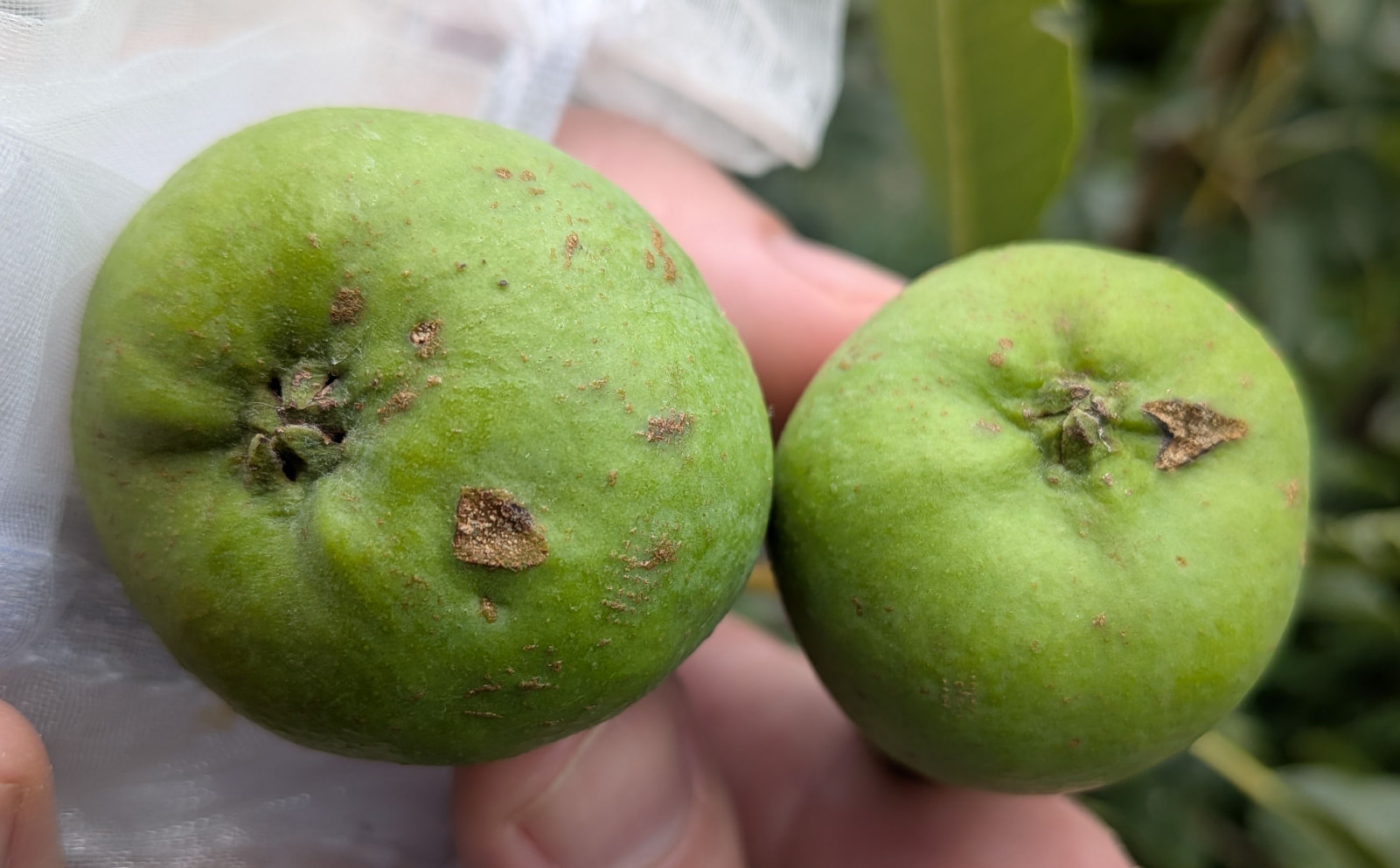
Below, some kind of heirloom with heavy russet on the blossom and stem ends, green to yellow in the center. My land was part of a century farm. The central part of my hose was the laborers’ housing.
This pear was already fully grown and producing when two prior residents (who visited) lived here as children. They are now in their 80’s.
I really doubt this is anything fancy. I also did somw work for an elderly lady a who used to walk with the residents to school and sneaked a peak at their orchard. She still had a couple very old pear trees. It was the wrong time of year for me to see if the fruit looked like mine. She’s dead now and her beautiful house has been vacant for a couple years. I have been tempted to sneak onto the property but I am not that brave.
I usually pick these around Sept 7 and a lot of them are overripe so this year I am picking the bigger ones early.i did notice a lot of these have a very shallow depression at the calyx, and the calyx is closed.
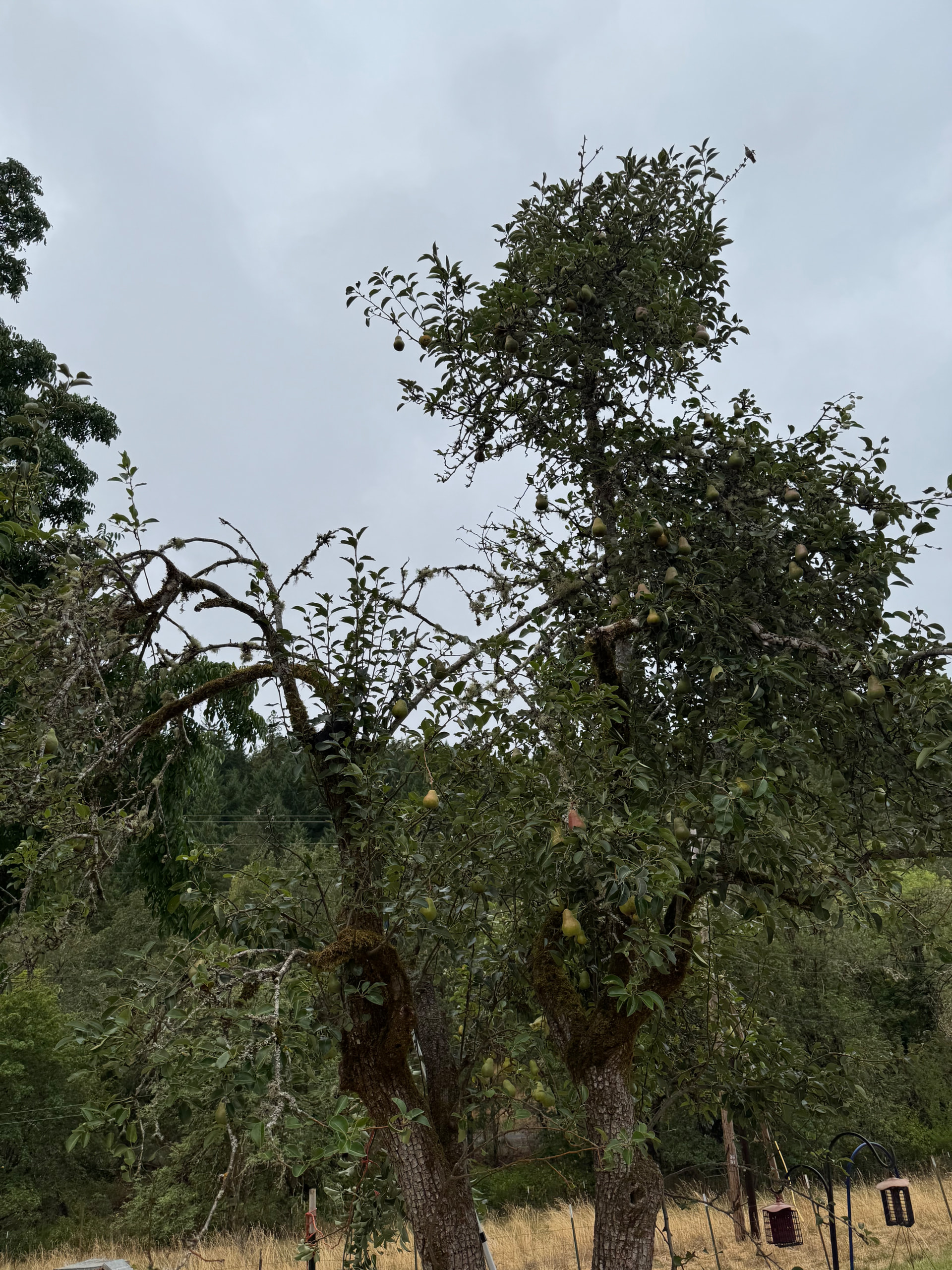
Here’s the top of the tree. Deer and turkeys have been breaking branches, but many branches also have a lot of lichen and moss, so they were ready to go
DH is very sweet but I don’t know if it is the sweetest. What sets it apart from others is the honey like taste. In central Alabama it starts to ripen in late July.
I’m more inclined to think it’s probably Nye Bartlett, which is a sport of Bartlett sold by SA Nye not too far south of me. I haven’t found any other russeted small to medium pears that would have been sold in this region 100 years ago.
Sometimes I am lucky and can find a copy of an old fruit nursery catalog buried online, like I did for Hudson’s nursery in Tangent, which is far enough north so I don’t believe anyone living here would have a reason to market there. Some big nurseries also paid salespeople to take small trees around and sell them in person, but a modern 3 hour drive might have been too far for that.
I haven’t found a catalog yet for a big southern nursery from that time yet. I have some other trees I want to id also. I do know there are 100 + year old California black walnuts and some kind of black walnut hybrid here, which also leads me to looking south. The Rouge River is the uppermost natural habitat for self-planted Northern California black walnuts.
Anyway, I would doubt I have a very old French tree on my property unless it were really common, like Comice.
I am going to buy some pear rootstock and graft this next year in case it doesn’t respond well to pruning. I should have done that with two apples I ended up cutting down years ago but it didn’t occur to me then.
My Potomac and Orcas trees have been plagued by disease, but this tree is healthy, with clean fruit.
My great grandfather Noah S. Jones was one of those people who traveled around selling fruit trees back in the 1920’s and 1930’s. He and a friend would load up their wagons with trees and drive through the southeast U.S. My dad has a picture of the two of them with horses hitched up about to leave on a trip.
Larisa, that doesn’t look like my Nye Russet Bartlett. Go to these photos from my Pear Harvest 2025 thread. Unfortunately, this year’s fireblight epidemic has resulted in most of the tree being removed. The remaining part of the tree is recovering well with no late strikes. I’m keeping my fingers crossed, as I’m having a few late strikes on other varieties.
Here is the link to the post with the photos:
You’re right… yours have russet all over, like a smaller golden russet pear. Mine are almost exclusively russeted at the stem and calix end. I looked at both 2025 and 2026 pear threads looking for this tree, but I guess I forgot between looking on the computer and picking the fruit.
@mayhaw9999@clarkinks Do either of you have an old pear that russets in this manner? I’ve seen Concorde russet like that, but it has the wrong shape. It does seem Bartlett like to me in that it is green until it’s fully ripe (usually overripe, and mushy inside) when it becomes yellow. It has minimal grit.
It was planted next to something that looked like a bosc pear, but the fruit were very small and hard and the entire tree looked sickly, so I cut it down a long time ago in hopes of saving this tree. Both pears and a crabapple that was also in decline were within 30 feet of an enormous walnut, so I would really like to save the remaining pear. The only problem it seems to have (other than being old) despite no spraying is that it attracts coddling moth, turkeys, and deer.
I hadn’t considered that as a possibility. We didn’t have much frost this year, though.
It looks like Raintree’s Onward pear, but I don’t think it’s at all likely. Onward European Pear - Raintree Nursery
It could be a seedling. I’ve had troubles identifying almost everything on this property, despite doggedly trying, so it’s possible nearly everything that came with the house was planted from seed by the original owners or the farmhands that lived in my house (the owners lived way up the hill), and they kept what actually tasted good… two pears, two apples, two walnuts, and a large striped crabapple. I have only been able to identify one walnut. All the rest is a mystery.
Yes. All my Orient look similar to yours. They have tough skin and they are hard to peel. They will never be a smooth flesh fruit. At the right stage they can get pretty sweet tasting.
Some years my pears are sweeter than other years which could be the tree age or timing the best date to pick them. This is a super sweet year for the Korean Giant and I feel a little guilty eating a fruit that tastes as sweet as ice cream. I’m up early and I’m going to take a few for my 5:30 am Pickleball friends to sample. Low temp at 5am is 78F and 88F at 8am. It’s hot and humid this time of the year in Central Alabama.