Big Dan: Dates to 1975, listed as a native from Monroe county, Holly Grove, Arkansas from D. Welchel. It is a large oval nut with good production but, as with many large nuts, can have problems with nut quality. 151, 477, 486 Hortsci 13:522-532; Pecan South 7(1):38-41; Pecan Quarterly 18(1):20-28; USDA, ARS, Pecan field station log book.
Hilton: G. E. Kenknight research notes and comments, this one seems to be a grower selection from central Mississippi. 57 nuts per pound with 53% kernel, scabs some, early nut maturity, good nut quality. I have not found any further details.
Edit: added the nuts per pound and percent kernel for Hilton
1 Like
From NW California
I have extra scion of Lucas, Hirschi, Osage, Kanza, Pawnee, Gibson, Snaps, Warren 346 and Carlson3
PM me if interested.
1 Like
I collected about 20 varieties of pecan scionwood from Auburn yesterday. Today I shipped a large box of Oswego to Nolin River Nursery. John should have plenty of trees to sell this time next year.
Today I will collect Adams #5 from the tree in my front yard. I know BambooMan wants Adams #5. Does anyone else want a pecan I might have?
Adams #5
Amling
Apalachee
Barton
Cherryle
Gafford
Hickory Major
Kanza
Kiowa
McMillan
Miss L
Moreland
Oconee
Oswego
Posey
Zinner
Thanks Darrel, PM sent. You are too kind.
1 Like
Hey Fusion, what size box are you using to ship the various scion wood you collected? Sorry for not asking sooner, but how much is the shipping cost? Are you using USPS medium flat rate box for $13.65?
yes, it is going in a flat rate box. I’m packing the rest of the walnut tonight. Expect the package to ship Monday with probable delivery Wednesday.
David, I had to go to the large flat rate box which is 6" X 12" X 12". The price of shipping is $18.90. I will ship tomorrow since the weather is not going to get any cooler. Please be prepared to receive it.
For the others who requested Pounds #2 and S127, I will be cutting the scionwood this weekend. I will ship yours sometime early next week.
Thanks Darrel, payment sent. I’m very excited. My girlfriend will be checking the mail for the shipping address I used for PayPal. I will be at the farm until Sunday.
I just noticed this, Elliot rootstock
Spring is definitely here, I’m just hoping for no March frosts.
3 Likes
Hey @Fusion_power I sent those Elliot scions by USPS priority yesterday. The two shorter sticks have excellent buds on them. The longer stick not so much. I will hopefully have even more next year to share. Also, I enclosed a couple of gifts for everything you provided me.
1 Like
Several hickory trees have broken buds. It is time to prepare grafting wax. I have about 50 pecan trees to graft over the next 3 months.
I’ve used grafting wax made from beeswax since I started grafting. I have a cake of about 10 pounds ready to melt. I mix it with shea butter and a couple of other soft waxes to get a soft consistency wax that does not melt in the sun.
2 Likes
I’m probably a little ahead of others on this forum in terms of grafting pecan; although, I do not have a greenhouse, which would really speed things up for me. It’s a little early to claim victory, but things are looking good. Here are some of Fusion’s “donations.”
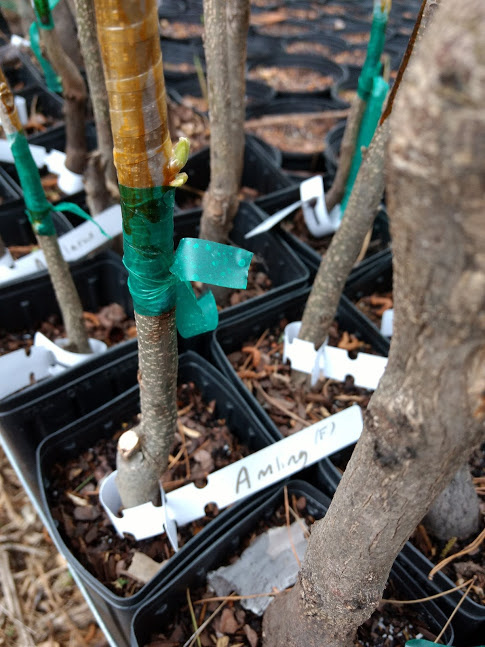

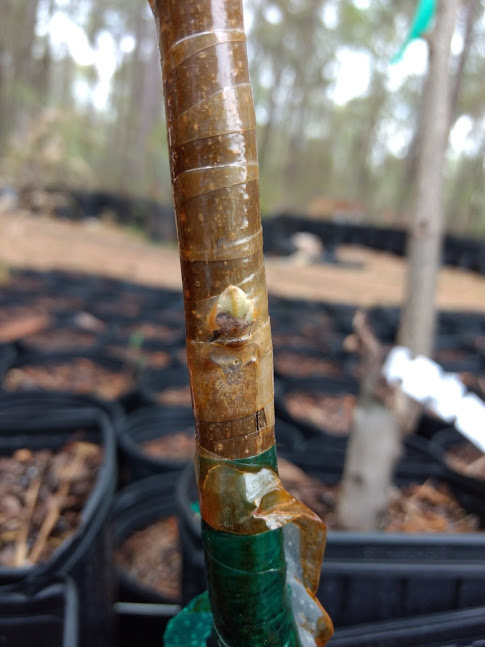
The last one is Gafford.
I will probably hit them with a time release fertilizer, the brand name escapes me at the moment.
1 Like
On a completely unrelated note, Moso is looking mean and green.
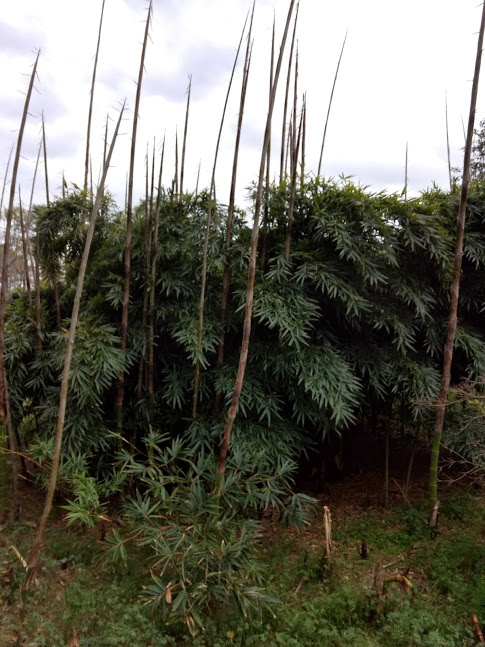
You can see the “late” frost’s effects on the lower part of the photo. I feel it was more of an early Spring. The entire month of Feb. was hot!
1 Like
Most of us use osmocote. I enjoy seeing the green buds pop a few weeks after grafting.
1 Like
I noticed Bill Reid updated his Pecan cultivar list. He showing the Hark as ripening about 7 days after Pawnee near the same time as Kanza. Does anyone else have date from other places on Hark ripening compared to Pawnee and Kanza?
Thank you.
I have data from 2 observations made by growers. Both stated it matures within a day or so of Kanza. I cross-checked in my spreadsheet which shows Kanza matures 7 days after Pawnee.
Bill Reid recommends Kansas and western Missouri growers plant Kanza, Hark, Oswego, and Pawnee as regionally adapted varieties with a caveat that parts of northern Kansas may be marginal.
2 Likes
Fred Blankenship theorizes that pecans adapt.
Everyone (us) knows Hark started its cycle of life way up here in Mercer County IL. And dropped buckets of nuts. One could further speculate its’ seed came from Major and that it did adapt to my climate.
I visited one of Gary Fernald’s Kanza trees a few days ago and it’s hardy and getting some size to it. We’re going to see what happens this year but it’s starting to produce nuts as of the last two years. Not a lot, but they’re completely filled just smaller than when grown in more southern places like MO. or KS. We had -17 twice this winter.
Fred sent a pecan named ‘Hall’ to me (probably you too Darrel I assume) that is from the deep south. He grafted it 14-years ago in KY and it began producing in year 14. It’s now adapted to KY. Fred has full faith it’s going to adapt here.
Dax
@wildernesssoul
Barkslip, Pecans can adapt but only to a limited extent. The timing of spring bud break is not readily adaptable as it is linked to number of chilling hours during winter. Fruit maturity date is genetically determined and will cause problems if it is too late. In very general terms, pecans adapted to northern conditions should be grown in northern conditions and most large fruited southern pecans should be grown in the south. Stuart is a rare exception that originated in the deep south but has been grown and found productive much further north than Biloxi MS. Stuart would never mature in your climate. The problem is not with ability to survive cold weather, it is the late maturity in mid-October that limits Stuart.
Hall originated as one of 3 trees set out about 1930 at Hall Crossroads near Monroeville AL, two trees died, the remaining tree produced the Hall pecan. Nuts run 60 per pound with 49% kernel and a high percentage of tri-lobe nuts produced. The sample I have runs about 1 in 14 tri-lobe. The tri-lobe nuts are often poorly filled. With good care, percent kernel would probably impove slightly. The kernel is fairly tighly bound into the shell but can be separated. The nut has acute apex with rounded base and is very close to being round in cross-section. Reported to have very good scab resistance. It is not known for sure if this is a seedling or was a grafted tree. I verified a list of varieties that most closely matched the characteristics and was unable to find a match. This pecan has 3 weaknesses; size is a tad small, shell is a bit thick resulting in low %kernel, and the kernel is bound a bit tight into the shell. Nuts provided by Mike Cartwright (Evergreen, AL Dentist and nut enthusiast) I generally agree that Hall is a pretty good pecan that may be capable of growing significantly further north than most southern pecans as shown by Fred growing it in KY. Whether or not it can grow and produce in your climate is yet to be determined.
Hall was kept going by a man - now in his 90’s - who got it grafted onto some rootstocks at his home in south AL. The original tree was 1 of 3 planted back in the 1930’s in a small community known as Hall Crossroads. It is not known if the original tree was grafted or a seedling. I tried to ID based on the nuts, but can only state that it is not one of the commonly distributed older varieties. As a variety, Hall would not get a second look from commercial growers here in Alabama. Small size, low percent kernel, and difficulty cracking make it a non-starter. From a home grower perspective, it has quite a bit of potential. When compared with most of the pecan varieties that can be grown in KY, Hall is very interesting. If you want to look back to Jan 12th, I posted about Hall in this thread.
Thank you! I’m out west in NW California with 25 plus Northern cultivars. Will see how this different climate affects pollination and maturity. We know that pollination out here is significantly different. Linwood Nursery
