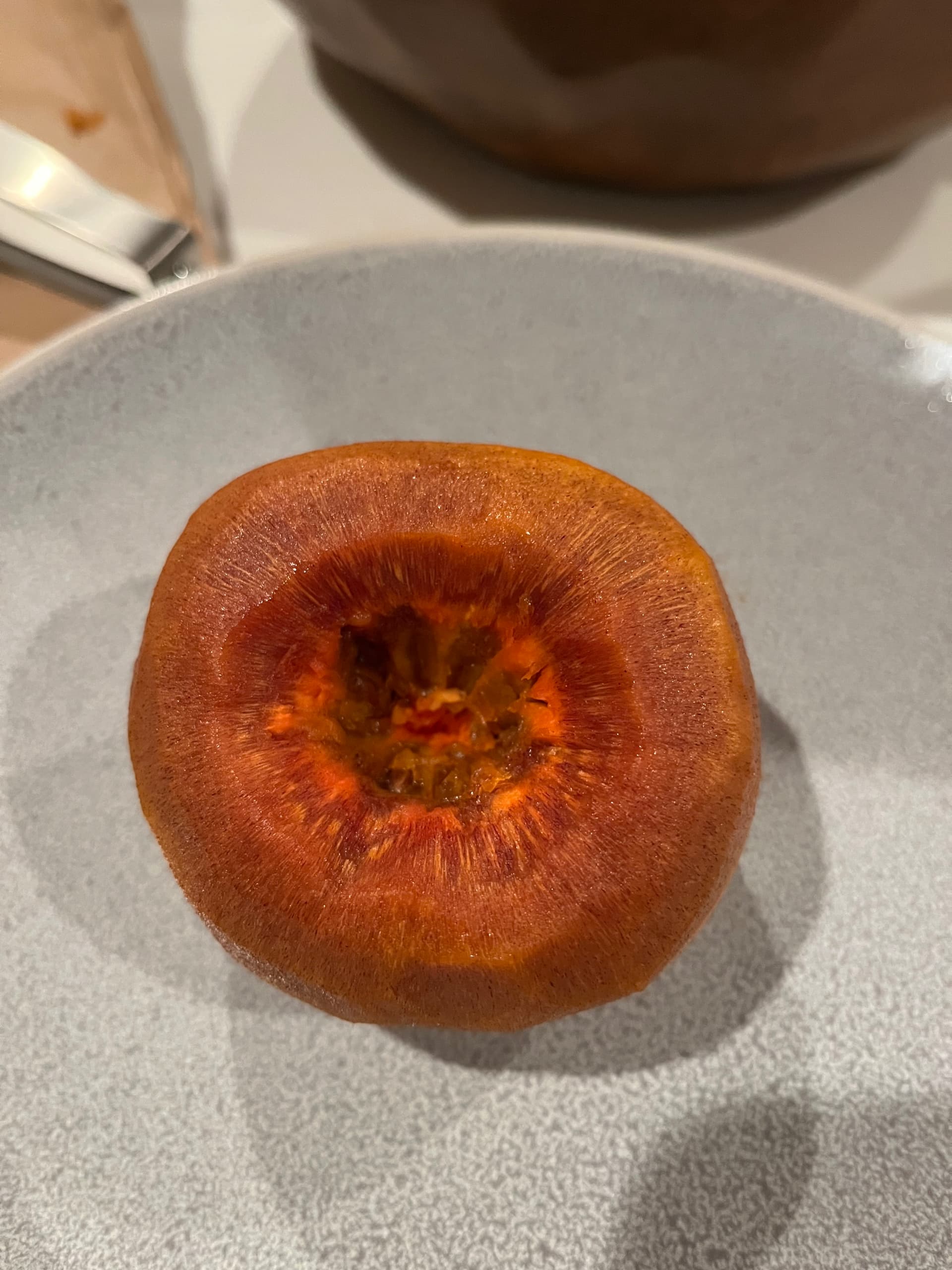
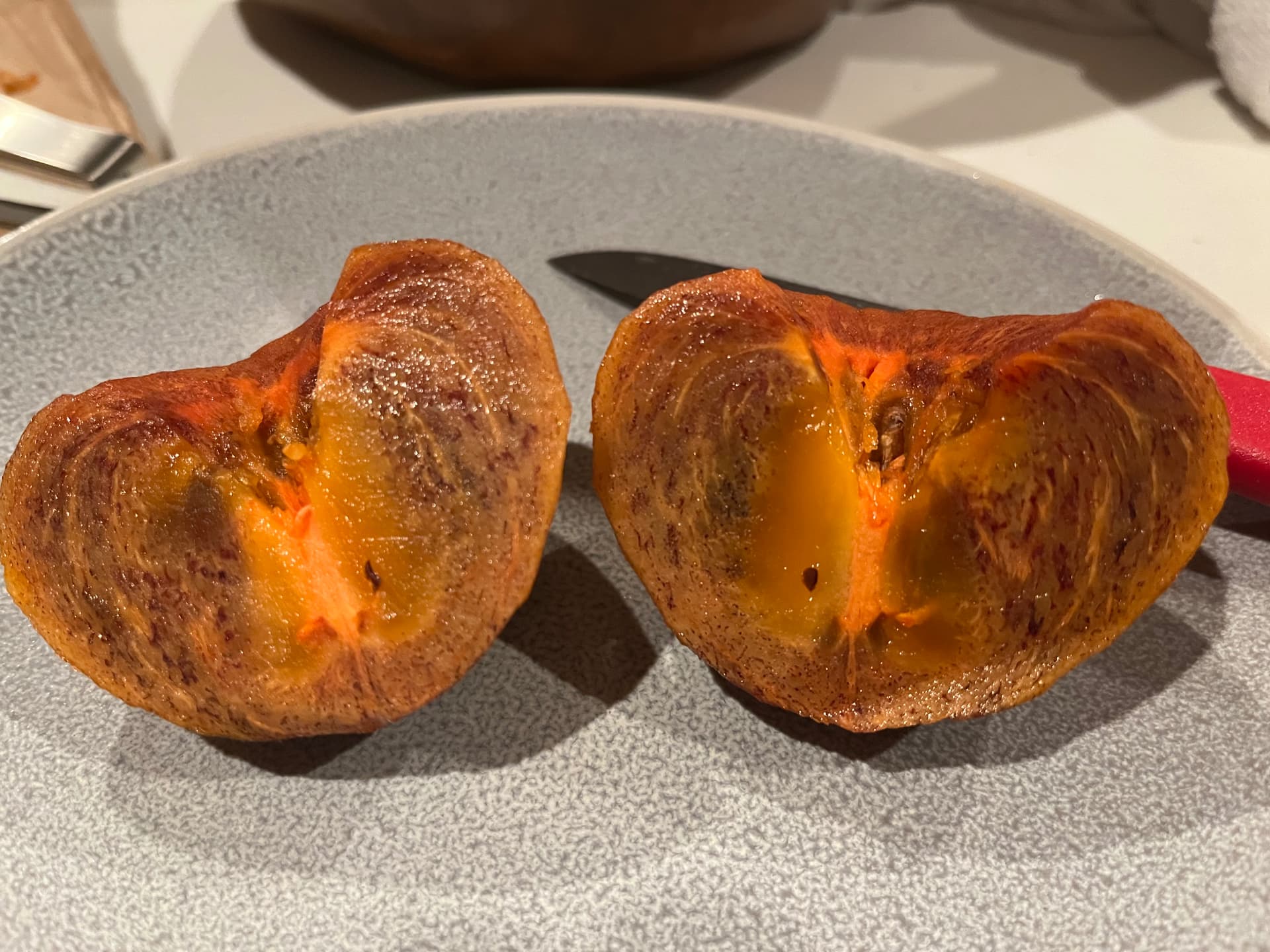
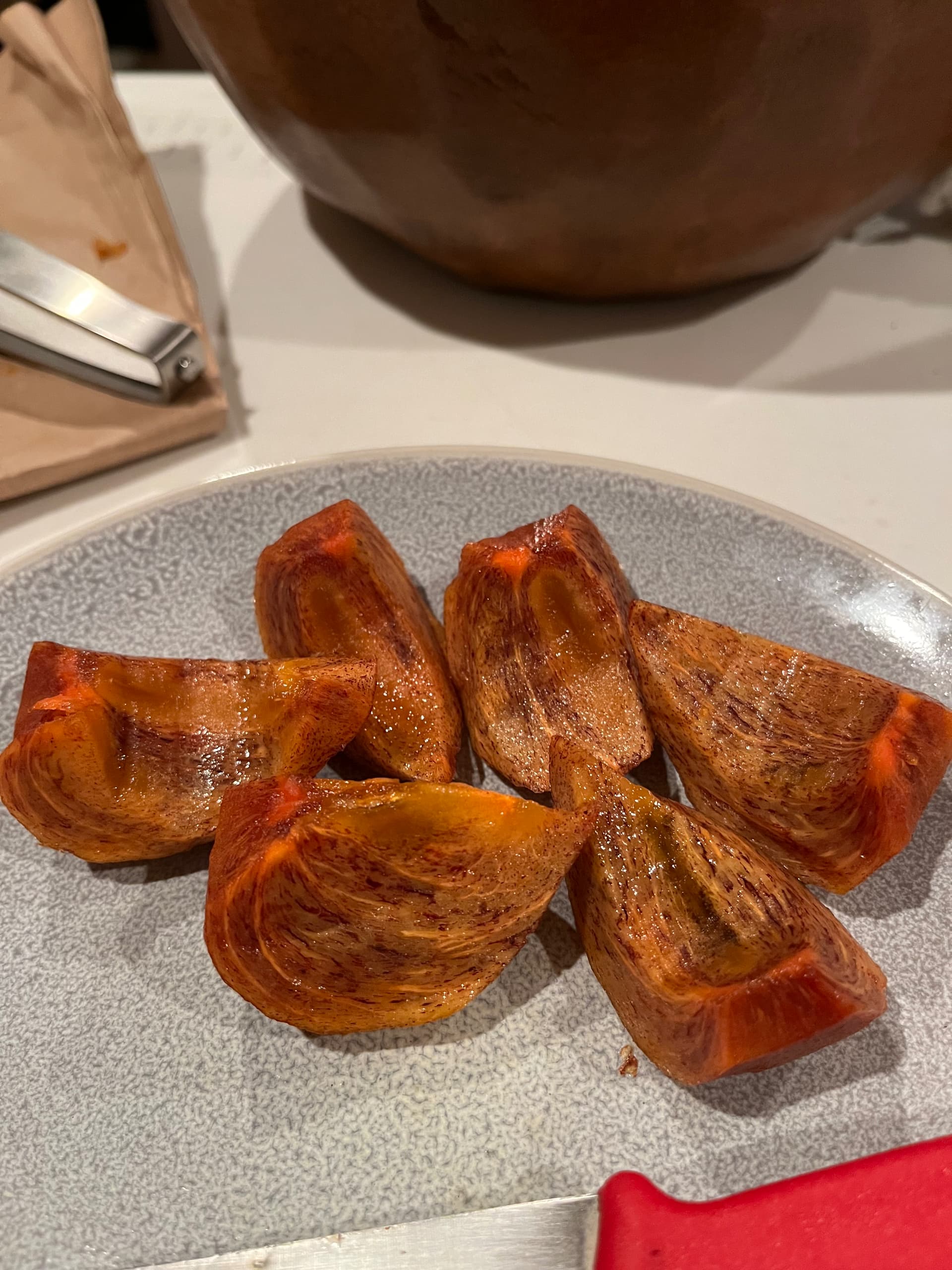
@a_Vivaldi … my wife just happened to have a eye doc appointment in Columbia… and i was using a vacation day… to just spend the day with her… we also got some Christmas shopping done and ate at a nice restaurant… which happened to be near Food Lion.
Which of course reminded me of persimmons…and yes they had them. The sign over the box said new fruit type.
The little sticker on the fruit said fuyu… product of usa. They were still quite firm. I have them sitting on the counter under a glass bowl. We will try then soon… next day or two.
I have a company retirement dinner to go to this eve. Last day of work coming up fast 12/29.
My wife and I tried out one of those Fuyu/Jiro presimmons for desert tonight.
We both liked it…
Nothing like a wild american on flavor but it had a mild flavor similar to a nice ripe cantaloupe but a little stronger and sweeter than a cantaloupe. The texture was much like a nice ripe cantaloupe too.
The second one is in the dehydrator now… we will try some of it tomorrow.
You can also let them hang out on the counter. They will turn to the consistency of an astringent and get sweeter and more flavorful as well. I’m not a big fan of them, but I think they taste better at that ripeness. I think they are better dehydrated as well.
We left these on the counter … i think 3 days… under a glass bowl. They seemed quite firm when we bought them but when i pealed and sliced one last night… it was not crisp… was semi firm but also soft and juicy very much like a perfectly ripe cantaloupe.
No seeds… no astringency, large meaty slices of persimmon… good flavor, nice sweetness level.
My wife, daughter and son are going to be fans of my IKKJiro for sure. If it taate as good as this store bought fuyu/jiro did. I think the average person at our farmers market will be fans of them too.
This will have me thinking more about possibly adding coffeecake, cocolate, cardinal.
I’m still in an experimental phase too. I added those three last year, among others.
I’ve only picked one crop from my better American varieties – H63A, Barbra’s Blush, and Dollywood – so it’s too soon for a definitive judgment (unless you just can’t tolerate a gooey texture). No doubt the Americans have a stronger flavor than PCNA Asians but I’m not sure the flavor is better.
Re PCNAs: When I let my PCNA Asian fruits from IKKJ fully ripen, they were very good; and when I partially dehydrated them, they was outstanding. NB: That’s fully ripened before dehydrating; I did not dehydrate semi-ripe IKKJs.
Re PCAs: My single PCA Asian fruit this year from a young Saiyo tree was excellent, as were the dozens of PCA hybrid fruits from Kasandra.
So far, I prefer Saiyo, Kasandra, and fully ripe IKKJ (especially if dehydrated) to the Americans. In any case, nobody should assume that Asians and hybrids aren’t worth trying.
It’s crazy how different palates are. I haven’t sampled nearly enough variety yet, but I much prefer the flavor of American persimmon to any kaki I’ve tasted so far. Nishimura Wase has been my favorite kaki, and its flavors were very mild in comparison to most American varieties.
The texture of PCNA and that Nishimura Wase PVNA, however, is much preferable to me over than all American varieties I’ve had.
“Cantaloupe” was my thought when I tried one for the first time in years recently as well. If you see any Hachiya locally I think I actually prefer those having only had one for the first time ever a week or two ago. The Hachiya I had was like a brown sugar jam with cookie spices. My only experience with American persimmons was with tiny fruit from what I assume were random seedlings I found at a nearby park. I liked the overall flavor.
Some Asian persimmons need to be pollinated to lose astringency early and to attain that rich flavor. Coffeecake and Chocolate are examples of this PVNA type. If you buy Coffeecake, you should buy Chocolate as a pollinator. The downside is that you will probably end up with seeds in your other Asians and Hybrids.
Cardinal is a PCNA type like Jiro. It should never develop much astringency and it doesn’t need seeds.
“Rich” is a strong word for the coffeecake I had. It had more flavor than any PCNA I’ve had so far, but still mild and sweet. It looks richer than it taste to me for sure. Delicious, but not rich.
Hmmmm… it was nice not to have seeds in that fuyu/jiro.
I would prefer not to have seeds in my IKKJiro when it does start producing. I think that is going to be appealing to my wife, daughter and and anyone at the farmers market that might want to buy some.
I read OGW description of Cardinal again…
the earliest ripening Asian Persimmon we have seen. Ready to eat 2-3 weeks before other varieties, it is large, sweet and great for fresh eating.
It seems that … ripening earlier might be the main difference in Cardinal and IKKJ.
Expect they are both going to be large, sweet, great for fresh eating.
Any major differences known about the flavor ?
it’s tough to tell. OGW says that “Cardinal” is the same as the Korean variety “Jo Choo.” Sadly, I can’t find anything about any Korean variety by that name. So we don’t know exactly what Cardinal is.
Meanwhile, until the Japanese and Koreans started their breeding programs, PCNAs were all late-ripening. After a lot of work, the Japanese produced an early-ripening variety – Izu (1970), which ripens at the Japanese breeding station in mid-October. So “the earliest ripening Asian PCNA we have seen” at OGW would have to be earlier than Izu, which we have all seen before. The ONLY PCNA persimmons that ripen that early would have come out of either the Japanese or Korean breeding programs – like Izu but released much later. FYI, the Koreans made early ripening a primary goal. I’ve asked OGW for more information about Cardinal, without result.
My favorite candidate synonym for Cardinal (Jo choo) based on phonetics is the Japanese release, Soshu (2000) – which the Japanese breeders themselves said was the earliest they had seen (early Oct there). Harbin says that Cardinal is not Soshu, and based on OGW’s picture I’d say that’s right. But maybe the picture is just a stock photo? Anyway, Soshu ripens in Japan in early Oct, slightly earlier than it’s female parent, Izu. But there are some recent Korean PCNA releases that seem equally early or perhaps even earlier.
The good news is that all of these recent, early-ripening PCNA releases from the Japanese and Korean breeding programs are reported to have excellent quality as fruit – flavor, sweetness, juiciness, firmness, and/or low cracking. So if Cardinal ends up being any of these recent releases, it should be better than IKKJ.
A final editorial comment: I REALLY wish that OGW would be more up-front about their variety names. For example, I noticed yesterday that they are now offering the variety “Phoenix.” They disclose that Phoenix is the Korean variety Dogeunjosaeng. With some research, I’ve learned that Dogeunjosaeng is the Japanese variety Tonewase. I wish they had disclosed this fact up front. I understand WHY they don’t disclose it. But it makes me not trust them at all.
I’ve mentioned this elsewhere but the renaming of varieties for marketing purposes bothers me too, and I think it snacks if impropriety. What if I were to start a car company which merely bought Toyotas but rebadged them with my own logo? I understand that theyre technically able to trademark anything and that a catchy name sells better, but its both confusing and arguably dishonest to appropriate someone else’s breeding work in that way, at least IMO
There are older Ford Rangers which are the same exact car as a Mazda, and plenty of other vehicles which are literally the same as you describe. The same thing happens to hvac units and I’m sure in other industries too.
They say some of the best artworks are almost copied from others. Copying can be perceived as a high form of flattery. I do agree most persimmons don’t need extra names. Some might not have a good one to market to the general public. I’m fine with growing a 100-46 or a Lehman’s Delight, but a row number might not sell as easily regardless of quality. It’s one of those things where apple breeders take the time to market under the flashy name and only a few breeders care what the trial name of Cosmic Crisp is. Should be the same concept for persimmon and everything else.
Your points are all well taken. If there is an obvious gap between the creator and the beneficiary though, or if the variety in question is already in circulation, then I see it as more problematic. Im sure they’re within their rights and I appreciate that they’re bringing new varieties to the fore. I just think they could be more judicious about when and how they trademark
I agree with this. I’m fine with OGW selling H-118 as Prairie Star, so long as they tell us. The descriptive notes should make it clear that “Prairie Star is AKA Early Jewel, which is AKA H-118.” But for most of their new-ish Kaki offerings, there’s either no such information or incomplete information. Contrast with apples such as Cosmic Crisp. I can find out easily not only what the trial name of Cosmic Crisp was but also what its parents and grandparents were.
This is important not least because most of us have limited time and space and would prefer not to have unintentional duplicates. For example, I don’t want to spend 5 years growing Cardinal only to discover that it is identical to the Izu right next to it.
The evolving situation with persimmons threatens to become like the market for figs, where growers clone existing varieties, slap on sexy names, tell stories about their desirable qualities, and then sell them at outrageous prices. As buyers, we should lobby for full disclosure.