I assume it needs a male. And wont have off years like many persimmons.
Perhaps NG has inherited the need for male (may be necessary for high fruit holding) from this variety.
3 Likes
@ramv … sorry… i said Nakitas Gift… but that is actually a mother of Dar Sofiyivky per Harbin.
I will correct above.
TNHunter
1 Like
I have seen this statement before with other varieties that did not appear to need pollination. I believe the statement was made about Chuchupaka that I see from growers doesn’t seem to require it. It may be that they carry a larger fruit load if pollinated. You may also get partial pollination from whatever is pollinating your other hybrids.
I don’t think there is a single fruiting age tree in the U.S., so it will be a while until we know for sure. I grafted it to an already fruiting 4 year old JT-02, so it is possible I’ll have fruit next year or the year after and will know more then. I believe @tonyOmahaz5 grafted it this year as well. @hobilus may have grafted it as well, but I’m not sure.
I think there has been less interest in this one in particular since many people looking to grow hybrids are in colder zones and want the added hardiness, but this variety probably won’t ripen for them. For those of us in marginal zones and lots of warm days hopefully it will work out.
3 Likes
'simmons for lunch. Today I had a Ruby, which is the latest ripening of my American persimmons. A little bit smaller than most American varieties, but still delicious and nice to have it after the others have all ripened. I didn’t have them side-by-side to really compare, but I think it is sort of along the lines of 100-46 in terms of a more brown sugar taste than caramel taste to me.
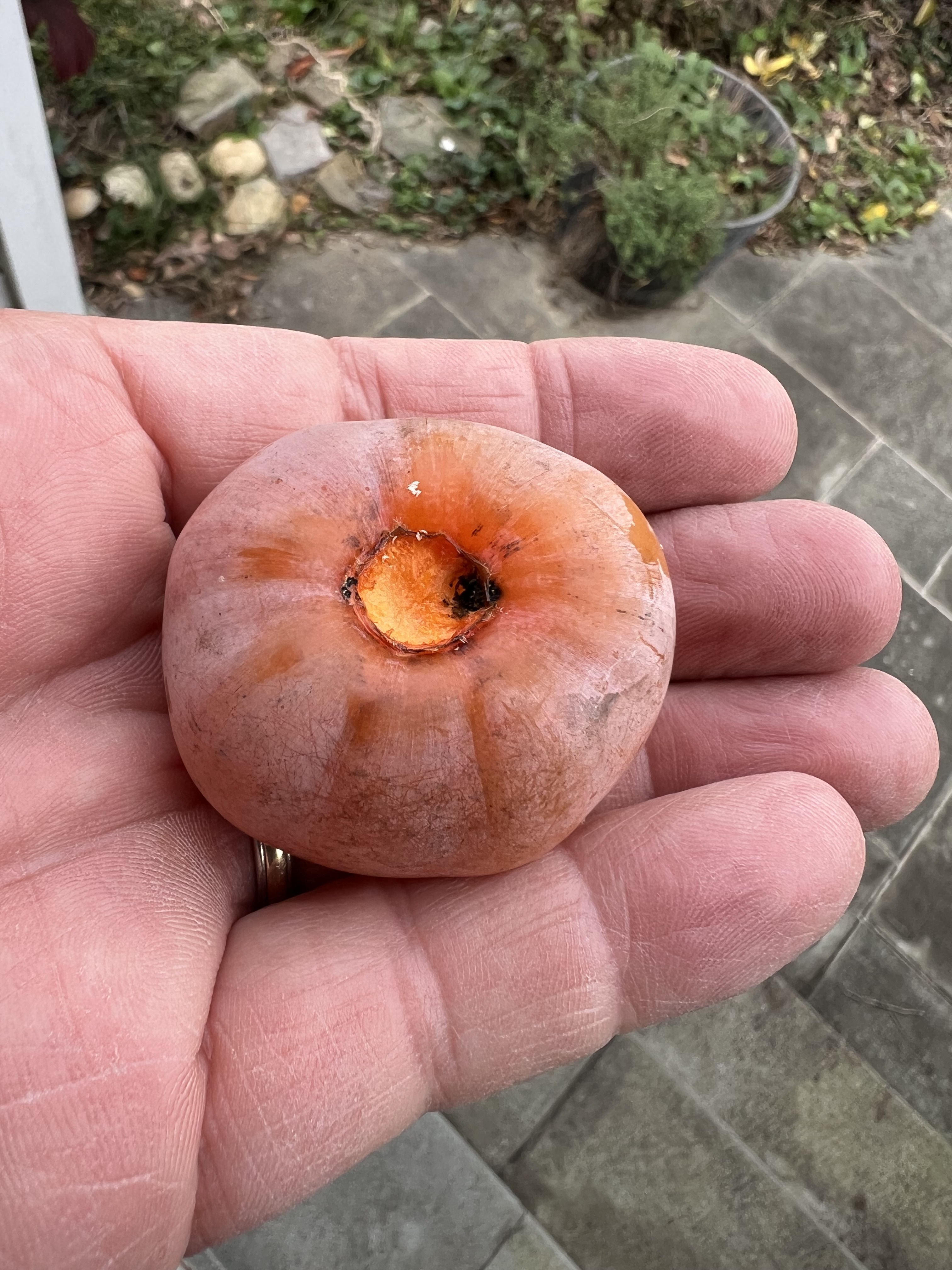
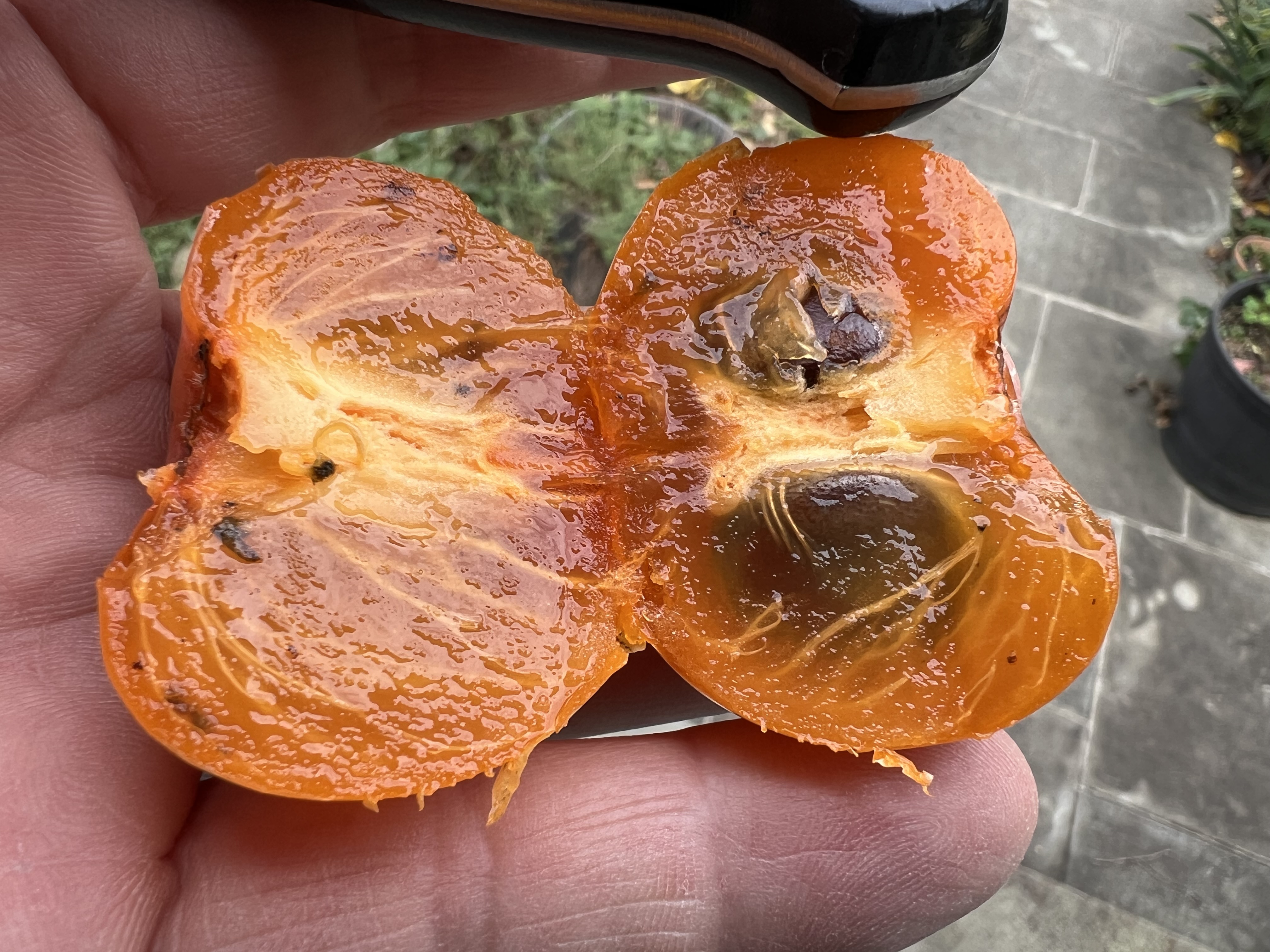
I’m also starting to enjoy my Giboshi fruit, which are fully pollinated PVNA types so I’m starting to eat them hard and crips and will keep sampling them as the continue ripening and softening. This year’s fruit is much smaller, probably because I let it way overset and didn’t thin it early. Ultimately it dropped a ton of fruit pretty late in the season, but I still got over 100. I think they would have been at least 50% bigger if all that energy had gone into 100 or so to start with.
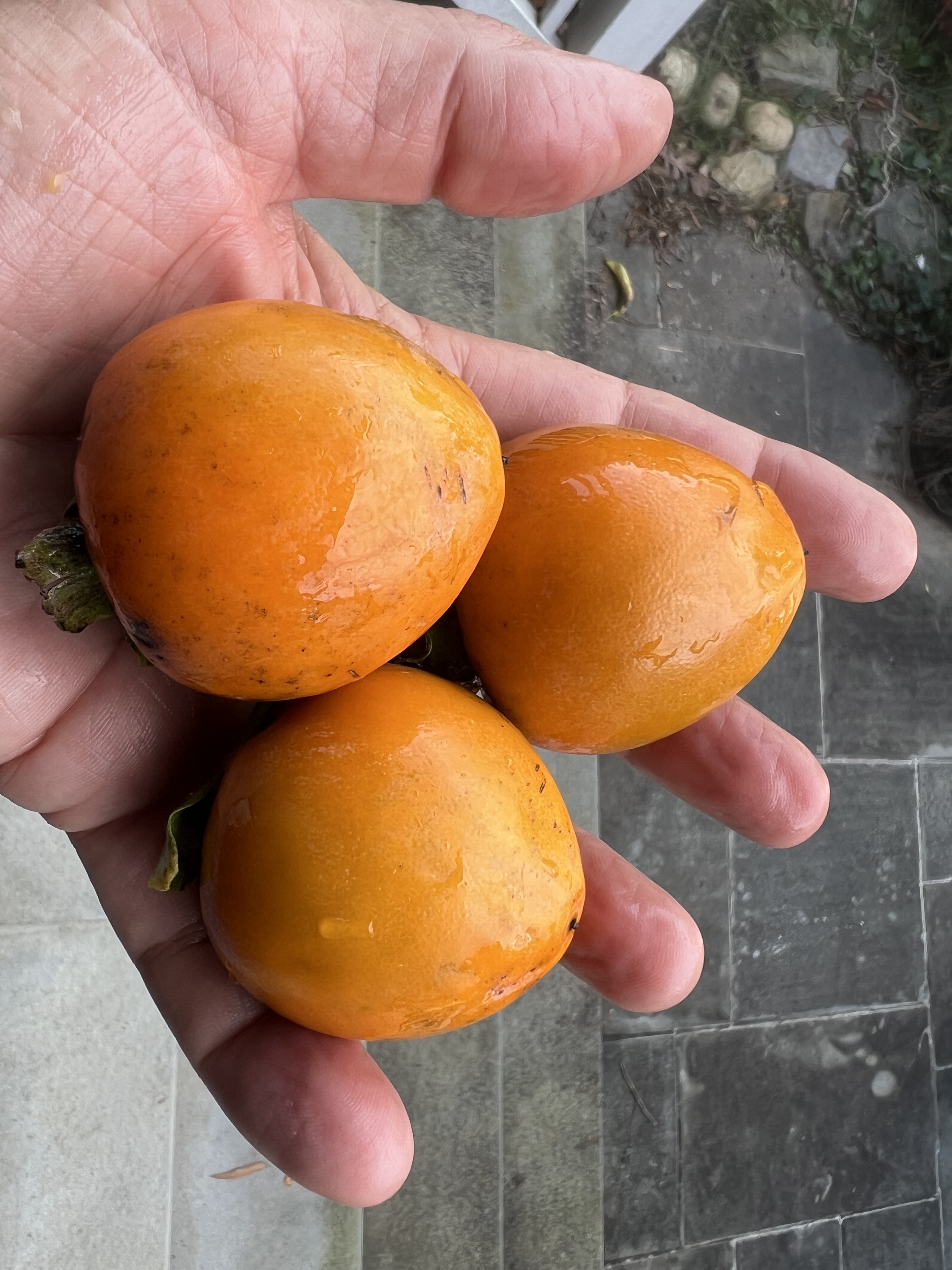
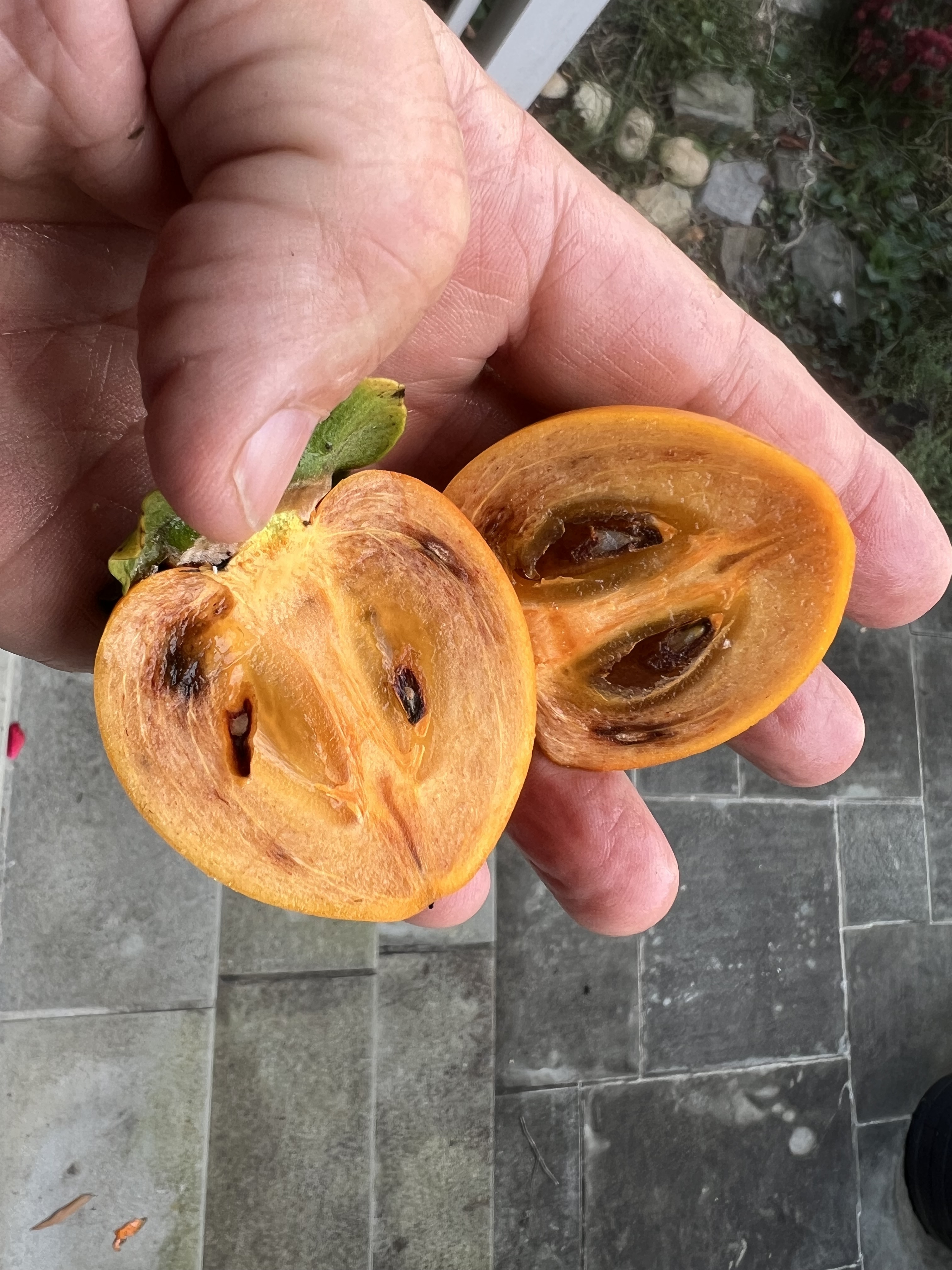
Very tasty and they just get better and better as they ripen and soften, but it is nice to just eat them at any stage and not worry about astringency.
11 Likes
Remind us of the trick to determine if Coffeecake is pollenated by its shape? I generally have no luck with searching here.
I have a Chocolate graft in my Coffeecake tree, and it had plenty of male bloom this year. But I think the first fruit I tried was orange-fleshed. It was non-astringent and as good as Hachiya when we ate it soft. It maybe had one seed that wasn’t fully developed.
1 Like
There is a pronounced bulge. I can show photos later. The base is round on pollinated fruit and flat otherwise.
Harder to tell on pointy fruit like Saijo
2 Likes
Thank you. I’ll see if I can tell if I have both bulged and non-bulged and can tell a difference. I think there may be only 5-20 fruit out there on the Coffeecake, I haven’t checked in a while.
My Saijo may have 20 or so fruit too, its not very close to the Chocolate though.
Personally I’m losing interest in non astringent persimmons. - both PVNA and PCNA. there is immense pest pressure on them and I end up having to net the tree/branches. Too much ongoing work.
5 Likes
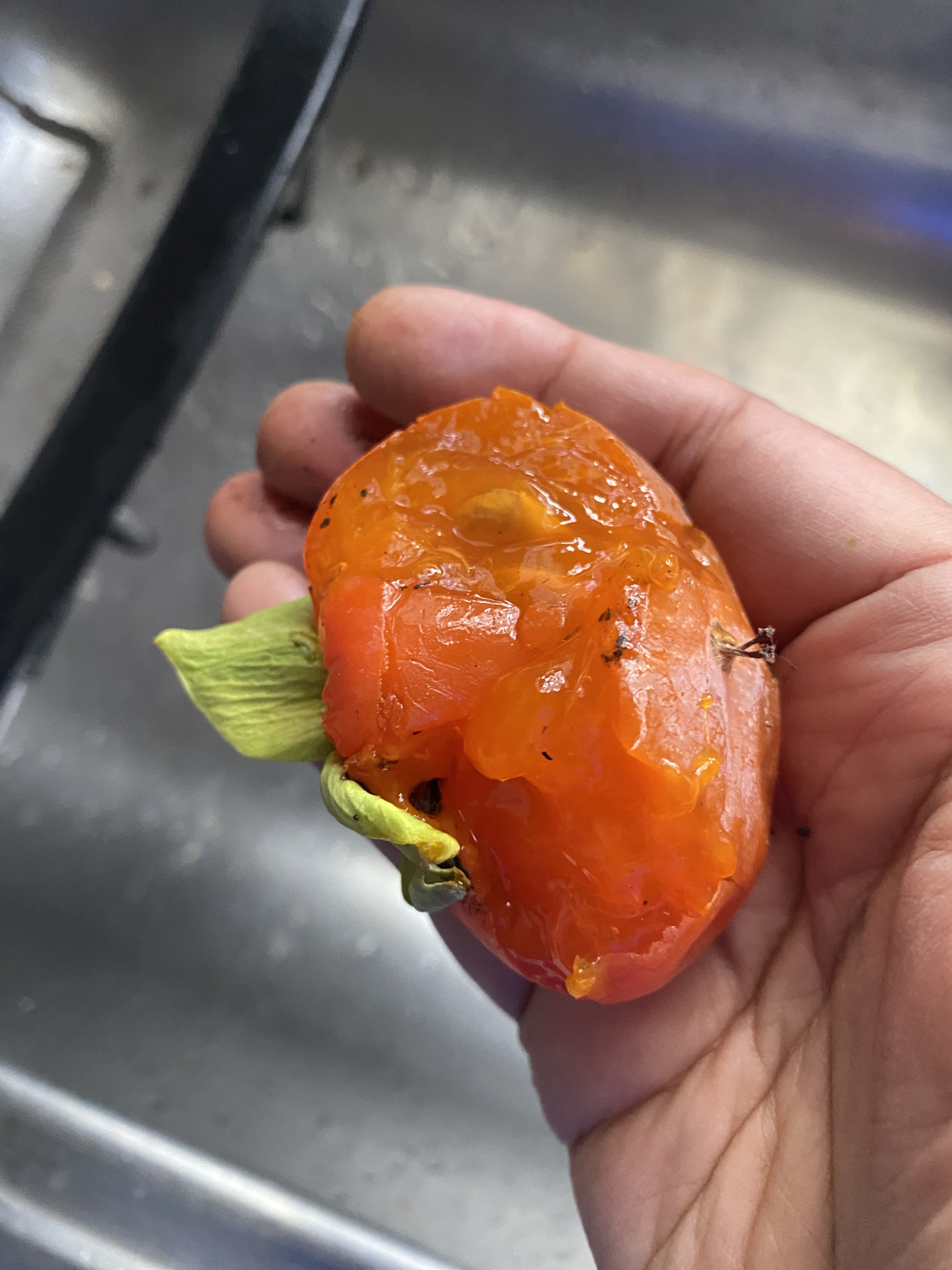
Super ripe Mikatani Gosho - bird pecked so it got very soft. Delicious!
I had to climb this large tree and net it so they ripen normally. Not safe!

5 Likes
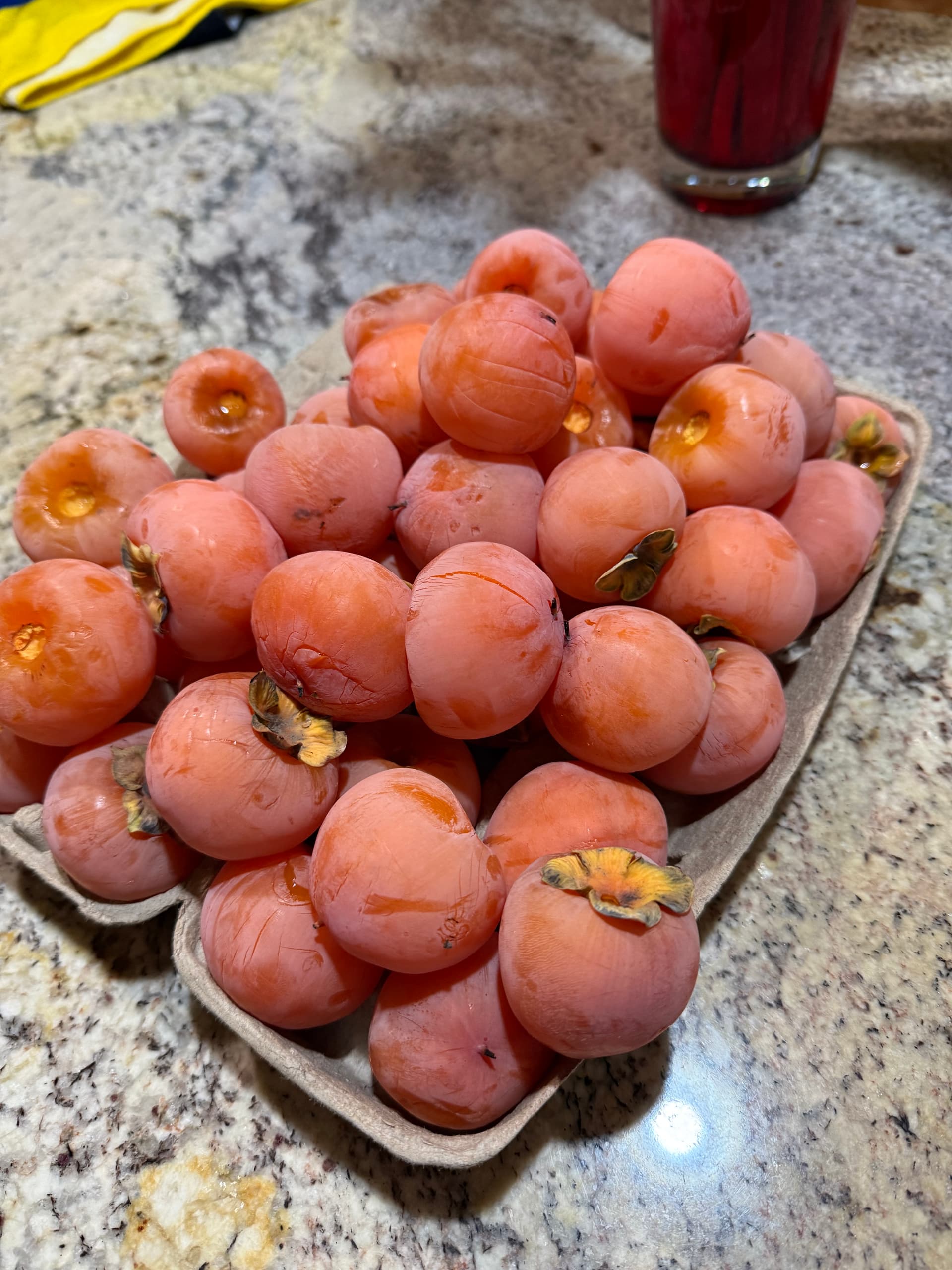
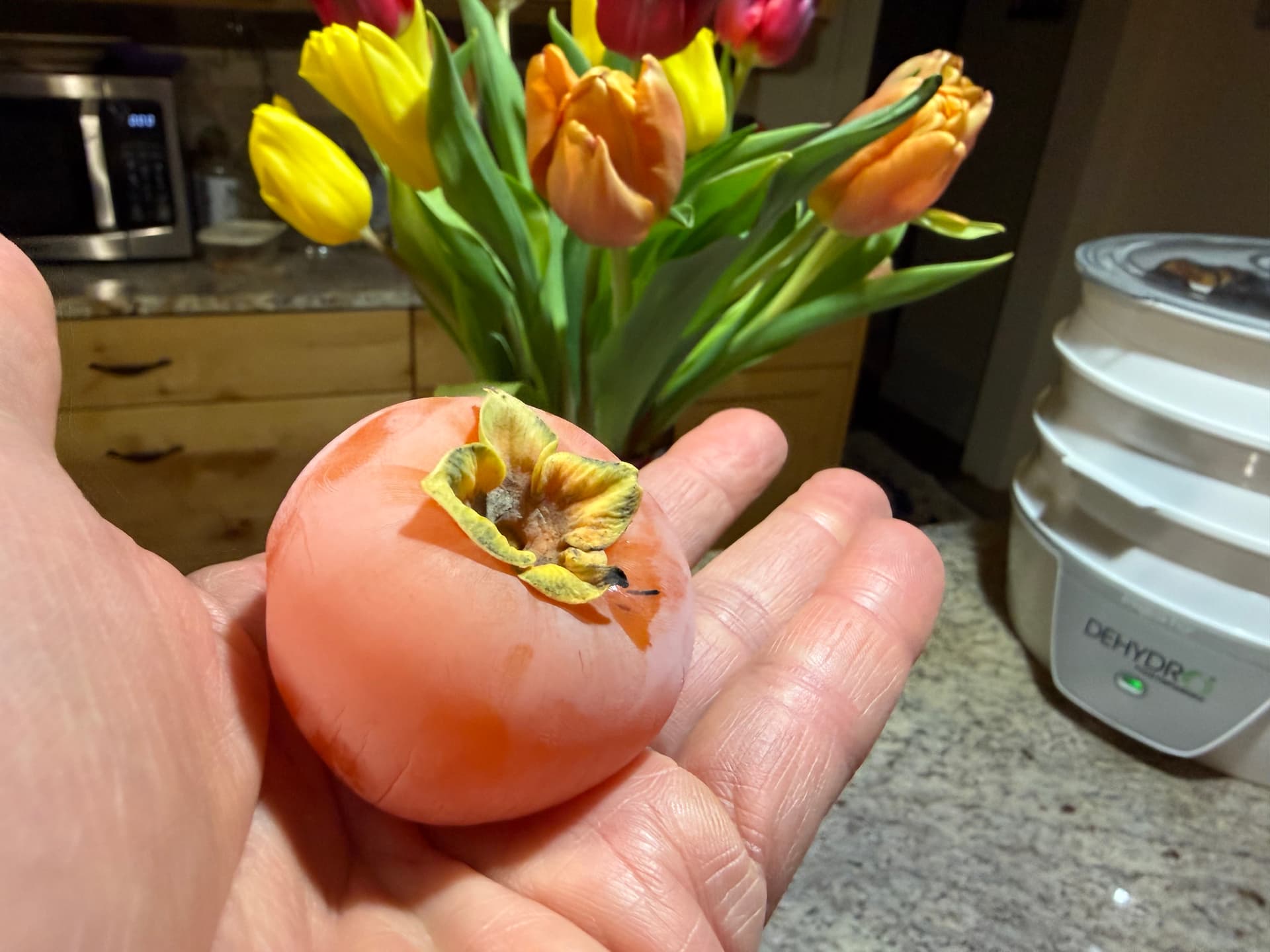
Nightly groundfall picked up. Know they are soft if hit the ground during the day and all tannin astringency is gone. Delicious! Yates and Prok tree (1 of each).
12 Likes
Thanks for the warning. But before we start a panic, I think we need to qualify “not hot.” Seattle’s daytime highs in summer are 69-75 F vs 73 - 84 F in Providence. Highs here are generally around 80 F.
I don’t have the problem of astringent PCNAs here. I say that after eating dozens of IKKJ over many seasons plus 2-3 Taishu this year. Also there’re some Izu on the way.
My takeaway is that we don’t need temperatures 85 - 100 F to remove astringency from PCNAs. It seems that 75-80 F is warm enough.
1 Like
Do you eat them hard/crunchy?
our summers aren’t that cool, maybe near the coast. We are usually 80+ all summer.
1 Like
Then I don’t understand the issue. I’ve had no astringency on IKKJ at any stage of ripeness. I prefer the taste and texture of s fully ripe PCNA, but I’ve eaten firm fruits with no sign of astringency. My granddaughters prefer them firm.
The NA mutation is understood to disable the production of significant tannins, So in general there is no astringency to lose. There are one or two exceptions (e.g., Fuyu, I think?) that seem to develop some astringency in a cool climate, but that is not the norm,.
1 Like
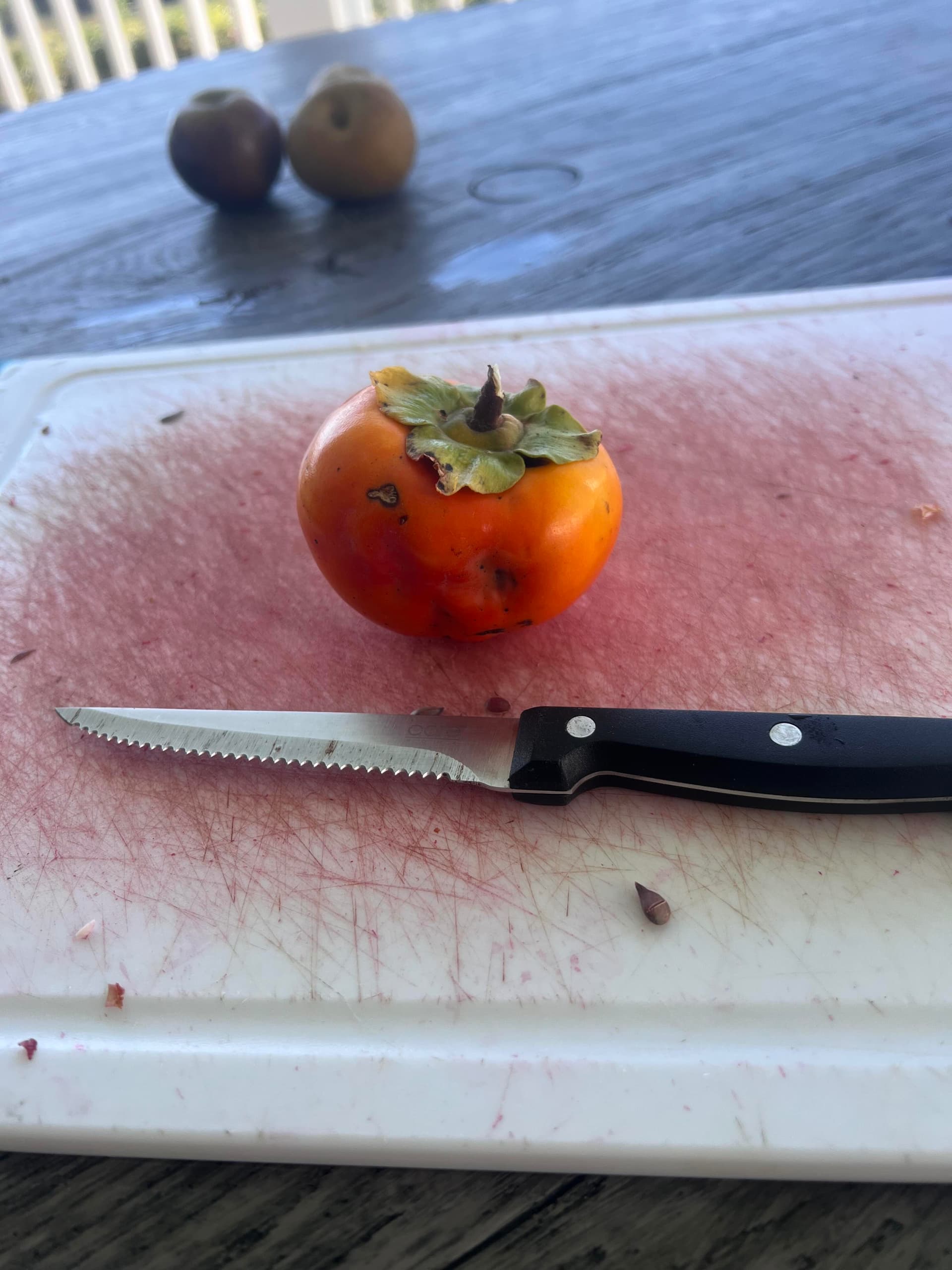
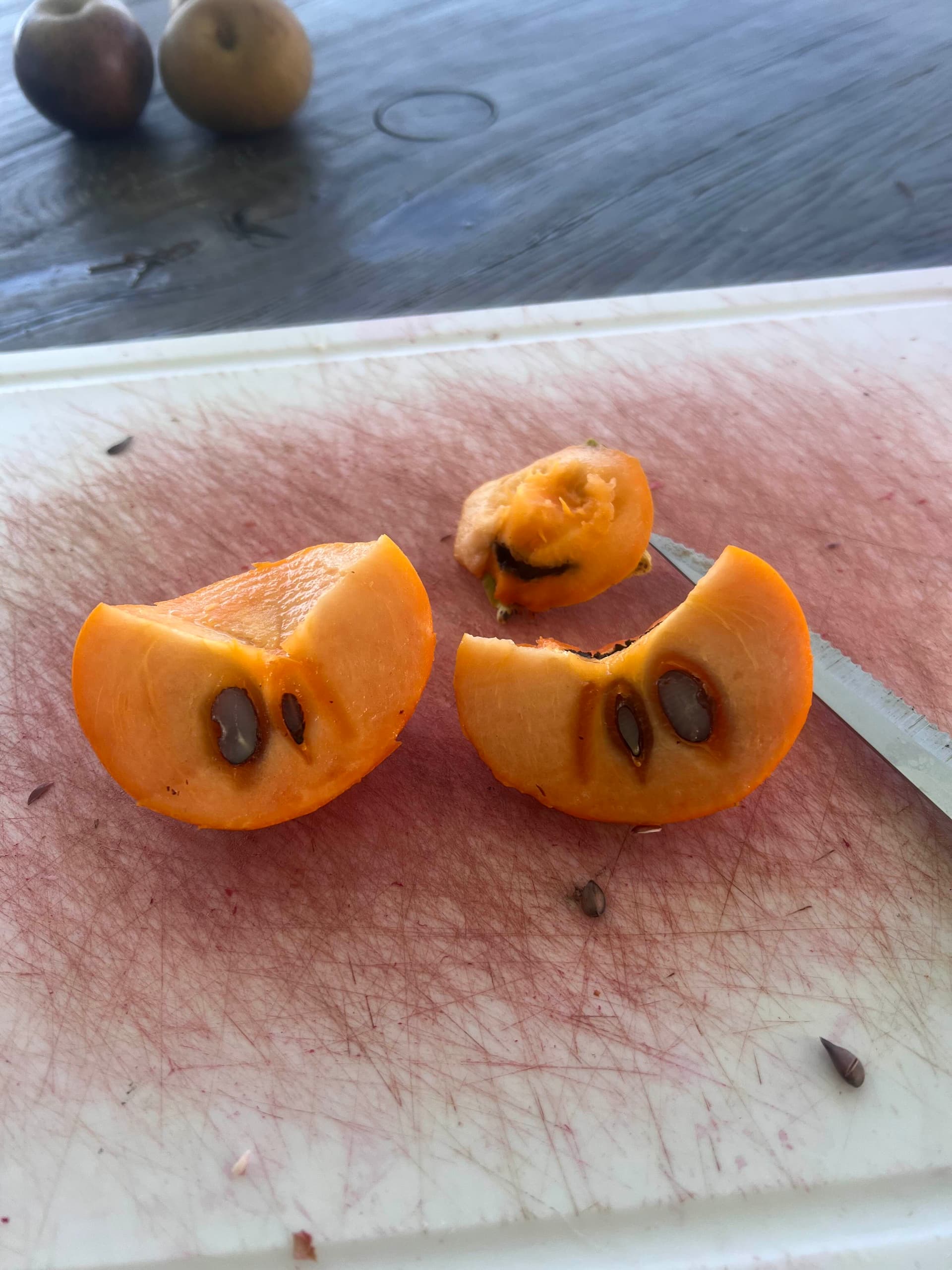
@ramv – Just to provide more data, I picked this not quite ripe (and slightly damaged) Izu persimmon from a young tree. As you can see, it is seeded – there’s a Nishimura Wase nearby.
I ate it. The flesh was moderately firm and frankly tasted somewhat bland. But I tasted no astringency at all in the flesh and perhaps only the barest perceptible hint of astringency in the skin.
This growing season was remarkably mild. I think the thermometer poked above 90 F only a couple times. Not “hot” by any stretch of the term.
5 Likes
I prefer the PCNA relatively firm. Generally my experience has been that their texture when soft is much worse than good PCA.
I’ve had mixed results with my PCNA maturing and ripening. The cultivars I have are Izu, Matsumoto Wase and probably Jiro or IKKJ. I’m more concerned about them being bland than astringent.
I hadn’t reached Ram’s conclusion that they won’t lose astringency and am skeptical that it applies to my place. My impression is that many of his fruits apparently ripen sooner for him than for me - such as figs. So I don’t think of my place as being warmer.
It’s something for me to continue to pay attention to.
Are the temperatures that matter through the growing season, or during the ripening time. Most of mine are still on the tree and we are getting highs around 60F and lows in the low 40s.
1 Like
When my tree was young, I didn’t have any astringency but the fruits were bland. So I topworked the tree to what I thought were more desirable hybrid varieties. But I left most of the tree alone.
Then it started producing extremely delicious fruit aka non bland- but they needed to be fully ripe to be non astringent. If picked crunchy, they had some lingering astringency near the skin. But I am somewhat sensitive to astringency unless the flavor fully overrides it - like in Americans.
Its also the same case with Izu which ripens about 10-15 days ahead of Jiro. But it wont lose astringency until it softens (no crunch)
The texture is not objectionable in either case. But most here prefer soft fruit to apple consistency. Apples are far tastier than persimmons when eaten at the crunchy stage anyway.
This has to be viewed as a continuum rather than a switch. If you pick a non astringent persimmon super early in any climate it will be astringent. But to a lesser degree. So the loss of astringency is faster in a PCNA variety but it isn’t always complete and might have some environmental triggers.
I think an analogy is the genetics governing a person’s weight vs height. Height is an almost fully inherited trait. But weight is both inherited and environmental (diet)
Also IKKJ might be slightly different in behavior when compared with Jiro or Izu.
2 Likes
Still have H120’s on the tree. That will make them the latest ripening American variety I have. Can anyone suggest some varieties even later?
1 Like
I don’t think this is totally accurate. See, for example, Figure 3 in the attached paper. The PCNAs start out (“green stage”) very low in soluble tannins – roughly where a PCA ends up when fully ripe, then drops to even lower levels at an intermediate stage (“color break”) and a ripe stage (“orange-red”).
1 Like
I don’t mean continuum in terms of classification but a continuum in the effect of non astringency.
Just because something is called non astringent doesn’t mean it will be entirely non astringent in reality.
You might have the genes for a type of cancer but the environment also has a role to play.
1 Like
Did you read the article? This is reality – more reality than subjective assessments of astringency. These scientists measured tannins, which are the source of astringency. PCNAs are low from start to finish.