I checked the bark on some of the growing tips now that the snow is starting to melt. It’s green. It’s amazing the insulating power of light fluffy snow. The tree is about 4 ft tall now, I grew it in a 25 gal. pot for several years. There’s about 3 ft of snow on the ground where it’s at, and then I mounded another foot of snow or so up above all the branches. It really helps protect from desiccation. I took a thermometer earlier this year and check the temperature 8 in. deep below the surface of the snow. It was 10° out, and the probe thermometer read 19°.
4 Likes
btw Oikos said they will have scionwood of this one in March at some point so check the website in March if anyone interested.
Wonder how non-astringent it truly is. Think i saw a review about Morris Burton’s supposedly non-astringency saying it wasn’t NA.
3 Likes
Thanks everyone who let me borrow pics for my Persimmon presentation for my Backyard Fruit Growers association (I tried to ask everyone I could on here for their photos; I can remove if any pics/quotes if anyone doesn’t like being included) … I tried emailing the Savanna Institute if i could use 3 slides of theirs but they never got back to me but everything else i think was fine to use.
It was a very random mix of various persimmon-related things/photos/quotes i liked and tried to put together in 1 doc …
Here is the presentation (imported from Powerpoint so some minor spacing/font issues):
I also had a quick presentation on quince/medlar/sour-cherries/maypops/currants to fill out the rest of the time. I can leave it public if it interests people, let me know if anything should be corrected.
8 Likes
Always interesting to read the taste scores 0-10, 10 = best.
I-94 Valeen Beauty 10
A-33 Prairie Sun 7
H-63a Carmel Cocktail = Paradise 7
A-118 Elmo 5
Yates = Juhl 4
D-120 Dollywood 4
H-118 Prairie Star = Early Jewel 3
4 Likes
I know of a lone persimmon tree that sets seeded fruit alone. Large crop every year. My wife’s Grandmothers place. Benn there 55 years that I know of and large then. We are at the northern edge of persimmon in IL. No wild trees left. My brother remembers two 70 years ago. 1 each on 2 different farms. I will try to get scion. I want seeded fruit hoping the animals will spread some seed in the wild.
2 Likes
How big is the fruit? The largest ones can be 2” - 2.5” but alot of wild ones are much smaller.
Must be a male within a few miles, unless the tree makes both male and female flowers which you can check with binoculars in the spring. What city is it near? Maybe we can check with some apps for you if some males are around
1 Like
is the Claypool or Lehman orchards still being maintained?
I wonder if some fruit growing group can visit (people who live relatively closeby in our forums) and do an updated re-rank throughout the fall :).
I saw that “Indiana Nut Growers/Lehman decided to carry on Claypools work when he died in the 90s”. Since they lived in different states, i assume they sent the scionwood for Lehman to grow at his place or Indiana Nut Growers are actually maintaining Claypool Orchard ? Since both breeders have passed away, whats going on with both orchards?
I assume a few peeps like Cliff has got alot of the good ones saved. But some large fruit i dont really see advertised anywhere like B101,C117, C127, H65A (haven’t checked Cliff’s farm chart yet though) and i don’t trust the old taste rankings if alot of those other famous varieties that others are selling are ranked below 5 out of 10.
Canton IL. I believe there are no males around. Likely no other persimmons around.
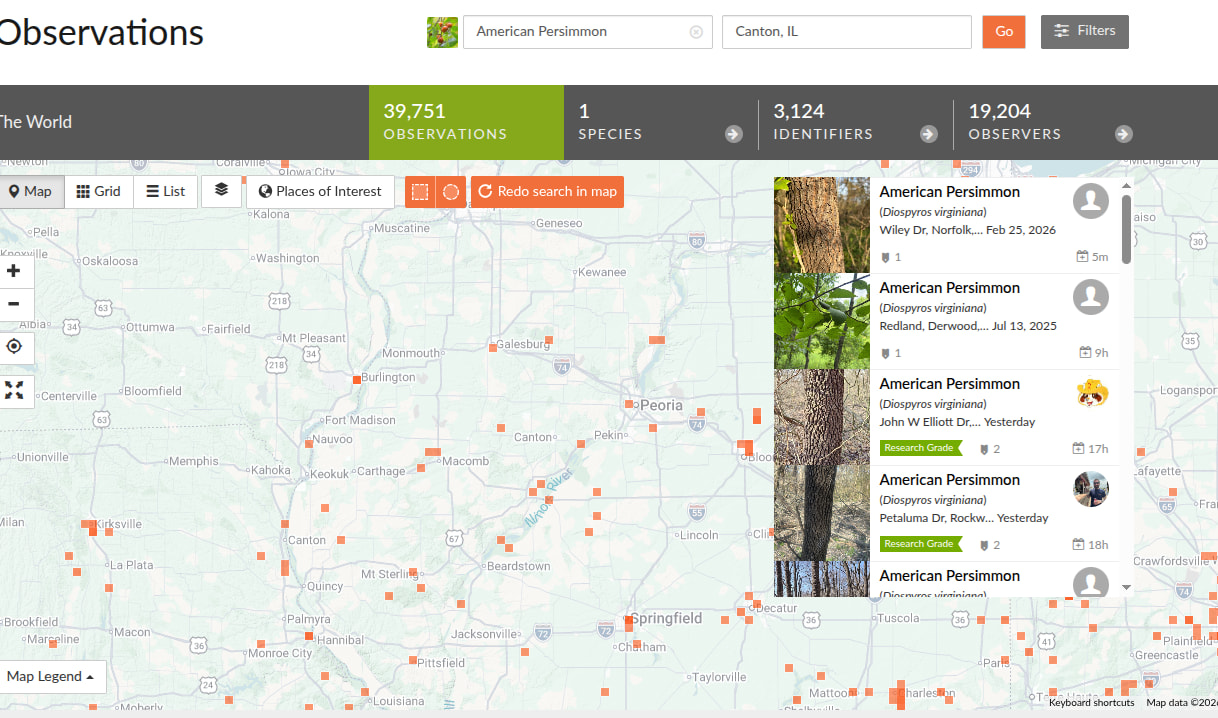
There are some persimmon observations around you on Inaturalist… So maybe its one lurking around. I think even a few miles away bees can still carry pollen i heard.
2 Likes
I planted Kitaro, Taishu, Taiya, Yellow June, Liyu and Emperor. I already have Chinese Black and Tamopan persimmons.
Next ones Bao Gai, Taiten and Reigyoku.
4 Likes
I am a beekeeper. What you say is true but unlikely is many situations. Bees travel to a pollen source some will forage on the way back others have a full load and go straight home. So if they are working fruit trees they often have a full load.
3 Likes
I’ve picked persimmons in and around Smithfield. There is also occasional a wild one in the woods round those parts. I know of a large grove of males in Smithfield proper. I would not be surprised if there are some wild and planted trees a little further east in Canton area here and there. I don’t think the trees are pollinated by bees, I think they’re pollinated by pollen traveling in the wind. So the male trees could probably be located fairly far and still pollinate.
1 Like
I’ve seen a few differing thoughts on various forums/sites, so not sure what to think is correct:
“The flowers are pollinated primarily by solitary native bees.”
”Bees are persimmon flowers’ primary pollinators, with wind helping out when bees are scarce.”
”Persimmons do indeed need a pollinator, but because they are pollinated by wind, not insects, a wildling will do, and it doesn’t need to be particularly close by. If you’re in an area with a lot of native persimmons, you don’t need to worry about it.”
”Wind plays a subtle yet crucial role, carrying pollen grains across distances. However, it’s the insects—especially bees—that are the real MVPs, actively transferring pollen as they flit from flower to flower…”.
I thought I don’t have males but there are some 10minutes away in a local park, so thought maybe they are pollinating my trees somehow (i get some seedless, some seeded on my Lehman’s Delight/Prok [female] trees).
2 Likes
I need some advice. Does anyone have experience growing both kaki and virginiana ? I have been having trouble keeping my 3-year-old kakis (Chocolate and Hachiya trees on lotus rootstock, Dave Wilson Nursery) happy in hot and dry summers in Zone 9b California. Each summer for the last handful of years we seem to get a heat wave of 110 degrees + for several days in July and although I water deeply in advance, the leaves invariably get crisp, the tree wilts, and I have over-corrected by over-watering them causing total leaf drop the past two summers. So they are limping along but have not even flowered yet. But I’ve also had two American seedlings (Fruitwood Nursery) in the ground nearby for two years and they’ve had no such issues with watering or leaves getting crispy. They are much smaller, maybe 2’ tall, but they seem to be growing fine, although very slowly. Any insights on if lotus rootstock is just susceptible to over-watering and Virginiana are not, or am I doing something else wrong?
For what it’s worth here’s an another observation : I’m well out of the natural persimmon range here in the the western Catskills. I planted seedlings trees in the Spring of 2013 that I’d purchased from Jerry. One was female, several males, and some still waiting to reveal themselves. One male blooms earlier and heavier than the others and the bees swarm it. They apparently love it. I can only assume that the Early Jewel next to it receives a fair portion of the pollen in turn.
4 Likes
I am just starting out learning about persimmons, I’m over in Missouri. Are wild persimmons worth growing? I am really trying to find some dwarf varieties that I could possibly grow in containers since I don’t own land yet.
IMO, the answer is NO. Fruit quality of wild varieties is generally poor. Named varieties of American persimmons (i.e., select wild names and their offspring) are worth growing but they are inferior to Asian and hybrid varieties. Also American varieties grow much bigger. Asians and hybrids can do pretty well in large (e.g., 25 g) pots.
1 Like
Do they bring those pots indoors in garages in winter (likes figs), or just lean them over (or latter option only can happen in certain zones)?
I figure it has to depend on local temperatures. I bring my pots indoors, just like with figs. I have the comfort of knowing, however, that persimmons are more cold-hardy than figs so they are very unlikely to die in building with a solid connection to the earth, such as a detached garage.
Question: If a grower lives somewhere warm enough to leave potted persimmons outdoors, why not just plant the trees in the ground?
2 Likes
renting or uncertain about current living location, even if a few years out, come to mind.
3 Likes