Asian non-astringent persimmons have the desirable traits of a crunchy texture and remaining on the tree when ripe. However, they aren’t as winter hardy as American persimmons and can taste fairly bland in comparison. So a breeding goal could be to combine all of these desirable traits (crunchy, doesn’t drop, hardy to zone 5 and complex flavor) in the same cultivar. For those of us with mild winters who can grow any Asian, hybrid, and American cultivars we want, this isn’t as much of a concern.
No, not really. This is an oversimplification and mischaracterization . . .
-
When most people discuss hopes for a “non-astringent American,” they are aspiring to a fruit that never has sufficient tannin to cross the taste threshold, whether green or ripe. This would be a non-astringent American that behaves like a non-astringent Asian. A non-astringent Asian is not merely a crunchy Kaki that remains on the tree. It could be eaten crunchy, firm but not crunchy, or soft and mushy. The point is that you never have to worry about it.
-
When Jerry Lehman and Martha Davis, as quoted earlier, refer to what they call non-astringent fruit, they mean that “some of the fruits could be picked off the tree while still firm with no astringency.” Those are evidently Jerry Lehman’s words. I assume that they are also not pursuing a crunchy texture, merely something firm.
Yeah most northern growers finish much of their crop (Asian, Hybrid, or American) indoors. So that’s no news. But Americans demand close attention so we may try to pick them before they drop. Asians and Hybrids aren’t so high-maintenance.
1 Like
personally i really like that slightly firm texture you get in a hachiya or something, i dont like the fully firm fuyu
3 Likes
Whenever I get Asian persimmons I wait till they slightly give. They are still firm but very juicy and sweet. I still eat some crunchy like an apple, but they aren’t my favorite. Anything that isn’t either of those I won’t eat.
Also when fuyu persimmons still on the tree aren’t at least 1/2 orange they will be slightly astringent.
2 Likes
Is the rock star ultra hardy male a hybrid?
I think Buzz said most of the 35-40k seed is from DEC (Donald Eugene Compton)’s orchard. And while I thought I read while there are some possible DEC hybrids maybe there (like reading here on the forums for example that someone heard DEC Goliath might be a hybrid), most of them are pure Americans.
1 Like
Okay, so it’s probably 99% likely it’s pure american.
1 Like
I am curious what the ‘PCF’ stands for.

He told me a few months ago he’ll have a male called Hardy Rockstar which i assume is this one (and a female called Hardy Golden). He said they may not be available for a while but was going to give some to some breeders to trial for him (as i assume there was a low amount of scionwood). Looks like he had a few extra scions as i didnt expect him to offer to public yet.
Probs perfect circle farm.
2 Likes
I’ve been curious about persimmon offerings from Perfect Circle for some time but found the website cryptic. When a recent and all too brief thaw put me in the mood for gardening, I threw caution to the wind and bought some scions this week from his offerings – some I am completely unfamiliar with and which are quite possibly unsuited to my area, zone 5 (B?) NW Catskills. Would anyone please help me by telling me about these three? Thanks! (I did pick up a few others as well, but am more familiar with those.)
PROK X HOKKAIDO MALE / DEC HAIKU (NG X THOR C5) / UKR- MP-3
2 Likes
I do wish he had more descriptions :).
At least with mulberries/chestnuts , some of the descriptions might be on the grafted plants page or a chestnut page/pdf. Otherwise may need to scour a few other seller sites to find descriptions. He’s very nice though. Ill have to ask how he grows many of these, maybe in a warmer protected area/greenhouse just for grafted plants … or maybe he gets supplied scionwood and grafts each year and stores somewhere for next year sales (just speculating). As his zone is a bit too cold for most even American persimmon I think (with his large cold-hardyness trial, out of so many seedlings only a few survived).
I got one of his called Crinkle Leaf last year that I think he said he lost this year. So maybe me and a few other people have it grafted (i don’t know if the leaves are different/crinkley yet, if they survive the winter in the garage, ill check).
2 Likes
I believe that this is a variety originally offered by Engalnd’s Nursery, one of >40 supposed crosses of various DV females x Hokkaido (Kaki) male. It is thus promoted as a DV x Kaki hybrid. IMO, it cannot be such an inter-species hybrid. Hybridization of DV x Kaki (F1) has succeeded only twice in roughly 90 years of breeding, once in Ukraine (Rosseyanka) and once in the U.S. / Japan (JT-02 / Mikkusu). ALL OTHER HYBRIDS are descendants of these two. By far the vast majority are descendents of Rosseyanka.
England claims to have produced this cross as described. My best explanation of what really happened is that Hokkaido failed to successfully pollinate Prok and instead Prok was open-pollinated by some neighboring hybrid or DV male. This doesn’t necessarily mean that the variety is inferior, but my recollection is that taste-tests were disappointing.
p.s. Hokkaido itself is a mystery. As far as I can tell, only England, Bass, and one other grower have grown it. The “other” one died. There is no such documented variety in official sources. Meanwhile, Hokkaido is the far north of Japan, where the Winter Olympics has been held (e.g., Sapporo). It’s not a natural home for Kaki persimmons.
2 Likes
For me the hybrid Zima Khurma hangs on the tree for about one week, then falls.
2 Likes
wasnt it determined he got htem from someone who was doing embryo rescue? and thus they are probably legit
Hahaha. No.
True hybrids such as Rosseyanka and JT-02 (and their many descendants) are wildly popular. See the thread within on the future of hybrid persimmons. In contrast, the faux DV x Hokkaido hybrids have been around for almost 15 years and almost nobody talks about them or grows them, not even for breeding. Moreover, I’ve been criticizing the promotion of these “hybrids” for at least a few years and nobody manages to mount a serious defense.
Also, consider: The cost of embryo rescue on DV x Kaki seeds is probably $1000 or more per. For DV x Kaki the success rate is guesstimated to be “well under 10%.” Cliff has >40 such reported DV x Hokkaido hybrids. So he would have to have spent roughly 40 x $1000 / 10% = $400 K (or more). Do you think that happened???
I consulted my ChatGPT to get a rough estimate of the success rate:
My best breeder-style estimate is therefore:
- If you mean lab success on embryos that are already rescued: often moderate to high, roughly **50–90%+**depending on embryo stage and protocol, with rooting/acclimation losses after that. This part can work reasonably well.
- If you mean whole-process success from pollination to a surviving kaki × virginiana hybrid seedling: likely low, and in many practical situations very low. I would plan as though it could be well under 10%, and possibly much lower, because the main bottleneck is usually getting a usable hybrid embryo at all, not merely culturing it afterward. That last sentence is an inference from the cross-incompatibility evidence and the rarity of successful named hybrids, not a directly reported single-number rate.
So, in plain language:
- Embryo rescue does not make kaki × virginiana easy.
- It mainly converts “almost no chance” into “possible, but still inefficient.”
- For planning, I would assume you need many pollinations / many immature seeds to get a modest number of live hybrids.
A practical rule of thumb for a breeder would be:
- if you have only a handful of fruits or seeds, odds of getting a live hybrid may be poor;
- if you can generate dozens to hundreds of pollinations, the project becomes more realistic.
1 Like
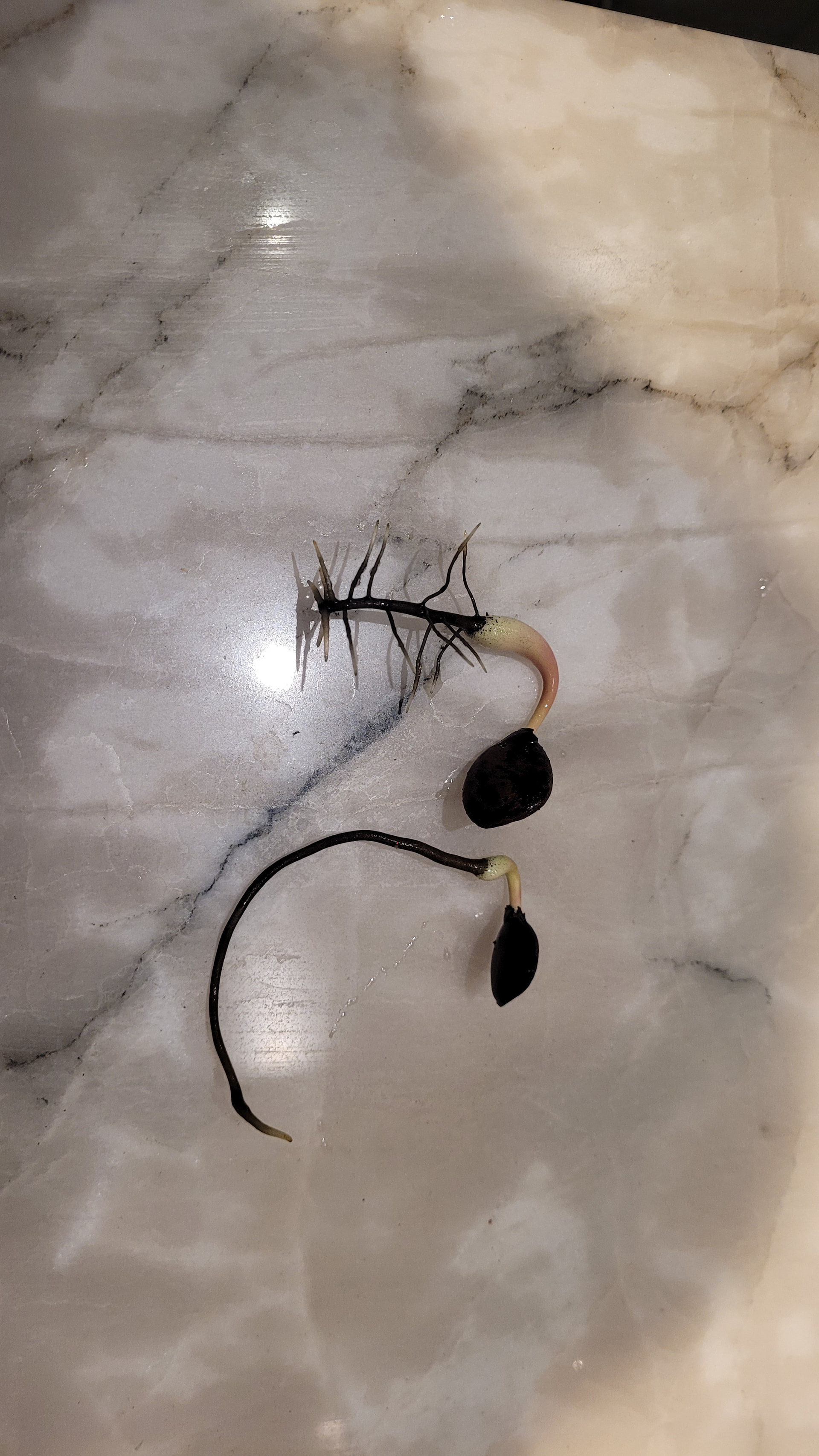
I was wondering if a deep taproot is a nice anchor for a tree (for plants that have deep taproots like pawpaw [ and persimmon?]) or is a shorter root-pruned plant with more horizontal roots better?
1 Like
My take: While a taproot does ‘anchor’, its primary function is as an energy reserve sink to drive resprouting after the seedling is browsed off by herbivores (deer/cows/grasshoppers/teens on the riding mower). The lateralized root system induced by root pruning - particularly at a young age - translates into higher transplant survival rates.
There is nothing magical about a taproot, and severing it does not equate to a death warrant for the tree. That said, in my experience, pecans/hickories deeply resent having their taproots cut in the process of digging them, and they will ‘sulk’ for 2 or 3 years subsequently, not really resuming much in the way of active growth beyond leafing out, until they have re-established a decent root system.
3 Likes
If I was buying a tree, I would rather have the branched roots over a single long taproot, though a taproot may be better if you don’t plan on watering since it would have more access to moist soil. I am putting these in 1-gallon grow bags with irrigation to size them up. When put into the ground and given good watering, the many branches of roots should spread into the soil and establish faster than the long, thin type pots that direct all roots downward. Either is probably fine, as long as there is minimal root circling, but there is more surface area of root in a branched system.