thank you. Hansen’s it is!
2 Likes
Any nurseries that you know of that would ship sand cherries to California? I found two nurseries but they don’t ship to California.
1 Like
Is it because they are known to the State of California to cause cancer? :}
6 Likes
But they only cause cancer if you are in California, right? 
3 Likes
Our sand cherry fruited for the first time this summer and I thought it tasted quite good. However, there were only two cherries, one for my wife and one for me.
4 Likes
You may want another for cross pollination?
1 Like
my cherry and apricot wall features 2 of 3 hansen’s from gurneys
Cherry Row/wall - General Fruit Growing - Growing Fruit
The first year I had maybe 6 lucky berries and the second year 0. There has been no significant growth.
I should have taken a picture of the row without leaves. I will do so in the future but currently everything is buried under 2+ feet of snow.
4 Likes
Hey Pete! It’s Jesse from our email exchanges. I didn’t know you were on here too 
I bought the Hansens Bush cherries from North Ridge a few years back, and also sand cherries from Cold Stream Farm that turned out to be Western. Through this post I learned they are the same lol. I thought they looked similar but I was using them as a short border row and wasn’t really observing them.
I was doing some searching looking for an Eastern source and came across a cultivar called Jade Parade that is a hybrid between Eastern and Susquehanna. I just bought one from Jung Seed.
Here is the link to its creation. Cheers
5 Likes
For anyone considering sand cherries for fruit, there is a tremendous amount of variability among plants—even within ‘Hansen’s.’ This comes from a trial in Wisconsin where the plants were ordered from a well-respected nursery, yet the plants were clearly not the same. The plants I have are definitely different as well.
Because of this variability, I suspect Gurney’s would be the best option for anyone seeking sand cherries for fruit, since they were the company through which Hansen originally sold his cherries. That is—unless someone happens to find one of the named Hansen’s bush cherry cultivars.

5 Likes
Creek Plum Jesse! You are a total plant nerd! Awesome!
man, i just bought from Jung; saw the plant (by total dumb luck) and said no. i just scanned your article and NOW i’m really intrigued.
IT CHECKS THE BOXES: “parents: Prunus pumila var. depressa and P. p. var. susquehanae”
ATTRACTIVE: it’s “taller, faster growing plant with larger flowers … ‘UCONNPP002’ sandcherry is a profuse bloomer with showy, white flowers in spring….”
OMG: i got another weirdo to track down, “Prunus pumila var. besseyi ‘P011S’ Pawnee Buttes®”
Candidly, i’ve shut the door on my buying after 30 days of crazed buying. i’ve made notes of this plant and ur article. and maybe we’ll trade root stock – maybe i’ll try to propagate the Creek Plum by root cutting and you look for suckers on the vigorous UCONNPP002.
2 Likes
Deal!
2 Likes
Here’s a source.
5 Likes
thank you! i’m on the wait list … which gives me time to find the space 
3 Likes
ColdStream is mainly a re-seller now, not a grower. The -exact- ID of their stock will depend on the accuracy of their wholesale supplier, which can be variable, and then their supplier can change from year to year anyway. This is fine for plants grown from seed for more non-specific uses, but is not going to give the same results as selected cultivars propagated by cuttings or grafts.
As I mentioned once, a whole lot of besseyi has been planted east of the Mississippi over the decades. Unless Sand Cherry has been collected from natural sites a good distance from any Human sites, anything can be happening with plants labeled “Sand Cherry.”For example, some planted seed production areas for v. besseyi in the Great Lakes can sit not far (as in, on same or adjacent parcel of land) from natural populations of v. pumila. That’s all fine for most planting applications, but would cause chaos in growing for best possible edible fruit.
6 Likes
Here is an interesting paragraph on Hansen and the Sand Cherries I came across:
“Finally, two species traditionally misclassified as cherries [Prunus subgenus Cerasus (Adans.) Focke] are also interesting. Prunus besseyi Bailey (also known as P. pumila L. in its eastern range) is one of the most cold-hardy Prunus species (Okie, 1987). It was used extensively by Hansen in South Dakota to develop cold-hardy plums (Hansen, 1937), with more than a million seedlings grown. ‘Sapa’ (Table 1) was his most important release, as it has been used as a parent of other hybrids and for rootstock development. All the breeding work appears to have been done with western forms of P. besseyi, as they had better fruit quality. Unfortunately, these forms have high sensitivity to blossom and twig blight caused by Monilinia sp., making them short-lived in humid climates. Recently, we collected P. besseyi from the pine barrens of central Michigan, where P. alleghaniensis also occurs. The species also ranges into the northeastern United States and south to Virginia, with an unconfirmed report from the mountains of North Carolina (Fig. 4). Other accessions have recently come from New York. It will be interesting to see how hybrids with these eastern accessions suit our climate. They are much smaller-statured plants than western accessions even in good soil, and plant health seems good so far. Their late-bloom is at least partly due to higher post-rest heat accumulation (Werner et al., 1988), enabling them to fruit well in lower-chilling zones.”
That’s from:
Which mostly focuses on Plums, rather than Cherries; in the mean-time there has been plenty of phylogenetics work on the clades of the Plum species and I don’t recall reading in any modern study that P. besseyi or P. pumila has been fit into those clades.
Personally I am just happy to have brought P. allehaniensis (now P. umbellata) into production for use in basic wildlife habitat plantings on ultra dry sites.
Next up is a continuing hunt for local P. nigra sources, but I am at the far western end of its native range and this is proving challenging, with some herbarium records even not seeming to fit as true P. nigra.
Anyhow that link may be of interest to anyone working with Prunus, particularly for the little historical details that might answer remaining questions. I don’t have to worry about selecting hybrids etc.; we just grow Natives from seed. But I do have to stay on my toes with naturally occurring hybrids out on the landscape.
3 Likes
Also I wanted to note that when you start discovering the history of Plums in the USA - at one time America had > 600 Plum cultivars available by mail-order - it can make one a bit reticent in attempting definitive Plum ID on any site that might have been a 19th Century human site. For example it is is not uncommon in the Great Lakes to come across an Apple tree in the middle of a 80 year old Pine plantation now standing on State or Federal land…
5 Likes
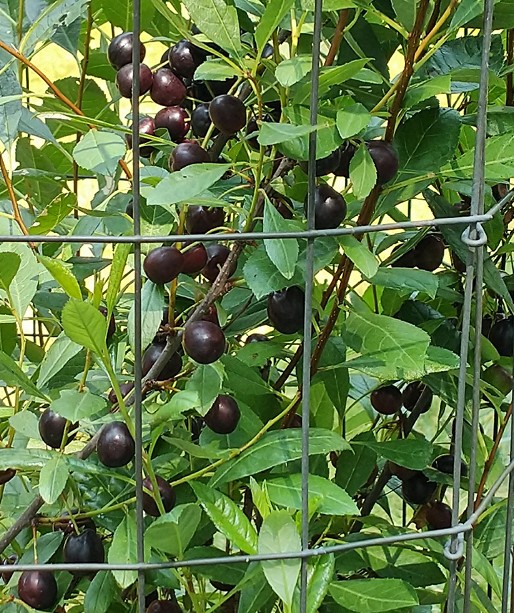
For native Western Sandcherry (Prunus besseyi), here is the size of the fruit with respect to 2" x 4" deer fence. Taste is great for something native.
11 Likes
i’m picking up “gus melquist” which is the parent of this today. anyone know if i need a second cultivar to get fruit ?
2 Likes
I think they are self fertile. Where are you getting it from? Do they do shipping? 
1 Like
Dropseed natives, and yes they do mail order for flats… not sure if they do potted plants. but they might be able to point you to their source https://www.dropseednativelandscapesli.com/
4 Likes